
AI Shops for You, but Whom Does It Listen To?
An essay on how AI shopping answers draw heavily on creator reviews and human conversation, citing licensing deals and consumer survey findings. It offers advice for brands, AI platforms, and creators on building trust and visibility in AI recommendations.
A while back, I was in the market for a new camera.
Unlike before — where I'd trawl e-commerce sites for specs and prices — I went straight to AI and asked: What have people been saying about it lately? Which one should I buy?
It gave me a pile of candidates, each backed with reasons and evidence. It had even "read" the reviews that came out just last week.
In that moment it hit me: on the surface, AI was making the call. In reality, it was the creators — the people who shoot reviews, write unboxings, and live inside these products every day.
This is worth a proper conversation.
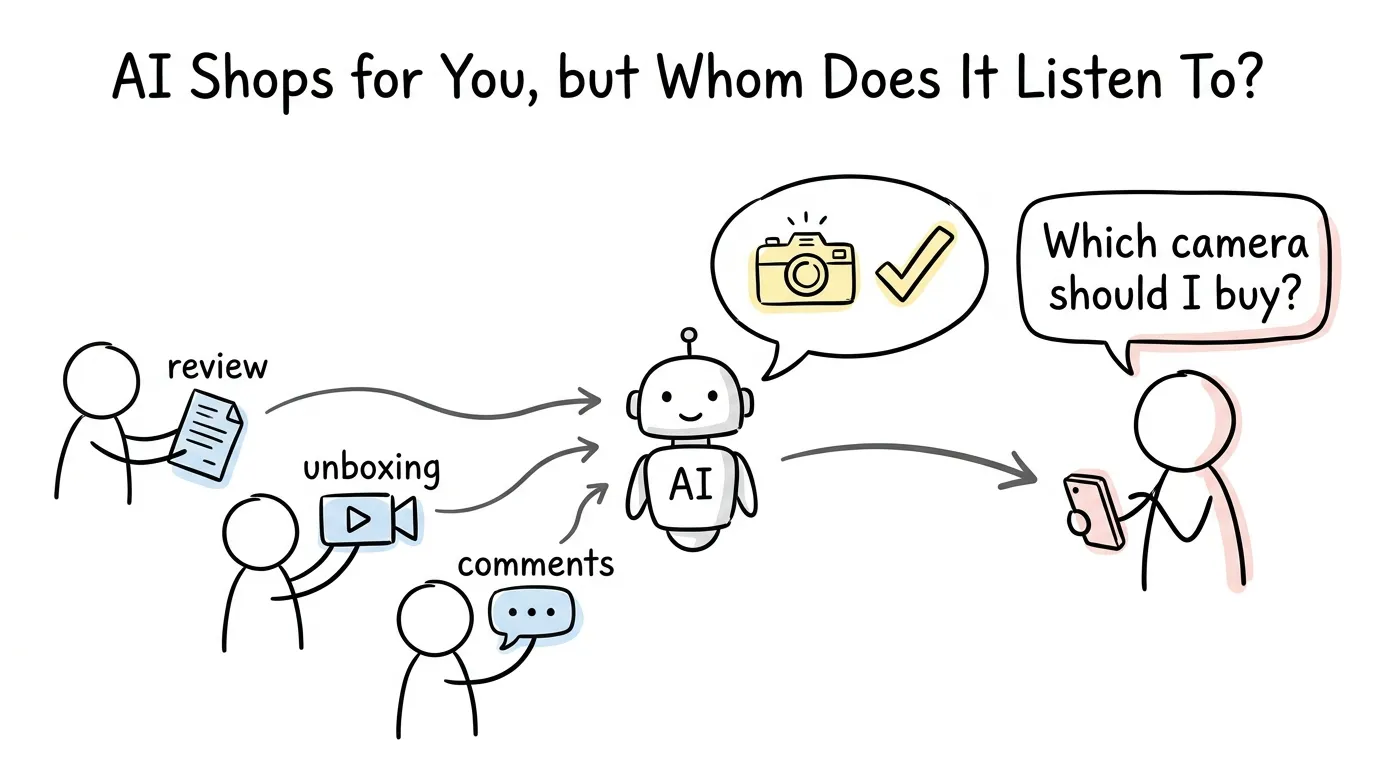
Where does AI's raw material come from?
What does "AI recommendation" actually mean?
You ask it: "Based on the latest reviews, which camera should I buy?" Before it can answer, it needs fresh material.
Where does that material come from? A big share of it comes from creators. Product reviews, hands-on demos, first-hand experiences — an unbroken stream of signals flowing to AI: is this product any good, how are people feeling about it, what's starting to trend.
Think about it: Samsung released a new flagship last week, and someone posted a deep-dive review that same week. Meanwhile another device, a 2022 model, still only has a review from three years ago. Which one is more useful to AI?
The former, obviously. Information is all about freshness.
AI even watches for shifts in sentiment. Say a phone suddenly gets flooded with "battery swelling" complaints in its comment section — that spike is an alarm: something might be wrong with this product.
Or take a creator who puts real effort into reviewing the Sony a7R VI mirrorless camera. AI will stitch that review together with information from other sources, assembling a fuller picture of the product.
So here's the thing: credible creators are, at their core, AI's information suppliers. What the suppliers say, the AI largely believes.
I talked about exactly this at Cannes this year. On the panel with me: Tony Roma's global CEO Mina Haque, P&G Chief Communications Officer Damon Jones, creator Paulo Aguilar, and Nielsen's head of advertiser and agency business, Trevor Fellows.
One line from Jones has stayed with me ever since: "Consumers need to hear three voices: the brand's voice, the expert's voice, and the voice of fellow consumers who are just like them."
What creators supply is exactly the "expert" vote.
The more the machines write, the more human words are worth
You might ask: can't AI companies just generate content in bulk? Why pay good money for real human posts?
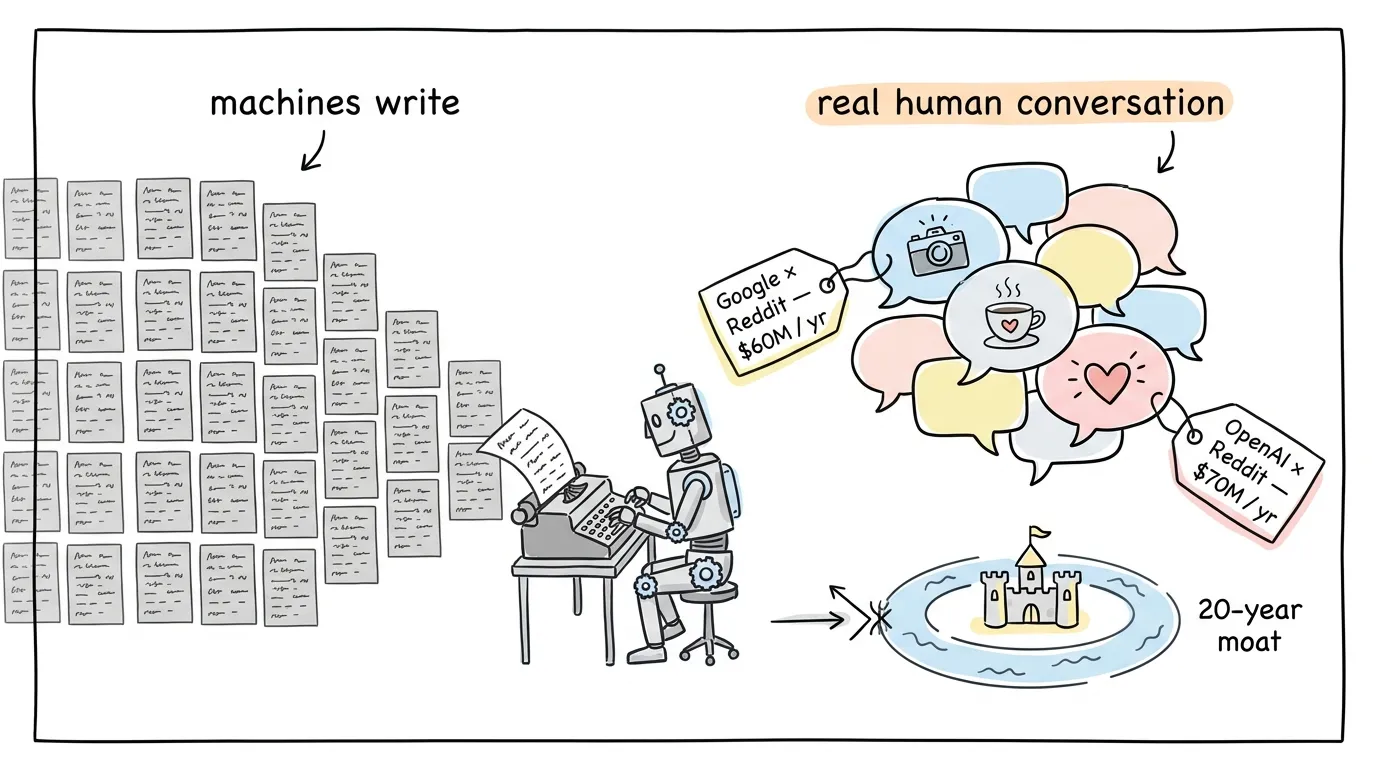
Because the more machines write, the more valuable genuine human voices become.
In February 2024, Google signed a content licensing deal with Reddit — reportedly $60 million a year — in exchange for access to Reddit's Data API: structured, real-time discussions from real people.
Two months later, OpenAI followed suit — reportedly $70 million a year.
Reddit CEO Steve Huffman said something refreshingly blunt on an earnings call: as more of the internet's content gets written by machines, content from real humans commands an increasing premium. And Reddit has been accumulating human conversation for nearly twenty years.
Twenty years.
That's the moat. Anyone who wants to copy it has to start from scratch.
Do consumers buy it?
They do. More than you'd expect.
The IAB (Interactive Advertising Bureau) ran a study using its own Insights Engine: 2,200 consumers across five markets — the US, the UK, Australia, Mexico, and India — all of whom had recently used AI for shopping research.
The result: 56% said explicitly that they want AI shopping recommendations to include a creator or blogger perspective.
Young people especially.
Why? Put yourself in the consumer's shoes: AI can dig up the products for you, and it's getting better and better at that. But "which one is right for you" — it's not sure, and neither are you. Somebody has to tell you why this one fits you.
It's like shopping in a physical store. The sales associate picks out a stack of clothes for you, and sure, you'll go try them on. But what actually gets you to commit is often a passing remark from another customer outside the fitting room: "That one makes you look thinner — take it."
Only consumers understand consumers.
The study had another detail: when credible creator reviews show up in AI recommendations, consumers' confidence in that advice rises noticeably.
For brands, that is a hard, concrete reason to keep investing in creators' expertise and credibility.
So what should you do?
Three groups, three pieces of advice.
Brands: switch the yardstick. When picking creators, stop looking only at follower counts. Haque put it brilliantly: "Reach is rented; trust compounds." A creator with 5,000 followers whose audience genuinely takes their advice may move more product than one with 100,000. Then do two concrete things. First, if your website features creator reviews, mark them up with structured data (machine-readable labels that describe a page's content to AI) — creator, product, publication date, rating all spelled out, so AI doesn't have to guess. Second, watch your comment sections, because AI is shopping there too. Haque also has a quip: "AI stands for Authentic Intelligence." The honest things consumers say in comments are the closest a brand can get to that "authentic intelligence."
AI platforms: put people in the pipeline. What consumers want is clear: recommendations that contain both reliable brand information and creator perspectives grounded in real experience. Whoever first weaves credible creator content into the shopping journey will have recommendations that are more useful — and more reassuring.
Creators: write it real. What AI recognizes as expertise is the substantive text in your posts. Videos can be short, but the writing needs depth. And don't treat AI purely as a threat: 51% of Gen Z and 46% of millennials say they discovered a creator for the first time through AI search results.
AI is also your acquisition channel.
Back to that camera
So, back to the camera from the beginning.
Behind AI's answer stood a crowd of creators: the reviews they posted last week, the grumbling in the comment sections, every honest word in their hands-on videos.
Creator content has always influenced consumers. Now it's doing something bigger: deciding what AI says when it speaks to tens of millions of people.
Consumer trust is moving from the shelf to the prompt.
Here's hoping you're the one who gets it first.
Continue reading
Related articles

What Is GEO? How Your Brand Gets "Mentioned" in the Age of AI Search
An explainer on GEO (Generative Engine Optimization) for e-commerce and DTC brands: how it differs from SEO and AEO, why AI answers shape brand visibility, and eight practices covering question-focused content, consistent brand messaging, structured pages, external evidence, comparisons, and AI mention tracking.

AI Is Already Making Decisions for Your Customers. Are You on the List?
A learn article explains GEO (Generative Engine Optimization): why AI-generated answers now shape which brands customers see, and how SEO fundamentals, entity clarity, citable evidence, and monthly measurement affect visibility in AI answers.

Google Is Stuffing Ads Into AI Search: These Recent Stories Are Really One Story
A news roundup linking recent AI marketing stories—Google adding ads to AI Mode, Amazon's Ads Agent, ChatGPT image updates, a UK startup tracking brand mentions in AI answers, and an AI ransomware warning—arguing that control over ad data and visibility is shifting toward platforms.