
AI Is Doing Everyone's Searching Now — Are You Still Fighting Over Keywords?
An explainer on GEO (Generative Engine Optimization), covering how AI-generated answers shift focus from keyword rankings to topic coverage, brand mentions, audience-specific content, and tracking visibility in AI tools.
What Exactly Is GEO?
A few days ago I had dinner with a friend who runs a cross-border e-commerce business. He pulled out his phone and, right in front of me, said to an AI assistant: "Help me find a sunscreen for sensitive skin."
Three seconds. The answer appeared — with recommendations, with reasons, with comparisons.
I asked him: how long has it been since you last used a search engine?
He thought for a moment, then said: "Last week, once. I was looking up my property management's phone number."
Wow. Have you noticed? More and more people around you are saying the same thing: stop searching — just ask the AI.
ChatGPT, Perplexity, Gemini — their user bases grow by the day. Where people go, business has to follow. And so a new trade has emerged: Generative Engine Optimization, or GEO for short.
What is GEO, exactly?
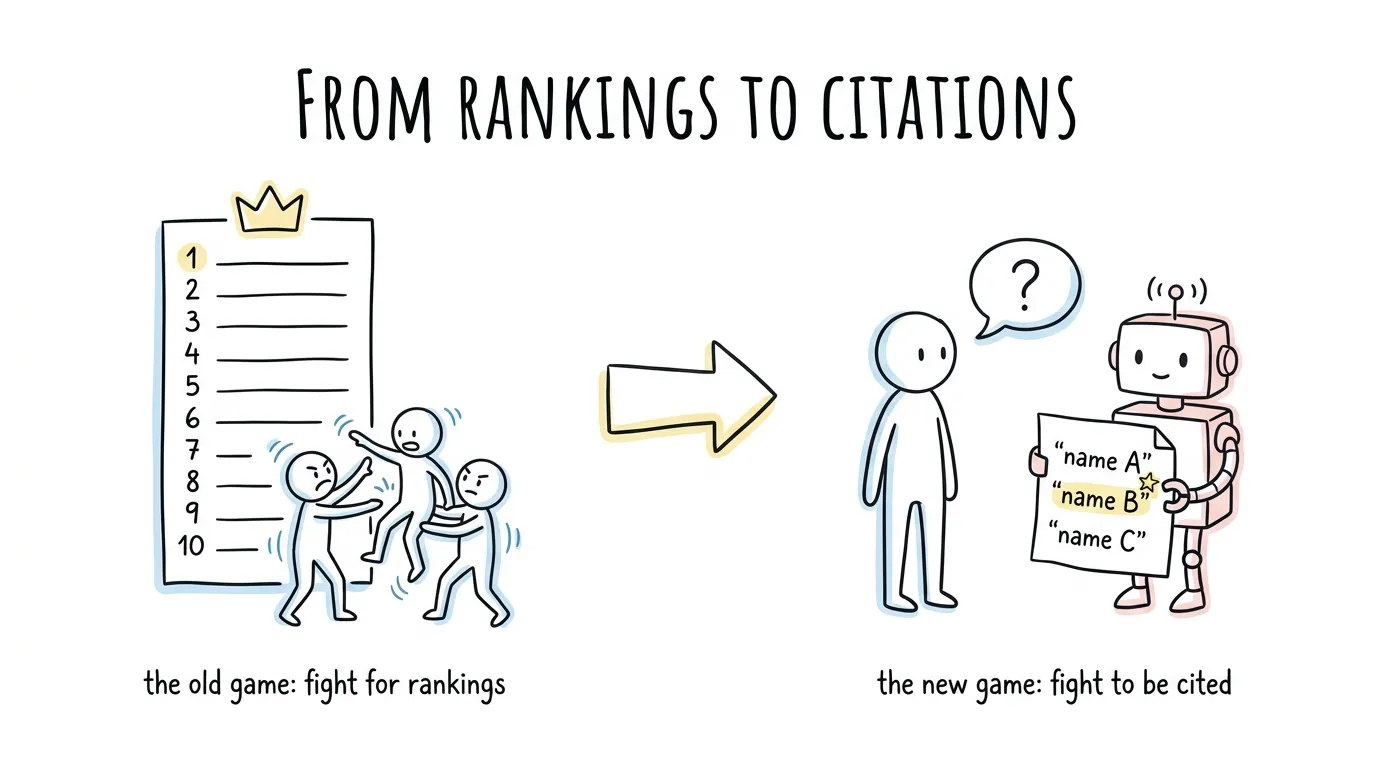
Put simply: people used to do SEO (search engine optimization), which meant doing everything possible to get search engines to rank your pages at the top. Now users don't scroll through search results anymore — they ask an AI directly, and the AI generates an answer on the spot. How do you get the AI to mention you, to cite you, inside that answer? That is GEO.
Before, you fought for rankings. Now, you fight to be cited.
This shift is bigger than many people realize. I've broken it down into six things, and I'll walk you through them one by one.
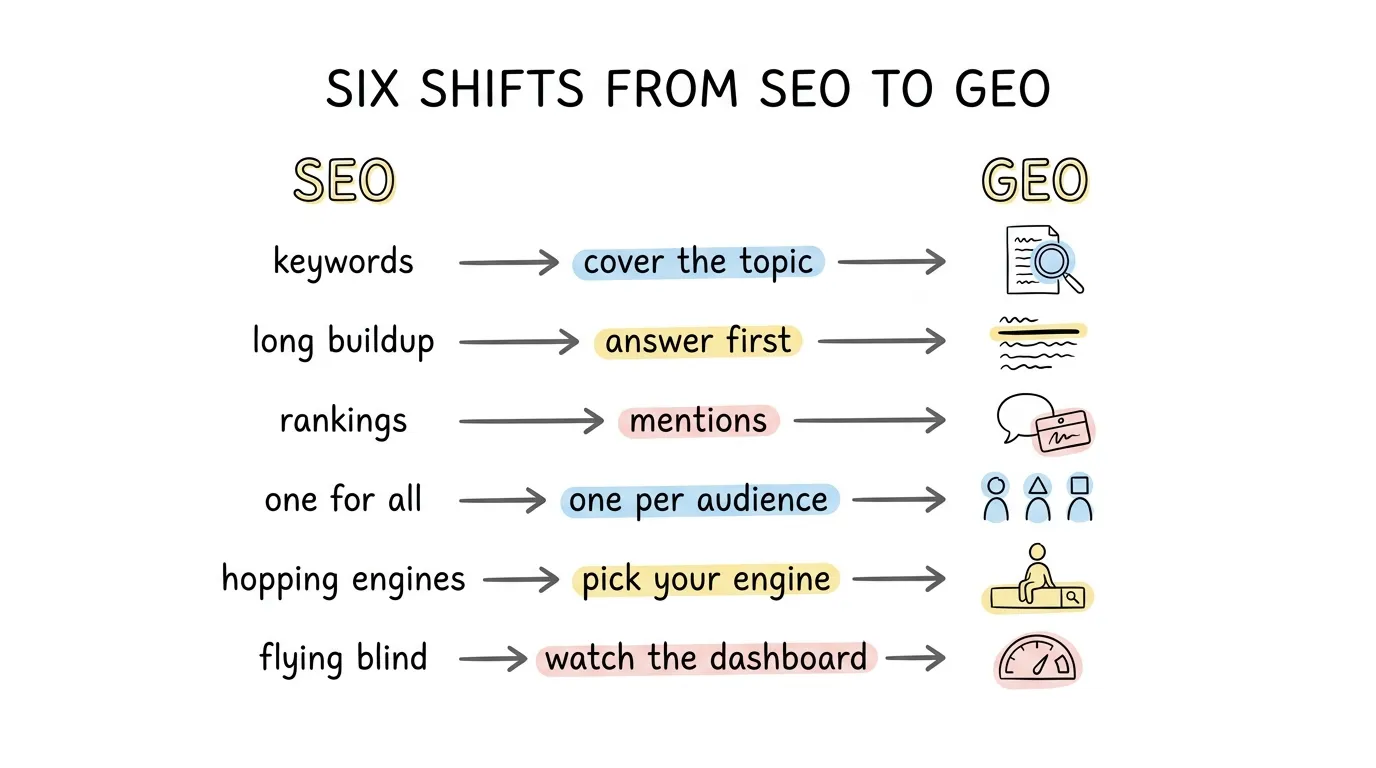
1. Keywords Are Losing Their Grip
People in SEO have spent their whole careers wrestling with keywords. Figure out what terms users search for, bury that keyword in the title, in the body text, in the image alt text — then wait for the traffic to come knocking.
But generative engines don't really play that game.
Think about it: when an AI answers a question, what does it rely on? Its overall understanding of the topic. The keyword you buried offers a little context — it doesn't decide whether the AI cites you.
What does decide it? Whether you've covered the topic thoroughly.
It's like an examiner grading essays. The old examiner scanned for whether you'd hit the "scoring points" keyword. The new examiner reads your whole essay, checking whether you've explained the problem clearly from start to finish.
So should you still do keywords?
Yes. Traditional search isn't dead, and the SEO playbook still works. But if you want the AI to mention you in its answers, the center of gravity has to shift — from "planting keywords" to "covering the topic in full." Whatever users will ask about a topic, that's what you explain thoroughly.
2. AI Is an Impatient Reader
Do you write like this too? Open with 300 words of industry background, add a stretch of emotional scene-setting, and only then serve up the actual answer.
A human reader might still walk that road with you.
An AI won't.
What a generative engine does is compress and distill the entire web's information and hand the user a ready-made answer. Your 300 words of preamble? Skipped in a second — it goes straight for the meat.
So content needs to be built differently:
- The moment a user's question appears, the answer should follow right behind it — no detours
- Use subheadings to slice the content into clearly defined blocks
- Every page should carry a summary that can be lifted wholesale
- Make your content quotable — if the AI can lift it easily, it will
In one sentence: AI doesn't read your buildup. It reads your answer.
3. No More Rankings — So What Do You Fight For? Mentions
This is the most fundamental difference between GEO and SEO.
Traditional search has a leaderboard — slots one through ten, each with a visible price tag, everyone fighting tooth and nail for them.
A generative engine has no leaderboard.
You ask an AI a question, it generates an answer, and the answer mentions three to five brands. There's no number one or number five here — only "mentioned" and "not mentioned."
So how do you get the AI to mention you?
Its logic is really word-of-mouth logic: the more people across the web talk about you, cite you, and recommend you — and the more authoritative they are — the more the AI sees you as a real player.
So going forward, accumulating mentions for your brand will become a big deal. Here are the routes:
- Publish guest content on third-party sites
- Produce original content with real viewpoints — the kind people want to link to, retell, and endorse
- Try to appear in industry roundups and aggregation pages of every kind
- Genuinely take part in discussions on communities like Reddit — don't post ads
The more people across the web mention you, the more the AI believes you're an authority. That simple — and that hard.
4. Same Question, a Different Answer for Everyone
The personalization I mean here is not opening an email with "Hello, Mr. Zhang."
AI answers are already tailored to whoever is asking. Same question: a beginner asks it, a veteran asks it — the depth of the answer is completely different.
What does this mean for people who make content?
It means one piece of content to serve everyone is increasingly a losing strategy. You have to get clear on:
- Who exactly this piece of content is for — which specific need
- Which stage the user is at: just heard of it, still hesitating, or about to buy
- Novice or expert — how deep should the explanation go
Content is no longer written one piece at a time; it's written one audience at a time. You have to deliver the information right to where each person stands.
5. Users Are Starting to Pick a Favorite
Back in 2025, when large AI models first took off, people hopped from one AI to the next like a visitor sampling every stall at a market. This one today, that one tomorrow. The platforms themselves were sprinting too, shipping a major redesign every month, and users' loyalties simply couldn't settle.
Now the picture is about to change.
People will gradually settle on the one that works best for them, commit to it, and stop wandering. Just like the search-engine era: some swear by Google, some by others — everyone has their pick, and rarely switches.
ChatGPT is most likely the "Google" of this market, with the largest share. But Perplexity, Gemini, Copilot — each has its own die-hard following. That doesn't mean the other engines aren't worth investing in.
How to decide? Don't guess. Go look at where your user base clusters, and put your effort there.
Go where your users are.
6. A New Channel Is Open — Time to Install a Dashboard
Get the first five right, and traffic really will start arriving from the AI side. Someone asks an AI, the AI mentions you, the user clicks through — and becomes your lead.
This is a new channel. And when a new channel opens, the old rule still stands: if you're not watching the data, you're working for nothing.
So you'll notice that software for tracking AI search performance is becoming a hot category. How many times your brand gets mentioned in the answers of the major AIs, what's said about you when it happens, how much traffic it sends you — all of this needs tools watching it for you.
There are already a handful on the market, such as Otterly.ai, Rankscale, Ahrefs' Brand Radar, and xFunnel. Pick one and start using it — that beats just about anything else you could do.
Finally
Back to that friend from the beginning.
He said something to me that day that stuck with me: "Searching is something AI now does for me. My only job is to ask."
Think about what that means for anyone doing business.
Users have outsourced "finding" to AI. So the business of "being found" has to be rebuilt from scratch. The playbook of rankings is being swapped for the playbook of citations; the playbook of keyword-planting is being swapped for the playbook of covering topics in full.
GEO is no passing fad. It's only just beginning.
So here's my wish for you: be the name that comes up again and again in AI's answers.
Continue reading
Related articles

It's 2026: Stop "Buying" AI Tools for Your Marketing Team — Start "Hiring" AI Agents
This learn article explains how AI agents differ from standalone AI tools in marketing, outlines three agent categories — build-your-own platforms, CRM-native agents, and vertical tools — and covers use cases across SEO, social media, advertising, and reporting, plus criteria for choosing one.

What Is GEO? How Your Brand Gets "Mentioned" in the Age of AI Search
An explainer on GEO (Generative Engine Optimization) for e-commerce and DTC brands: how it differs from SEO and AEO, why AI answers shape brand visibility, and eight practices covering question-focused content, consistent brand messaging, structured pages, external evidence, comparisons, and AI mention tracking.

AI Is Already Making Decisions for Your Customers. Are You on the List?
A learn article explains GEO (Generative Engine Optimization): why AI-generated answers now shape which brands customers see, and how SEO fundamentals, entity clarity, citable evidence, and monthly measurement affect visibility in AI answers.