
The AI Search Business Already Has People Quietly Making Money
An analysis of the emerging AI search advertising market, covering advertiser sentiment, early ChatGPT ad activity, GEO budget trends, and content formats that AI engines tend to cite.
A while back, a friend of mine who runs a consumer-goods export business invited me out for tea.
Within three minutes of sitting down, he asked: "So — should I start buying ads on ChatGPT? A competitor already has, and it's been nagging at me."
I didn't answer directly. I asked him back: "Is what's nagging at you the channel, or the money?"
He froze.
I said, channels show up every day, so don't rush to open your wallet. Let's sit down first and get a clear look at the numbers behind this business: who's spending, who's earning, and where the money actually flows. Then you decide.
Today, I'm going to take the batch of statistics I've been digging through, break them apart piece by piece, and walk you through them.
Start with Who's Making Money
Before spending a cent, answer one question: are the customers AI brings in actually worth anything?
The answer is more brutal than most people expect.
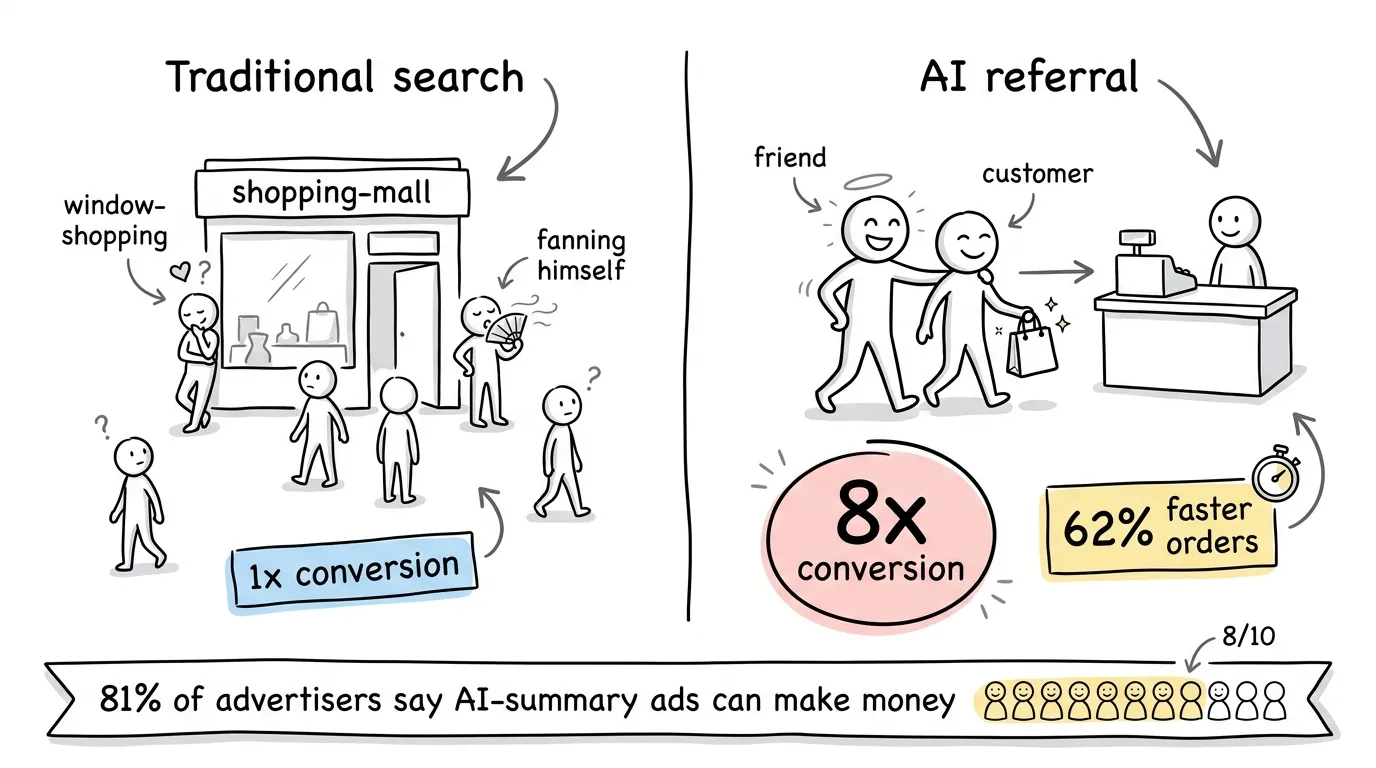
Several different statistical lenses point to the same conclusion: visitors who click through from AI engines convert at 8 times the rate of traditional search traffic — and they place orders 62% faster.
8 times. What does that mean?
Here's an analogy. Traditional search traffic is like the foot traffic outside a shopping mall — plenty of people, but nine out of ten are just there for the air conditioning. AI referral traffic is like the customer a friend drags right up to the counter, saying, "I'll take this one."
One is browsing. One is buying. Whose conversion rate do you think is higher?
The data says the same: content optimized specifically for AI answer engines — GEO (Generative Engine Optimization) traffic — consistently converts better than traditional SEO traffic. And when asked "AI search or traditional search — which drives more sales?", more and more marketers are siding with the former.
So you see, the first question about this business is no longer up for debate.
Customers from AI don't just come in greater numbers — they're also more willing to pay.
Advertisers Have Already Voted with Their Wallets
Conversion rates alone aren't enough. Whether a channel truly works shows up in the most honest signal of all: advertisers' budgets.
What do the budgets say?
In one survey of advertisers, 81% believed that ads appearing inside AI summaries can make money.
81%. Eight out of ten advertisers voted yes.
Advertisers' instincts have always been sharper than analyst commentary. What people say can be wrong; the money they put down is not.
Now look at what's actually happening on ChatGPT. Someone scraped and tallied the ads already running there: roughly 580 in total. Of those, 36% had only ever run once.
I stared at that number for a long time.
580 listings, against Google's ad library of hundreds of thousands, is practically an empty lot. And what does the 36% one-timers figure tell you? That a flood of advertisers came in with a "fire one test shot" mindset — spend a little, watch the splash, still undecided about whether to camp here for the long haul.
An empty lot, plus a wave of tentative players. That's exactly what a window of opportunity looks like.
So who's out in front?
Finance and insurance. These two industries have already claimed the front row of ChatGPT's commercial-keyword ad slots.
Think about why. In finance and insurance, a single customer's lifetime value is enormous, so they'll pay up even when acquisition costs run steep. Wherever fresh, precisely targeted question traffic appears, they charge in. Back when search engines were just emerging, they were the first to pour money in, too.
History doesn't repeat itself, but it rhymes.
But This Market Is Nicely Chaotic
Don't get carried away just yet. The other side of the coin deserves just as clear a look.
The same set of statistics contains this line: 86% of ads on ChatGPT have nothing to do with the brand the user asked about.
86%.
What is brand hijacking? You ask about Brand A, and the ad that shows up is Brand B. The user wants to hear from A; standing in the ad slots is nothing but B.
In traditional search, that would be unthinkable. You search "Nike" and Adidas is standing at the top of the results page — it took search engines twenty years of policing to stamp that out. The ad slots of AI search, by contrast, are still basically growing wild.
Chaotic? Absolutely.
So who wins from the chaos?
The newcomers. The rules aren't set, the seats aren't full, and early arrivals get first pick of the plots. What my friend who asked about ads should really fear is not entering now — it's showing up only after the rules are written.
One more line worth chewing on: in commercial-keyword ad slots, roughly 10% have already been taken by affiliates.
Who are affiliates? They're the crowd that makes no products of their own and just funnels traffic to sellers for a commission. They move fastest because their nose for money is sharpest — no meetings, no approvals; spot the opening and slip straight in.
By the time the affiliates have all claimed their spots, when the institutional players finally walk in, the price of land won't be this price anymore.
A New Line on the Budget Sheet
Now, another angle on the spending side: marketing budgets themselves.
Over the past two years of talking with business owners, I've noticed a quiet but profound shift: on more and more companies' marketing budget sheets, GEO now has a line of its own.
What did that sheet look like before? A line for paid media, a line for content, a line for SEO, a line for social media. Now, AI visibility has its name on the list too.
One statistic cuts the data by company size: the larger the company, the more seriously it invests in generative engine optimization. That tracks — the budget sheets of big companies are always the first barometer of a trend. Small companies watch and wait, mid-sized ones dip a toe in, big ones have already earmarked dedicated funds.
But another statistic pours cold water on that: asked about the maturity of their AI search strategy, most teams' answer is — still testing.
On one side, dedicated budget lines. On the other, everyone saying "still testing."
Contradiction? No. This is "money moves first, the playbook catches up." The budget goes out first to claim the seat; the method gets figured out along the way. Every new channel in history went through this: paid search in 2005, feeds in 2015 — all had a phase where "the money arrived before the capability did."
Now it's AI search's turn.
To Get Named by AI, Learn Its Taste
Spending is the external practice. This business also has an internal discipline: getting your brand named inside AI's answers.
People have already started to figure out what AI likes to cite.
Take content formats. Break down the types of content AI cites, and listicles take 48%, leaving everything else in the dust. Why? Think about it: when a large language model answers a question, what structure does it love most? One, two, three, four — crisp and clear. Hand it an essay and it has to digest it itself; hand it a ready-made list and it serves it up as-is.
Take video. Citations of YouTube content in AI summaries have grown 34% in six months. AI is growing fonder of video, because videos hold plenty of detail that plain text can't capture.
Take query habits. The questions that most often trigger AI summaries are 6 to 10 words long. Too short, and the search engine answers by itself; too long, and users can't be bothered to type. Mid-length questions are the main battlefield where AI answers live.
But the most piercing finding is this: the statistics state it plainly — a Google ranking guarantees nothing about AI citations.
In other words, the martial arts you spent the past twenty years perfecting don't automatically carry over to the new ring. Another survey, with 200 marketers taking part, put the question even more bluntly: what brings the most AI citation authority? The answers converged on a single point: whether your brand shows up in the places AI loves to visit.
An old map won't find you new lands. You've heard that line until you're sick of it, but it hits closer to home here than anywhere else.
Back to That Cup of Tea
Having come this far, it's time to get back to my friend.
So what did I tell him in the end? Three sentences.
First: you can start spending, but spend it "test shot" style — don't go all in. On the empty lot of 580 ads, plant your flag first; build the tower later.
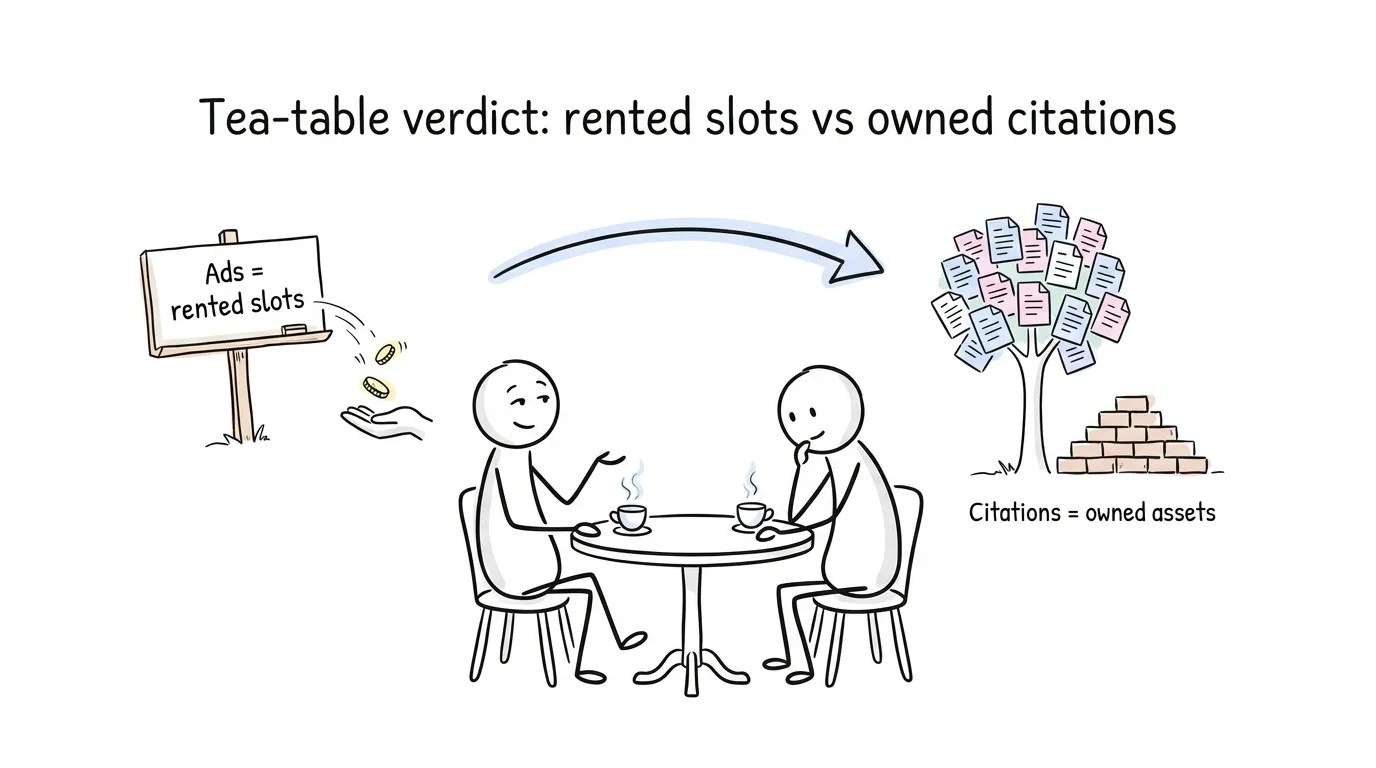
Second: buy the ads, yes — but earn the citations too. Ads are rented slots; citations are accumulated assets. Rented slots can raise the rent at any time; accumulated assets are actually yours.
Third: rework your content to AI's taste — lists, video, answers served right to its lips.
Ads buy today's traffic; citations build tomorrow's reputation.
As for what this business will ultimately grow into — honestly, I don't know. All I've seen is a batch of numbers, and behind the numbers, the people who've already made their move.
But there's one call I'm willing to make: by the time everyone else gets it, the window will have closed.
Here's to my friend — may he bet early, and bet right.
Continue reading
Related articles

What Is GEO? How Your Brand Gets "Mentioned" in the Age of AI Search
An explainer on GEO (Generative Engine Optimization) for e-commerce and DTC brands: how it differs from SEO and AEO, why AI answers shape brand visibility, and eight practices covering question-focused content, consistent brand messaging, structured pages, external evidence, comparisons, and AI mention tracking.

AI Is Already Making Decisions for Your Customers. Are You on the List?
A learn article explains GEO (Generative Engine Optimization): why AI-generated answers now shape which brands customers see, and how SEO fundamentals, entity clarity, citable evidence, and monthly measurement affect visibility in AI answers.

Google Is Stuffing Ads Into AI Search: These Recent Stories Are Really One Story
A news roundup linking recent AI marketing stories—Google adding ads to AI Mode, Amazon's Ads Agent, ChatGPT image updates, a UK startup tracking brand mentions in AI answers, and an AI ransomware warning—arguing that control over ad data and visibility is shifting toward platforms.