
Want ChatGPT to Recommend You? Get the Diagnosis First, Then Book the Appointment
A learn article explaining GEO/AEO: how AI engines name and cite brands, why entity consistency matters, and how to triage and choose an AI search agency, including a 90-day checklist and pre-purchase test.
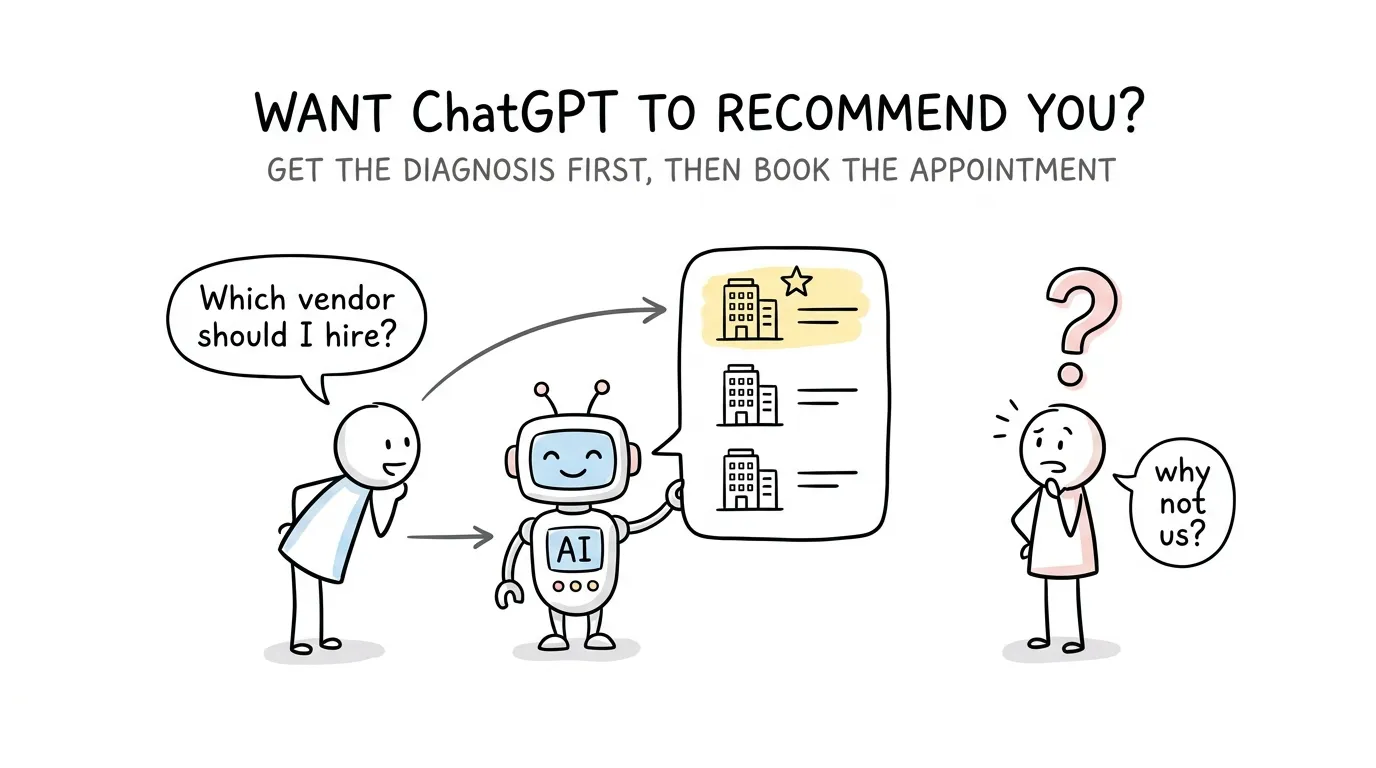
A few days ago, a friend of mine who runs a B2B software company came to see me. He showed me a screenshot: a customer, before ever asking him for a proposal, had simply thrown a shortlist of vendors at him.
Where did the shortlist come from? ChatGPT.
He asked me: my SEO is solid—why doesn't the AI ever mention me?
I told him: don't rush to spend money yet. With this, you get the diagnosis first, then you book the appointment.
What Is GEO?
Buyers have changed. Purchasing used to start with a Google search and ten pages of links to flip through. Now a lot of people go straight to ChatGPT, Claude, Gemini, or Perplexity and ask for a ready-made answer. That's what "AI search" refers to.
Then a pile of new buzzwords appeared: AEO, GEO, LLM visibility…
The truth is, AEO and GEO are two names for the same job: making it easy for AI engines to find you, describe you clearly, and want to recommend you. The term GEO (Generative Engine Optimization; AEO, similarly, is Answer Engine Optimization) was coined in a 2023 academic paper. Don't let the jargon intimidate you.
Two metrics here are easy to confuse. One is being named: among the set of buyer questions you track, how often does the AI mention you? The other is being cited: when the AI answers, whose links does it attach behind the answer? You can be named without being cited, and cited without being named—so treat them as two separate things.
But there's something that matters more than any metric.
When an AI engine introduces a company, it relies on compression. It takes everything said about you—on your website, in the media, on review sites, in forums—and compresses it into one sentence. In one place you say you do quality inspection for factories; in another, you call yourself a digital transformation partner; and on the review sites, there's nothing at all. What comes out of the compression is something vague like "a company that provides solutions." The industry term for this is entity consistency—or plainly put: do all the places that describe you tell the same story?
An engine won't dare recommend a company it can't describe clearly. People are the same: would you recommend to an important client someone whose job you couldn't explain yourself?
Why Did This Suddenly Become Valuable?
Seer Interactive ran a study: it tracked 3,119 informational queries over 15 months. The result: on results pages that carried an AI summary, organic clicks fell by 61%.
Where did those clicks go?
Brands cited in the AI summary captured 35% more organic clicks than those that weren't.
To be fair, Seer itself is quick to note that correlation isn't causation. But the direction is unmistakable: clicks are flowing toward the brand that gets named.
Here's a number that stings even more. Seer says that since January 2025, 15% of its own inbound leads have come from someone discovering the firm inside some AI.
Back then, not doing SEO meant hiding yourself. Now, not doing this means the AI will "translate" you wrongly on the buyer's behalf.
Diagnosis First, Then the Appointment
So what do you do? Hire a provider.
Practically everyone doing this work calls themselves an AEO agency, a GEO expert, or an AI search firm. It all sounds like the same thing, but the ailments they treat are different.
It's like walking into a hospital: you don't just grab any registration number in the lobby—you go through triage first.
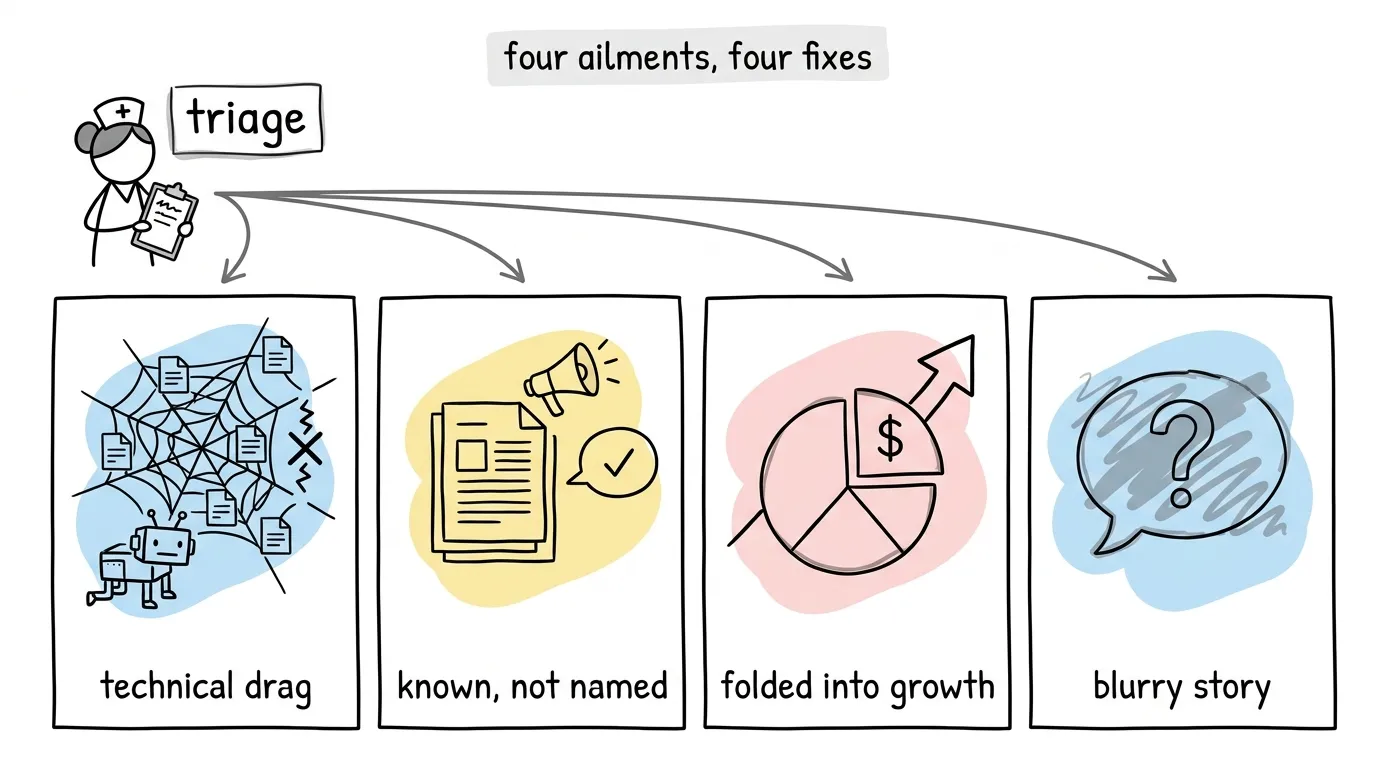
The first ailment: a big, complicated website, where technical problems are dragging down visibility.
Thousands of pages, crawls that fail at every turn, an information architecture in shambles—that's enterprise-grade technical work. This is the turf of firms like iPullRank, who call their method Relevance Engineering and take GEO apart as an information retrieval problem: how engines distribute queries, how they pick passages, how they synthesize answers. Their founder hung an entire AI search manual openly on the web—in this market, full of jargon, few dare to do that. Their client list includes Target, American Express, and Adidas. Seer Interactive takes a different road: diagnose first, then line up tests, and finally train your team so the capability grows in-house. Go Fish Digital handles tools, PR, and paid media all under one roof.
The second ailment: the AI actually understands you fairly well—it just doesn't recommend you much.
This is when you bring in the content engine. Siege Media's logic is refreshingly blunt: large models love citing sources, so go become the source worth citing. Its schedule is detailed down to the month: the first two months build a baseline and map out citations; months two through four roll out data journalism, digital PR, and Reddit; after that, it reports citations and revenue month by month. Omniscient Digital (full-service from $10,000 a month), Animalz, Foundation Marketing, and Discovered Labs (pay monthly, no long-term lock-in) all sit in this box.
The third ailment: you want AI search folded into your entire growth picture.
Demand-generation agencies like Directive, First Page Sage, and NoGood (average monthly fees starting north of $20,000) sell GEO bundled together with paid media, leads, and revenue reporting. They suit brands with ample budget that want one accountable bucket covering it end to end.
The fourth ailment, the most easily overlooked: the AI can't sum up who you are in even one sentence.
At this point, buying more content and distribution only amplifies a blurry story into a blurrier one. You have to fix the story first. PitchKitchen does exactly this: first it helps you write your positioning, narrative, and evidence into a single document—they call this the Magnetic Messaging Framework—putting in black and white what the engines should repeat, then growing pages, entity corrections, and tracking out of that document. They have a 90-day fixed-price sprint, from $15,000 to $45,000 and up depending on company size; they also run a lightweight monthly service called OpenKitchen, at $3,500 to $7,500.
These prices were all checked in October 2026. Most companies don't publish prices; the few that dare to are actually saving you time.
One Ugly Truth Up Front
All of these providers share one line that none of them may cross:
No one can guarantee that ChatGPT will recommend you.
No agency controls what ChatGPT, Claude, or Gemini answers. A trustworthy firm improves the inputs the engine reads—your pages, your consistency, the places third parties mention you—and then watches the numbers for movement.
Anyone who thumps their chest and promises "guaranteed ChatGPT placement"—turn around and walk away.
By the way, even Google has said so officially: there are no extra requirements to appear in AI summaries, and no magic markup file to add. Whoever is selling a "magic file" is selling something that doesn't exist.
Legit Work or Shady Tactics? One Question Settles It
One question is enough: does the tactic make it easier for the engine to describe you accurately, or does it try to trick the engine?
Legit work: a fixed set of buyer questions, tracked every week across several engines; one single story about the company, told everywhere it speaks externally; pages that get straight to the point on the questions buyers actually ask; and third-party reviews earned the honest way.
Shady tactics: waving a screenshot of "ChatGPT mentioned me" as proof of results; swapping in different wording page by page to chase keywords; batch-generating several hundred pages of thin content; hiring shills to fake reviews; buying ranking positions that hide the payment terms.
One more thing: many "best providers" lists are written by the providers themselves. A list isn't a bad thing in itself—check three things: whether it clearly explains its method, whether it dares to list its competitors, and whether it dares to say who shouldn't hire it.
What Should You See in the First 90 Days?
No matter whom you hire, a legit AI search agency should hand over these things within 90 days:
- A baseline. Run your set of buyer questions across at least three engines, and record visibility, position, and citation status. This set of questions must belong to you.
- An entity audit. Official website, LinkedIn, review sites, directory sites—cross-check every place that describes you for consistency.
- A written-down "standard answer," the kind management has signed off on.
- A gap list: the questions where competitors show up and you don't, sorted by business value.
- Ship against the list: answer-style pages, corrected information, an endorsement plan with names and dates.
- Reports averaged weekly or monthly, plus one honest sentence: which wins they dare not claim credit for.
If after 90 days all you've seen is a "monthly content quota" and a dashboard nobody can decipher, stop right there.
Run One Test Before You Pay
Take a blank sheet of paper. Open three brand-new sessions and ask ChatGPT, Claude, and Perplexity those three questions: the kind your best buyers will definitely ask before paying. Write down who got named, how you were described, and who got cited.
Take this sheet of paper into every meeting with every provider and ask one question: what would your first step be.
Their answers will be more honest than any slide in their deck.
As for whether to buy tools: tracking platforms like Profound, Peec AI, Scrunch, Otterly, and Goodie can get you started for tens of dollars a month at the cheap end. If you have a team that can edit pages and information themselves, buying tools is enough. No team? The tool will only tell you where it's broken; it won't fix it for you. Then you still have to hire someone.
One Last Thing
Back to that friend from the beginning.
Here's what I finally told him: being good at SEO doesn't help you anymore, because buyers no longer search—buyers are "asking." And an AI only recommends the companies it can describe clearly.
What an engine can't recommend was never the company that didn't try hard enough; it's the company it can't sum up.
Here's to your company being described, clearly and correctly, by every engine out there.
Continue reading
Related articles

It's 2026: Stop "Buying" AI Tools for Your Marketing Team — Start "Hiring" AI Agents
This learn article explains how AI agents differ from standalone AI tools in marketing, outlines three agent categories — build-your-own platforms, CRM-native agents, and vertical tools — and covers use cases across SEO, social media, advertising, and reporting, plus criteria for choosing one.

What Is GEO? How Your Brand Gets "Mentioned" in the Age of AI Search
An explainer on GEO (Generative Engine Optimization) for e-commerce and DTC brands: how it differs from SEO and AEO, why AI answers shape brand visibility, and eight practices covering question-focused content, consistent brand messaging, structured pages, external evidence, comparisons, and AI mention tracking.

AI Is Already Making Decisions for Your Customers. Are You on the List?
A learn article explains GEO (Generative Engine Optimization): why AI-generated answers now shape which brands customers see, and how SEO fundamentals, entity clarity, citable evidence, and monthly measurement affect visibility in AI answers.