
Are You in AI's Answers?
An overview of GEO (Generative Engine Optimization) explaining why AI citations matter as search shifts to AI answers, and how GEO tools cover question discovery, mention monitoring, competitor tracking, and impact measurement.
Last month, a friend of mine in the smart home business invited me to dinner.
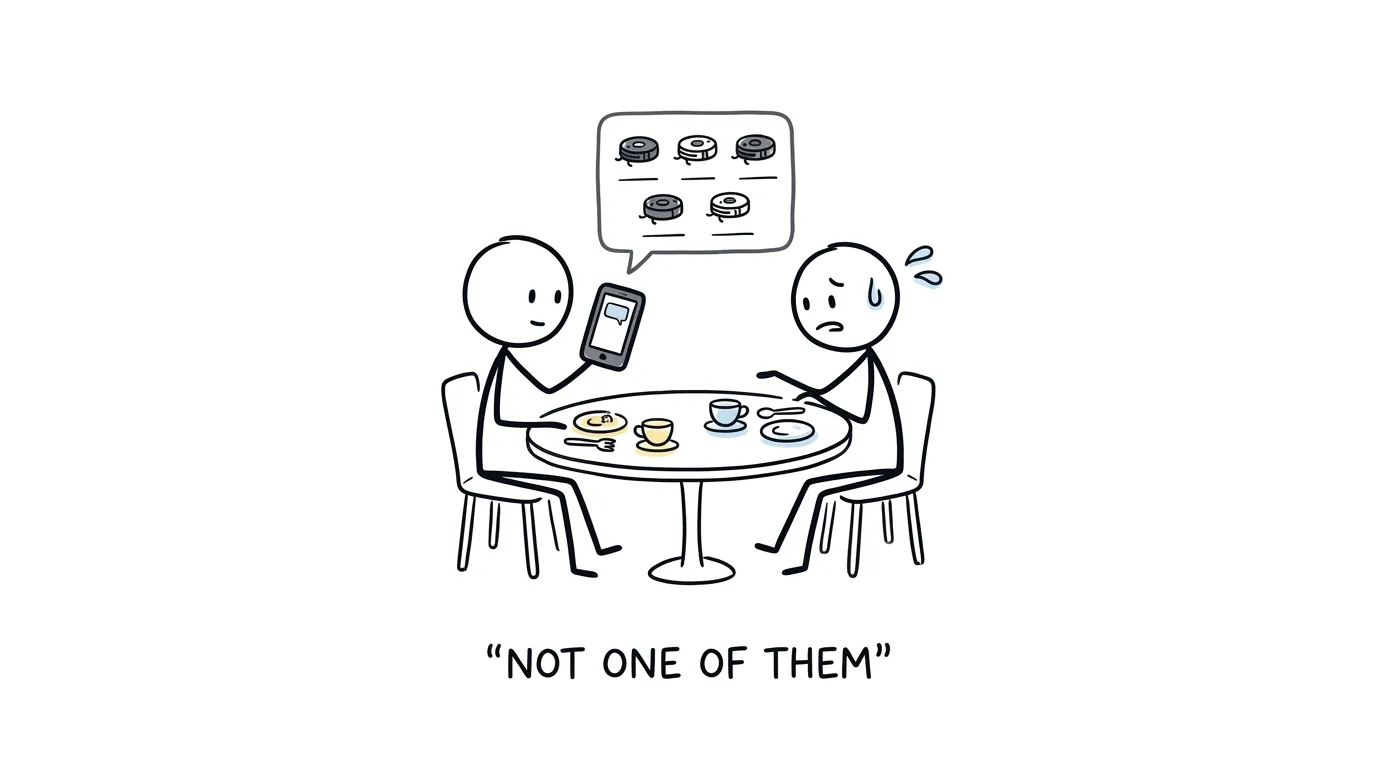
Halfway through the meal, he pulled out his phone and showed me something. He had asked ChatGPT to recommend a few robot vacuums in the 1,000-yuan price range. The AI earnestly wrote five hundred words and recommended five brands.
"Guess what," he said. "I'm not in there. Not one of them."
He told me he had spent ten years doing SEO, and every one of his core keywords ranked first on page one. In AI's answers, he was nowhere.
For a moment, I didn't know what to say. But I kept thinking about it, and the more I did, the more I felt this wasn't just his problem.
So What Is GEO?
GEO stands for Generative Engine Optimization.
Put simply, it means getting AI to mention you and cite you when it answers questions.
Old-school SEO was a ranking game. Ten blue links; if you ranked first, the traffic was yours.
And now? A user asks one question, and the AI writes the answer for them and serves it up on a plate. The blue links are still there, but they sit behind the answer. Whoever gets mentioned in the answer is the one who gets seen.
Here's a number worth memorizing: Google's AI Overviews have already siphoned off more than 35% of clicks. Out of every ten people searching, three and a half read the AI summary and leave, never scrolling further.
The part that stings even more comes next. When AI Overviews picks its citations, it often ignores rankings altogether. Pages outside the top ten get picked all the same. What it judges is how citable your content is: whether the structure is clear, whether the facts are solid, whether the answer is complete. That's why you'll see Reddit threads, forum replies, and niche blogs with little authority cited openly and without fuss.
A high ranking does not mean you get cited.
Being cited is the new ranking.
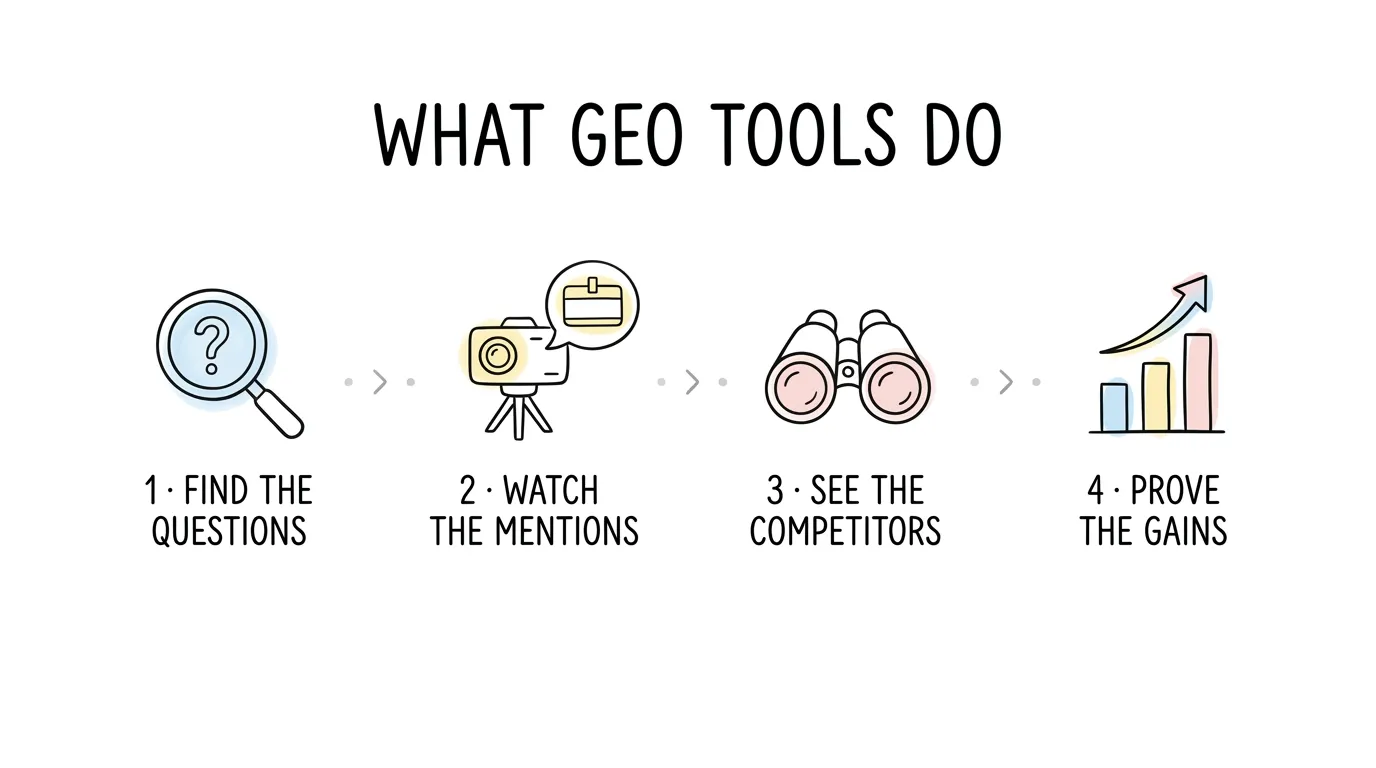
This shift has given rise to a whole breed of tools built for exactly this job, collectively called GEO tools. There are dozens of them on the market at least — enough to make anyone dizzy. After working through them one by one, I found that, don't panic, these tools are really only doing four things.
The First Thing: Find the Questions AI Loves to Answer
The starting point of everything is knowing what users are asking.
Note: what you're looking for is not keywords, but the complete questions as they come out of users' mouths. AI is a question-answering machine, and the content you feed it has to look like an answer.
In this category, the tool I most want to recommend is Answer Socrates.
It began as a keyword tool, and over the past two years it has grown into a full GEO toolbox. You give it a seed term, and it goes digging through the autocomplete suggestions of every major search engine, pulling back thousands of real user questions, clustering them automatically — complete with search volume, cost per click, and competition — and exporting them all in one go. Over a thousand questions, in seconds.
The first time I saw its clustering results, a single word came to mind: spread out. All the vague doubts inside users' heads, spread flat on the table, one category at a time, perfectly clear.
It has two things that set it apart from the rest.
One is LLM brand tracking. Whether your brand gets mentioned in ChatGPT, Claude, Gemini, DeepSeek, Grok, or Perplexity — it watches for you. You no longer have to go ask each AI, one by one, "So, what do you think of us?"
The other is a full suite of AI writing assistance: headline generation, data-point generation, content hooks, all of it included. The pricing is friendly too: the free tier allows three searches a day, and the paid Pro plan is $29 a month. For individual site owners and small-to-mid-size teams, this is the cheapest ticket in.
Of course, it isn't all-powerful. There's no backlink analysis; if you want to work on backlinks, you'll need a separate tool.
There's also a player in this category that plays the game completely differently: Cognizo. What we described above hands you the ingredients and lets you do the cooking; Cognizo opens the restaurant for you. Every day it runs 150 prompts on your behalf, across ChatGPT, Google AI Overviews, Gemini, Perplexity, Copilot, and Grok, watching how the AIs mention you and whom they cite. When it finds a topic where you're absent, its content agents write the piece, publish it, and refresh it on a schedule, filling the gap.
The company was founded in New York in 2024, with founders Deniz Özcan and Mehmet Alp Aysan. It raised a $1.8 million seed round, and its client list includes Kraft Heinz, LG, and Prezi. The product is genuinely complete — and the pricing is enterprise-grade too: the entry-level Growth plan runs $499 a month. There's no self-serve signup either; every contract starts with a demo. Big brands with budget to spare can go straight to it. Smaller teams — hold that thought until the next thing.
The Second Thing: See Whether AI Mentions You
You've found the questions and shipped the content. Then what?
Then you fall into a new kind of anxiety: is AI actually mentioning me?
Rankings used to be checkable — one tool covered your whole site. Now citations are scattered across several models. ChatGPT mentions you, Perplexity doesn't; you're there this week, the next version update ships, and you're gone. Asking each model by hand, one at a time, will wear your fingers out.
I call this category of tools the dashcam. You don't rely on it to drive, but when something happens, you need it for the replay.
First, Hall — among the most comprehensive in this category. It watches citations from ChatGPT, Perplexity, Gemini, and Grok, one by one, and it shows you the exact snippet of the citation: which sentence the AI mentioned you in, and with what context. Only by seeing the original text do you learn how the AI talks about you — praise or digs, a genuine recommendation or a passing mention. There's a free tier; paid plans start at $99 a month. There's a lot to digest, so if a small team uses it, you'd best assign one person to actually read the reports — otherwise you genuinely won't keep up.
Semrush's AI Toolkit is another route. It's an add-on to Semrush's main platform, starting at $119.95 a month, putting mention data from AI Overviews, ChatGPT, Gemini, and Copilot into the same dashboard as its signature traditional SEO data. Share of voice, prompt analysis, sentiment analysis, gaps against competitors — all visible at once. It fits teams that already use Semrush and have their SEO workflows running smoothly; they add a module and level up in stride. The shortcomings are just as blunt: it's expensive, and the learning curve is not gentle.
If your budget is especially tight, look at LLMrefs. The free tier monitors one keyword; paid is $79 a month. It has an LLMrefs Score that checks whether your keyword performs consistently across five or more major models: ranked high in ChatGPT but nowhere to be found in Gemini — that kind of mismatch, it points straight at. The features are thin, but thin in an honest way: everything monitoring ought to have, it has.
There's also a clever workaround: Perplexity Pro. At $20 a month, it's essentially a research assistant, but its answers list their citation sources. Search the core questions of your industry, open the sources panel, and check whether you're there. Manual, crude — but cheap and fast, good for feeling out the water first.
Then there are tools like SEOTalos, which specifically track site-wide citations inside AI Overviews; these also belong in this category — worth viewing alongside the rest.
The Third Thing: See Your Competitors
After staring at yourself long enough, the next question pops up: what about my competitors?
Many tools only tell you that a given question's AI answer came through AI Overviews. That sentence is useless to anyone preparing a report. What the boss wants to hear is: which companies got cited in that answer? Where do we fall short?
SE Ranking is strong exactly here. It puts traditional Google rankings and AI citations in the same dashboard, and for the AI answers to your target prompts, it tells you by name which competitors got cited. When you report to clients, this data is rock solid: we're being pressed by exactly whom in AI results — the facts, the screenshots, the names, all here. The standard plan is $129 a month and already includes AI features; for another $70 or so you can add the AI add-on for more capacity. Agencies should take a serious look.
One step further up is Profound. Enterprise-grade, no public pricing, built to serve the big brands. It has a Conversation Explorer, where you can see how many brand mentions a certain type of question generates in AI answers, and it can also monitor product exposure in ChatGPT Shopping, with SOC 2 (a widely recognized security compliance standard) on the compliance side. Large companies and well-funded content teams use it the most. Small companies can just have a look — this price point was not built for us.
The Fourth Thing: Prove Your Changes Actually Work
Once the first three things are done, you hit the most crucial gate: I changed my content — did AI traffic really go up?
This is the step where fooling yourself comes easiest. You update a page today, and next week AI traffic is up 20%, so you take the credit. Is it really yours? Maybe a model version updated. Maybe a competitor fell out of the answers. Maybe it was already climbing.
What SEOTesting does is make this rigorous. Its LLM tests use your own GA4 (Google Analytics 4) data, not estimates. You pick a page or a group of pages, record the changes — added an FAQ, put in structured data, rewrote the opening — and then look at how sessions from ChatGPT, Claude, and Perplexity changed before and after. It's like setting up a control group for an experiment, letting the data speak for itself.
The company's origin is interesting too. Founded in 2016 as SanityCheck, it set out to solve the problem that Google Search Console only shows three months of historical data. In 2020 it renamed itself SEOTesting, and to this day it remains a three-person team in Cornwall, England. One site costs $50 a month, with a 14-day free trial and no credit card required.
One boundary needs to be stated clearly: what it measures is clicks from AI, not mentions by AI. If AI mentions you but nobody clicks, it can't see it. Mentions belong to the second category of tools; clicks belong to this one. Two different things — don't mix them up.
A Special Scenario: E-commerce
Most of the tools above keep their eyes on brands. But e-commerce owners think a little differently: the brand can wait — first tell me, my products, are they being recommended by AI?
Shop Mentions grew up for exactly this scenario. It's a Shopify-native app; once installed, it pulls your product catalog straight into the backend and checks it product by product: when ChatGPT, Perplexity, Gemini, or Claude recommends similar products, are you there? Which sources did they cite? After that it automatically rescans once a week and, along the way, compares competitor performance.
Its perspective is product-level, not brand-level. Which SKU won in AI recommendations and which lost — perfectly clear. There's a 7-day free trial; the subscription price is listed in the Shopify App Store, ranging from $9 to $129 a month. It serves Shopify only — that is its everything, and also its moat.
Questions You'll Most Likely Ask
Do backlinks still work?
They do, but not as well as they used to. AI Overviews will cite Reddit comments, forum posts, and blogs without much authority. Backlinks are still in the game, but the form, structure, and topic coverage of your content are gaining weight.
What kind of content does AI love to cite?
Judging by how things look today: first, clear short summaries of 100 to 200 words that directly answer questions like "which is better," "how do I do this," and "A or B — how to choose"; second, structured formats — FAQs, tables, pros-and-cons lists; third, paragraphs carrying data and sources. Conversely, flabby marketing-speak often gets skipped by AI outright.
GEO, LEO, VEO — what is all this mess?
Don't be frightened by the acronyms. GEO governs AI-generated answers; LEO governs localized AI responses, like a voice assistant answering your "which store is nearby"; VEO governs voice scenarios, where the answer must be short enough to read out loud. The three circles overlap, and one well-structured piece of content can be cited in all three places at the same time. Make GEO solid first, and the other two come along for the ride.
Back to That Dinner
After dinner, I gave my friend an idea.
First, use Answer Socrates to spread out every question in his industry, and see what users are actually asking. Pick a few questions that AI is already answering but where the answers contain nothing of him, and rework his content into the shape AI loves to cite. Then install a monitoring tool, and once a week take a look at whether he's been mentioned.
Do the math after one quarter. If it works, double down; if not, adjust.
The essence of all this, put plainly, is one sentence: Before, you begged the search engines to give you a ranking. Now, you have to make AI feel that you're worth citing.
The questions users ask haven't changed. What changed is the one who assembles the answer on their behalf. Before, algorithms ranked pages. Now, models write answers.
And all these GEO tools do, in the end, is help you see this shift clearly — and explain it just as clearly.
May you hear your own name in AI's answers soon.
Continue reading
Related articles

It's 2026: Stop "Buying" AI Tools for Your Marketing Team — Start "Hiring" AI Agents
This learn article explains how AI agents differ from standalone AI tools in marketing, outlines three agent categories — build-your-own platforms, CRM-native agents, and vertical tools — and covers use cases across SEO, social media, advertising, and reporting, plus criteria for choosing one.

What Is GEO? How Your Brand Gets "Mentioned" in the Age of AI Search
An explainer on GEO (Generative Engine Optimization) for e-commerce and DTC brands: how it differs from SEO and AEO, why AI answers shape brand visibility, and eight practices covering question-focused content, consistent brand messaging, structured pages, external evidence, comparisons, and AI mention tracking.

AI Is Already Making Decisions for Your Customers. Are You on the List?
A learn article explains GEO (Generative Engine Optimization): why AI-generated answers now shape which brands customers see, and how SEO fundamentals, entity clarity, citable evidence, and monthly measurement affect visibility in AI answers.