
AI Agent Keeps Getting It Wrong? Don't Blame the Model — Blame What You Fed It
A practitioner guide arguing that most AI agent content errors stem from outdated or contradictory source material, not the model. It covers defining agent scope, building a source of truth with knowledge base, exemplars, and sandbox layers, and tracking a grounding rate.
A while back, I asked our company's AI agent to write a product comparison post.
It looked the part: clean structure, smooth tone — ready to publish at first glance.
Before shipping it, I gave it one closer look. Then my stomach dropped.
The way it described our positioning used language we had retired a full year earlier.
Retired. A full year ago.
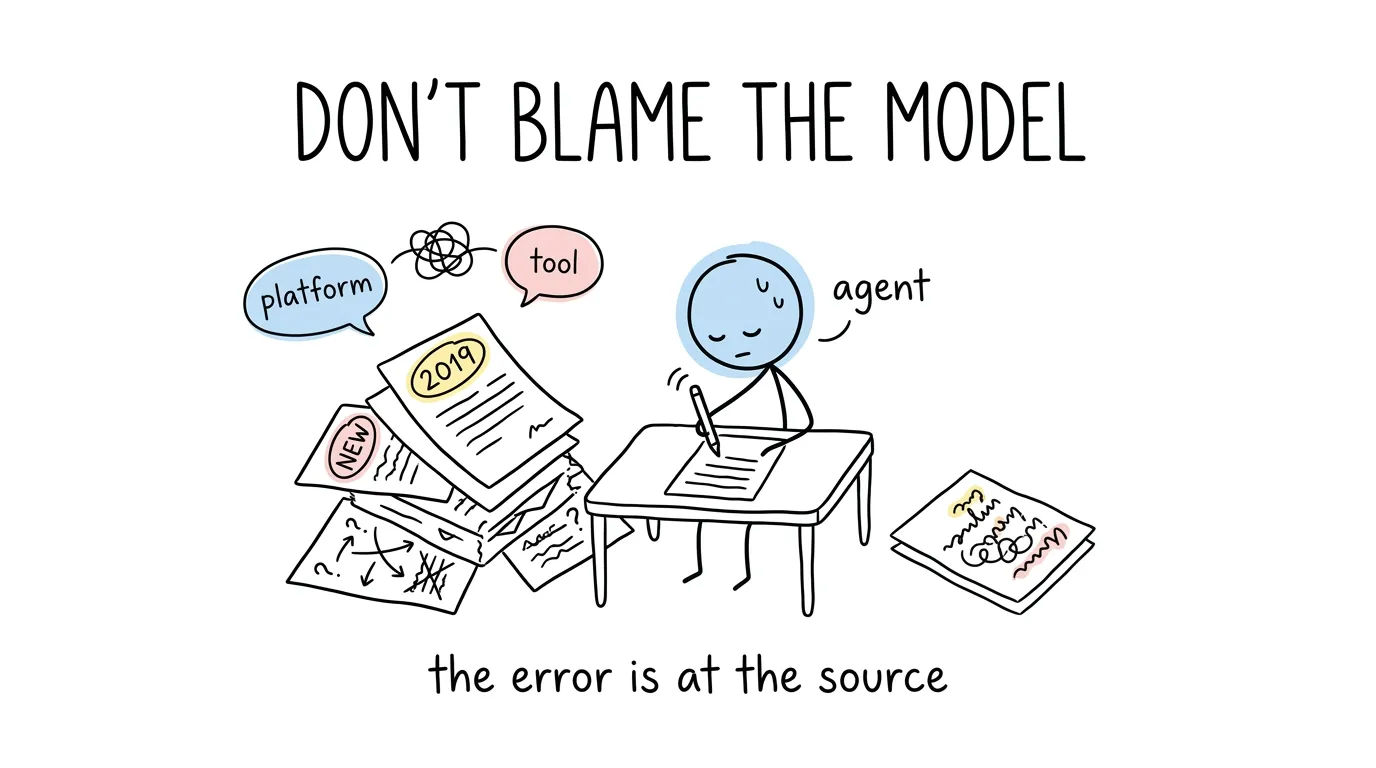
Is the agent dumb? No. It dutifully dug through our own files and wrote based on whatever it found. The problem was the files: half of them were outdated, and two of them flat-out contradicted each other.
I've told this story to plenty of people in the industry, and they all nodded — they'd been through almost exactly the same thing. Comparing notes, I found that in every disappointing agent performance, neither the model nor the prompt was the culprit. The real bottleneck was the pile of material it read.
When an agent gets it wrong, nine times out of ten the error is at the source.
How Bad Can Bad Source Material Actually Get?
You might say: a little stale, a little messy — how big a deal can that be?
Let me count the ways.
The most common failure is copy that smells machine-made. With no bad examples to learn from and no real customer language to borrow, what the agent writes is safe and even: every word correct, every sentence boring. Readers won't finish it, and the editor ends up rewriting from scratch — which takes longer than writing it in the first place.
The second is positioning drift. Two documents tell two different stories, and the agent bounces between them: this page calls you a platform, the next calls you a tool. One article reads like three different companies speaking on your behalf.
The third is inaccurate feature claims. It writes roadmap items as if they were already shipped, says nothing about a capability released last month, and describes other features based on how they worked two versions ago. Readers believe it, and the trouble lands on you.
The fourth is picking the wrong rivals. The agent may be able to look up competitors' prices, but it can't tell who your real competitors are or where you actually win. If you haven't spelled that out, it will benchmark you against the wrong players. Take our own time-tracking product, TMetric: this market is packed with players of every stripe, the competitors are wildly varied, and each customer segment cares about different things. Leave it unstated, and the agent is guaranteed to compare you to the wrong crowd.
The fifth is numbers that don't agree. The agent uses last year's metric definition, or one nobody has updated. Suddenly the figures don't match across drafts, your boss's trust sinks along with the numbers, and you have to verify everything by hand. One round of manual checking, and you've handed back every hour the agent saved you.
The sixth is having no SEO soul. No target keywords, no topic clusters, no priorities — so it can only produce an article that is "generically reasonable," not the one article you actually need to rank.
Notice: not one of these six failures is the model's fault.
Fix the source, and this entire category of errors disappears all at once.
Where to Start? First, Be Clear on What This Agent Is For
Don't rush off to collect documents yet.
First, get clear on: which decisions this agent owns, what it reads, what it delivers, which calls it can make on its own, and which need a human to review.
Why does this step come first?
Because scope determines rations. An agent that writes blog posts needs editorial guidelines and SEO rules; an agent that writes ad copy needs the handful of claims legal allows it to make. Hand both agents the same giant folder, and each one drowns in the other's mountains of irrelevant material.
The fastest way I've seen to ruin an agent: give it more material to read.
There's a one-sentence test: if you can't say in one sentence which decision this agent owns, it hasn't earned a library yet.
Set the scope first. Everything else comes after.
What Is a Source of Truth? One Home, One Date, One Owner per Fact
When two documents contradict each other, which one wins?
If you can't answer, neither can the agent. It just grabs whichever version it picks up first, and your external messaging starts to drift.
So every fact, every metric, needs one official home. Everywhere else that mentions it points back to that single home. Then the question "which one is right?" simply stops existing.
There's one more step most teams skip: stamp every fact with the date it was last verified, and assign it an owner.
Think about it: a definition untouched for 11 months and one confirmed last week should be two different things in the agent's eyes. But how would it know? Only if the date is written right there.
My approach: keep all core definitions in one file that the agent cites by ID number. When a number changes, I fix it in one place, and every downstream draft updates automatically.
Conversely, copy the same definition into five decks, and you've created five chances to contradict yourself.
A fact gets exactly one home on record. Every extra home is one more fight.
Write for Retrieval, Not for Reading
I've seen award-winning brand books that would be worth nothing to an agent.
Because when the agent reads your 40-page PDF, it may take away only one section. The way you write has to accommodate that.
What does that look like in practice? A few principles.
Keep sections short and self-contained — one section, one topic. Put the answer in the first sentence; models trust what comes early. Use the question the section answers as its heading. Write everything in plain text or Markdown, not slide format — Markdown is the native format of the AI era.
How do you verify it's written right? The simplest test: ask the agent, "Where did you get this sentence?"
If it can quote your source verbatim, your material is structurally sound. If it hedges and stalls, the fact got buried. A buried fact slowly gets replaced by a guess.
A Knowledge Base Alone Is One-Third of the Job
A dependable source of truth needs three layers.
Layer one: the knowledge base, which defines what's true and how to talk. Layer two: exemplars, which show what good looks like. Layer three: the sandbox, where you test the agent on real inputs.
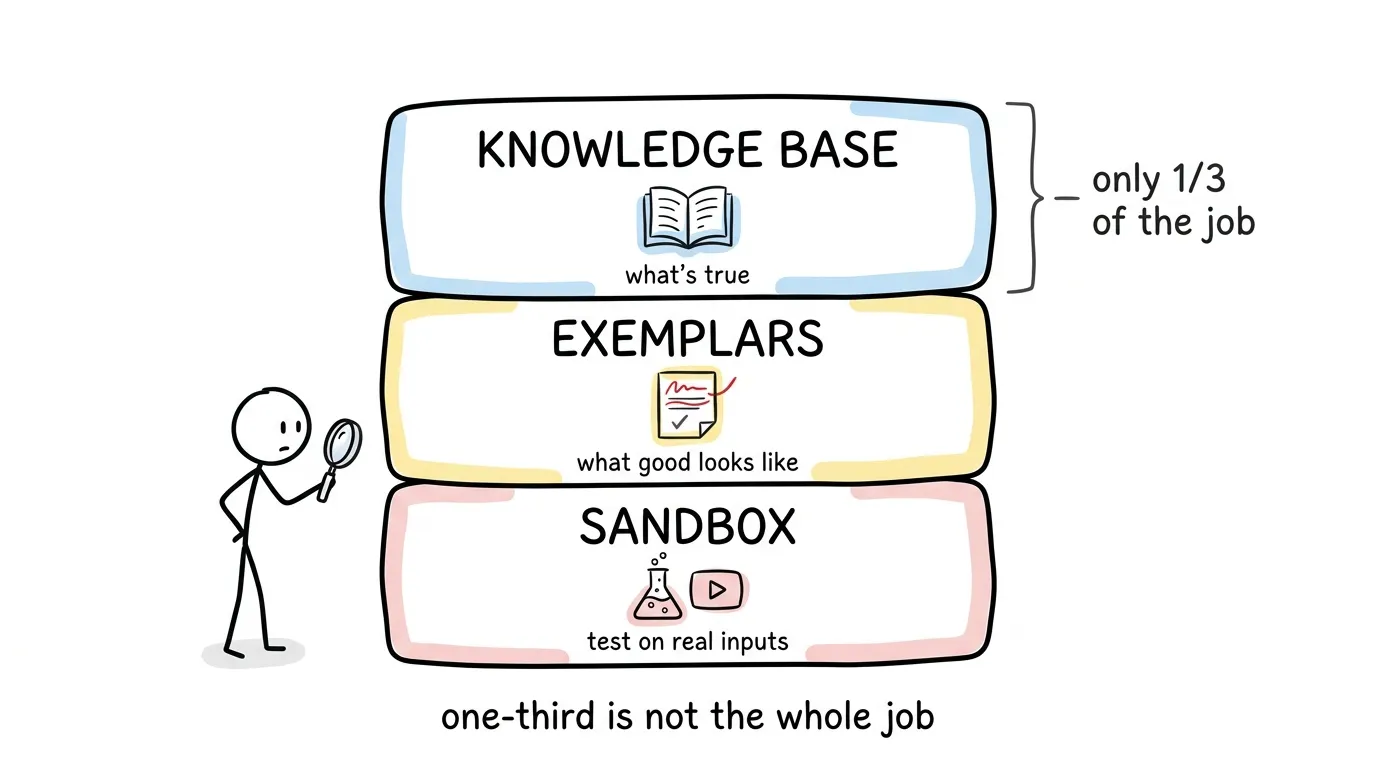
All three are indispensable. Without exemplars, the agent writes copy that is technically flawless but uniformly mediocre. Without rules, it can't handle new requests. Without a sandbox, problems don't surface until publishing day.
What do most teams do? Build the knowledge base and call it a day. That's one-third of the job — and the least important third.
What goes in the knowledge base? Brand positioning, the core messaging line, your ideal customer profile (ICP), a persona for every buying role, voice and tone guidelines, editorial standards for each content type, keyword and search-intent rules, a terminology glossary, and supporting evidence.
One detail deserves its own callout: for the voice of the customer, use verbatim quotes from sales calls, not summaries. A line like "We picked you because onboarding was up and running in a day — we didn't have to wait a quarter" beats a digest of ten phone calls. The agent can take that sentence and write with it directly, word for word.
The most useful thing in the exemplar layer is an editor's redline markup on a real draft: three openings cut down to one, "an empowering solution for teams" replaced with the actual feature name, the customer quote moved from the bottom of the page to the top.
A finished piece tells the agent where the destination is. The redline shows it how to get there.
Add a couple of filled-in briefs (a how-to tutorial and a competitive comparison list, say), two or three published articles that set the benchmark, and several bad-to-good before-and-after pairs labeled with why each one failed: too generic, key point buried, no evidence — each marked clearly. That way the agent learns rules, not one-off cases.
The sandbox layer turns the source of truth from something that can be read into something that can be run. Put in real sample data, plus a map of which fact comes from which system. For example, a Google Search Console export where one page has rankings and another doesn't — that's how the agent can actually see the pattern it's supposed to grasp. Then spell it out: pricing comes from the billing system, win/loss reasons come from the CRM, so the agent knows where to fetch each kind of information.
The knowledge base is just the passing grade. The exemplars and the sandbox are what separate "polished-sounding fluff" from output that's genuinely on-brand.
Anything You Didn't Mark Off-Limits, the Agent Will Use
Listing what it may use isn't enough. You have to write down, clearly, what it may not touch.
The agent's logic is simple: whatever it can reach is ammunition. If you don't fence it off explicitly, it will use it.
My list has exactly three categories.
One: anything not yet launched. Roadmap features, plans not yet in effect, promises not yet fulfilled — none of it gets written. What you can't deliver, the agent shouldn't hype for you.
Two: anything requiring approval. Performance numbers, security certifications, named-customer case studies — these clear legal or management before publishing.
Three: anything you can't keep fresh. Any data the team has no bandwidth to maintain doesn't go into the source of truth. Why do I say that? A stale fact is more dangerous than a missing one. Missing, the agent will go look, or ask. Stale, it uses in good conscience — and the more confidently it's used, the harder it blows up. If you can't guarantee freshness, delete the entry; don't leave it there to rot slowly.
Speaking of which, a quick story. The biggest gap on our team wasn't a missing document — it was that our entire keyword logic lived inside two strategists' heads.
We didn't wait for them to free up time to write documentation. We recorded a 30-minute conversation, transcribed it, and that transcript became the rules document.
Rough but written beats polished but missing.
Close the Gaps, Ranked by What Breaks First
Before you formally plug the agent in, run a gap analysis: list everything it will need, mark each item "have, half, missing," spell out exactly what's absent, then rank it all.
Pay attention to what you rank by. Not how much is missing — how soon it will break something.
And the most dangerous items are often not the missing ones but the "half" ones: they look complete, and the pit hides exactly there.
Take my own gap list. Keyword rules: missing, stuck in two heads, so nothing else has anything to stand on — fix now. Benchmark articles: missing, nothing to model against — fix now. Verbatim customer quotes: half, the ten calls on hand aren't enough for the agent to generalize from — fix now. "How to write so it doesn't read like AI": half, the guidelines exist but the labeled bad-to-good pairs don't yet — fix next.
I see this pattern every single time: the knowledge base is usually fine; the gaps cluster in the examples and the sandbox.
How do you keep tabs on it over time? Here's an accounting method.
Pick 10 tasks the agent has gotten wrong before, and write down the correct answers. Every time you change the source, rerun those 10 tasks. Then count one thing: in each piece of output, what share of statements can be traced back to a specific line in the source?
That share is the grounding rate. It's the one number you watch.
If it drops, fix the source, not the prompt: add the missing examples, delete the duplicated definitions, write in the missing rules. Rerun the 10 tasks; when the number comes back, then publish.
Meanwhile, three don'ts: don't grade only on stylistic polish; don't stuff ten new rules into the prompt to fix one bad output; and don't use tasks the agent already handles smoothly as your test set. Pick test cases from past failures, not easy successes.
Finally
A source of truth that gets filed away the moment it's finished will die.
To stay alive, it has to be run like any product you ship: scope it, date-stamp it, test it against reality, manage its versions.
Do all that, and the agent no longer needs to guess. Every claim traces back to a line you've nodded yes to, every number reconciles across every draft, and no one has to rewrite the tone piece by piece anymore.
And that comparison post that nearly shipped? We later overhauled that pile of material and had it rewrite the piece. The second version contained not one stale claim.
The next step for a content team isn't smarter prompting — it's tending your fact repository with more care.
Here's to an agent that never has to guess.
Continue reading
Related articles

It's 2026: Stop "Buying" AI Tools for Your Marketing Team — Start "Hiring" AI Agents
This learn article explains how AI agents differ from standalone AI tools in marketing, outlines three agent categories — build-your-own platforms, CRM-native agents, and vertical tools — and covers use cases across SEO, social media, advertising, and reporting, plus criteria for choosing one.

What Is GEO? How Your Brand Gets "Mentioned" in the Age of AI Search
An explainer on GEO (Generative Engine Optimization) for e-commerce and DTC brands: how it differs from SEO and AEO, why AI answers shape brand visibility, and eight practices covering question-focused content, consistent brand messaging, structured pages, external evidence, comparisons, and AI mention tracking.

AI Is Already Making Decisions for Your Customers. Are You on the List?
A learn article explains GEO (Generative Engine Optimization): why AI-generated answers now shape which brands customers see, and how SEO fundamentals, entity clarity, citable evidence, and monthly measurement affect visibility in AI answers.