
The Traffic ChatGPT Sends Is Not Even a Fraction of Google's
An analysis of a study comparing ChatGPT referral traffic with Google organic search, discussing GEO budget decisions and the study's limitations.
A few days ago, I had dinner with a friend who runs a cross-border e-commerce business.
He told me he plans to move a big chunk of his budget into GEO this year. What is GEO? Generative Engine Optimization. In plain English: people used to study how to rank high on Google; now they study how to get tools like ChatGPT to mention you in their answers.
His logic sounded airtight: going forward, everyone will be asking AI instead. Who will still use search? You need to stake your claim early.
I told him: sit down — they haven't even finished serving. I just came across a study. Hear me out before you decide whether to move that budget.
The study comes from a search-industry consultant named Marie Haynes. She pulled GA4 data from 100 websites, spanning a full 12 months, totaling more than 145 million visits.
She arrived at one number: the visits ChatGPT brings amount to just 0.62% of Google organic search.
0.62%. You read that right — less than 1%.
And it doesn't stop there. She added up the referral traffic from every other large model, and all AI combined accounted for only 0.73% of Google organic traffic.
Note the denominator: Google's organic traffic, not the sites' total traffic.
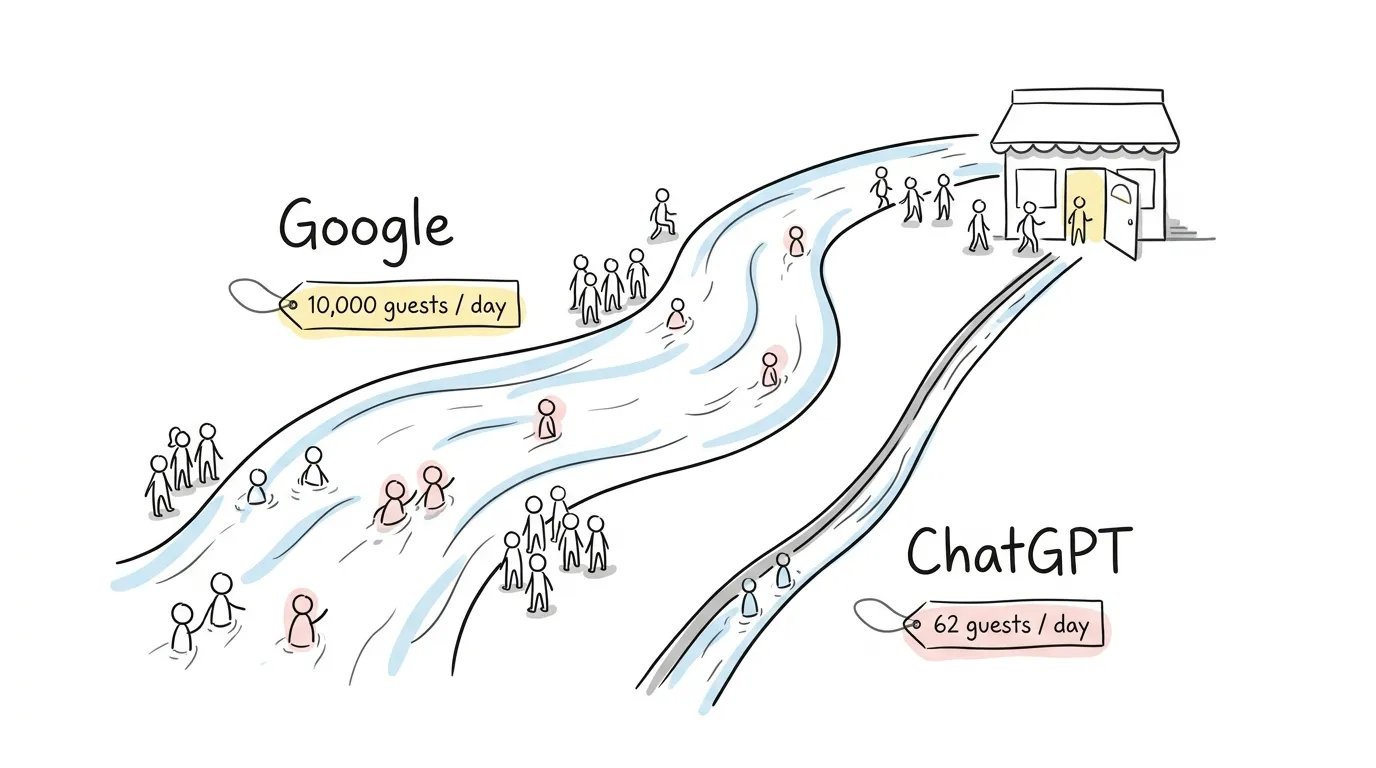
What does that mean? Here's an analogy. If Google sends you 10,000 guests a day, ChatGPT sends about 62.
Next to a great river, there runs a little ditch.
Guess what my friend said?
"Sure," he said, "but the people ChatGPT sends convert at a much higher rate!"
And he's not wrong — that number really is in the study.
Among the 55 websites that tracked conversions, ChatGPT visitors converted at 13.8%, while Google organic search visitors converted at 3.02%. A gap of more than four times.
The crowd is small, but every one of them shows up wallet in hand. Sounds wonderful, doesn't it?
But let's do the math.
10,000 guests, times 3.02%, is 302 orders. 62 guests, times 13.8%, is just over 8 orders. Even if you add together the deals from every large model, Google organic search still drives 27 times more sales than all of them combined.
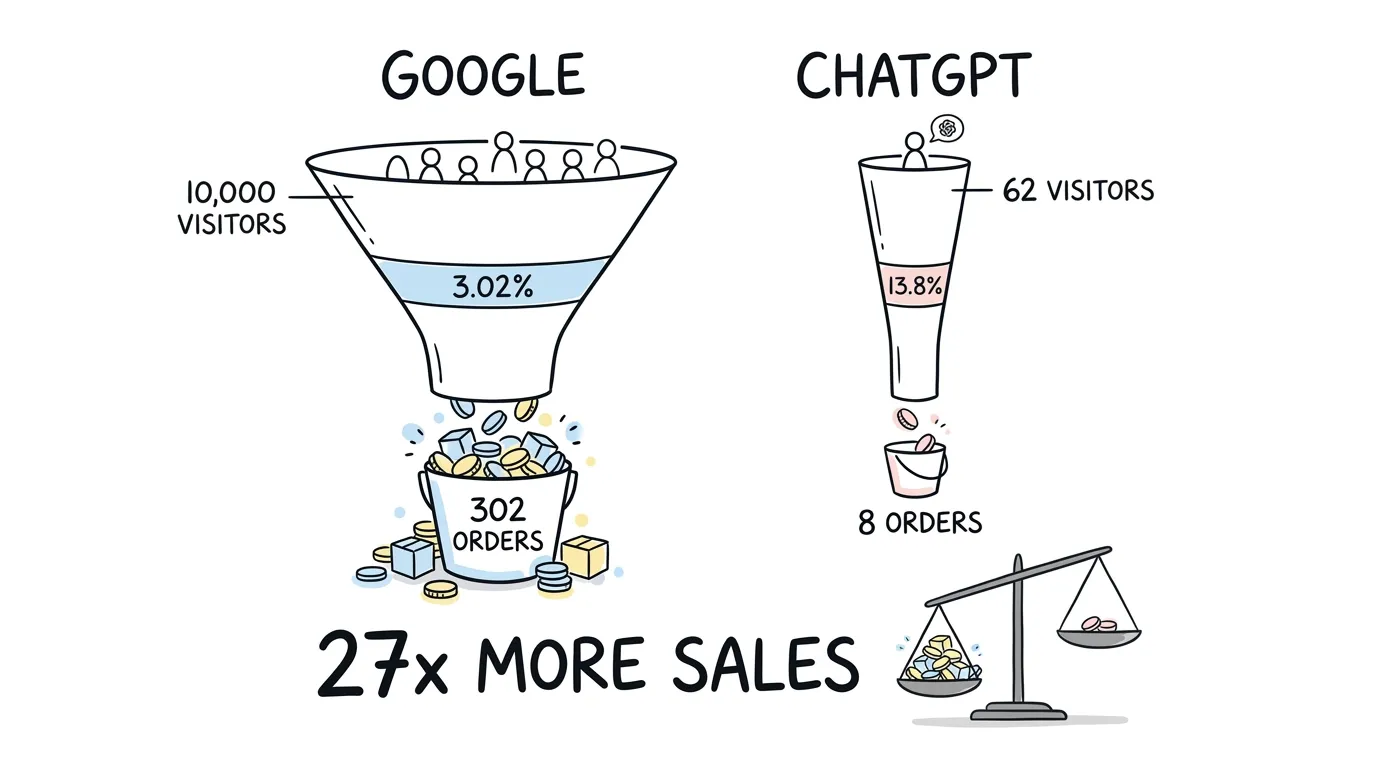
Traffic is measured on someone else's denominator; business is counted in your own orders.
One line from Haynes stuck with me. She said:
"The AI search that's actually delivering customers to a business's doorstep today isn't ChatGPT. It's Google."
See what she's saying? She isn't asking you to choose between AI and Google. She counts Google as part of AI search itself — it has been pouring AI into its search results all along. Skipping it to optimize elsewhere is like bypassing the front door to climb in through a window.
There's a second half to this story, and it's even more interesting.
ChatGPT's referral traffic was climbing exponentially before August 2025, with a curve so steep it was scary. But from that month on, it stopped rising. Haynes says it has even been declining since.
So her verdict on GEO is blunt: distraction. A wrong turn.
Does that mean AI search will never take off?
I wouldn't dare say that. This study measures where things stand today; it can't answer tomorrow's questions. Whether the way people discover brands through AI will completely change, we'll only know a few years down the road.
And to be fair, the study has its limits. The 100 websites vary in size; it never specifies the exact time window, the industry mix, or how "conversion" was defined; and it didn't measure changes in Google's own organic traffic.
So don't treat it as a verdict — treat it as a set of scales.
If you're agonizing over this budget too, my advice comes down to one line: make your Google foundation solid — that's the river actually feeding you today. Keep one eye on the AI ditch, and if it truly rises one day, you can follow then, and still be in time.
Before we parted, I sent the study to my friend.
He read it and replied with three words: "Let's eat first."
Fair enough. The river still holds the most water today.
Continue reading
Related articles

It's 2026: Stop "Buying" AI Tools for Your Marketing Team — Start "Hiring" AI Agents
This learn article explains how AI agents differ from standalone AI tools in marketing, outlines three agent categories — build-your-own platforms, CRM-native agents, and vertical tools — and covers use cases across SEO, social media, advertising, and reporting, plus criteria for choosing one.

What Is GEO? How Your Brand Gets "Mentioned" in the Age of AI Search
An explainer on GEO (Generative Engine Optimization) for e-commerce and DTC brands: how it differs from SEO and AEO, why AI answers shape brand visibility, and eight practices covering question-focused content, consistent brand messaging, structured pages, external evidence, comparisons, and AI mention tracking.

AI Is Already Making Decisions for Your Customers. Are You on the List?
A learn article explains GEO (Generative Engine Optimization): why AI-generated answers now shape which brands customers see, and how SEO fundamentals, entity clarity, citable evidence, and monthly measurement affect visibility in AI answers.