
What Makes a Simple Straw Hat Sell in Nearly 70 Countries?
A study of straw hat exporters in Cixi shows how small cross-border factories use sales data analysis and a locally fine-tuned open-source image model to guide product selection and speed up sampling. The article reviews market analysis, price-band insights, and an AI-assisted design workflow.
A while back, I came across a rather interesting piece of research.
The subject of the study might make you smile: straw hats.
This is no high-tech product. Woven from water grass, wheat straw, and palm rope—a craft handed down for thousands of years.
Yet this humble straw hat, in Cixi, Zhejiang, supports more than 50 manufacturing companies with an annual output value of 250 million yuan. The golden-thread straw hats made in Changhe Town of Cixi sell to nearly 70 countries and regions around the world.
The wholesale price? About 10 yuan a hat.
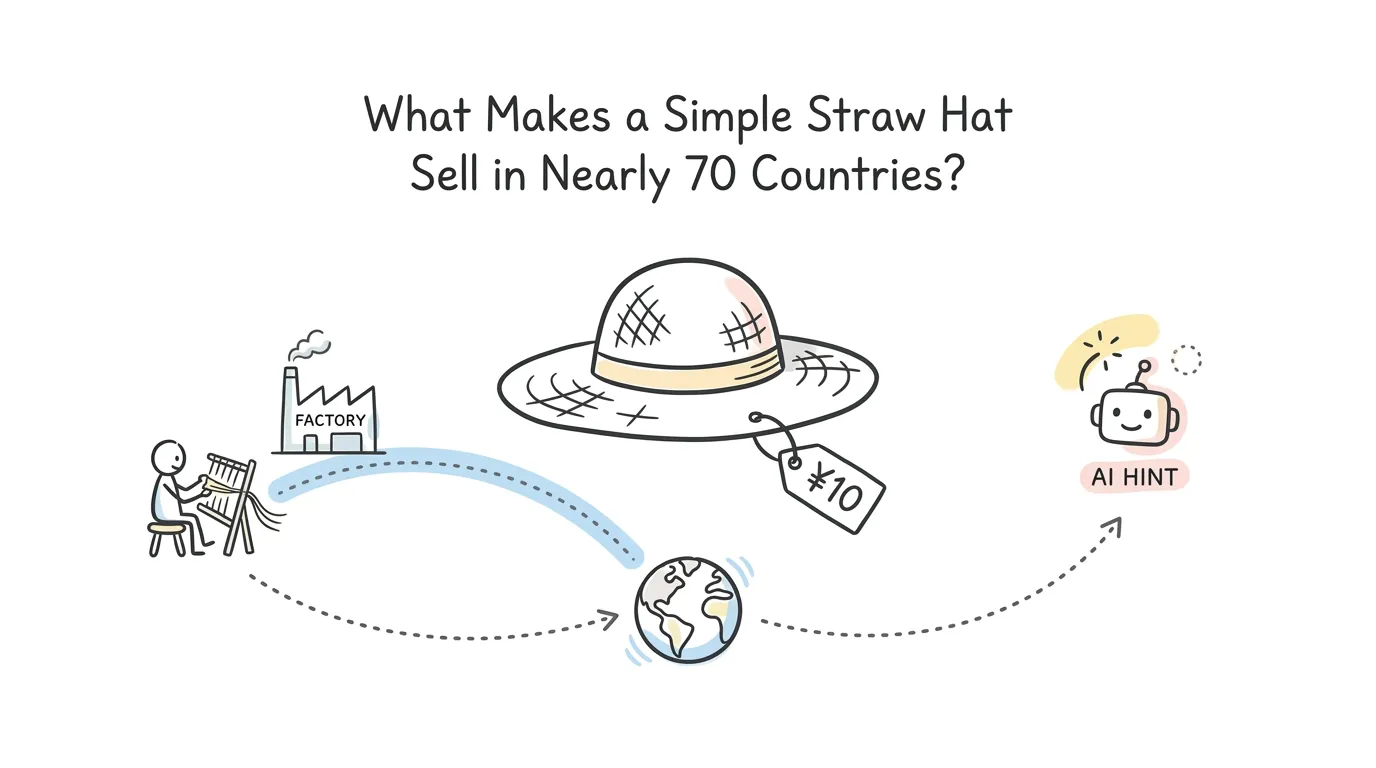
When something that costs 10 yuan has to sail across oceans to find buyers, every cent of profit in between has to be squeezed out of efficiency.
This study, published in December 2024, is about exactly that: how a group of small factories that count every cost down to the bone use AI and big data to squeeze one layer deeper.
After reading it, though, I felt it isn't really about straw hats at all.
It's about the survival playbook for every small factory going overseas.
First, How Hard Is This Business, Really?
The straw hat trade used to be mostly domestic. Then domestic capacity overflowed and demand peaked, and one by one, everyone turned to overseas markets.
The overseas market is genuinely huge. More than 1 billion people now shop cross-border online, international e-commerce exceeds $179 billion, and Chinese merchants hold more than a third of that share.
But a big market doesn't mean an easy business for you. Once you go overseas, you run into two problems you can't dodge.
The first is labor cost. When orders pile up, every business function needs more people: checking requirements, revising designs, signing contracts—every step costs money. For a handicraft business with razor-thin margins, nothing scares it more.
The second is not knowing what to make. The e-commerce game is about catering to mainstream demand and manufacturing hit products. But small workshops lack the technical capability to read the market, let alone the consumer. Guess one style wrong, and inventory piles up to the rafters.
The standard answer of the past few years: turn to data. Use machine learning to analyze consumer behavior and predict trends; use NLP to read the reviews consumers leave online and understand their sentiment and needs.
All of these directions are right. But after reading this study, I realized that "understanding the market" alone isn't enough.
Plenty of people can read the market. Very few can catch the order the moment it lands.
And the latter is the real deciding factor for straw hat factories. Be patient—we'll get there layer by layer.
3,607 Straw Hats Teach the Machine
The researchers picked 1688.com, Alibaba's wholesale platform, used "straw hat" and "woven hat" as keywords, wrote a Python script, and scraped the entire year of 2023 product data.
How much did they get? 3,607 products with 187 product features.
The raw data was filthy. Some fields had less than 5% useful information; some sellers wrote "fits all seasons," others "spring, summer, autumn, winter"—meaning exactly the same thing. After cleaning, merging, and standardizing, the 187 features converged to 49.
Then the machine started to talk.
The first thing: what kind of straw hat sells well?
Word-frequency analysis on the style tags put these words at the top: versatile, casual, minimalist. "European-American style" and "Korean style" also ranked high. Put plainly, young people buying hats today are buying comfort and ease.
Grouping by style and averaging sales, "chic commuter" hats sold the most; but by average revenue, "original design" hats did better. Think about why: design costs and brand premium give them the confidence to charge more. And hats with "no obvious style" ranked dead last in both sales and revenue.
The second thing: is customization worth it?
72% of the sellers offered customization: logo printing, make-to-order from customer artwork, rhinestone application, camouflage. Sellers offering customization averaged 1,198.68 in monthly sales; those that didn't, only 676.3.
Some would say this comparison is unfair. Sellers offering customization outnumber the others by more than two to one, so the average naturally gets pulled up.
The researchers thought of that too. They recalculated using medians and interquartile ranges. Not only did the conclusion hold—it got even stronger: customization sellers had not only higher medians, but less volatility in revenue.
What does that mean?
Customization brings higher revenue—and steadier revenue.
The third thing is the most interesting. The researchers guessed: the more use scenarios a hat fits, the better it should sell. The data confirmed the guess. 87.4% of straw hats were tagged with only one use scenario—work, leisure, or party, pick one of three. But hats suited to 5 or more scenarios pulled clearly ahead of all other hats in average revenue.
Seasons worked the same way—the more seasons a hat fits, the better it sells. Only the "winter" attribute backfired. In the consumer's mind, a straw hat is about coolness and style, not warmth.
See? For a 10-yuan straw hat, every step—picking the style, adding customization, covering more scenarios, steering clear of winter—has data behind it.
Three Price Bands, Three Entirely Different Customers
The 1688.com data tells the seller's side of the story. What do overseas consumers actually think?
The researchers switched to a different source: Amazon. They scraped the user reviews of popular straw hats and analyzed them with a topic model called LDA (Latent Dirichlet Allocation).
What is LDA?
Think of it as an automatic classifier: it takes the words that keep appearing together across thousands of reviews and automatically sorts them into a few "topic piles." No human reading required—the machine sorts out what customers care about for you.
Straw hats on Amazon fall into roughly three price bands: under $25, $25 to $50, and above $50. Three price bands, three entirely different customers.
In reviews under $25, the recurring words were: size, fit, head circumference. These customers care most about "does it fit my head," and, second, whether it works as a gift and covers multiple occasions. People buying cheap are buying utility.
Reviews in the $25-to-$50 band change the picture: photos, star ratings, after-sales service. These customers care whether "the real thing looks like the photos," care about customer service, and care whether the hat stands up to wind and can be worn to work. One detail hides in the data: at this price point, solid colors are more popular, because they're easier to match with clothes.
Reviews above $50 come from yet another crowd: material, craftsmanship, looks. In their eyes, the straw hat stopped being a sun-shading tool long ago. It's a fashion accessory, a piece of craft, an expression of personal taste. Eco-friendly materials at this price aren't a bonus—they're the entry ticket.
Same product, three price bands, three separate businesses.
A store that uses one pitch on all its customers is forfeiting all three markets at once.
The Machine Can Also Make Decisions for You
Up to this point, we've looked at every attribute one at a time. But when a customer places an order, all the attributes work together at once.
How do you find the optimal combination? The researchers brought in a decision tree model.
What's a decision tree? Picture a tree that keeps asking yes-or-no questions: enough color options? High ratings? Right style? With each question, the hats get split into finer piles, and the finer they get, the more accurate.
Feed in five attributes—hat shape, style, season, color, service rating—with sales as the answer. The trained model scored 0.755 accuracy, 0.753 recall, 0.755 F1. For a model meant to guide real product selection, that's a credible result.
Then the machine produced the weight ranking.
First place went not to color, not to hat shape, but to the store's service rating—a weight of 0.5857, leaving everything else far behind. Second was color (0.1361), third style (0.1241).
In other words, when it comes to influencing "buy or not buy," getting your store's service right works better than launching three new styles.
The optimal combination the study gave: a dome or brimless crown, a style that fits current aesthetics, 5 or more colors, focused on spring and summer. As for the store's service rating—push it toward 0.9.
The Real Cost Isn't the Hat—It's the Sampling
By now, you might think the data has already told the whole story of this business.
Not yet. Everything above solved "what to make." But for cross-border factories, the biggest share of cost hides somewhere else.
Traditional export orders work like this: the client sends an inquiry with a design file or a few sketches attached; the factory finds designers and artists to make a sample preview; the client gives notes, revise; more notes, revise again; once everyone agrees, sign the contract and start production. If midstream the client says "change the color," the designer starts all over.
After field research at several straw hat factories, the researchers found that the back-and-forth communication of inquiries and sampling alone eats 30% to 60% of the entire order-processing cost.
30% to 60%. For a 10-yuan hat, before work even starts, half the profit gets talked away.
This is the question this study truly wants to answer: can AI eat this communication?
How One Straw Hat Factory Did It
The researchers picked a leading local straw hat company as their case: Jusheng Straw Hats, one of Cixi's largest straw hat manufacturers and exporters, with years of accumulated overseas orders and customer requirement records.
Their approach had three steps, each one a cost equation worked out in advance.
Step one: which model to pick?
Internationally there's Stability AI's Stable Diffusion, OpenAI's DALL-E, Midjourney; domestically there's Baidu's ERNIE and Alibaba's Luban. Each has its own specialty. DALL-E is strong on creativity and understands complex descriptions; Midjourney is abstract and distinctive in style, suited to film and games; ERNIE and Luban understand Chinese and are cost-effective for illustration and layout.
But for small factories, the selection logic comes down to one thing: free and open source. Most models are closed-source and pay-per-call—a factory can't afford to keep them fed. Plus, since the business is mainly overseas, domestic models don't fit well either. In the end they chose the open-source Stable Diffusion.
Step two: how to use it?
Not hosted in the cloud—deployed locally. Why? Clients' design requirements are sensitive data; pass them through a third party's hands and there's a risk of leaks. Move the model onto your own machines, and the data never leaves the factory.
Step three, the most critical one: the generic model doesn't know your house style. What then?
Teach it with your own order history.
Jusheng had accumulated about 3,000 pairs of "order requirement text + final sample image," and used them for low-resource fine-tuning (the LoRA method—Low-Rank Adaptation). What does that mean in practice? Training parameters dropped to one ten-thousandth of the original model, GPU memory overhead was cut by two-thirds, and inference speed was almost untouched.
No training a large model from scratch. No expensive compute to buy. Just like that, you've raised a private model that knows your own craft. Impressive.
And they demonstrated the results: type in a text description of the requirement, and a sample draft comes out; the client wants a different color or style, one click produces a new image—work that used to take a designer half a day now arrives almost instantly; and it can even refine a rough hand-drawn sketch into a polished drawing ready for sampling.
In traditional straw weaving, different styles call for different weaves. The model learned these details too.
A small factory with years of accumulated orders, raising a model that knows its own craft.
Assembling Two Things into One Machine
Looking back, this study actually did two things.
The first half: use data to understand the market—which styles sell well, what to say at which price band, which attribute most affects ordering.
The second half: use AI to speed up production—compressing the most expensive parts, communication and sampling, down to nearly zero.
The researchers put the two together into one framework. A market module that aggregates sales data, product attributes, and user reviews across platforms in real time, cleans them, and computes optimal product parameters; and a company's private model that takes these analysis results and directly generates sample images and marketing copy. End to end, plug and play.
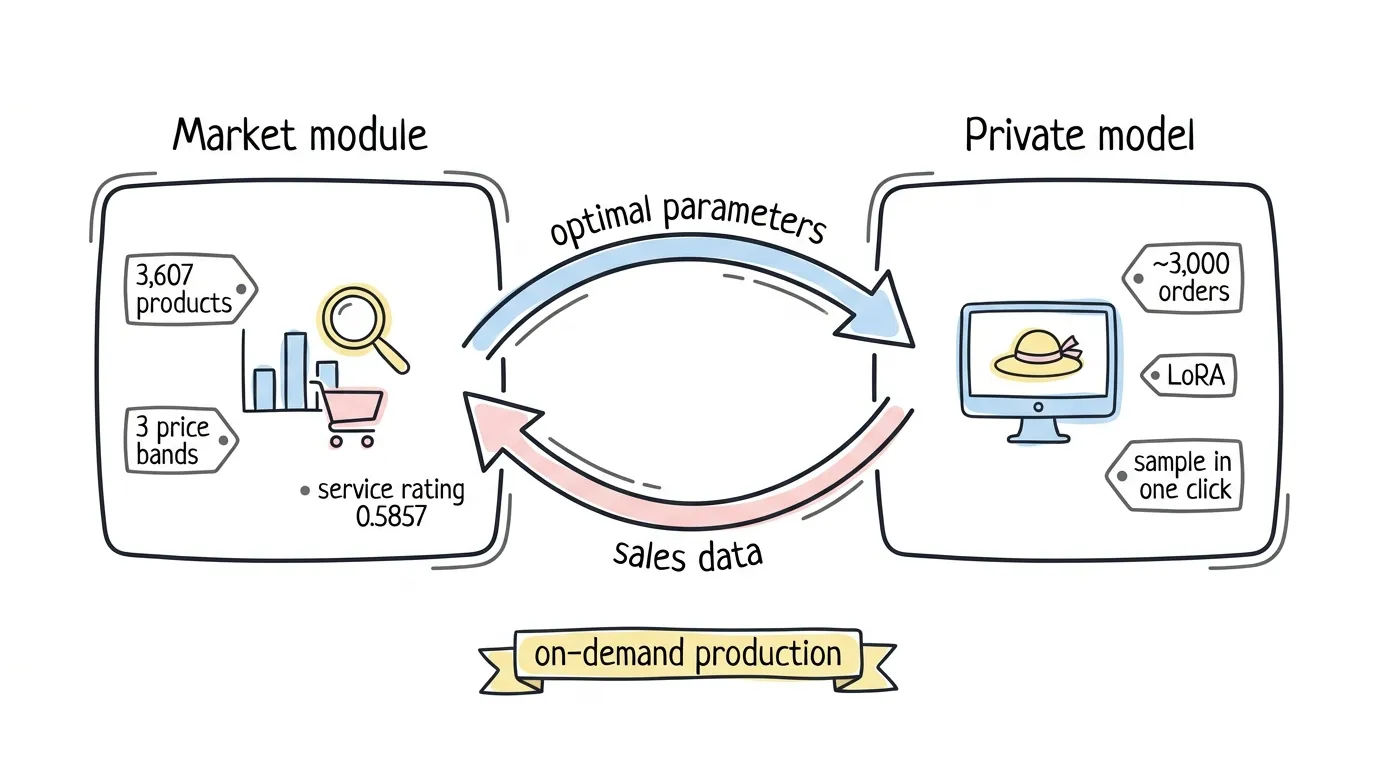
When the market shifts, the parameters shift; when the parameters shift, the product shifts. Only at that point do you touch the door of "on-demand production."
Finally, Back to That Straw Hat
The study's conclusion isn't complicated: AI and big data really can raise both market responsiveness and sales performance for small and micro factories in cross-border trade.
But what I remember isn't the conclusion—it's that bit of arithmetic. A 10-yuan hat, with 30% to 60% of the cost burned on communication and sampling.
Data tells you what to make; AI makes it for you fast. These two things used to be affordable only for big companies. Now, an open-source model plus a batch of historical orders is enough to start.
The people of Cixi have woven straw hats for thousands of years; the craft has never been lacking. What was lacking was the link that translates craft into data, and data back into product.
Now, that link can be filled in by one machine and 3,000 orders.
Maybe soon, on some beach abroad, you'll see someone wearing a golden-thread straw hat. You won't know which town in Zhejiang it came from, but the lay of every wheat straw in it was worked out in a conversation between data and AI.
May your product, too, be made with this kind of care.
Continue reading
Related articles
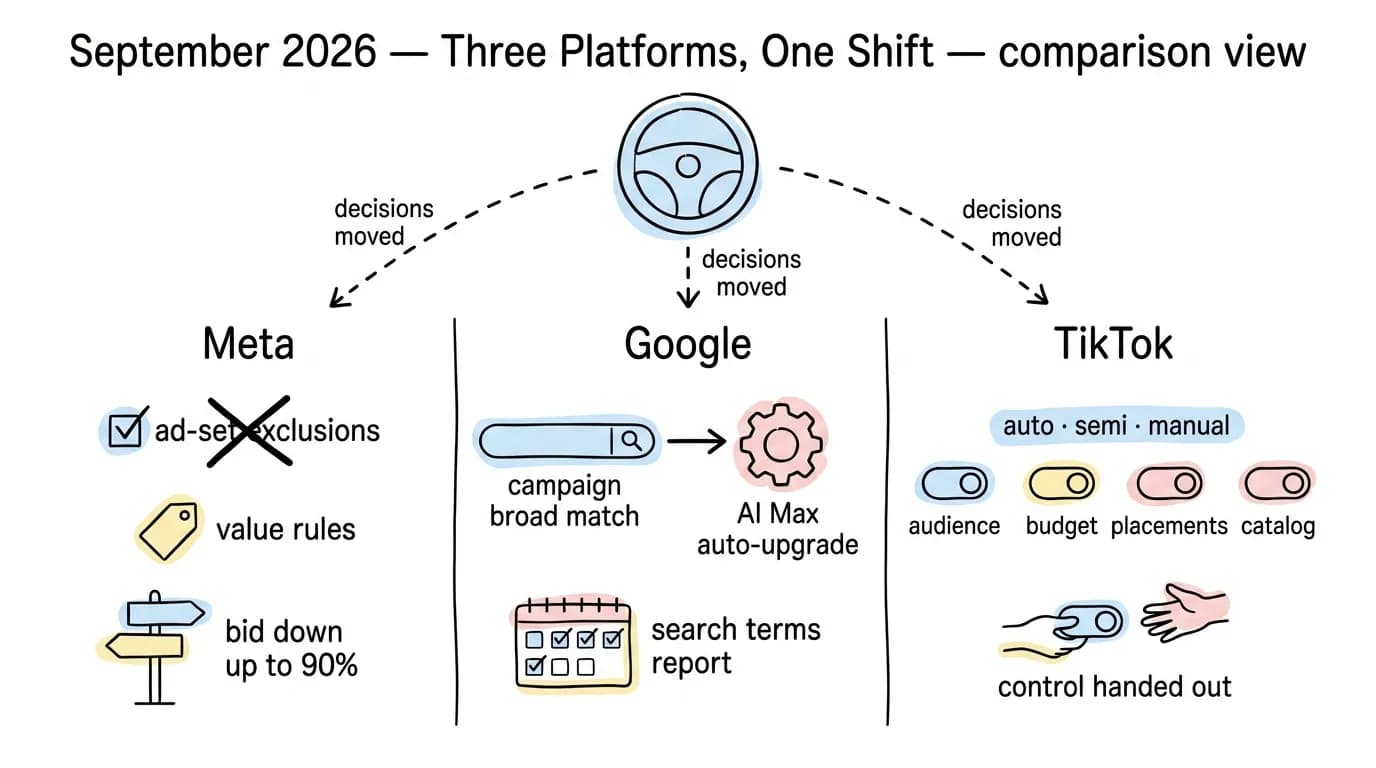
In September, Three Platforms Took Away Part of Your Steering Wheel
A few days ago, I went through everything the three big ad platforms did in September 2026. And I noticed a remarkably interesting coincidence.
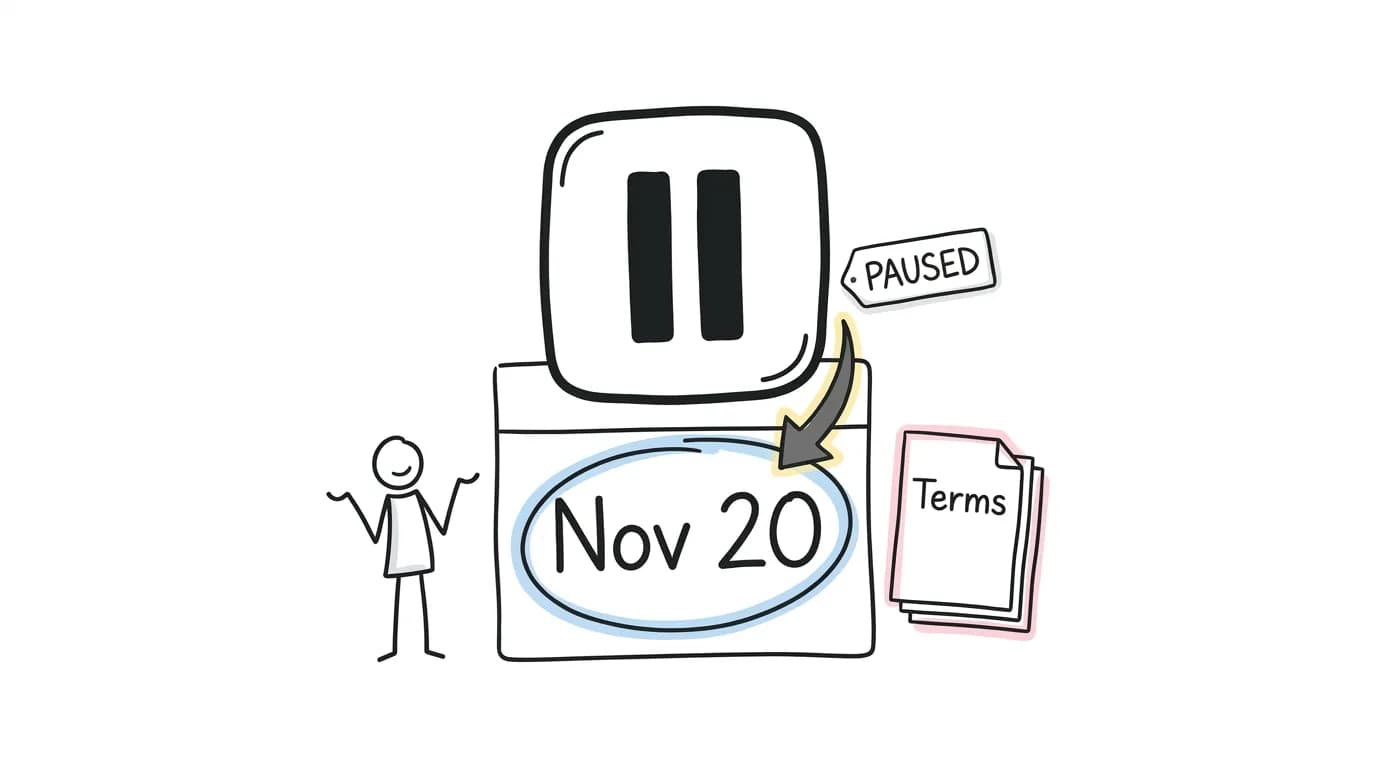
Meta's New Terms Hit the Pause Button on the Eve of the Effective Date
A while back, I was helping a friend of mine who runs a cross-border e-commerce business go through the compliance checklist for his ad account.
Google and Meta changed 17 ad rules this week. 6 of them need checking today.
A few days ago, I was helping a friend who runs a cross-border e-commerce business go through his ad accounts.