
Want AI to Recommend You? See This Market Clearly Before You Hire an Outside Brain
An overview of the GEO (generative engine optimization) agency market, explaining how it differs from SEO, when hiring outside help makes sense, and five vendor types to consider. It also covers typical budget ranges, timelines, and how to judge results by pipeline rather than traffic.
Two weeks ago, a friend of mine who runs a SaaS business invited me out for tea. He laid three proposals on the table. Three vendors, all selling the same thing: getting your brand into AI's answers.
He asked me two questions. First, could my own team do this work? Second, if I hire outsiders, do they guarantee results?
On the second question, let me put this out here right now: anyone who guarantees "we'll get you recommended by AI" — hand the proposal straight back to them. Nobody can control what the engines answer. The only thing anyone can improve is the input the engines read. That's the premise behind every judgment that follows.
As for the first question, don't rush — by the end of this article you'll have your own answer.

First, Let's Be Clear About What This Business Actually Sells
What is a GEO (Generative Engine Optimization) agency?
It's a marketing vendor whose job is making your company visible, clearly explained, and worth recommending — to AI engines like ChatGPT, Claude, and Perplexity. When a buyer asks an AI "which tools are best in this category," you want to be on the list it names. What these vendors do is fight for a spot on that list.
Many people can't tell it apart from SEO. The difference isn't that mystical.
SEO helps your web pages rank at the top of Google. GEO gets your brand named and cited inside AI's answers. The two overlap heavily — a lot of the sources that AI summaries cite were already well-ranked pages. So the foundation is still SEO. If the foundation is no good, everything after it is a castle in the air.
So why did this business only just take off?
Because buyers changed the way they ask. Procurement used to start with a search and ten pages of results. Now more and more people ask AI directly: which tool solves this problem? Which vendors are actually reliable?
And whom the AI recommends depends on whom it trusts. It trusts whether your website explains itself clearly, it trusts what people say about you on review sites, and it trusts the genuine discussions on Reddit. When your pages say what you do in plain language, the AI can retell it with far less effort.
The reasoning isn't hard. The work is: content, technical work, semantic structure, retrieval analysis — four things stacked together. And so the question becomes: how many of the four does your team already have?
When Is It Worth Hiring an Outside Brain?
Before you look at vendors, look at yourself first. Three questions.
First, do you have people who know SEO, know content, and also understand a bit about how AI retrieval works? Whatever's missing, that's what needs filling.
Second, do you have the tooling to keep an eye on — among the questions buyers commonly ask — whether AI actually mentions you? Without it, you don't even know what score you're at right now, and whoever you hire will be prescribing blind.
Third, do you want speed? The playbook for a lot of teams goes: hire an agency to get the results running first, then learn the craft back and bring it in-house. Buying time is nothing to be ashamed of.
If you answer "no" to all three, the outside brain is worth considering. Then, and only then, comes the picking.
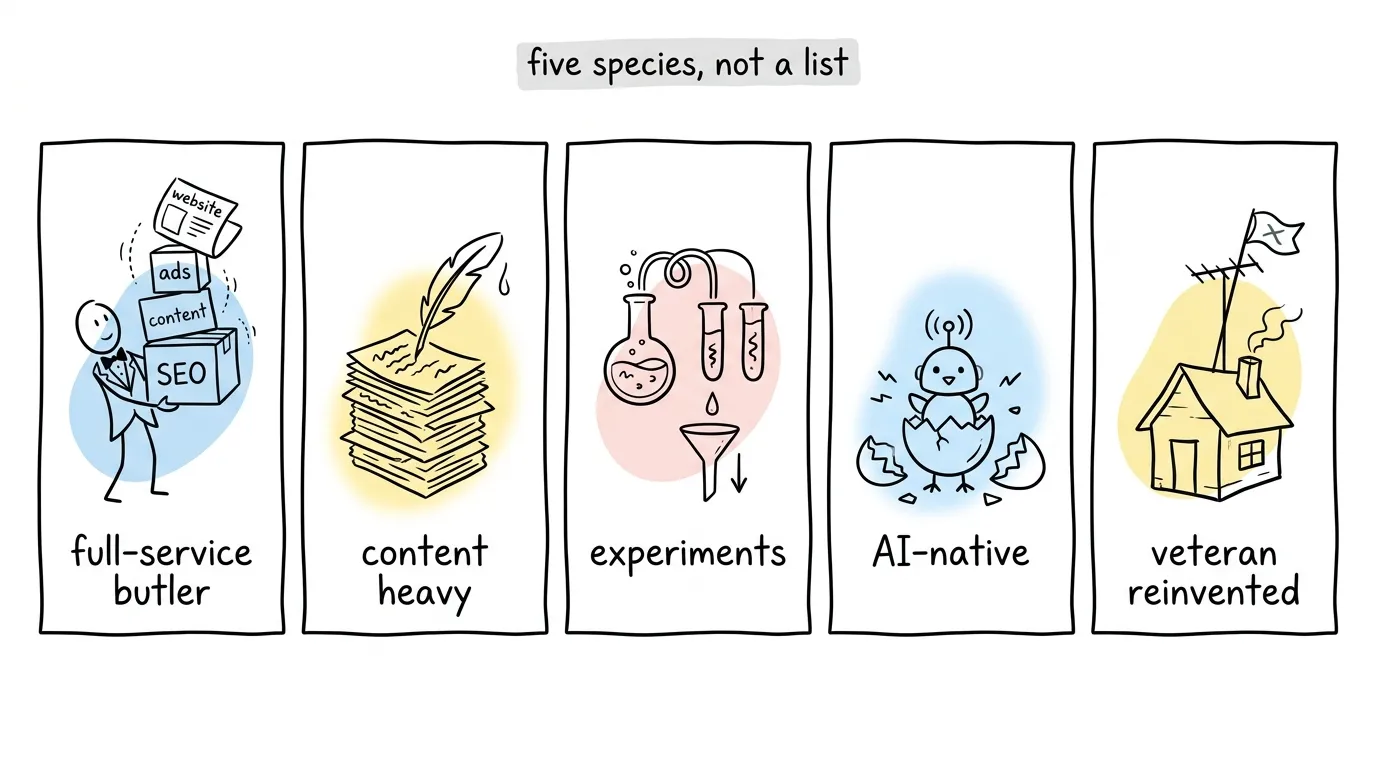
I'll Break This Market Down Into Five Species
Of the dozen or so vendors active in this market, I went through every one of them. You don't need to memorize them all. Remember one thing: this is not a list — it's five species. Whatever you're missing, find that species.
The first species: the full-service butler.
SEO, content, paid media, websites — they take everything on. Fits companies that don't want the hassle.
Perceptric walks this path: SEO/GEO content, founder LinkedIn presence, and paid campaigns, three strands twisted into one rope, all pulling at the pipeline. They've shared one case study that I think deserves a close look: a B2B SaaS client whose pipeline from organic traffic climbed from $20,000 in January to $326,000 in June, over six months. A 16x increase. Their client roster includes technology companies like Katalon and Anduin Transact.
Powered By Search has been at it since 2009. Paid media is their home trade, and from it grew HubSpot-ecosystem and revenue-operations work, with a specialty in tough industries: insurance, finance, healthcare. WebFX is even more seasoned — started in 2007 building websites and grew all the way into a full-service giant, with a self-built attribution system called MarketingCloudFX, and a client base full of multi-location local businesses.
The second species: the content heavy industry.
The faith that good content is the answer to everything. Fits companies with solid budgets that want to build authority slowly.
Grow and Convert's signature act is "Pain-Point SEO": only high-intent keywords that buyers search before they spend money. Content retainer starts at $10,000 a month; add paid media and it's another $3,500. They also put serious effort into teaching clients to reconcile content against deals in GA4. That part, I particularly like. Marketing that doesn't settle accounts is just performing for yourself.
Siege Media serves only three industries: SaaS, fintech, and ecommerce. They built two systems in-house — BlueprintIQ and DataFlywheel — one governing content structure, the other governing refreshes and internal links, with monthly fees starting at $8,000. Omniscient Digital's leadership comes out of companies like HubSpot and Shopify, and they do exactly one thing: make content line up with pipeline, never touching vanity keywords. YesOptimist is an interesting specimen — a fully remote team stitched together from freelancers that built a seven-figure business. Consulting starts at $3,000 a month, full-service at $4,000, paid monthly with no lock-in, and their clients include SEMrush and ZoomInfo. Animalz is a veteran content factory making thought-leadership content for mid-to-large companies; their GEO offering comes in seven steps: audit visibility, set a roadmap, refresh old posts in small steps, write new pieces for high-frequency questions, go out and earn citations, hang out on Reddit, then tally up the accounts.
The third species: the experiment-led growth crowd.
No mysticism, only testing. Fits fast-growing teams that want the money spent where it cuts.
NoGood's self-introduction is delightfully brash: "Looking for a traditional agency? Then we can't help you." They use multivariate experiments to screen out what actually works — try small and cheap first, then bet heavy. Skale focuses on "revenue-first" SEO for SaaS, tracking demo requests and qualified pipeline; raw traffic numbers never make it into their weekly reports. SaaStorm from the UK runs the same playbook: monthly fees from €4,000, plus a €3,000 ten-day diagnostic sprint. Check the patient first, prescribe second. That order — I like it.
The fourth species: the AI-native newcomer.
Born for AI search. Fits teams in complicated niches looking for people who understand how engines think.
The 66th studies how large language models gather material, how they synthesize, and why they favor citing certain sources — training data, retrieval augmentation, citation preferences, all in scope — and then rearranges your content and entity information to match the engine's temperament. WeTalkTheTalk's founder came out of independent B2B content work and works only with tech companies in the seven-to-nine-figure range; the play is a seven-factor analysis plus a 90-day action list, with engagements starting around $3,500.
The fifth species: the legacy shops reinventing themselves.
Old SEO veterans carrying the old craft into the new era.
Victorious has served SoFi, Salesforce, and Wayfair, and their position is steady: technical foundations, authoritative links, quality content — the old trio isn't dead. They build trust, and trust is the first step toward engines being willing to cite you. Their website suggests budgeting at least $6,000 a month, for a full 12 months. Virayo goes big on data-driven work, with clients who mostly renew long-term; the minimum engagement is $7,500 a month with an initial six-month term, and their clients include mid-sized SaaS companies like Sprout Social.
Then, Run the Numbers
Let me walk you through the pricing.
Across the whole market, the monthly budget most companies spend on SEO plus GEO lands between $5,000 and $10,000. The range runs from $3,000 on the low end to $20,000 and up — it depends on how crowded your niche is, how big your goals are, and how much execution you need. The prices marked above belong to the few willing to publish them; most companies require a quote.
What about time to results? Mentions and citations in AI can start moving in 30 to 45 days at the fastest. Real leads generally surface at 90 to 120 days. And one piece of good news: the citations your content earns today keep earning interest over the months that follow.
How do you judge whether the money was worth it? Don't count traffic. Watch exactly three things: whether AI mentions you on the key questions, AI-driven visits in GA4, and leads in your CRM that connect to pipeline. Pipeline is the only number that counts. Everything else is a footnote.
Let me say two ugly truths upfront. Don't touch quotes that are too cheap — GEO is real, hands-on content work, and good content takes time; the absurdly cheap ones — guess where they cut. The chest-thumpers were covered above: turn around and walk away.
Back to That Friend
By the time the tea had gone cold, he asked: so do I hire one or not?
I asked him back: over the past month, how many hours did you spend on making AI explain you clearly?
He went silent.
I said: then this money is probably worth spending. Because what needs filling is something concrete: finally, someone is actually doing this work. Whether the person doing it is your own employee or hired from outside doesn't matter. The real value of the outside brain is lending you speed of thought first; borrow it long enough, and the craft has to take root in your own hands.
What's truly expensive is never the outside brain — it's the year when nobody actually did the work.
Here's to your brand finding its place on that AI recommendation list soon.
Continue reading
Related articles

It's 2026: Stop "Buying" AI Tools for Your Marketing Team — Start "Hiring" AI Agents
This learn article explains how AI agents differ from standalone AI tools in marketing, outlines three agent categories — build-your-own platforms, CRM-native agents, and vertical tools — and covers use cases across SEO, social media, advertising, and reporting, plus criteria for choosing one.

What Is GEO? How Your Brand Gets "Mentioned" in the Age of AI Search
An explainer on GEO (Generative Engine Optimization) for e-commerce and DTC brands: how it differs from SEO and AEO, why AI answers shape brand visibility, and eight practices covering question-focused content, consistent brand messaging, structured pages, external evidence, comparisons, and AI mention tracking.

AI Is Already Making Decisions for Your Customers. Are You on the List?
A learn article explains GEO (Generative Engine Optimization): why AI-generated answers now shape which brands customers see, and how SEO fundamentals, entity clarity, citable evidence, and monthly measurement affect visibility in AI answers.