
AI Marketing Daily · 2026-10-22
AI Marketing Daily for 2026-10-22 covering TikTok's ad automation upgrades with Google Analytics attribution, four GEO guides and statistics, Kolsquare influencer benchmark data, and AI marketing case studies.
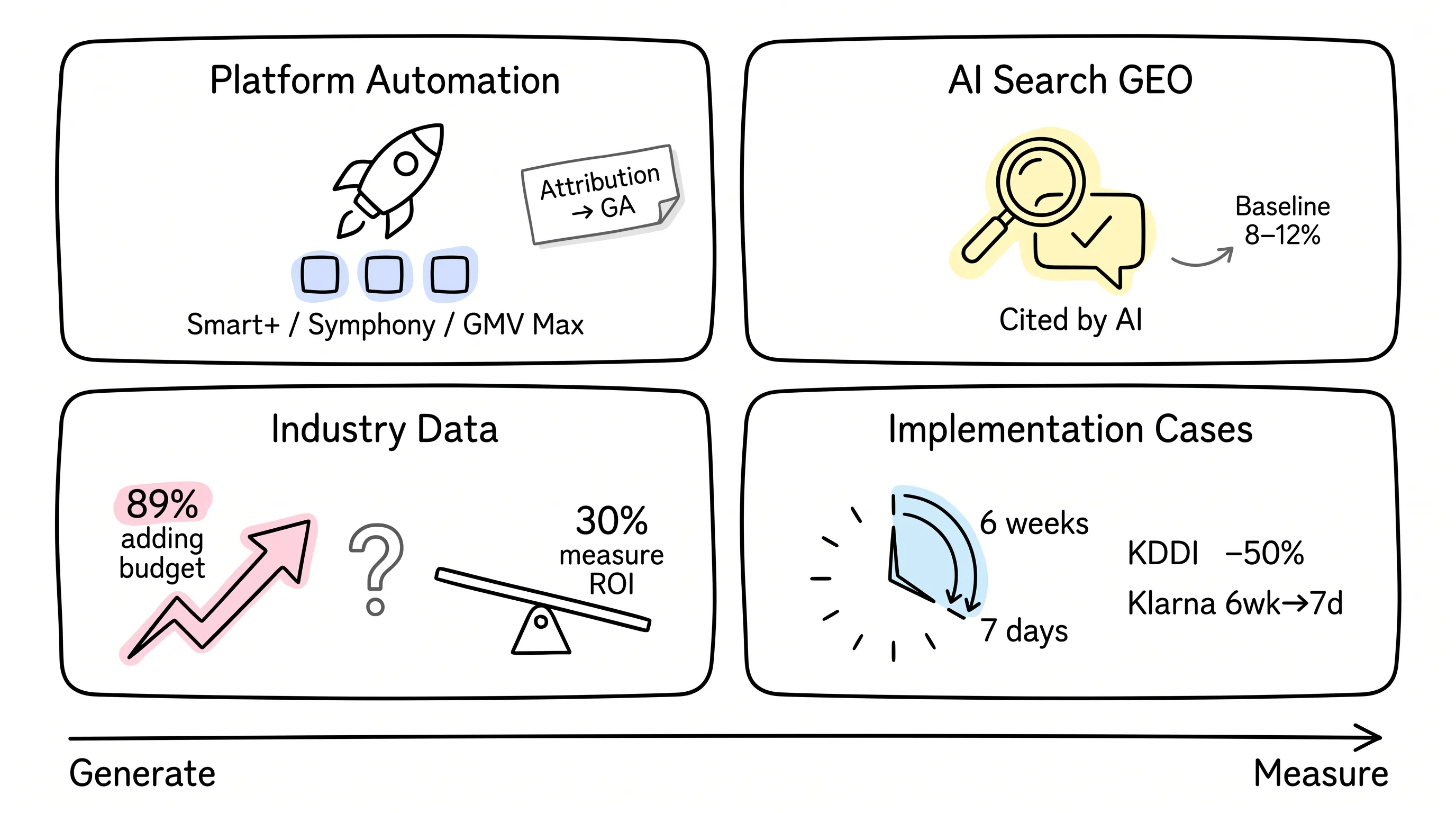
Of today's 13 items, TikTok pushes ad automation up a full notch — Smart+, Symphony, and GMV Max all upgraded at once, with its attribution solution opening up to Google Analytics for the first time. On the AI search side, GEO (Generative Engine Optimization) tactics take up four items, with tutorials, frameworks, and a statistics library all arriving together — proof that getting cited by AI has gone from concept to must-do discipline. On the data side there's Kolsquare's influencer-marketing benchmark; on implementation, six officially confirmed AI marketing cases; and on the organizational side, Northwestern's four-step playbook for AI adoption. Read on — every item comes with hands-on commentary, and the headline works as a standalone deep read.
🎯 Today's Headline
TikTok's ad automation upgrade: Smart+ unifies buying, Symphony embeds into creative, GMV Max adds granular attribution
At Advertising Week in New York, TikTok officially announced a round of ad automation upgrades spanning three product lines. Smart+ is consolidated into a single buying flow: advertisers can fine-tune targeting, budget, and creative modules per campaign across fully automated, partially automated, or fully manual tiers, and split tests now work at a granular level. Symphony's creative tools are embedded directly into Smart+: Recommended Creatives picks assets from your historical library or Symphony GenAI videos based on predicted performance, while Automatic Enhancements uses GenAI to resize, swap soundtracks, translate voiceovers, and sharpen image quality. GMV Max adds a Creative Hub, launched ahead of the shopping season, with creative-attribution reports that cut across campaigns, products, and creators — showing sellers which creative, and which influencer, is actually driving sales.
The attribution side saw big moves too. Third-Party Optimization launches with Google Analytics as its first integration: early testing with 115 advertisers showed conversions up 54% on average and cost per action down 27%. Assisted Conversions recaptures contribution that used to be undervalued: more than a quarter of TikTok-attributed conversions happen when a user goes straight to the brand's site and buys the same day after watching an ad — conversions that historically mostly never made it into reports. Some background: NewtonX research shows 93% of marketers say AI automation has reduced manual work and sharpened their focus, and 90% of executives see AI as key to future growth; in the same survey, 78% of advertisers and executives credit TikTok for consistently shipping new AI features. The platform's own research adds that 70% of users discover new brands on TikTok and 61% have made a purchase after watching content — the two numbers TikTok leans on when it talks about full-funnel impact.
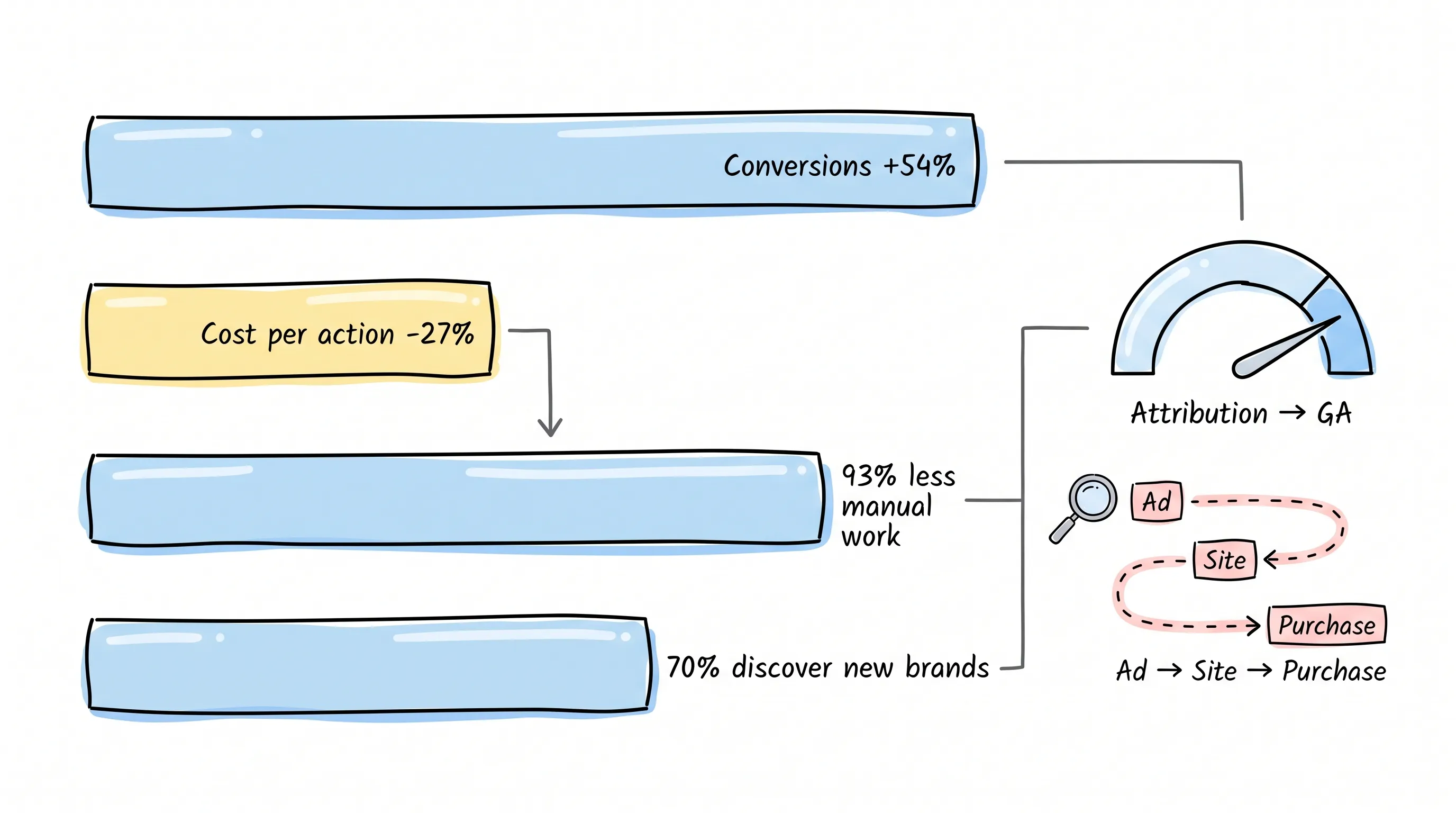
Why it matters: what's worth watching in this round of upgrades isn't any single feature — it's TikTok's stated position on automation. Product lead David Kaufman's framing: automation should be customizable and trustworthy. Rather than pushing one-size-fits-all fully managed automation, the platform has turned the degree of automation into an adjustable dial — a reassurance for advertisers worried about losing control, and a point of differentiation from Meta Advantage+'s fully managed route. Opening attribution to Google Analytics deserves even more scrutiny: TikTok is actively proving its impact across the entire purchase journey, not just on-platform conversions. This is a grab for the narrative in cross-channel budget reporting.
Impact for marketers: your team's workflow needs to adjust. Tiered automation means every team now has to decide explicitly how much of each campaign to hand over: full automation buys efficiency, manual mode preserves control, and a hybrid tier is likely to be the norm. Creative asset requirements have changed too — both Recommended Creatives and Automatic Enhancements feed on clean, multi-version master assets; if the asset library isn't organized, GenAI enhancement has nothing to work with. And with attribution rules loosened, when you report TikTok's contribution to leadership you finally have GA-side data to cite — a few fewer rounds of cross-channel budget arguments.
How to use it: four actionable steps. First, run the new Smart+ buying flow this week; set up split tests against your existing campaigns and quantify what different automation tiers actually deliver — don't switch modes on gut feel. Second, get your asset library into an enhancement-ready shape: vertical masters, clean subtitles, and multilingual voiceover tracks all staged, so Automatic Enhancements has something to work with. Third, teams already on GA4 should connect Third-Party Optimization first, watch how conversion and cost metrics shift over two weeks, then decide where the budget moves. Fourth, ahead of the shopping season, e-commerce teams should use Creative Hub to identify creator assets that genuinely drive sales, and put incremental budget behind proven combinations.
My take: making automation an adjustable dial is a defining signal of platforms going AI-native in 2026 — platforms are leaving advertisers a choice between efficiency and control. I expect the hybrid tier to become the mainstream: room for purely manual campaign management keeps shrinking, while teams that go fully managed will pay for it in creative homogenization. One more thing to watch: GMV Max's Creative Hub launching right before the shopping season means the platform is using attribution reports to help sellers decide which influencer gets the money — effectively pulling budget-allocation decisions toward the platform side too. Teams whose creative pipelines go AI-first will capture the biggest gains from this upgrade.
🔗 Further reading: Read the full article
🏷 Platform & Product Updates
TikTok Ads vs Google Ads 2026: split the budget by purchase intent — don't make it either/or
SEONIB rounds up both platforms' 2026 updates and buying strategies. Google's side saw a dense Q2: the Travel beta for Search ads expanded on July 8 to cover attractions, experiences, and event ticketing; feed-based formats and text ads are now managed together, with AI Max capabilities available; the conversion settings page added a last event ping timestamp so you can see when a conversion tag last fired and troubleshoot even with zero conversions — no more waiting on data to debug your tracking; the AI Max FAQ got an update clarifying performance tuning and the migration path from Dynamic Search Ads; and Google is testing a Visit Site button on sponsored results plus a unified-theme option for asset groups, with the platform underwriting creative consistency. On TikTok's side, Search Ads, launched in late 2025, matured through 2026 and can now catch users actively searching on-platform; Smart+'s controls keep expanding, with bidding and creative optimization available in both automatic and manually adjustable modes; and the new Collage Carousel layout combines multiple images or videos into one swipeable ad unit, so each ad unit now carries more creative. The article lays out a side-by-side table for DTC brands: on intent, TikTok owns discovery and seeding (organic product-discovery content) while Google Shopping captures high purchase intent; on format, it's native video plus search results versus product listing ads; on attribution, TikTok typically runs 1-day view-through while Google uses last click — the two measurement bases are not interchangeable. The conclusion: TikTok posts stronger ROAS in discovery-driven and impulse categories, while Google Shopping closes the final conversions.
💬 Don't treat budget across the two platforms as a single-choice question. Layer it by intent: TikTok handles discovery and seeding; Google Shopping takes the final push. Before you touch anything, align your attribution basis — one side is 1-day view-through, the other is last click; leave them misaligned and the two platforms will fight over the same conversion in your reporting, and the numbers leadership sees won't reconcile. Teams doing travel on the Google side should apply for the new beta this week — there's a window on feed-based traffic for ticketing and attractions.
🔗 Further reading: Read the full article
Survey of major ad platforms' AI capabilities: Meta, Google, TikTok, Snapchat in one table
cipiai lays out a horizontal inventory of AI capabilities across the major ad platforms: Meta's Advantage+ system, Google Ads' PMax and generative assets, TikTok's Symphony, Snapchat's GenAI ad tools, plus what LinkedIn, X, and Pinterest are doing on targeting and creative automation. The selection question the article answers: whose AI actually helps you win? Three comparison dimensions — degree of automation (who saves the most manual work), control (who lets you fine-tune), and asset requirements (who feeds on creative volume) — match them against your own budget and team capacity. Worth noting: this item's source scrape is thin; most of the page is navigation and privacy notices, the substance is mainly the feature list itself, so deep-reading value is limited — better used as a quick-reference table.
💬 Treat roundups like this as a map, not as terrain. Make your selection by your own budget and creative capacity: high-automation platforms feed on creative volume, so teams short on assets should fix that first before going full-auto — otherwise the machine just amplifies mediocre creative at scale. The week you read this, rank the platforms you're currently running on; take the campaigns that need the most control back to manual mode for a week and let the data decide.
🔗 Further reading: Read the full article
IAB releases a Generative AI advertising playbook: three use-case domains — content, optimization, measurement
On January 25, 2025, the IAB published its official guide, the Generative AI Playbook for Advertising, dividing GenAI's advertising use cases into three domains: content creation, campaign optimization, and measurement. Aimed at brands, agencies, and technology providers, it offers a methodology for folding GenAI into marketing strategy, with claimed benefit directions including faster creative development cycles, personalized customer experiences, and finer-grained campaign optimization. The full content sits behind a registration-required PDF, and the page itself is cut off by the registration wall — so this item is also thin, with limited readable substance. One related signal from the same period is worth flagging: the IAB raised its 2026 US ad-spend growth forecast to 12.3% — the overall market is expanding — and a separate consumer study found users want AI shopping recommendations to include trusted creators' perspectives: recommendations need a human endorsement, not just an algorithm.
💬 The signal value here outweighs the content value: when an industry standardization body writes GenAI advertising into a playbook, practice has converged to the replicable-methodology stage. Teams that haven't formally kicked off an internal project yet can use it as their justification — far more persuasive than a gut-feel pitch. Before downloading the PDF, be clear about which part of your workflow you're trying to fix; don't buy into a tool collection just to have it.
🔗 Further reading: Read the full article
🏷 AI Search Playbook
LLM Pulse publishes the complete GEO 2026 guide: a five-surface framework plus ten evidence-backed citation-rate tactics
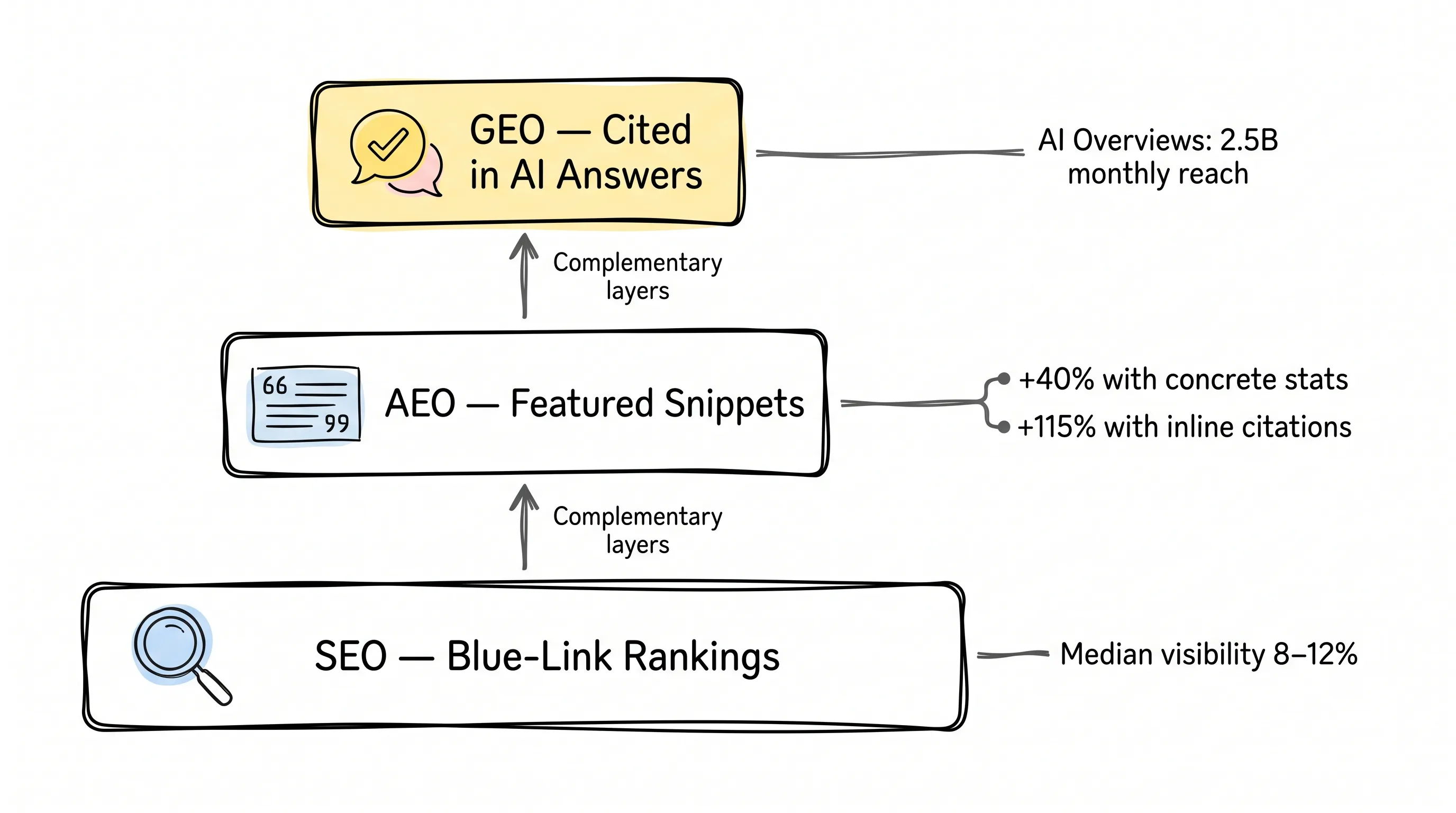
On October 5, LLM Pulse updated its complete GEO (Generative Engine Optimization) 2026 guide. GEO's goal is to get your brand cited and recommended inside generative answers — ChatGPT, Perplexity, Gemini, Google AI Mode, AI Overviews — forming a three-layer complement with SEO competing for blue links (traditional organic search listings) and AEO competing for featured snippets. The guide traces the discipline's origins to the 2023 Princeton-led paper, and it comes with hard numbers: AI Overviews reach over 2.5 billion users per month; cited sources run about 26% fresher than the corresponding SEO results — freshness is a real ranking weight; comparison content accounts for roughly 32% of all AI citations; Wikipedia is the most-cited domain across every engine, and Reddit is the most-cited UGC source. On tactics, the strongest play measured by the Princeton paper is replacing vague statements with concrete statistics that carry a year and a source — overall visibility up 40%; adding inline citations from authoritative sources lifted visibility by 115% for a site ranking fifth on Google; direct quotes from named experts are another high-yield move — never write "research shows" without a name. The technical layer has its own checklist: allow retrieval crawlers like OAI-SearchBot, PerplexityBot, and Claude-SearchBot — whether you block training crawlers is your call, but block the retrieval crawlers and you're out of the answers; keep structured data valid but don't expect it to guarantee citations; treat llms.txt as an experimental option. The measurement layer delivers a KPI system: visibility or mention rate, a position-weighted Visibility Score, share of voice, cited-source coverage, and sentiment — that last one you cannot skip, because being mentioned in a negative context is worse than not being mentioned at all. There's a baseline for measurement too: the median brand visibility across engine answers is only 8–12%, while category leaders reach above 40%. One caveat: the author is an AI visibility platform, so there's a product agenda.
💬 Three things you can do this week: swap vague numbers in your pillar pages for concrete figures with a year and a source; check robots.txt and allow PerplexityBot and OAI-SearchBot; then add one comparison page for your category. Set the llms.txt debate aside — it's far lower priority than these three. Use that 8–12% median to baseline your own visibility first.
🔗 Further reading: Read the full article
Jellyfish proposes the GEM framework: design brand presence for humans and AI at the same time
Jellyfish proposes the GEM (Generative Engine Marketing) framework, arguing that brands have entered the age of ambient intelligence: AI systems interpret content and recommend products throughout the customer journey, their role evolving from gatekeeper all the way to purchasing agent, so brand strategy must now address humans and machines simultaneously. The framework runs three steps: analyze how AI models perceive the brand, measure the brand's visibility in AI answers, then optimize assets, data, and media strategy accordingly. The measurement layer introduces two new metrics — mention rate and average position — to quantify how often and how prominently a brand appears in AI answers, combined with cited-source insights into how models form their picture of a category. Operationally it's a loop of technical optimization, content strategy, testing, distribution, and measurement; run it well and media efficiency improves directly. Execution requires coordination across brand, media, SEO, content, and e-commerce teams, and the measurement framework itself has to be rebuilt for AI's influence across the discover, consider, and purchase stages. The article's judgment: AI doesn't replace marketing — it expands the boundaries of brand strategy, and the winning brands are the ones that design their presence for both audiences and AI systems. Full report requires download.
💬 The mention-rate metric costs nothing to self-test: list 20 questions your buyers would ask an AI, run them manually through ChatGPT and Perplexity, and record how often and how high your brand shows up. Build a baseline before you talk about buying tools — don't get led around by the platforms' dashboard marketing.
🔗 Further reading: Read the full article
DigitalBranches GEO guide: the first-mover window for SMBs is still open
DigitalBranches' GEO 2026 guide targets small and mid-sized businesses, leading with a set of widely circulated figures: AI-driven referral sessions grew 527% year over year in the first half of 2025 (cited from a Previsible/Frase report), and AI Overviews are turning huge volumes of queries into zero-click results — even pages with strong rankings are now competing with AI summaries for exposure, and once users have their answer they stop clicking blue links. The article draws the division of labor clearly: blue-link rankings, featured snippets, and inline citations inside generative answers — three complementary layers. Its judgment: by 2026 most enterprises will already have GEO initiatives underway, while most SMBs haven't started — the first-mover window is still open. The guide provides an immediately executable step checklist for SMBs plus a pros-and-cons analysis, and the cons column is refreshingly honest: GEO results wait on citation accumulation, and there's no instant short-term payoff. One caution: the data is mostly secondhand, the site has service-conversion intent, so credibility is moderate — but the hands-on value is real.
💬 Use that 527% as a signal, not a slide — the citation chain is too long to survive scrutiny. The real move is to grab the comparison keywords and best-of selection keywords in your category while competitors haven't started GEO: early movers earn the citations; latecomers fight over the scraps. With an SMB budget, doing one pillar page thoroughly beats publishing ten thin posts — and don't expect a short payback period; citation accumulation is slow by nature.
🔗 Further reading: Read the full article
AllAboutAI compiles a GEO statistics library: a $7.3B market, 58% of consumers use AI for recommendations
AllAboutAI's GEO statistics roundup assembles a batch of quotable data points: the GEO market was worth about $886M in 2024, projected to reach $7.3B by 2031 at a 34% compound annual growth rate (Valuates Reports); 58% of consumers rely on AI for product recommendations, up from 25% two years ago (HBR 2025); 58% of searches become zero-click because of AI Overviews; GEO-optimized content gains up to 40% visibility, with conversion performance 4.4x that of traditional SEO; 89% of ChatGPT citations come from beyond page two of Google — long-tail, high-context content has room to win; and 71% of CMOs plan to spend over $10M a year on GenAI. The piece also offers figures like $3.71 return per $1 of GEO spend. By industry, tech and finance lead GEO adoption, while e-commerce shows the highest AI-driven conversion rates; by region, North America leads, with Asia-Pacific growing fastest. It's visibly a second-order compilation, and some sources need verification.
💬 Keeping this page as a data ammunition stockpile is fine — before citing anything, pick the two entries that name their original sources; HBR and Valuates will hold up. The $3.71 return figure, which cites no methodology, stays out of any ROI commitment for now — nobody will back you up when it gets challenged.
🔗 Further reading: Read the full article
🏷 Industry Data
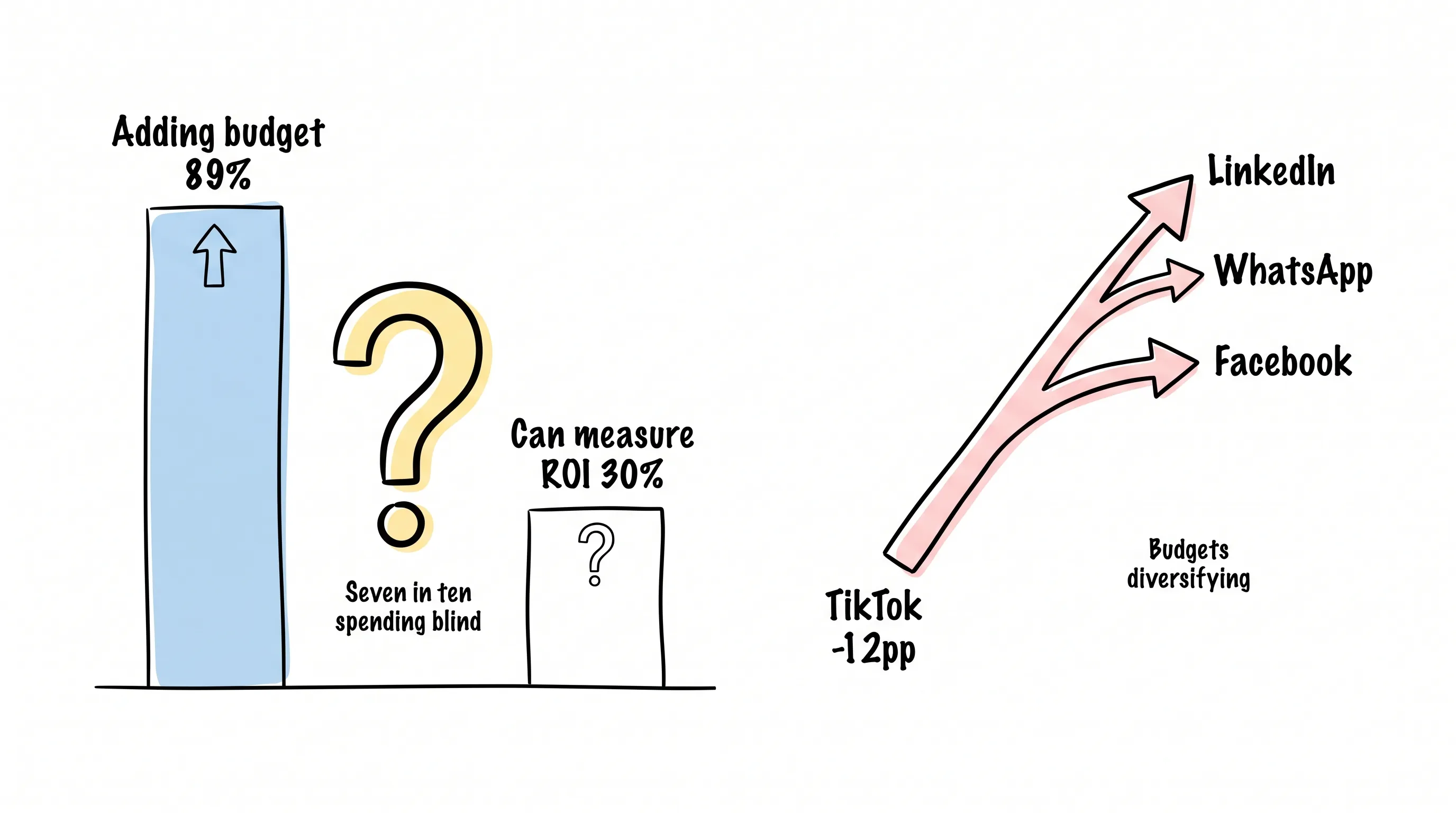
Kolsquare influencer-marketing study: 89% of brands are adding budget, but only three in ten can measure ROI
Kolsquare's 2026/2027 influencer-marketing study (the webinar's full transcript with subtitles, published September 16, 2026), covering 1,123 marketers across 7 markets, delivers the benchmark numbers: 89% of brands and agencies plan to increase influencer budgets, up from 75% last year; 79% view influencer marketing as a critical or important support channel, and only 3% treat it as experimental. On revenue contribution, three in ten brands draw over 25% of revenue from influencer marketing, and 5% draw over 50%. The incremental budget is going 67% to paid amplification of creator content, plus UGC and long-term creator relationships — the extra money prefers to be spent on already-validated content. The channel mix is rebalancing: TikTok's share dropped 12 percentage points, with budget flowing to LinkedIn, Facebook, and WhatsApp; creator rosters doubled within two years, small and mid-tier creators make up a rising share — both platform and talent selection are diversifying. Measurement is the clear weak spot: only about 30% of marketers can measure ROI; most trust platform metrics like view counts, while sentiment analysis and EMV (earned media value) see little use. The evidence chain for spending can't keep up with the pace of spending — which is exactly why every round of budget growth triggers another round of internal pushback. On compliance, about 30% of brands now require creators to hold a responsible-influence certification, climbing to 40% in the Benelux region. The discussion session also touched AI's place: AI-drafted influencer outreach emails and AI virtual influencers — both buzzing, but nobody offered a verdict on the trade-offs.
💬 Budgets are rising while measurement lags — that's seven in ten brands effectively spending blind. Before you ask for more influencer budget, attach a trackable conversion basis to every spending tier; it's the cheapest risk hedge available. Responsible-influence certification is shifting from exception to routine — negotiate the compliance terms into the contract upfront and save yourself a mid-campaign talent swap. And don't over-read TikTok's share decline: it's diversification across platforms, not a retreat.
🔗 Further reading: Read the full article
🏷 Implementation & Organization
Palpa compiles six officially confirmed AI marketing cases: KDDI cuts workload in half, Klarna goes from six weeks to seven days
Palpa has compiled 6 AI marketing cases each confirmed by official company announcements, grouped into three types: compressing ad-asset production, building consumer engagement experiences, and extending expression into TV commercials and packaging. Three hard numbers stand out: KDDI, working with Supership and Recursive, built semi-automated banner generation within brand guidelines plus automated best-pick selection; beta testing showed a 50% reduction in related workload — broken down by stage, workload fell 60% at both the concept and rough-draft stages and 20% at finishing, meaning concept and first drafts are where AI saves the most labor; CyberAgent's 極予測AI ("ultra-prediction" AI) forecasts ad performance before launch and pairs with LLM-generated copy and AI talent assets, self-reporting 5.6x production efficiency on its own advertising business; and Klarna used image generation plus an internal copywriting tool to compress its image development cycle from 6 weeks to 7 days while cutting external production spend 25% — also self-reported. None of the three experience-type cases published effect numbers: Itoen put AI talent on TV commercials, Asahi built a generative image experience, and Coca-Cola used GPT-4 plus DALL-E to build a fan co-creation platform. The article also covers how AI divides up marketing functions and the representative tools, landing on how to make adoption sustainable. The real highlight is the methodology: every number is tagged with its official basis and limitations, and cross-case direct comparison is explicitly ruled out.
💬 This article demonstrates the right way to cite a case: numbers must carry their basis, and different bases can't be compared side by side. When you pitch your own project, borrow KDDI's breakdown — split the savings into concept, rough draft, and finishing stages and count each separately, so you know which segment AI actually saves on, and your reporting holds up too.
🔗 Further reading: Read the full article
Zeta breaks down generative vs predictive AI: Stitch Fix runs all its ad copy through AI, with human review under a minute per ad
A Zeta Global resource piece (published June 2024, framework still current) draws the boundary between the two kinds of AI clearly: predictive AI uses historical data to compute probabilities — say, which customers are about to churn, or what time to send email; generative AI builds campaign content directly — say, assembling a win-back campaign for churning customers. Of the four benefit directions, the efficiency case is the most solid: Stitch Fix uses GenAI to produce all of its Facebook and Instagram ad copy, with human review taking under 1 minute per ad and a 77% approval rate. The second value: once you hand over A/B tests like email subject-line matrices, the team shifts to strategic questions about the email experience — the freed-up bandwidth lands on higher-leverage work. Generative segmentation is another point worth copying: state it in a natural-language prompt — "I want to target sneaker buyers on the East Coast" — instead of stacking if-then conditions, and the system builds the audience automatically from structured and unstructured data. Forrester principal analyst Jessica Liu and Zeta CTO Monberg's judgment: GenAI finally lets marketing deliver on its promise of simplicity.
💬 Stitch Fix's 77% approval rate is a playbook worth copying: start with AI drafts plus human review, get per-item review under 1 minute, and only talk about full automation once that runs smoothly. For audience segmentation, starting from a natural-language prompt is enough — don't stack conditions from day one; complexity is something you add after the retrospective, not before.
🔗 Further reading: Read the full article
AI personalization in practice: the hard part is sequencing, not complexity — build the data foundation first
Rathiam's AI personalization playbook (republished via HRTechFeed; only the opening is included here, full text on the original site) makes a direct claim: personalization succeeds or fails on sequencing, not complexity. Successful teams don't chase full automation on day one — they lay the foundation first, pick a few high-impact moves to run on AI, and expand as organizational confidence grows. The foundation means customer data: most organizations already have the data; the problem is fragmentation. CRM and billing data sit in separate stores, product telemetry and marketing systems run in their own lanes, and support records live in yet another ecosystem. If AI can't see the customer clearly, personalization is a nonstarter. Step one is mapping where the data lives and wiring it into a unified structure, covering CRM, marketing automation, web analytics, product telemetry, subscription billing, and the support platform. Only then comes step two: picking scenarios — a few high-impact moves first, expanding once the organization has confidence. The playbook is written for practitioners on marketing, product, RevOps, and support teams, taking an operations-first route where every step delivers visible progress.
💬 The sequencing here is exactly right: connect the data first, pilot one high-impact scenario second, expand last. For SaaS teams, make the first cut a churn-warning flow for paying users — the data is already there, results show up fast, and it's the easiest case for winning internal confidence to keep investing. The repost only carries the opening; the full path is on the original site. Read the whole thing before you set your own timeline.
🔗 Further reading: Read the full article
Northwestern lecture recap: 70% of marketers are still waiting for employer AI guidance
Northwestern's Medill Spiegel Research Center compiled Professor Kelly Cutler's lecture, "Transforming Marketing with Generative AI, the Research-Driven Way." The data lays out where things stand: 70% of marketers say their employers provide no AI guidance at all. On sentiment, 69% are excited and 17% ambivalent — AI literacy is becoming the most visible skill gap for marketers. CMOs face a double challenge: bringing in new technology while holding onto the human advantages of empathy, ethical judgment, and cultural understanding — efficiency and relationship capability both have to carry weight. The areas where AI is already creating value include time savings, cost reduction, customer insight, and personalized engagement — concretely in content development, SEO and SEM, email targeting, video production, and persona building. The lecture also offered four trend calls: personalization gets more advanced, content production scales faster, analytics and testing go deeper, and SEO and advertising strategy get rewritten by AI tools. At the organizational level it delivered two frameworks: Bain's five golden rules — consumer-oriented, holistic use of AI, long-term planning, keep core use cases in-house, strong CMO leadership — and a four-step implementation path: a cross-functional team, use-case prioritization, a roadmap, and training investment. Data quality got singled out: poorly managed data can't underwrite any AI strategy.
💬 That 70% with zero guidance is a number you can take straight to leadership to ask for budget: everyone has the gap — whoever fills it first gets their team running first. Of the four steps, the cross-functional team is the easiest to start: you can spin one up and get it working within a week. Tie training budget to use cases, and it's also the line item most resistant to budget cuts. Don't overlook Bain's keep-core-use-cases-in-house rule either — a capability you outsource never takes root in your own organization.
🔗 Further reading: Read the full article
💡 Today's Big Picture
Put today's 13 items side by side and the through-line is clear: AI marketing's center of gravity is shifting from being able to generate toward being able to measure. The headline TikTok story opens attribution up to Google Analytics, conceding that advertisers want to see results inside the reports they already trust. Kolsquare's survey exposes the other side: 89% of brands are adding influencer budget, yet only three in ten can measure ROI. GEO tutorials and statistics libraries are piling up because getting cited by AI now has measurement metrics and baseline numbers — once a reference point like the 8–12% median visibility exists, you can actually check yourself against the benchmark. The IAB writing GenAI advertising into a playbook is the industry setting standards for practice; even the personalization implementation piece argues for connecting data before talking intelligence — sequencing over complexity.
Generative capability stopped being scarce in 2026; what's scarce is a verifiable performance basis. That's why today everyone from platforms to industry bodies to research institutions is filling in the measurement layer. Look one level deeper: once measurement is filled in, budget flows follow the evidence. TikTok uses assisted conversions to prove the value of upstream seeding; GEO uses mention rate to prove the value of your position inside AI answers; influencer marketing has to attach every budget tier to conversions before it can prove anything. Whoever produces a credible measurement basis first gets a seat at the table where budgets get split.
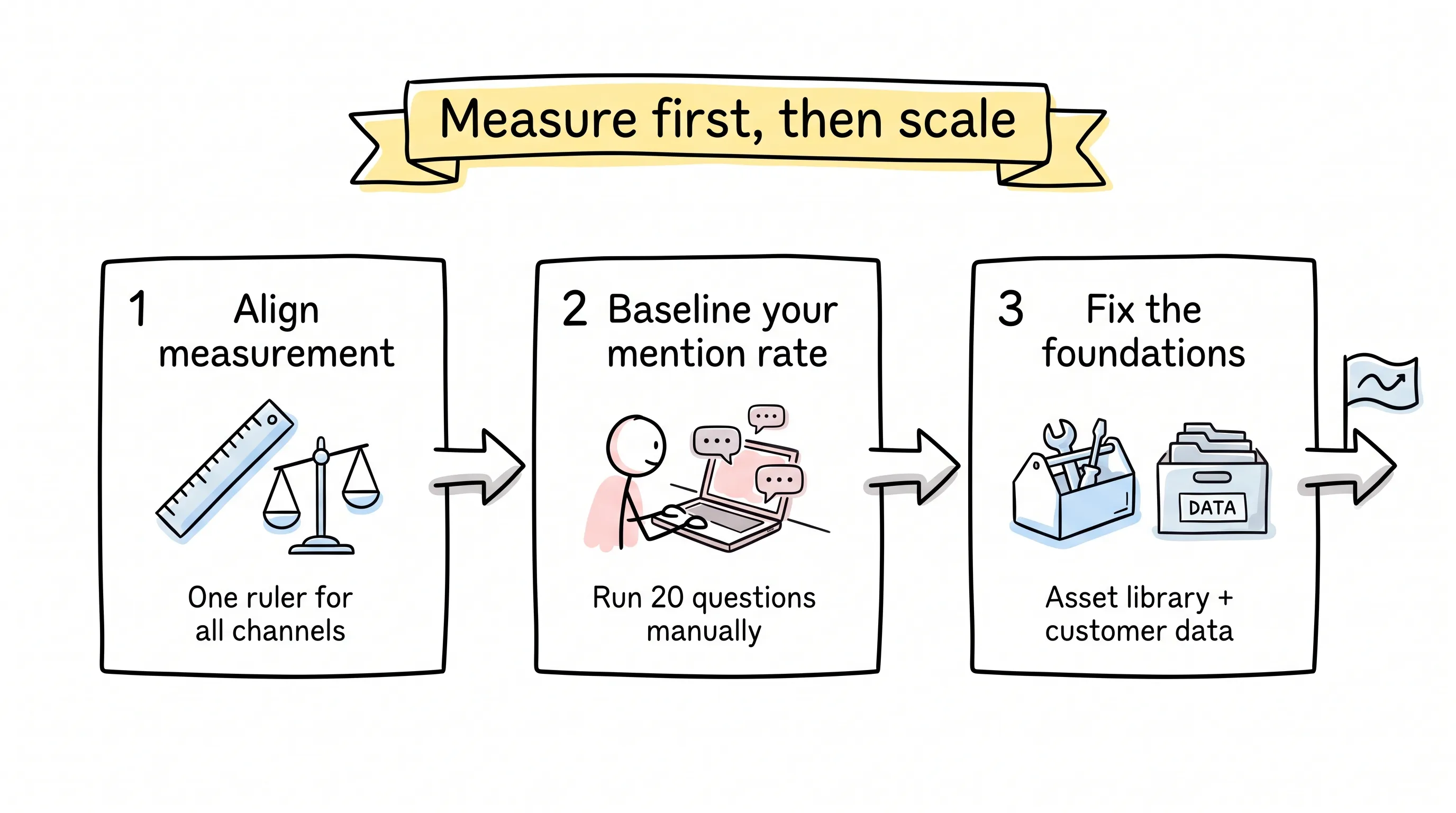
Your weekly to-do list, three things in order: first, align your conversion measurement across TikTok, Google, and influencer budgets — one ruler for all of them; second, run a mention-rate baseline for your own brand across AI engines — 20 questions, run manually, is enough; third, clean up the two foundations, your asset library and your customer data, because platform upgrades and data intelligence both feed on them. Measure first, then scale. Get the order backwards and you're just putting blind spending on fast-forward.
Continue reading
Related articles
AI Marketing Daily · 2026-11-22
AI Marketing Daily for 2026-11-22 rounds up 20 items led by Microsoft opening Bing AI Overviews to ads and Google expanding AI Mode ads to ten countries, plus GEO guides, ad automation delegation guidance, AI Overviews CTR data, and a legal-risk checklist for AI-generated creative.
AI Marketing Daily · 2026-11-21
A November 21, 2026 AI-marketing daily covering AI search visibility, GEO methods, Google AI Mode ads expanding to ten countries, Meta's pre-Black Friday changes, agentic shopping, and industry adoption and ROI data.
AI Marketing Daily · 2026-11-20
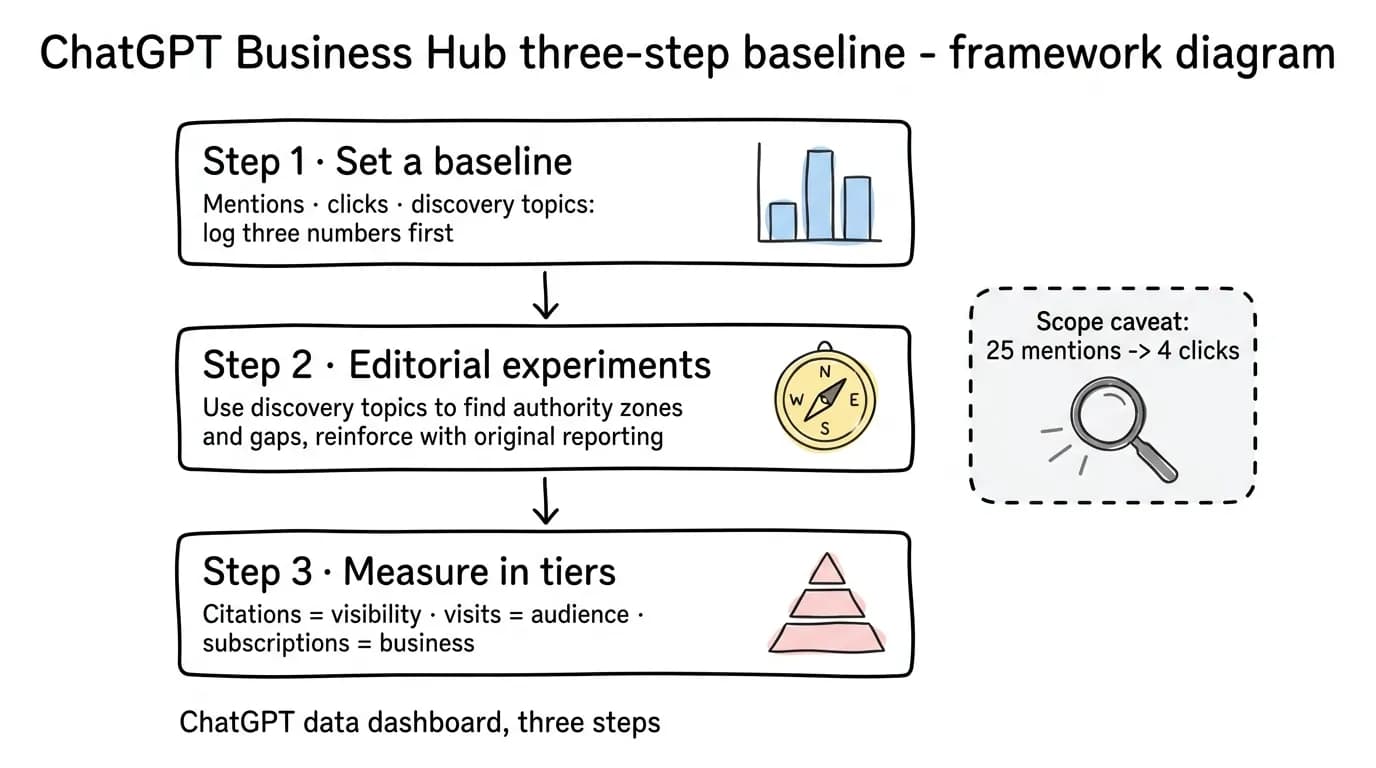
AI Marketing Daily for 2026-11-20 rounds up 19 items centered on measurement: OpenAI's ChatGPT Business Hub dashboard, EU rules for agent-mediated purchasing, Meta pausing four AI terms, and B2B data on shortlists and the dark funnel, each with action advice.