
6 Big Companies Using AI in Marketing — I Went Through Their Official Announcements and Found a Pattern
Summarizes official announcements from six companies—KDDI, CyberAgent, Klarna, Ito En, Asahi, and Coca-Cola—on AI in marketing, noting that announcements with figures center on ad and content production while experience campaigns lack numbers, with advice on adopting AI in marketing workflows.
A while back, a friend of mine who works in marketing invited me out for tea. Her opening line: "We want to use AI, but we don't know where to start."
Her second line: "And we have no idea how far along everyone else is. I'm worried we'll end up learning nothing."
I told her: don't bother with all those articles online that make everything sound spectacular. If you want to read something, read the announcements companies publish themselves. Companies can't afford to bluff in their own announcements — every claim has to be defensible.
So I actually went and did it. I went through the official announcements of six companies — Japanese, Swedish, American. And I found a genuinely interesting pattern.
Here it is, laid out for you today.
First, the Three with Numbers
Company one: KDDI — half the banner-ad workload, gone
KDDI teamed up with Supership and Recursive to build a system: generative AI produces ad banners, the banners must comply with KDDI's own brand guidelines, and once generated, the system automatically picks out the ones with the strongest historical performance.
They ran the beta inside their own digital marketing division. According to the announcement, workload on these tasks dropped 50%.
Break it down and it gets more interesting: concepting, down 60%; rough drafts, down 60%; the final polish, down just 20%.
Think about what that means. AI devours the "from nothing to something" phase. The hardest last bite — the final refinement — still belongs to humans.
One caveat, mind the basis: these are figures from an in-group trial. Selling it to enterprise clients externally? Still under consideration.
Company two: CyberAgent — predictive AI plus generative AI, a twin engine
Since 2020, this company has run a predictive AI that forecasts ad performance before campaigns go live. In May 2023, they bolted on copywriting powered by their own large language model — copy that accounts for both the image content and audience traits like "office workers cramming onto the morning train."
Their December 2024 announcement gave a string of numbers: AI creators are 5.6x more productive; the assets they produce are 2x more likely to perform well; overall productivity is up roughly 11x.
And here's the bigger one: ads featuring virtual influencers — auto-generated by AI, with AI-handled casting — saw click-through rates rise roughly 4x.
That's serious firepower.
But let's be precise: all of these figures are from their own business operations. For that ~4x CTR lift, neither the comparison baseline nor the statistical window was disclosed. Study it as a case of "AI prediction plus human operation" — great. Treat it as a guarantee that "AI will always 4x your clicks" — that would be naive.
Company three: Klarna — bringing production fully in-house
Klarna, the Swedish payments company. They took image-generation AIs — Midjourney, DALL-E, Firefly — plus an internal copywriting tool, and stuffed the whole kit into their marketing department.
Their announcement from late May 2024 was generous with numbers:
In the first three months of 2024, over 1,000 images generated. Image development cycles compressed from 6 weeks to 7 days. Spending on external marketing vendors down 25%. Image production costs cut by $6 million.
And it keeps going. AI accounted for 37% of total cost savings, roughly $10 million annualized. And 80% of all copywriting across the company was handed to AI.
Of course, this is Klarna's own ledger, their own scale, their own org structure — yours may look nothing like it. But "6 weeks down to 7 days" is scary enough all by itself.
Now, the Three Without Numbers
Reading through the last three companies, I noticed the announcements turned bone-dry. Not a single number.
And that's exactly what makes them interesting.
Ito En — a TV commercial starring an AI talent
Ito En produced a TV commercial for its Oi Ocha catechin green tea using an AI virtual talent. Officially, this was Japan's first TV commercial featuring an AI performer — it launched in September 2023, and a second one followed in April 2024.
The packaging got the same treatment: Plug's "Package Design AI" produced the initial design drafts, with human designers doing the finishing touches.
Sales figures? The announcement doesn't breathe a word.
But they did explain why they used an AI performer, and the reasoning is brilliant: they needed the same person to appear "now" and "30 years from now" side by side, still looking like the same person. A human actor can't do that. An AI performer can.
Asahi — turning your photo into art
Asahi ran a campaign on the brand site for its "Super Dry Dry Crystal" product: upload a piece of text and a photo of yourself, and Stable Diffusion generates an original piece of art for you. Officially, this was the first time Stable Diffusion was used for experiential promotion in Japan, open to participants aged 20 and over.
The goal: build brand awareness and purchase intent. Any performance numbers? None.
Coca-Cola — inviting the world to paint with its bottle
In March 2023, Coca-Cola launched a platform called "Create Real Magic," built with OpenAI and Bain, running on GPT-4 and DALL-E. Users could create using Coca-Cola's brand assets — the contour bottle, the logo, all yours to play with.
The best works went up on digital billboards in Times Square in New York and Piccadilly Circus in London. They also invited 30 creators to a workshop in Atlanta.
Any performance numbers? None here either. Their CMO said they want to compress the creative production cycle from weeks to days.
Note: that's a goal, not a result.
Here's the Pattern
Six companies in, and the pattern surfaces on its own.
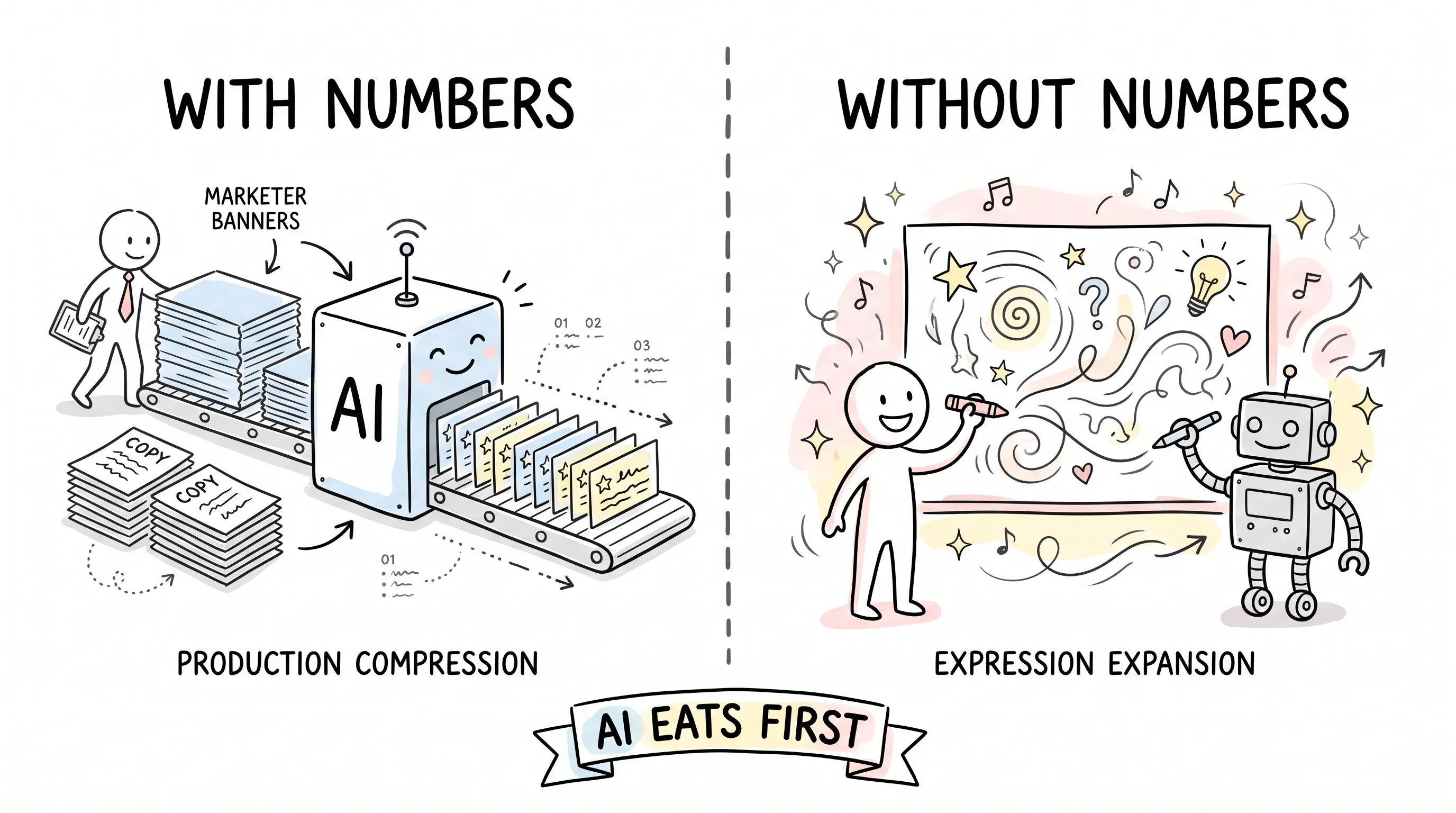
The three with numbers — KDDI, CyberAgent, Klarna — are all doing "production compression": generating ad creatives, writing copy, making images. High-volume, repetitive, quantifiable work.
The three without numbers — Ito En, Asahi, Coca-Cola — are all doing "experiences" and "expression expansion": getting consumers to participate, or doing things humans simply can't.
Wherever effects can be quantified, AI eats first. Wherever they can't, AI merely tests the waters. Whether the announcement contains numbers tells you everything by itself.
One more common thread, and it's the one worth chewing on: not a single company handed the whole job to AI.
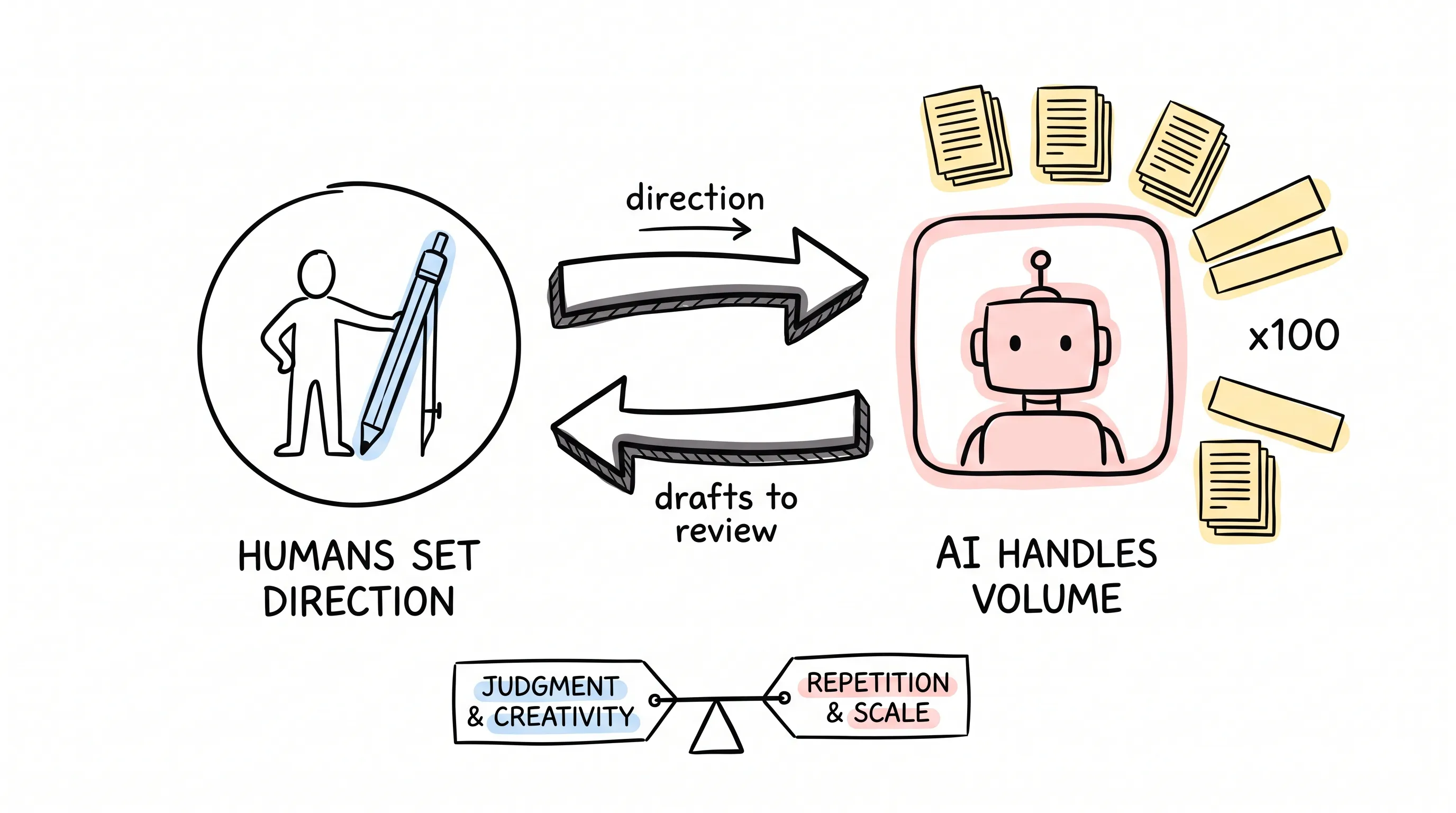
KDDI generates within its own brand guidelines. Ito En has human designers do the finishing. CyberAgent is predictive AI plus human operation. Humans set the direction; AI handles the volume. This holds at startups, and it holds just as well at giants.
Oh, and one last warning: don't take these numbers as your own benchmarks. Theirs are internal-trial figures and own-business figures. If you want to learn from them, start by measuring your own current hours and results, then pilot small.
What Does "AI Marketing" Actually Mean?
So what does using AI for marketing actually mean?
Plainly put: embedding generative AI and machine learning into the core marketing workflow — content production, data analysis, ad buying, customer relationship management. Quality and speed, improved together.
Think about it: marketing, at its core, is made of two activities — finding patterns and producing content. Reading customer-behavior trends out of historical data, distilling what competitors are doing, churning out a hundred ad copy variants in one go. These happen to be exactly what AI is best at.
But what about directional judgment? Strategy? A deep understanding of your customers?
Those still require a human to make the call.
Humans own judgment and creativity; AI owns repetition and volume. Whether you can draw this line cleanly decides whether you use AI — or get used by AI.
By the way, AI marketing used to be a big-company-only game; you needed mountains of data. Generative AI smashed that barrier. Now small teams can play with text, images, and data summaries too.
Four Functions, Four Playbooks
Content creation offers the highest return. Outlines, first drafts, copy variants, translation and localization — AI can assist with all of it. But there's one iron rule: anything AI generates must pass human review before publishing. Brand voice and fact-checking — that responsibility can't be outsourced.
For ad placement, AI is a good fit for scaling up asset production and shortening the data-review loop: multiple headlines and descriptions for search ads, "why did last week's numbers change" in weekly reports, batch generation of banner images. The KDDI and Klarna cases above belong to this category.
Customer analytics — segmentation, churn alerts, personalized recommendations — leans on machine learning. Generative AI alone isn't enough; you need a decent data foundation underneath.
As for SEO, AI can help you draft, optimize structure, make internal-linking decisions, and cluster queries. And there's a new item on the list: will your content get cited in AI search answers? That metric is becoming more and more important.
Tool Roundup
For text: ChatGPT and Claude handle general-purpose work; output quality depends heavily on how well the prompts are written, which is why many teams are building shared prompt libraries. NotebookLM shines when you feed it your own documents and want summaries. Perplexity is the one for tracking competitors and industry movements.
For images: Midjourney and Adobe Firefly produce banners, social media visuals, and landing-page graphics. Note that most teams don't treat AI images as final products — they use them as strong starting points for designers. Gamma is formidable for first-draft presentations.
For analytics: AI hooked into BI and data pipelines can auto-generate reports and flag anomalies. Asking your data questions in plain language is increasingly common too.
How to Keep It From Dying
Plenty of teams' AI initiatives die the same death: "Tried it. Dropped it."
Why? Because they mistook "installed a tool" for "embedded the tool into the workflow."
Those are two entirely different things.
Four pieces of advice:
- Start with a single point. Don't roll out across every function at once. Pick one small, visible, measurable task — say, "first drafts of weekly reports" — and get it working end to end.
- Save the prompts that work, and share them across the whole team. The goal is a system, not a private craft locked in one guy's head.
- Set evaluation criteria. Compare AI output against the non-AI baseline on time, quality, and cost. With numbers in hand, you can make the case for the next budget line.
- Never cut the human review step. AI drafts, humans gate the quality. That pipeline preserves your standards — and your credibility.
Finally
Look back at my friend's two questions.
First one: where to start? Start with the work that's highest-volume, most repetitive, and easiest to measure.
Second one: how far along is everyone else? Far enough to run "humans set direction, AI does the work." Not a single one handed everything to AI.
And here's one number I want you to remember: Klarna compressed its image development cycle from 6 weeks to 7 days.
Six weeks, down to seven days.
Yes, AI helped. But what helped more was that they truly embedded AI into their workflow. Everyone has the tools. The workflow is the gap.
Here's wishing your AI an early promotion from "tried it" to "can't live without it."
Continue reading
Related articles

It's 2026: Stop "Buying" AI Tools for Your Marketing Team — Start "Hiring" AI Agents
This learn article explains how AI agents differ from standalone AI tools in marketing, outlines three agent categories — build-your-own platforms, CRM-native agents, and vertical tools — and covers use cases across SEO, social media, advertising, and reporting, plus criteria for choosing one.

Did the Money You Spent on AI Marketing Ever Come Back?
A guide to measuring AI marketing ROI across three layers: ad reports, sales pipeline, and the financial ledger. Covers metrics such as ROAS and CPA, eight dashboard metrics, industry benchmarks, and common measurement mistakes.

How to Pick a Creative Automation Platform: First, Figure Out What These Eleven Actually Do
A learn article sorts eleven creative automation platforms — including Bannerflow, Celtra, Smartly.io, and Storyteq — into four functional groups and proposes five evaluation questions covering publishing reach, automation depth, ease of adoption, team fit, and verifiable evidence.