
Your Next Customer Might Not Be Human
This article explains how AI is becoming a participant in the customer journey, introducing the ambient era and Generative Engine Marketing (GEM). It outlines auditing how AI perceives a brand, measuring mention rate, average position, and citation sources, and aligning teams around the new metrics.
A few days ago, a friend of mine who runs an e-commerce business came to vent.
He said: my brand has a solid reputation on the e-commerce platforms, our review scores are rock-solid, and our ads are plastered everywhere. The other day I casually asked an AI, "recommend something good for me," and it rattled off a whole list of competitors' names — mine wasn't among them.
He said: where did all that ad money go?
I told him: the money wasn't wasted. It's just that the "person" you were paying to reach has changed.
He sat with that one for a long moment.
So What Exactly Changed?
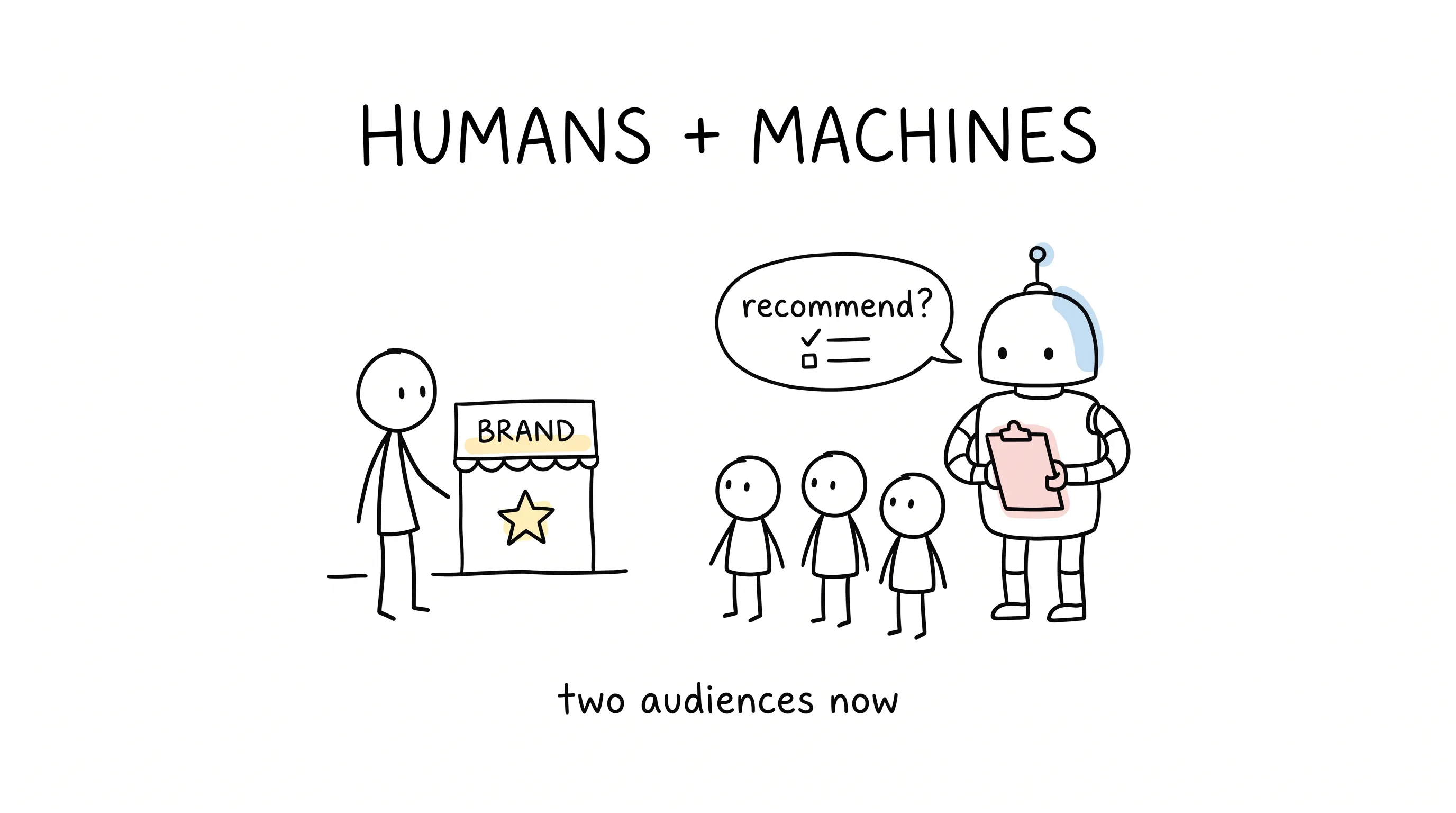
For decades, the audience brand strategy faced was human.
You dug into consumer insights, polished ad copy, and fought for shelf space and mind share. Every move you made was performed for humans to see.
But now there's a new participant in the customer journey: AI.
It reads content on the user's behalf, shortlists products, and in some scenarios can even place the order outright. In a report published earlier this year, Jellyfish gave this shift a name: the ambient era.
What is the ambient era?
Put simply: AI is no longer a tool — it's a participant that is everywhere. At every link in the chain of who carries your brand message, who interprets it, and who converts on it, AI is there. In this world, being seen by people is no longer enough. Your brand also has to be understood by AI.
Your next customer might not be human.
That sounds a little unsettling. But the friend I mentioned earlier has already run straight into it.
What Is GEM?
So what do you do?
In the same report, Jellyfish laid out a methodology called Generative Engine Marketing, or GEM for short.
What is GEM?
Brand strategy used to be made for human eyes. GEM says you need to add one more dimension: how AI models "see" you, how they interpret you, and when they bring you up — all of that needs managing too.
AI plays several roles in this. It's a gatekeeper, deciding which information gets recommended. It's an advisor, reading through your copy, images, and videos, then relaying what they say to the user. And it's quickly learning a new trick: buying things for users without ever asking a human.
That last one has a name of its own: agentic commerce.
What is agentic commerce? It's AI browsing on the user's behalf, comparing on the user's behalf, buying on the user's behalf. When that day comes, the "customer" your brand faces isn't a pair of eyes — it's a model.
How do you plan to tell your brand story to a model?
How Do You Actually Do It?
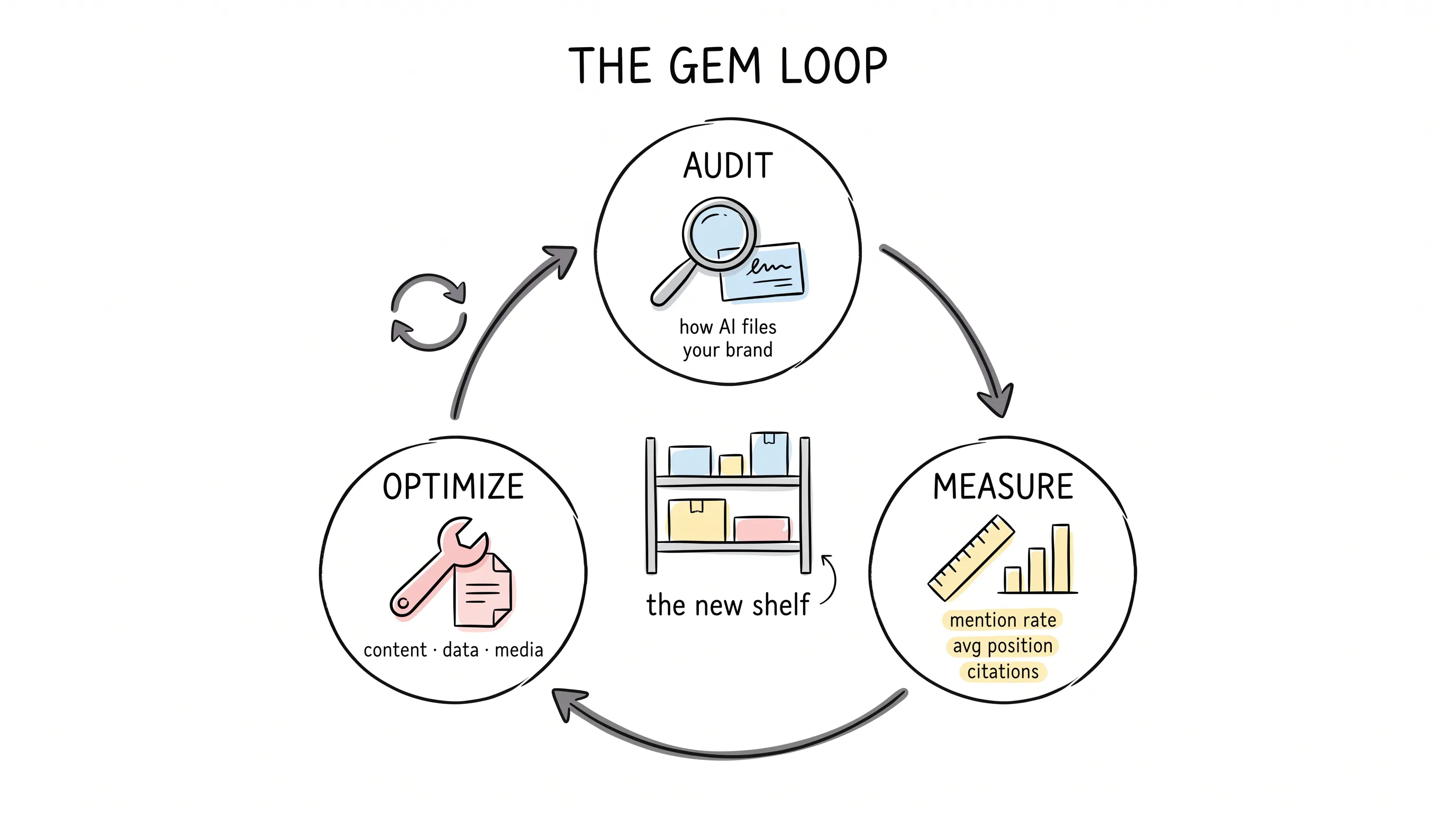
GEM isn't just a concept — it's a working method. Roughly three steps.
Step one: take stock. Figure out how AI actually "thinks" about you. Which category does it file you under? What kind of brand does it believe you are?
Step two: measure. Jellyfish offers two metrics, and I think they're brilliant.
What is mention rate? How often your brand gets named in AI's answers.
What is average position? Among the answers that do mention you, where you rank.
Does that feel familiar? It's a lot like shelf placement in a supermarket, a lot like search rankings in e-commerce. Except the shelf has moved from the physical world into the model.
Beyond those two, there's one more thing worth studying: citation sources. When AI speaks on your behalf, whose content is it actually citing? Get to the bottom of that, and you've figured out who's putting in a good word for you behind the scenes — then you can go cultivate that relationship.
Step three: optimize. Content, data, and media strategy all need to be adjusted based on what the audit and the metrics tell you. And this has to run in a loop: optimize, test, deploy, measure — then go around again. Jellyfish says that once this loop runs smoothly, campaign performance and media-buying efficiency show visible improvement.
The one-line takeaway: treat AI as a new shelf — and keep it diligently stocked.
One More Thing
By now you might be thinking: isn't this just the SEO team's job?
It really isn't.
AI runs through the entire marketing process. The brand team sets the tone, the media team handles placement, the SEO team owns search, the content team owns materials, the e-commerce team owns conversion. If any single link falls out of alignment, what AI "hears" about your brand is a muddle.
So making GEM work is, in the end, an organizational matter: these teams have to go from working in separate silos to sitting in the same room. And the measurement framework has to change with them — the conversion funnel of the human-led era can no longer fully explain the path by which AI shapes discovery, comparison, and purchase.
Finally, Back to That Friend
Later, I told him: ask the AI to introduce your own brand again.
This time, don't just listen for whether you're mentioned — look at where you rank, and look at whose words it cites.
He checked, went quiet for a moment, and said: got it.
Right. AI won't replace marketing, but it has pushed the borders of brand strategy further out.
The winners will design their brands for two audiences: the humans who can see you, and the machines that decide who gets seen.
May your brand always be the first name out of the AI's mouth.
Continue reading
Related articles

It's 2026: Stop "Buying" AI Tools for Your Marketing Team — Start "Hiring" AI Agents
This learn article explains how AI agents differ from standalone AI tools in marketing, outlines three agent categories — build-your-own platforms, CRM-native agents, and vertical tools — and covers use cases across SEO, social media, advertising, and reporting, plus criteria for choosing one.

What Is GEO? How Your Brand Gets "Mentioned" in the Age of AI Search
An explainer on GEO (Generative Engine Optimization) for e-commerce and DTC brands: how it differs from SEO and AEO, why AI answers shape brand visibility, and eight practices covering question-focused content, consistent brand messaging, structured pages, external evidence, comparisons, and AI mention tracking.

AI Is Already Making Decisions for Your Customers. Are You on the List?
A learn article explains GEO (Generative Engine Optimization): why AI-generated answers now shape which brands customers see, and how SEO fundamentals, entity clarity, citable evidence, and monthly measurement affect visibility in AI answers.