
TikTok or Google? In 2026, Where Should Your Ad Budget Go?
A learn article on splitting ad budgets between TikTok and Google in 2026, contrasting browsing-driven discovery with search-driven demand, covering updates such as AI Max, Smart+, and TikTok Search Ads, and outlining four budgeting rules for DTC brands.
A few days ago, a friend of mine who runs a cross-border e-commerce business invited me to dinner. The dishes had barely landed on the table when he pushed his phone across: "This is the budget I've got. TikTok on one side, Google on the other. Help me split it."
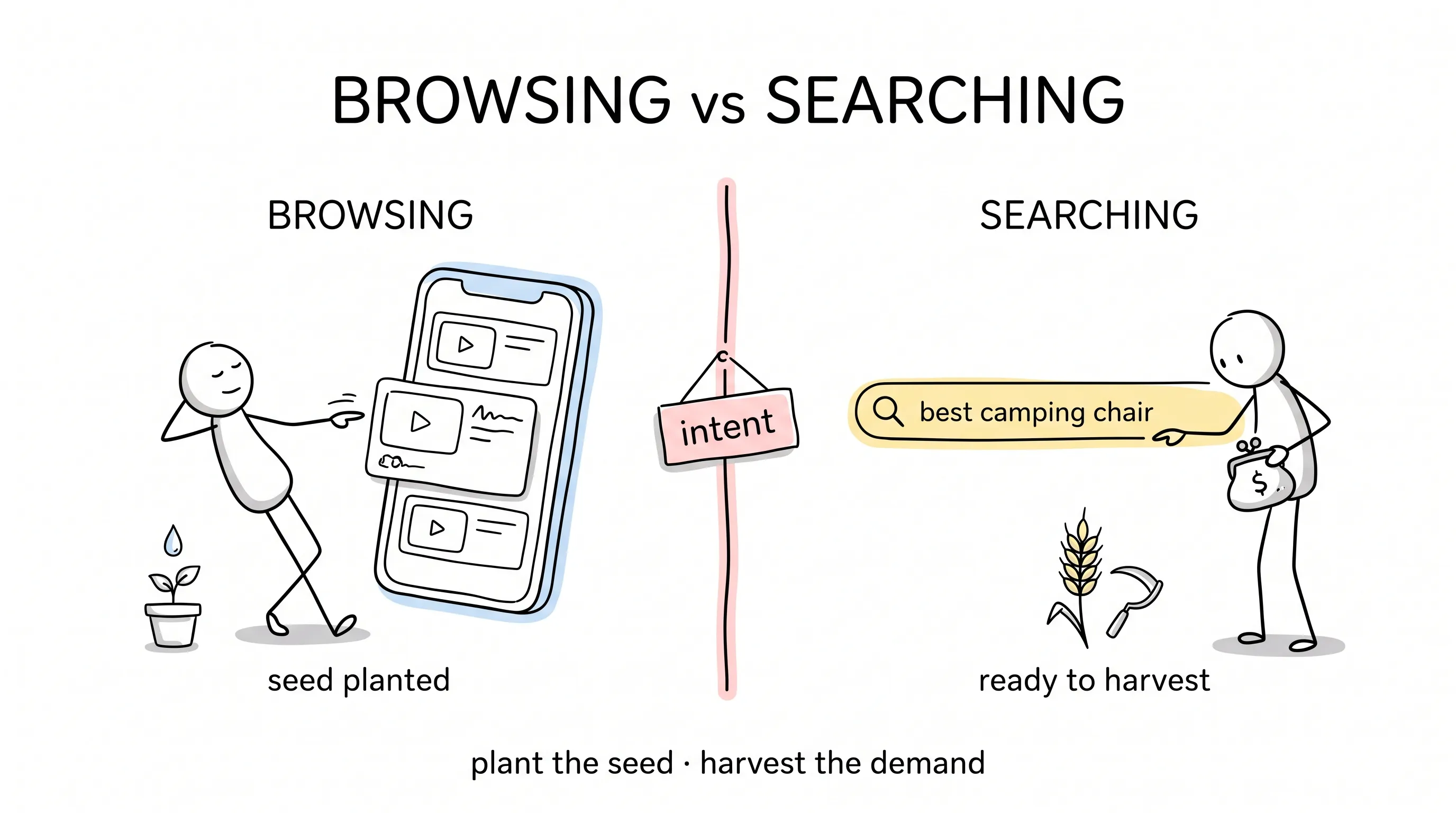
I said, don't rush to split the money yet. Answer one question first: are your customers browsing, or are they searching?
He froze for a second.
Those two words sound similar, but they describe two completely different kinds of demand.
What is "browsing"? It's when someone never planned to buy anything — they're scrolling along, a video hits them, and the money comes out right then. The purchase was instant, but the need was manufactured on the spot.
What is "searching"? It's when the money is already clenched in their fist. They search "which camping chair actually holds up," and the moment they finish searching, they're ready to order. The need already exists — the only question is whether you can catch it.
Once you see this, the division of labor between TikTok and Google becomes obvious: TikTok plants the seed, Google harvests.
But understanding the division of labor isn't enough. In 2026, both sides are sitting on something big, and you need to know what new muscles each has grown.
First, Google: A Busy First Half of the Year
The biggest move came in travel. In early July, Google expanded the beta of Search campaigns for Travel, adding Things to Do and Events. From now on, advertisers selling tickets or running attractions can combine media ads with text ads, plug in AI Max, and reach that high-intent search traffic.
If you run travel or event marketing, this one deserves a closer look on its own.
Several other updates look small but are genuinely practical.
Take conversion debugging. Google added a timestamp in the backend showing the exact date and time a conversion tag last fired — even if that firing didn't produce a conversion. Think about it: troubleshooting conversion tracking used to be basically guesswork. Is the tag even alive? Nobody could say. Now you can see, at a glance, the day and hour it broke.
Take AI Max. What is AI Max? Simply put, it hands several campaign types over to a single AI optimization engine that runs them all together. Google also updated its FAQ, spelling out — point by point — how to steer it back when it drifts off course (performance tuning), and how to migrate over from Dynamic Search Ads.
Then there are a few small interface changes: a "Visit Site" button is being tested on sponsored results, and asset groups now have a one-click apply-theme option to keep a set of creatives looking consistent.
The direction is clear: Google is pushing automation deeper while handing more control back to you.
Now TikTok: Hand-to-Hand Combat
On the TikTok side, one phrase sums it up: hand-to-hand combat.
First card: on-platform Search Ads. Launched at the end of 2025, and by this year it has matured considerably. Plenty of users post a video right after buying something; many more do the reverse — they open TikTok and search directly for "sun-protection jacket" or "camping chair." Searching is shifting from "go to a search engine" to "open the app and search."
For DTC (direct-to-consumer) brands, this is a signal you have to keep an eye on.
Second card: Smart+. It automated both bidding and creative optimization, and this year it opened up more manual control — you can specify which stages must follow your instructions and which you let it run free.
Third card: a brand-new format, the Collage Carousel. Multiple images and video clips stitched into a single swipeable ad. Creative richness has become a tunable parameter.
The Real Question: TikTok Search Ads vs Google Shopping
For DTC brands, the question you can't dodge this year is how to position TikTok Search Ads against Google Shopping.
Start by laying out the differences:
- Intent: TikTok captures "browsing"; Google Shopping catches "buying."
- Creative: On one side, native videos blend into search results; on the other, Product Listing Ads (PLAs).
- Targeting: One side leans on interest signals plus an algorithm guessing at you; the other locks on through search terms plus purchase history.
- Attribution: One side commonly credits a conversion to an ad view within a day (view-through attribution); the other credits the last click.
Category matters too. Industry watchers have put the two side by side: for impulse-driven categories like beauty and apparel, TikTok Search Ads deliver stronger returns; for electronics, high-ticket items, and anything that demands repeated comparison shopping, Google Shopping is the steadier bet.
So mature brands stopped choosing one over the other long ago: seed money goes to TikTok, harvest money goes to Google, and they own the entire funnel.
The Most Interesting Story Is the Third One
But what's truly worth pondering this year isn't the offensive and defensive moves between these two. It's their convergence.
Put the three giants side by side: Meta has Advantage+, Google has AI Max, TikTok has Smart+. Different names, identical underlying logic: bidding goes to AI, targeting goes to AI, and even creative selection goes to AI.
What does that mean?
It means the edge you built by "learning one platform's temperament" is being sanded away, bit by bit. As the differences between platforms narrow, only three things are left to compete on: whether your creative is fresh enough, whether it's good enough, and how deep your first-party data runs.
Once that clicks, your budget strategy has to change with it: instead of studying the platforms, turn around and arm yourself.
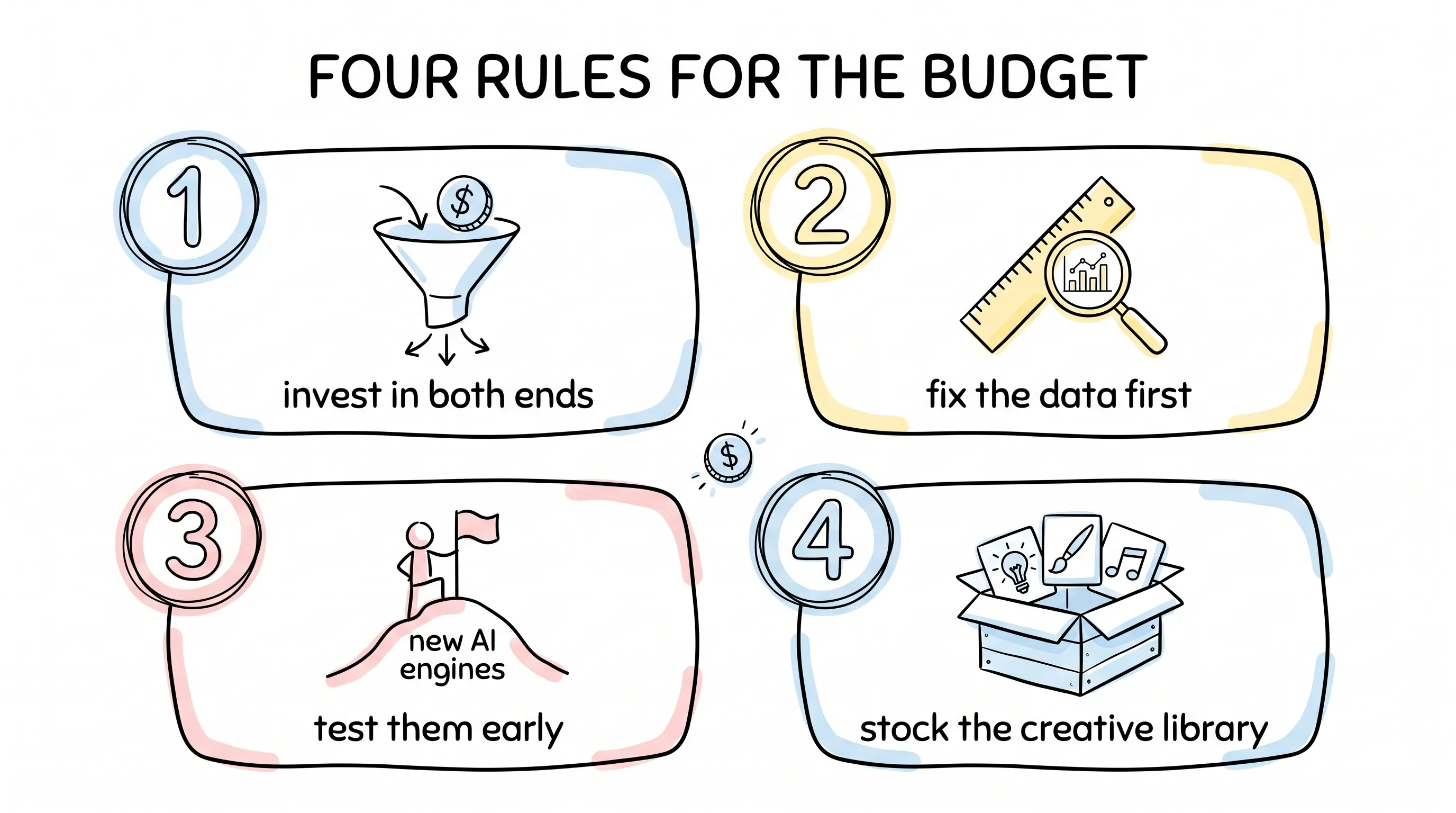
So How Should the Money Be Split? Four Rules
- Invest in both — don't go all in on one. TikTok handles discovery, Google handles harvesting; occupy both ends of the funnel.
- Put the new measurement tools to work. Use Google's conversion timestamp to debug your tags; use TikTok's view-through attribution to see your true impact. Get the data right, or every judgment downstream goes crooked.
- Try new engines like AI Max and Smart+ while they're still immature. Once everyone has them dialed in, the early-mover advantage is gone.
- Build a deep creative library. Creative that feeds one AI engine won't necessarily feed another. Stock several sets, so no engine ever goes hungry.
At the end of that dinner, my friend said: got it.
I said: got what, exactly?
He said: seed money to TikTok, harvest money to Google; stock several creative sets; test new AI tools with small money first.
Right. It's that simple.
Platforms will change. Algorithms will change. But user intent never will.
May every dollar of your ad budget go where it's understood.
Continue reading
Related articles

It's 2026: Stop "Buying" AI Tools for Your Marketing Team — Start "Hiring" AI Agents
This learn article explains how AI agents differ from standalone AI tools in marketing, outlines three agent categories — build-your-own platforms, CRM-native agents, and vertical tools — and covers use cases across SEO, social media, advertising, and reporting, plus criteria for choosing one.

Did the Money You Spent on AI Marketing Ever Come Back?
A guide to measuring AI marketing ROI across three layers: ad reports, sales pipeline, and the financial ledger. Covers metrics such as ROAS and CPA, eight dashboard metrics, industry benchmarks, and common measurement mistakes.

How to Pick a Creative Automation Platform: First, Figure Out What These Eleven Actually Do
A learn article sorts eleven creative automation platforms — including Bannerflow, Celtra, Smartly.io, and Storyteq — into four functional groups and proposes five evaluation questions covering publishing reach, automation depth, ease of adoption, team fit, and verifiable evidence.