
AI Gives Only One Answer. Is Your Brand in the Room?
A learn article explaining GEO (Generative Engine Optimization): how AI engines such as ChatGPT, Perplexity, Gemini, and Google's AI surfaces select and cite sources, with tactics, measurement metrics, and common myths for brands seeking visibility in AI answers.
A few days ago, at dinner, a friend who has spent a decade or so in SEO poured out his frustrations.
His keywords still ranked number one, and traffic looked fine. But last month, a major client told his sales team: I asked ChatGPT first, and it recommended three companies. You weren't one of them.
He asked me: our rankings haven't dropped, so why can't clients "see" us anymore?
My answer: because the thing you optimize for has changed. You used to optimize for the search box. Now you have to optimize for the AI that hands people their answers.
This thing already has a name in the industry: GEO.
What Is GEO?
GEO stands for Generative Engine Optimization.
What's a generative engine? It's the kind of thing you don't ask "where can I find information" — you ask it directly, "what should I buy?" ChatGPT, Perplexity, Google's Gemini, Google AI Mode, AI Overviews — they all count.
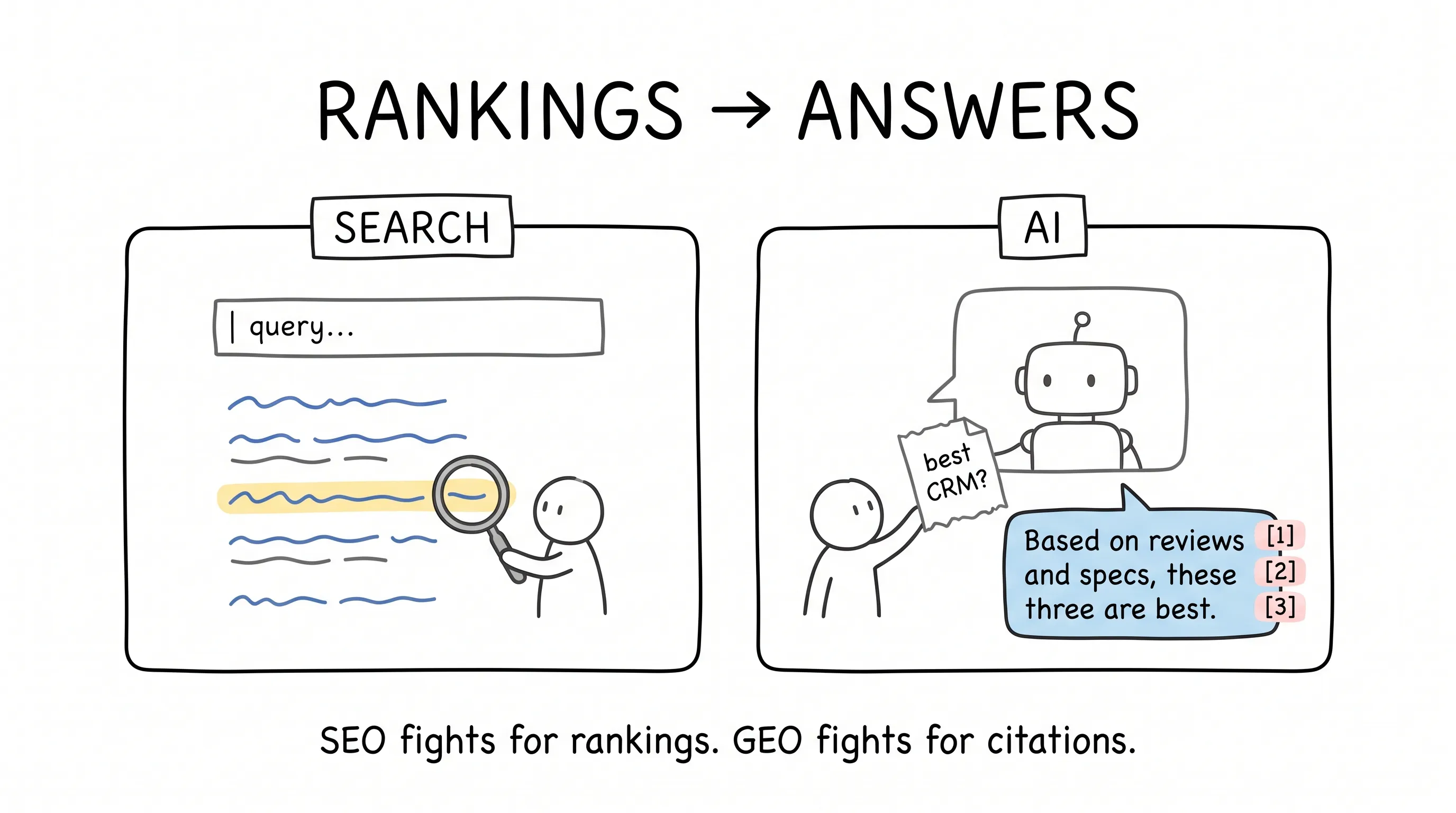
And there's a fundamental difference between these and search engines. A search engine hands you a list of links and lets you pick. A generative engine goes off and does the digging itself, pulls together a few useful sources, mashes them into a single answer, and tells you: here's what to do.
SEO fights for rankings. GEO fights for citations.
If your brand isn't among the "few sources" the engine dug up, then in the answer the user actually sees, you don't exist.
The Term Wasn't Invented by a Marketing Agency
Here's the interesting part: GEO wasn't coined by some marketing guru. It came out of an academic paper.
In November 2023, researchers at Princeton University, together with the Indian Institute of Technology Delhi, Georgia Tech, and an AI research institute, published a paper on a preprint server titled "GEO: Generative Engine Optimization." In 2024, it was accepted by KDD, the flagship conference in data mining.
What this group did was very practical: they built a benchmark called GEO-bench, collected roughly ten thousand real user questions across domains, and then tested nine different "content revision" methods, one by one, on generative engines.
The result: apply the right methods, and your content's chances of being cited by the AI — of being spoken out loud by it — could rise by as much as 40%.
Good grief. Forty percent.
Even better: the methods that actually work run completely counter to most marketers' instincts. Want to guess which tactic proved the most useless of all? Cramming keywords into articles. More on that later.
In mid-2024, "GEO" broke out of the paper and into marketing newsletters. Today it sits alongside SEO and AEO as a legitimate discipline.
First, Untangle Three Terms
SEO, AEO, GEO — the three look alike and are easy to conflate.
SEO, search engine optimization, fights for position in a list of links. Where you rank determines whether anyone clicks.
AEO, Answer Engine Optimization, fights to be "extracted." The featured snippet, the line a voice assistant reads aloud, the sentence served up directly in an AI overview — that's AEO.
GEO fights to be cited, mentioned, and recommended inside AI-synthesized answers.
Here's an example. You ask, "What tool should I use?" SEO gives you a ranked list. AEO gives you one standard answer. GEO gives you a synthesis: "Based on user reviews on X platform, Y agency's comparison report, and the specs on Z's official site, the most recommended options are…"
SEO ranks. AEO extracts. GEO endorses.
Someone will ask: if I rank first in search, am I safe?
No. Rank first all you like — ChatGPT can still leave you out of its answers. The signals overlap, but they don't coincide. These are two parallel tracks.
One research firm predicts that by 2027, more than forty percent of enterprise SEO budgets will have shifted to GEO. The window for SEO-only players is narrowing.
Five Arenas, Each with Its Own Temperament
"AI search" is not one thing. As of today, there are five tables worth most brands' serious attention.
The first: ChatGPT. The biggest by scale, with real-time web retrieval enabled. It has its own search crawler, and whether it acknowledges you starts with whether it has crawled you.
The second: Perplexity. Born an "answer engine," it labels sources on every response. Its citation behavior is the most transparent — which makes it the easiest to measure and the most sensitive to optimization.
The third: Gemini. Google's conversational assistant, scattered throughout the Google ecosystem. It's pickier than Perplexity, but brands and sources still get surfaced.
The fourth: Google AI Mode. The conversational mode inside Google Search. It has a special mechanism called query fan-out: your one question gets split into several sub-questions, researched in parallel, then stitched back together. One of the tactics later in this piece is aimed squarely at it.
The fifth: AI Overviews. The AI summary box that sits above the classic ten blue links. By Google's own published numbers, it reaches more than 2.5 billion people every month. And often, once users have read it, they never scroll down at all.
Think about it: these five differ in retrieval logic, citation tastes, and freshness preferences. Defending only one table is like advertising on a single media outlet and expecting national coverage.
How the Engines Actually Work
To get cited, you first need to know how the "citing" happens. The pipeline has three steps.
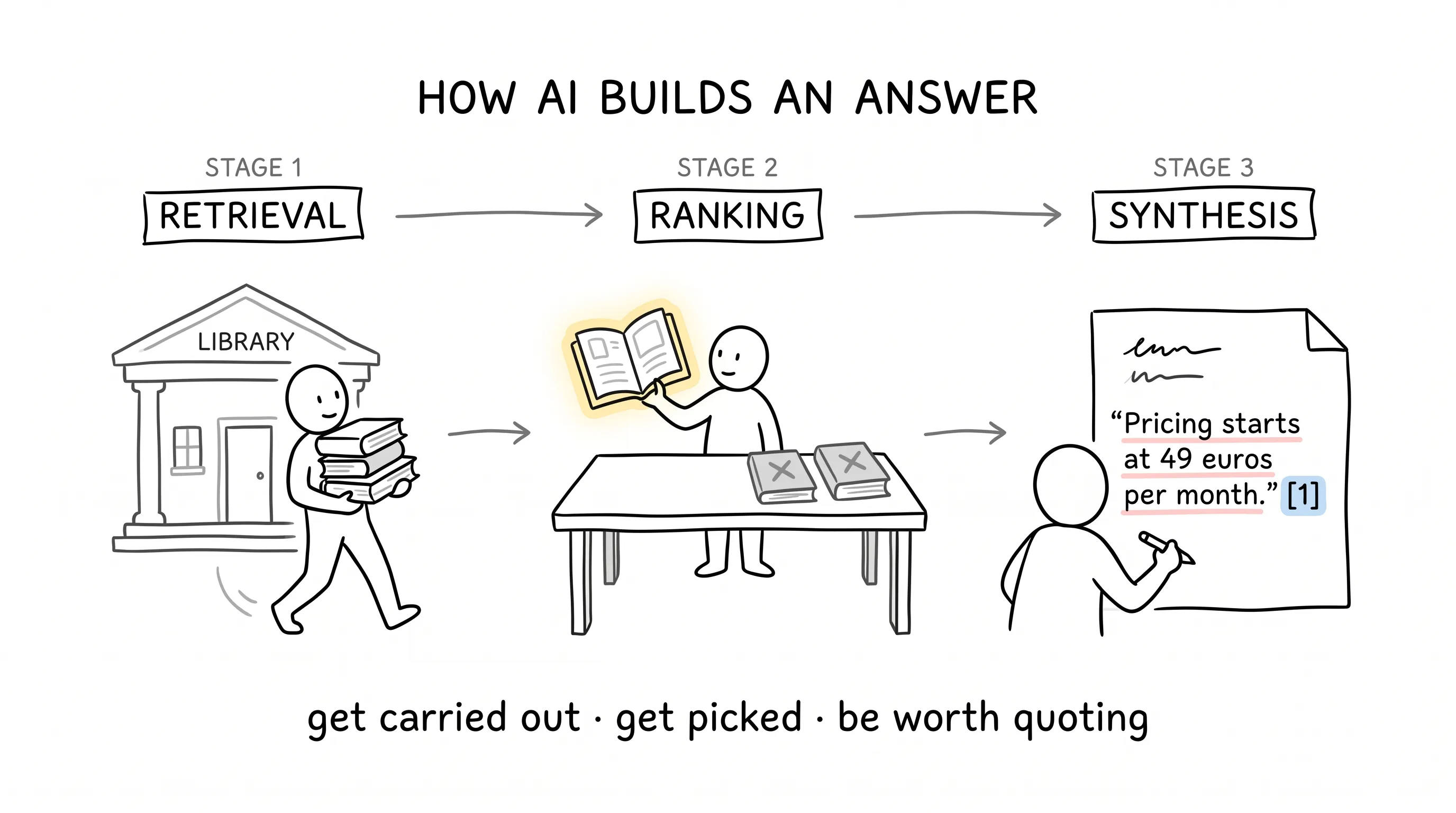
Step one: retrieval. The moment you ask, the engine goes digging. Who's doing the digging? Each engine has its own crawler: OpenAI's OAI-SearchBot, Perplexity's PerplexityBot, Anthropic's Claude-SearchBot, plus the veterans Googlebot and Bingbot. Note that the training crawlers are a different crew — don't mix them up.
Step two: ranking. A pile of candidates comes back, and the engine has to choose. By what criteria? Relevance, freshness, source authority — and an increasingly important ingredient: how strong your brand is as an "entity."
Step three: synthesis. It reads the selected passages, extracts the key points, blends them into one answer, and tags citations along the side.
Think of a student writing a report. Step one is hauling books out of the library. Step two is deciding which books to trust. Step three is writing the report with footnotes.
If you want to be cited, you have to clear every stage: get carried out of the library, get picked, be worth quoting.
Most brands understand the first two steps and have done absolutely nothing on the third. And what the Princeton paper essentially measured is how big the lever on that third step is. The 40% lift comes mainly from there.
The Tactics That Actually Work
What follows are the moves with the hardest evidence behind them today. The sources are that paper, plus data from several independent measurements.
Move one: pour the foundation. Generative engines still retrieve from Google's and Microsoft's indexes. If your pages can't be crawled, aren't indexed, and have no links pointing at them, whatever GEO house you build on top will collapse. The cleanest conclusion this year: classic SEO is a necessary condition, but no longer a sufficient one. Keep laying the foundation — shift the marginal effort to the moves that follow.
Move two: cite authoritative sources in your own body text. This one performed extremely well in the paper. When your pages cite external authoritative sources, the AI is in turn more willing to treat your pages as authoritative. The signal is symmetric: trust others, and others will trust you. The data is even harsher: a page sitting in fifth position in search results lifted its visibility 115% with this single move. The lower your ranking, the bigger the payoff.
Move three: let real experts speak, and put names on it. The paper calls this "quotation adding." A direct quote with a name, a title, and an organization gives the AI a solid block of material it can grab and pass along. The anonymous "experts say" does nothing.
Move four: swap every vague claim for a specific number. This is the single most powerful tactic in the paper's set of nine. Why? Numbers can be extracted, verified, and cited. "Many users" can't be quoted; "62% of users" can. "Growing fast" can't be quoted; "growing from 1.2 billion in 2024 to 3.8 billion in 2026" can. Remember the combo: number, plus year, plus source.
Move five: write with conviction. LLMs are trained on expert-level text, and they prefer to draw from sources that "read like expert text." Hedging, roundabout paragraphs — every one of them lowers your odds of being chosen. If you have a point of view, state it outright, then back it with citations.
Move six: split the sub-questions and win each one. This is aimed directly at AI Mode's query fan-out. If it splits a user's one question into five sub-questions, then your page needs to deliver on all five. If you write "the best CRM software," the page needs clearly labeled sections like "CRM for small businesses," "CRM for sales teams," "open-source CRM," and "CRM pricing." Don't bet everything on the head term.
Move seven: sow seeds where the AI already trusts. Generative engines' tastes in citation sources are remarkably concentrated: Wikipedia, Reddit, YouTube captions, G2, Capterra, top-tier media, industry reports. Whether your brand has a credible presence in those places determines whether you show up at all — more so than anything you polish on your own site. Some call this "off-site GEO." The practical moves are few: build and maintain your Wikipedia entry; firm up your listings and reviews on the major review sites; participate genuinely and consistently in relevant subreddits; contribute to the media that keeps getting cited.
This move is slow. But its returns are startling. One sentence on Wikipedia, one review on G2, can get you cited across all five tables at once — and keep paying for years.
Move eight: watch branded search volume. The simplest proxy the AI uses to gauge how important your "entity" is: how many people are searching for your brand name — on Google, in ChatGPT, in Perplexity. Branded search volume is a lagging indicator, but it's the best signal of whether GEO is actually working: ads, PR, and even being cited by AI itself all feed back into it. Treat it as your GEO KPI, not just the brand department's.
Move nine: keep content fresh. Both ChatGPT and Perplexity show a pronounced recency preference. One independent measurement put a number on it: for the same question, the sources AI cites are, on average, about 26% newer than the sources ranking in SEO. What does that mean? That pillar article written brilliantly in 2024, if nobody has refreshed it since, is invisible today. Set up a quarterly refresh cycle: for the pages most often cited, update the data, the examples, the year.
Move ten: do comparison content thoroughly. Analysis of citation patterns shows comparison articles account for roughly thirty percent of all AI citations: X vs Y, best X for Y, X alternatives. Whatever people ask the AI, the AI goes looking for. If your category doesn't yet have a few solid comparison pages and alternatives pages, you're leaving the easiest questions on the exam unanswered.
The Principles Behind the Tactics
Behind the moves, there's a doctrine.
What is extractability? It's whether the AI can pull, in one clean motion, a complete, factual, quotable sentence from your page. It will not paraphrase your 800 words of beautiful buildup — it extracts only the sentence that directly answers the question. So: lead with the answer, keep headings clear, keep paragraphs short, use lists where lists fit, use tables where tables fit.
What does standalone sentence mean? "Pricing starts at 49 euros per month" can be quoted. "Pretty reasonable — in that range we mentioned earlier" cannot.
Depth beats breadth. The engines reward sources with real depth on a topic, not sources that graze every keyword. Build content clusters around your pillars, weave the internal links tight, and update the whole set together.
Original data is the hardest currency of all. Numbers nobody else has carry the most citation value. Your own research, benchmarks, and case libraries are the highest-leverage content investment in GEO.
One more: take sharp positions. "On the one hand… on the other hand…" fence-sitting content gets straight-up displaced by sources with clear points of view.
The Technical Layer: Don't Cut Corners
Beyond content, there's a layer of engineering work. Three things.
One: put the right crawlers in robots.txt. Retrieval and user-triggered crawlers (OAI-SearchBot, PerplexityBot, Claude-SearchBot, Googlebot, Bingbot) — let them through if you want to show up. Training crawlers (GPTBot, ClaudeBot, Google-Extended) — blocking them or not is your call. But think it through: block the retrieval crawlers, and your content never enters the answers. Even if ChatGPT sees your page through a third-party search source, all that surfaces is a link and a title; the body text doesn't come through.
Two: keep structured data valid, but don't treat it as a talisman. Google has said it plainly: AI Overviews doesn't require special structured data. Just make sure your markup matches what's visible on the page. It is not a citation pass.
Three: don't deify llms.txt. It's a proposed plain-text file listing site content, and mainstream engines haven't confirmed it affects citation eligibility. It cannot replace crawlable HTML, internal links, robots.txt, and sitemaps. Publish it if you like — as icing, not cake.
Doing the Math
This section is the dividing line between doing the work and going through the motions.
SEO's measurement stack is mature — Search Console, rank trackers, plenty more. GEO's measurement is still new. The market is flooded with tools that rebranded themselves "GEO platforms" between 2025 and this year; most are still catching up.
The minimum viable measurement system has four parts. A set of target questions real buyers would actually ask an AI. Run them against all five engines at least once a week. Automatically parse the answers for brand mentions, cited sources, sentiment, and position. Then add a dashboard that assembles the trends by engine, by question, by competitor.
Which numbers to watch? Here are five.
First, mention rate: of your target questions, the share where your brand appears. The industry median sits between 8% and 12%; category leaders run 40% and up.
Second, position-weighted visibility: first place counts 100%, second 50%, third 33%. It's the AI version of "average rank," and it belongs in the center of your dashboard.
Third, share of voice: your mentions divided by the combined mentions of you plus your competitors. When comparing, freeze the question set, the competitor list, the engines, and the schedule. Change any of them and the comparison is dead.
Fourth, citation source coverage: of the third-party sources the engines cite, how many include you. This is the scoreboard for your off-site work.
Fifth, sentiment. Watching mention rate alone is dangerous: being named in a negative context is worse than not being named at all.
Two more numbers, which the CFO tends to like: GA4 traffic and conversions from AI sources (add filters for each AI provider's referrers), and the upward curve on branded terms in Search Console. Conversion rates on AI-sourced traffic run roughly 4x those of organic search. The base is small, but the math still pencils out.
Don't want to manually paste the same batch of questions into five engines every week? There are tools built for exactly this — LLM Pulse, for example, tracks visibility, share of voice, and sentiment across the five major engines plus a set of paid models, on a schedule. Which vendor you pick matters less than not flying blind.
And a question you're guaranteed to get: how long until it works? The fast moves — citations, numbers, named quotes, writing with conviction — show visible change two to three weeks after a crawl. The slow moves — Wikipedia, Reddit, media coverage — compound monthly. For a brand starting from a low base, seeing respectable improvement in share of voice within a quarter is a reasonable expectation.
Five Myths, Dismantled One by One
Myth one: SEO is dead, go all-in on GEO. No. What gets fed to AI Overviews and the other engines is still that same index. If you can't be crawled and can't rank, you can't be cited. SEO is the foundation; GEO is the building on top.
Myth two: stuff more keywords for the AI. The Princeton paper tested this specifically: zero effect, sometimes negative. Keyword stuffing wrecks fluency — and fluency is itself one of the effective moves.
Myth three: hide instructions in your page telling the AI to praise you. Don't. The major vendors now filter such prompt injections at the retrieval stage. And even if one slips through, the day it's discovered is the day your reputation explodes. This kind of thing always gets discovered.
Myth four: publish llms.txt and you'll get cited. You won't. It's a piece of infrastructure, not a switch.
Myth five: AI traffic will completely replace organic search. Two channels. Measure them separately, and let your own conversion data do the talking.
One More Look Ahead
Three shifts worth preparing for now.
Agents are starting to ask questions on people's behalf. By 2027, a meaningful share of "searches" won't be typed by humans at all — they'll be initiated by shopping agents, research agents, support agents. They'll read your website the way they read an API: llms.txt, structured data, clean interfaces. At that point, the competition is no longer "being cited" — it's "being selected." Your core product pages deserve to be managed as interfaces starting today.
Multimodal synthesized answers. Text, images, video, and audio are being blended into the same answer. Image alt text, video captions and chapters, podcast transcripts — they've all become part of GEO.
The tracks are converging. GEO, SEO, AEO, brand — these labels will matter less and less, while the thing underneath matters more and more: getting machines to understand you, trust you, and reuse you. The winners will run an integrated playbook under one unified measurement. For agencies, that's a business opportunity too: clients no longer want to fund three teams; they want one team accountable to a single KPI.
Back to That Dinner
At the end of that dinner, I told my friend: don't panic — and don't be lazy, either.
The way you won at search engines was by placing yourself in the results. The way you'll win with AI is by placing yourself in the answers. You spent ten years on the first. For the second, the window is still open and the room isn't crowded.
The 40% lift, the 26% freshness premium, the thirty percent of comparison citations — none of these numbers are ones I made up. They've already been measured. Measured and ignored is not the same as never measured.
The entrance to search is moving. And moving is most expensive for the people who find out last.
Here's to you: may there be a spot for you in every one of AI's answers.
Continue reading
Related articles

It's 2026: Stop "Buying" AI Tools for Your Marketing Team — Start "Hiring" AI Agents
This learn article explains how AI agents differ from standalone AI tools in marketing, outlines three agent categories — build-your-own platforms, CRM-native agents, and vertical tools — and covers use cases across SEO, social media, advertising, and reporting, plus criteria for choosing one.

What Is GEO? How Your Brand Gets "Mentioned" in the Age of AI Search
An explainer on GEO (Generative Engine Optimization) for e-commerce and DTC brands: how it differs from SEO and AEO, why AI answers shape brand visibility, and eight practices covering question-focused content, consistent brand messaging, structured pages, external evidence, comparisons, and AI mention tracking.

AI Is Already Making Decisions for Your Customers. Are You on the List?
A learn article explains GEO (Generative Engine Optimization): why AI-generated answers now shape which brands customers see, and how SEO fundamentals, entity clarity, citable evidence, and monthly measurement affect visibility in AI answers.