
Your Ad Budget Is Being Quietly Spent by AI
A cross-platform overview of AI ad-delivery tools on Meta, Google, TikTok, Snapchat, LinkedIn, X, and Pinterest, covering where automation helps, where it misfires, and how to verify results with third-party measurement.
A few days ago, a friend who runs a cross-border e-commerce business invited me out for tea. The first words out of his mouth as we sat down: "Lao Liu, I can't make sense of the numbers in my dashboard anymore."
I asked, what can't you make sense of?
He said the budget in his Meta ad account had been moved around by the system itself. He hadn't touched a single setting, yet money flowed from Campaign A into Campaign B on its own. He contacted support, and support told him: that's Advantage+ — the system is optimizing for you.
He couldn't decide whether to laugh or grumble. Helping? Helping whom?
I thought about this for a long time, because his confusion is not his alone. Today, nearly everyone who runs ads lives in the same situation: the platform you rely on for growth is making decisions on your behalf. Targeting — it picks for you. Bidding — it adjusts for you. Creative — it edits for you. And much of the time, without so much as a heads-up.
I'm not saying this is a bad thing. I'm saying you should at least know what it's actually doing for you, whether it's doing it well, and where it's going to burn you.
Over the past while, I went through the AI advertising tools of every major platform — Meta, Google, TikTok, Snapchat, LinkedIn, X, Pinterest. Today I'll walk you through them: which ones are genuinely worth turning on, which ones deserve caution, and which ones are pure hype.
First, the fundamentals: what is this AI actually doing?
What counts as an AI ad-delivery tool?
Put plainly, it's a set of machine-learning models trained on massive amounts of behavioral data to predict "will this user pull out their wallet in the next second." If the prediction is confident, bid more; if not, bid less. It computes this every millisecond.
Targeting tools find people who "look like your existing customers." Creative tools take your assets apart and recombine them, then give more impressions to whatever combination performs best. That's really all it is.
The principle isn't complicated. What's complicated is that every platform works with different "ingredients," and the dishes they cook end up tasting worlds apart.
Let's go through them one by one.
Meta: the thickest data moat, and the blackest box
What does Meta hold in its hands? Billions of users, and decades of behavior, purchase, and conversion data across Facebook, Instagram, and WhatsApp. On depth of ingredients, nobody comes close.
Over the past year or two, Meta has packaged its AI capabilities into Meta Advantage — targeting, bidding, placements, creative, all managed for you. And most new ad types default to it.
What is Advantage+? In one sentence: you supply the creative and the conversion goal, and everything else — targeting, bidding, budget allocation — is handed over to it.
How well does it work? Meta's own published case studies say it cuts costs 12% to 32% versus manual campaign builds. But independent third-party reviews poured cold water on that: for e-commerce advertisers with large catalogs and plenty of conversion signals, it genuinely runs well; for niche audiences and heavily regulated industries like finance and healthcare, it frequently misfires.
There are two traps you need to know about.
The first is creative. Advantage+ Creative will automatically add music to your images, adjust aspect ratios, apply filters, overlay text, and even wrap product shots in 3D animation. Note: this transformation is on by default. If you want it to leave your assets alone, you have to go turn it off yourself. Many people never find out, and their brand identity gets edited away. And Meta's own data admits it: click-through rates go up, but downstream conversions don't necessarily follow.
The second is attribution. The conversion numbers Meta reports to you are model-estimated, not counted one by one. After iOS privacy restrictions broke pixel tracking, Meta started relying on the Conversions API and statistical modeling to "estimate." The default attribution window is 7-day click plus 1-day view, and in multi-touch scenarios this accounting inflates Meta's own share of the credit. So the numbers in the platform dashboard and the numbers in your own analytics tools often don't match.
One more trend worth noting: Meta's AI assistant has already moved into WhatsApp and Messenger chats, and the platform is experimenting with wiring ads into those conversations. It's very early, but the direction is plain to see.
My advice in one sentence: e-commerce advertisers with clear products, ample conversion events, and a tolerance for ceding control should use it boldly. The same goes for app developers — Meta's fully automated App ads work the same way, but if you have fewer than 50 conversion events a week, the system can't learn and your data will swing wildly. As for affiliates, regulated industries, and anyone who needs precise audience exclusions, handle with care: turn off creative auto-transformation first, feed clean signals through the Conversions API, and check the placement quality report once a week.
Google: the oldest master, a strong hand holding one risky card
Google's AI advertising is the most mature in the industry. Decades of search-intent data sit right there.
Smart Bidding needs no second thought. Target CPA, Target ROAS, Maximize Conversions — the machine is far faster than any human. Search queries, device, location, time of day, audience, cross-device history — no human could ever process that many signals — it bids in milliseconds. With enough data (at least 50 conversions a month for Target CPA; 150 or more a month is recommended for Target ROAS), it consistently beats manual bidding. But remember: every time you change your bidding strategy, the learning period restarts, and that takes a week or two. Don't touch it during peak season.
The risky card is Performance Max — PMax for short.
One campaign reaching Search, Shopping, Display, YouTube, Discover, Gmail, and Maps. Sounds wonderful, right?
The problem is that it cannibalizes traffic that would have converted anyway. When a user searches your brand terms, one click used to cost very little; now PMax eats that budget too, booking conversions that were already cheap as its own. The books look prettier, but your true incremental cost may actually be higher. The "brand-term cannibalization" that independent reviews keep flagging is exactly this.
So here's how I'd play it: keep brand terms and high-intent traffic in dedicated Search and Shopping campaigns; give PMax the job of prospecting new audiences. Mixing them together and expecting one campaign to do it all is a mistake.
Responsive Search Ads (RSA) have been the default format since 2022 — you can load up to 15 headlines and 4 descriptions, and the machine shuffles the combinations itself. To make it perform well, write genuinely distinct selling points across headlines, not a pile of synonyms. If you want to pin a specific line to a position, you can, at the cost of giving up some optimization room.
By the way, Demand Gen — formerly Discovery — added video generation and Meta-style lookalike audiences in 2026, plainly aimed at Meta's inspiration-driven territory. Also: Google will crawl your landing pages automatically and generate extra headlines and descriptions for you. Screen these by hand; don't leave it on by default — what it writes is often so mediocre it underperforms what you wrote yourself.
TikTok: the fiercest discovery engine, but the math isn't settled yet
What is TikTok at its core? The most powerful content-recommendation machine on earth. What it holds isn't a social graph — it's an interest graph. It knows which videos you finish, which snippets of music make you stop scrolling, and which behaviors precede an order. That's a completely different logic from Meta or LinkedIn targeting built on friend relationships.
TikTok Smart+ launched at the end of 2024 and rolled out through 2025. Targeting, bidding, placements — fully automated. The official line says costs drop by as much as 52% in some categories. Independent data isn't that dazzling, but for impulse-purchase categories — apparel, beauty, food, gaming — it genuinely runs. For B2B and heavily regulated industries, don't count on it.
On the creative side, they built the Symphony toolbox: give it a product link and it generates finished videos with script, voiceover, and editing; AI avatars, both brand-made ones and licensed likenesses of real creators; plus multilingual AI dubbing, so one asset can roll out across a dozen countries without a reshoot. The avatars aren't yet indistinguishable from real people, but for running tests, they're good enough.
One thing to be clear-eyed about with TikTok search ads: users search there for "what's a good skincare routine," not "buy VPN." That's discovery-driven search, not purchase-driven search. Since the rollout in 2025, it works for reaching new audiences and planting the seed of interest — counting on it to harvest direct sales is premature.
As for TikTok Shop, it has taken hold in Southeast Asia and the UK; the US is still rolling out. If you sell consumer goods, keep an eye on it.
Snapchat: a singular AR craft, unmatched anywhere
Snapchat's users are mostly 18 to 34, phone never out of hand. Its AI tools have grown up around that crowd: targeting automation is less mature than Meta's or Google's, and the bidding system is decent for app installs and brand awareness but erratic for deep conversions.
But it has one craft nobody else masters: AR.
The average play time on a sponsored lens is 15 to 20 seconds. Ordinary video ads? 2 to 3 seconds. Nearly a tenfold difference. Virtual try-ons for makeup, try-on experiences, interactive mini-games — in retail, beauty, and entertainment, the lift in purchase intent is measurable. The price: building a decent AR lens is expensive and slow.
In 2026, sponsored links opened up inside the My AI chatbot too — when a user's conversation with the AI touches a relevant intent, a brand can surface. Very early, thin data, but the idea is worth noting: this is showing up inside a conversation, not inside an interruption.
Don't overlook catalog ads either. The machine assembles creatives automatically from behavioral signals and runs e-commerce retargeting; in fashion, beauty, and consumer electronics — categories Snap's users know well — it performs solidly.
Bottom line: if you sell to young people in the US, UK, or Australia — especially fashion, beauty, and entertainment — Snap is worth adding as a complement to Meta. As your main channel, it's still too green.
LinkedIn: expensive, but precisely on target
LinkedIn is the only platform that targets by job title, company, seniority, and skills. When it comes to B2B, only it can do this.
Two highlights.
One is Predictive Audiences: feed it your customer list as a seed, and the machine finds people who look like them. Public benchmarks show cost per lead dropping 15% to 21%. But note: the quality of the seed list decides everything. A seed built from your real CRM customers works well; a tiny audience scraped together from a few pixels is garbage in, garbage out.
The other is Thought Leader Ads: take posts from executives' and employees' personal accounts and promote them as paid ads. Content posted by real people naturally earns more engagement than brand accounts. For ABM and executive branding, it works.
They also have Accelerate — give it a URL and it auto-generates a full campaign with copy. Fine for a first draft; the copy needs rewriting, and its targeting suggestions tend to run broad, so you still need to tighten them manually by company size, job function, and seniority.
Two little-known facts for you: Document Ads — pay to promote a PDF resource — work surprisingly well for B2B SaaS lead generation; and each person can receive only one InMail per month, so volume never scales, but open rates beat email.
The bad news is one word: expensive. CPC and CPL run far above Meta and Google. It's only worth it when the lead quality that precision buys justifies the price. Which is why LinkedIn fits the middle and late stages of a B2B funnel — the few decisive steps.
X: hard times, but a crowd you can't find anywhere else
X, formerly Twitter, has had a rough few years. After Elon Musk's 2022 acquisition, advertiser trust broke down, brand-safety controversies kept surfacing, and revenue fell substantially.
But it still holds a few unique cards: the real-time discussion arena. News, finance, crypto, sports, tech — the density of conversation in these circles is extremely high, and its users skew high-income and opinionated.
On the AI front, Grok is now embedded. It does two things: first, AI-generated sponsored replies, still in limited testing and fairly controversial; second, using Grok to analyze conversation trends and audience interests for topic selection and creative briefs — that part is genuinely practical. The Performance+ audience-expansion tool is passable for buying new exposure, but counting on it for precise conversion is not realistic.
Bidding automation works, but it's less refined than Meta's or Google's. The summary: X is special forces, not the main army. Consider it only if your target audience happens to live in those circles. And if you do use it, watch brand safety the whole way.
Pinterest: a quiet corner hiding the most genuine purchase intent
Pinterest's users are mostly women aged 25 to 49, concentrated in home decor, fashion, food, beauty, crafts, and weddings. These people come to Pinterest already in the mood of "I'm planning to buy something." That is a purchase-intent signal few other platforms can match.
Performance+, launched in 2024, bundles targeting, bidding, and creative automation; the official numbers say costs down 10% and ROAS up 6%. In core categories like home and fashion, independent feedback agrees: the intent data from visual search is the real thing. There's also an in-house lookalike system called Actalike, and bids can automatically follow your goals.
What I especially like is Pinterest Trends. It doesn't just show search volume — it predicts which trends are about to take off, weeks to months in advance. Say you're planning a summer outdoor campaign: it can tell you which furniture styles and which color palettes are climbing right now. You produce content ahead of the curve, and when demand erupts, you're already waiting at the summit.
Pinterest Lens is even more interesting: users point their phone at a real object, and matching products show up in search — and your catalog can plug straight into those results.
The limitation is obvious: the pond is small. Its user base and advertiser pool are both a notch below Meta and Google, and outside the core categories the automation hasn't matured.
So how do you choose? Three sentences
First sentence: look at your goal. For scaling e-commerce, Meta's Advantage+ Shopping plus Google's Smart Bidding is today's ceiling; for B2B leads, LinkedIn's Predictive Audiences has no rival; for discovery-driven new audiences, TikTok Smart+ is the fiercest.
Second sentence: look at your volume. Below 50 conversions a month, none of these AIs get enough to eat — the learning period ends and resets, and you'll thrash without results. Turn them on once the volume is there.
Third sentence: look at yourself. The shared price of AI tools is transparency. It does the work for you, but it won't show you the work. Black-box targeting, inflated attribution, runaway placements — that's where all of it comes from.
The final lesson, and the most valuable one: how to check the goods
Never take the platform's own reported numbers at face value.
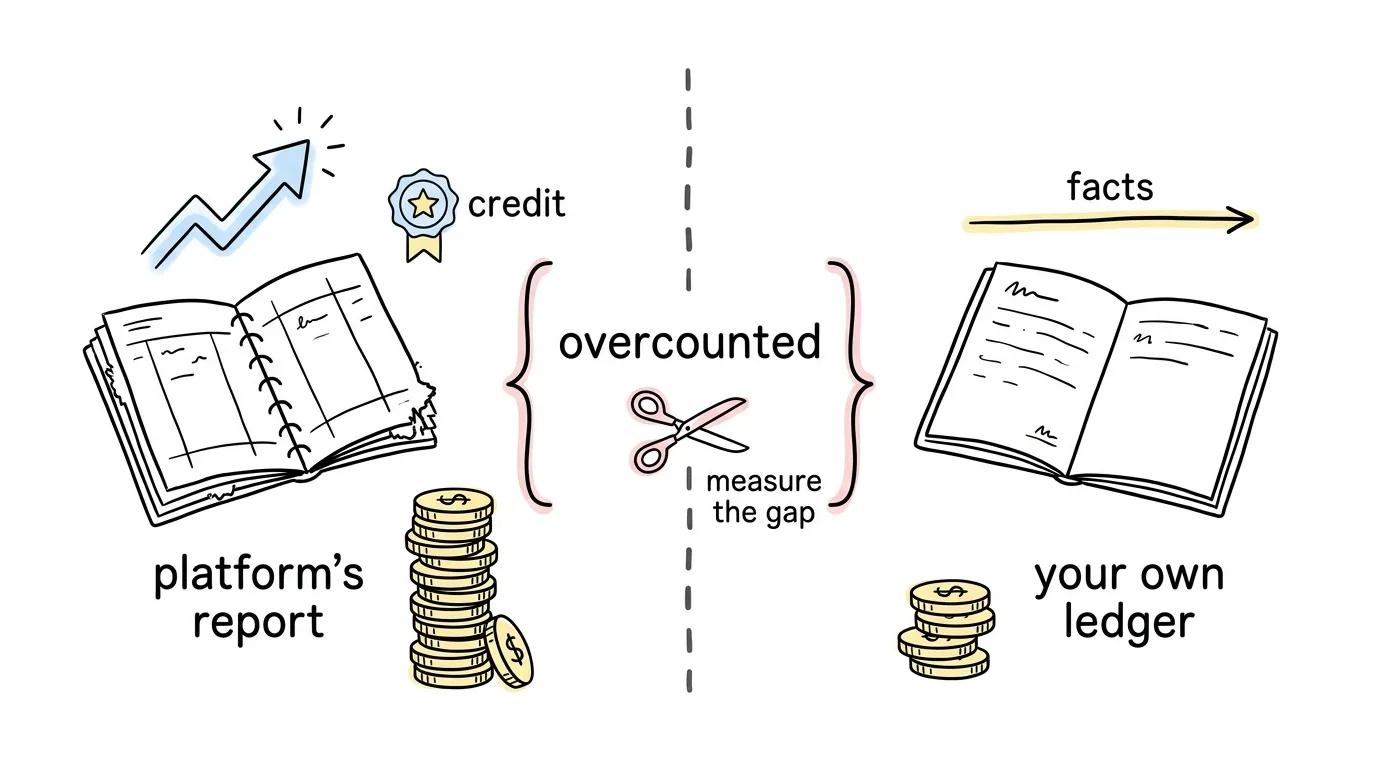
The method is plain. Use third-party tools — Google Analytics 4, AppsFlyer, Adjust — as your second ledger. Run holdout tests: keep a region where you don't advertise, and measure true incremental lift. Before and after turning on an AI tool, strip out seasonality and compare cost and return on the same accounting basis.
The platform reports credit; third parties measure facts. The gap between those two ledgers is precisely the part by which you're being overcounted.
Back to that friend from the beginning. He went on to do three things: turned off creative auto-transformation, connected the Conversions API, and reviewed the placement report once a week. When we met last month, he said something I still remember clearly:
Let the machine spend your money if you like — but the ledger has to be kept in your own notebook.
May every cent you put into ads be a cent you can trace.
Continue reading
Related articles

It's 2026: Stop "Buying" AI Tools for Your Marketing Team — Start "Hiring" AI Agents
This learn article explains how AI agents differ from standalone AI tools in marketing, outlines three agent categories — build-your-own platforms, CRM-native agents, and vertical tools — and covers use cases across SEO, social media, advertising, and reporting, plus criteria for choosing one.

Did the Money You Spent on AI Marketing Ever Come Back?
A guide to measuring AI marketing ROI across three layers: ad reports, sales pipeline, and the financial ledger. Covers metrics such as ROAS and CPA, eight dashboard metrics, industry benchmarks, and common measurement mistakes.

How to Pick a Creative Automation Platform: First, Figure Out What These Eleven Actually Do
A learn article sorts eleven creative automation platforms — including Bannerflow, Celtra, Smartly.io, and Storyteq — into four functional groups and proposes five evaluation questions covering publishing reach, automation depth, ease of adoption, team fit, and verifiable evidence.