
Rankings Held. Traffic Vanished. A New Discipline Called GEO
Introduces GEO (Generative Engine Optimization): how AI engines decide which brands to mention and cite, why rankings can hold while traffic falls, and four practical plays covering content clusters, third-party trust platforms, structured data, and AI visibility monitoring, plus how GEO complements SEO.
Last week, a friend who runs a cross-border e-commerce store posted a screenshot of his analytics dashboard in a group chat.
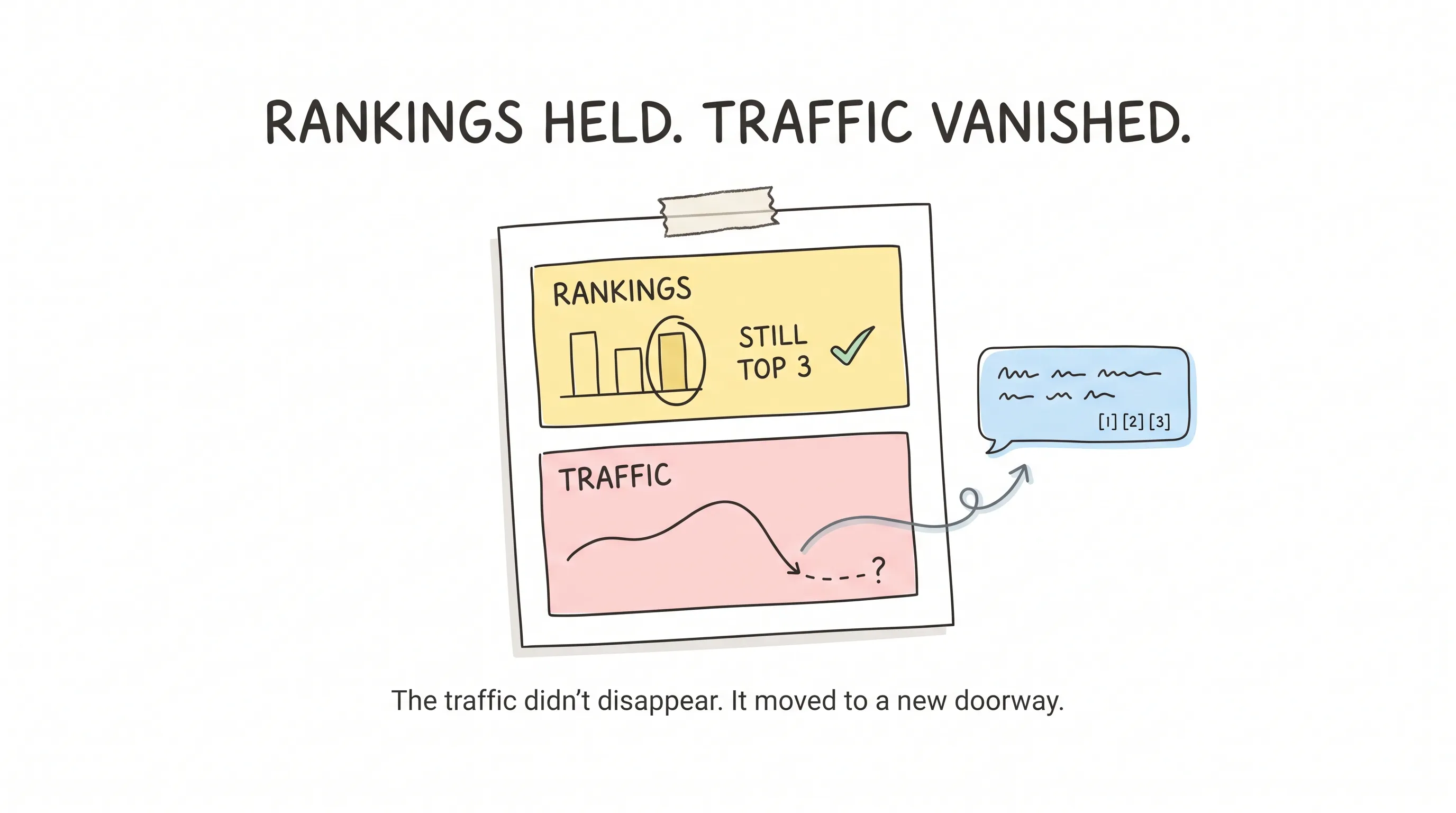
Search rankings: rock solid, top three. Traffic curve: cut in half.
He asked: I haven't changed a thing. Where did everybody go?
My answer: the people didn't leave. They just stopped clicking links. They asked ChatGPT "which one should I buy," got an answer, and ChatGPT casually listed three recommendations. His store wasn't one of them.
He's not alone. In Google's own published data, AI Overviews now appear in at least 16% of searches — and the share is higher for commercial and comparison-shopping queries. According to Previsible's AI traffic report, in the first half of 2025, visits from AI sources grew 527% year over year.
Wow. 527%.
What Exactly Is GEO?
GEO stands for Generative Engine Optimization.
Put simply: it means getting AI engines — ChatGPT, Perplexity, Google's AI Overviews, Gemini — to mention you, cite you, and recommend you when they answer user questions.
Note carefully: the goal is not "ranking first." The goal is being spoken.
Here's an analogy. A search engine is like a shopping street: SEO is renting the best storefront, with foot traffic walking right past your door. A generative engine is like a top sales associate. The customer asks one question, and the associate says: for this situation, I suggest you look at these three.
AI is not a channel. AI is a sales associate.
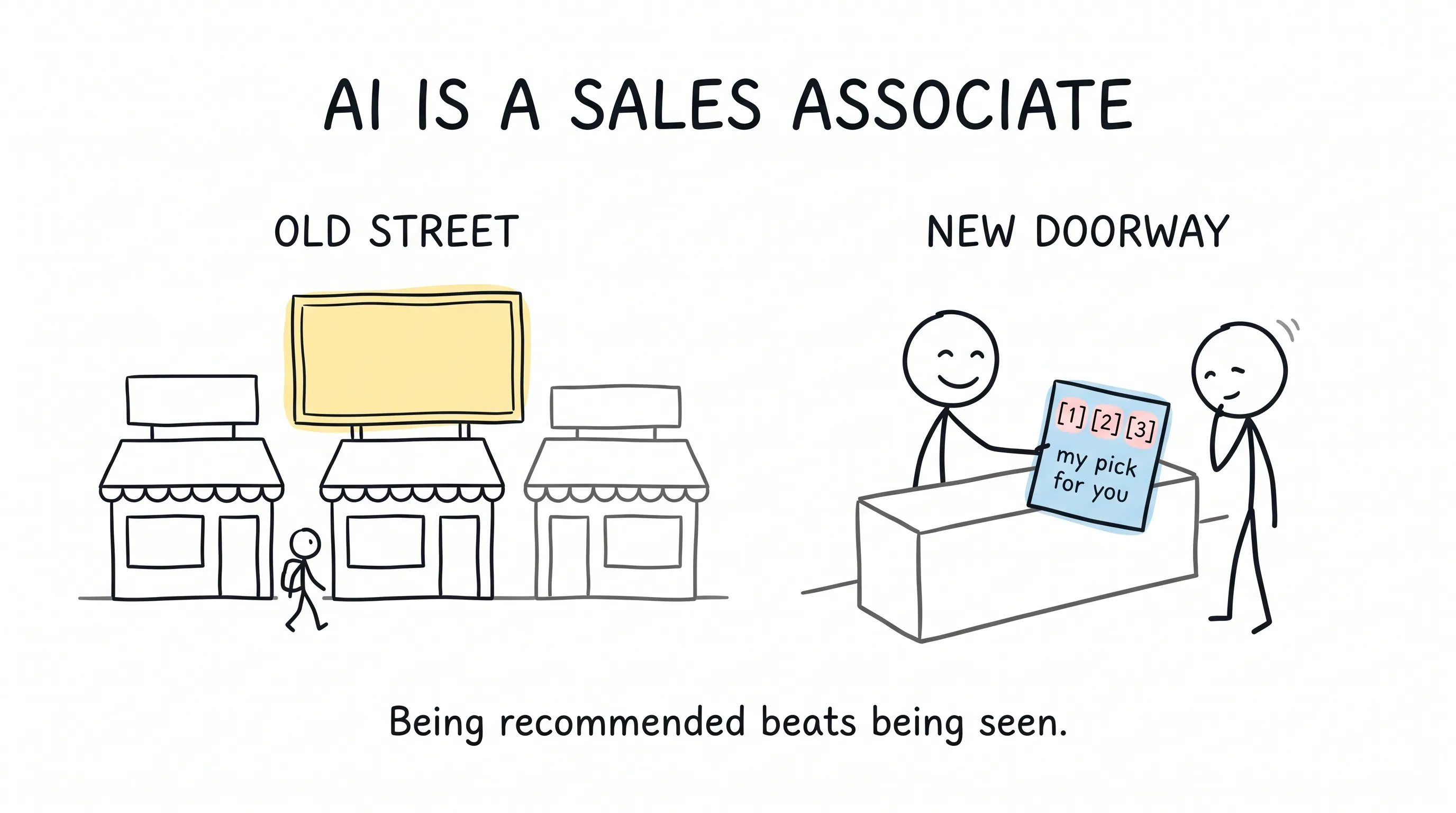
Whomever the associate recommends makes the customer's shortlist. If your store doesn't get recommended, it doesn't matter how big your sign is — the customer never walks down that street.
Why Now?
Look at a few numbers.
ChatGPT has over 800 million weekly active users and handles 2.5 billion queries a day — that's OpenAI's mid-2025 figure. Google's Gemini has passed 750 million monthly active users. Perplexity has 45 million active users making 780 million queries a month.
60% of searches now end in zero clicks. The user reads the answer, the problem is solved, the link never gets clicked.
And here's the one that stings: when an AI summary appears at the top of the page, the number-one organic result's click-through rate drops to 2.6%. That figure comes from Incremys' January 2026 statistical report.
Think about that. You spend three years and a six-figure budget pushing a keyword to the top spot. Then an AI box hangs above your head and finishes the sentence for you.
In MarGen's report, one projection: by 2026, roughly half of all global searches will be AI-driven. McKinsey predicts that by 2028, the figure will be 75%.
The direction is no longer up for debate. The only question left is when you get on board.
How Does AI Pick Whom to Mention?
This is what every business owner wants to know: on what grounds does ChatGPT mention you and not the shop next door?
Most AI search runs on a mechanism called RAG (retrieval-augmented generation). The name sounds intimidating, but it comes down to two steps: first, scour the web for material; second, knead what it finds into a single answer.
Picture these two steps as two rounds of interviews. Round one reviews the résumé: can your content be crawled and retrieved? Round two meets the person: is your content credible enough to make the final answer?
Anyone cut in round one never gets a shot at round two.
So what does the examiner look for in round two? Five things, mainly.
One: do you have real depth on the topic? AI doesn't look at a single article; it looks at the entire field of content you've built around a subject. One viral hit cannot establish authority. A cluster of content can.
Two: do you answer crisply? When AI extracts content, it takes the 40 to 60 words at the start of each subsection that directly answer the question. However beautifully you craft the buildup, it won't memorize it.
Three: are the numbers plentiful and solid? "Many users say it's great" cannot be cited. "43% repurchase rate" can. AI has been trained to favor precise, verifiable statements.
Four: what do others say about you? Reviews on G2, Capterra, Trustpilot; discussions on Reddit and LinkedIn; press coverage. In AI's eyes, this third-party testimony is worth far more than your own self-praise.
Five: can machines read you at all? Can crawlers get in? Is your structured data marked up? Is your site fast? This one is the most basic, and the easiest to fumble.
Clearscope put it well in its SEO/AEO handbook: the world as AI sees it is not the same world as search rankings. Optimizing for one does not automatically get you into the other.
So How Does the Math Work Out?
I like to run the numbers on the downside first. People in my feed are already pitching GEO as a miracle cure. That's dangerous.
The bad news, in four parts.
First, measurement is still crude. Only 16% of brands systematically track their AI search performance. Good luck answering "how many orders did ChatGPT actually send me last month."
Second, zero-click means being seen does not equal being visited. You get brand exposure; traffic is not guaranteed.
Third, it's slow. GEO results typically take 3 to 6 months to show. If you need numbers this quarter, don't count on it.
Fourth, the big players crowd the field. 99% of AI Overviews citations come from Google's top ten organic results. One industry snapshot shows 26% of brands receive zero AI mentions within their own industry. Small sites muscling into head topics start at a disadvantage.
But the good news is harder — harder numbers, that is.
Visitors arriving from AI are 4.4 times higher quality than traditional organic search traffic — again measured by Incremys. Why? Because they arrive holding a recommendation list the AI gave them. They come to confirm, then to buy. Traffic will shrink, but the people who reach your door are closer to pulling out a wallet.
Tally, a small team building a form tool, adjusted its content along GEO lines — and ChatGPT became its number-one traffic source. Semrush's analysis specifically recorded this case. Note: number one, ahead of Google.
Now consider the size of the pot. The GEO market was $886 million in 2024 and is projected to reach $7.3 billion by 2031, a 34% compound annual growth rate. And right now, only 23% of marketers are systematically investing in GEO.
In a window of opportunity, today the premium is on being first; tomorrow, the premium is on catching up.
What Do You Actually Do?
The playbooks floating around run eight to ten items long. I've boiled them down to four.
First: build your content like a tower, not a utility pole.
Build a content cluster around your core business: one pillar article, ringed by smaller pieces on sub-topics and sub-questions, all interlinked. When AI judges your authority, it looks at the whole complex of buildings — not a lone pole.
At the same time, the first 60 words of every subsection should deliver the answer directly. No buildup. Answer first; data and examples after. For Q&A sections, add FAQ structured data (machine-readable markup).
And produce some original data. Your own surveys, case libraries, benchmark tests — these are what AI loves to cite most. If the whole internet has already said it, why would AI cite you instead? The figures nobody else has are the ones worth citing.
Second: go where AI trusts, and leave your name there.
In 2025, Reddit, LinkedIn, and YouTube all sit near the top of large models' citation lists. So: write seriously on LinkedIn, participate seriously on Reddit, fully build out YouTube descriptions and subtitles, accumulate reviews on rating platforms, and chase coverage from industry media.
This is slow work — but the compounding is frightening. One review, one citation, may go live simultaneously across several AI engines and keep paying out for years.
Third: keep the machines happy.
Deploy Schema structured data wherever it belongs: FAQ, Article with full author information, Organization, Review. Fill out author bios completely — titles, photos, links to social profiles; these are the hard currency of E-E-A-T (Experience, Expertise, Authoritativeness, Trustworthiness — Google's credibility framework). Don't block crawlers, and don't load slowly.
Treat important pages like living documents. Keep a "last updated" date at the top; refresh the data every quarter. The same article, refreshed this year versus untouched for three years, is two different creatures in AI's eyes.
Fourth: put three gauges on your dashboard.
Stop staring at rankings. Watch these three numbers instead: AI citation share — of all target questions, the proportion where you get mentioned; citation sentiment — whether the mentions speak well of you or poorly; and zero-click erosion rate — how much traffic AI summaries siphon off your pages.
Tools like Semrush, Writesonic, and Clearscope can already monitor your brand's visibility inside ChatGPT, Google AI Mode, and Perplexity. Which tool you pick doesn't matter. What matters is that you stop flying blind.
Three Kinds of Business, Three Playbooks
Different businesses put GEO's weight in different places.
For "nearby" businesses — clinics, renovation contractors, law firms — the weight is local: keep your Google Business Profile polished, keep name/address/phone consistent across every directory, pile up reviews with location names, and turn the questions local customers would actually ask an AI into Q&A content.
For e-commerce, the weight is product data: structured product information, thorough comparison content, Q&A pages for every category — and reviews. Reviews. Reviews. MarGen's report carries another figure: by mid-2025, retail traffic from AI had grown 4,700% year over year.
4,700%. This is one ride e-commerce cannot afford to miss.
For B2B services, the weight is professional reputation: publish research and case studies with real data, and run LinkedIn as your home field. B2B decision-makers check LinkedIn before they ever ask an AI a question. And the AI is reading LinkedIn too.
Does This Fight with SEO?
No. Quite the opposite.
As noted above, 99% of AI Overviews citations come from Google's top ten organic results. That means SEO is the admission ticket. If you can't crack the top ten, AI basically can't see you.
Flip it around, and GEO feeds back into SEO. When AI cites you, searches for your brand name rise; rising brand-name searches signal authority to Google; authority brings rankings; and rankings raise the odds of being cited again.
A wheel that accelerates itself.
Incremys' statistics hold two more numbers: among companies already doing GEO, 63% observed improved overall digital visibility; with the right methods, AI visibility can rise by an average of 40%.
So stop asking whether GEO should replace SEO. They are two gears meshed into each other.
Once the wheel starts turning, it accelerates itself.
Finally
Back to the friend in the group chat.
I later gave him three moves: first, refresh your twenty most valuable articles — answer at the top, freshen the data, complete the structured data; then spend one afternoon in ChatGPT and Perplexity asking twenty questions in a customer's voice, logging every time it mentioned you and every time it didn't; then, three months later, look at that traffic curve again.
He said: that doesn't sound like mysticism.
It never was. 800 million people have already changed how they ask questions. 60% of searches already end without a click. And fewer than a quarter of the players are inside the window.
The traffic didn't disappear. It just moved to a new doorway.
Here's to moving to the new door — sooner rather than later.
Continue reading
Related articles

It's 2026: Stop "Buying" AI Tools for Your Marketing Team — Start "Hiring" AI Agents
This learn article explains how AI agents differ from standalone AI tools in marketing, outlines three agent categories — build-your-own platforms, CRM-native agents, and vertical tools — and covers use cases across SEO, social media, advertising, and reporting, plus criteria for choosing one.

What Is GEO? How Your Brand Gets "Mentioned" in the Age of AI Search
An explainer on GEO (Generative Engine Optimization) for e-commerce and DTC brands: how it differs from SEO and AEO, why AI answers shape brand visibility, and eight practices covering question-focused content, consistent brand messaging, structured pages, external evidence, comparisons, and AI mention tracking.

AI Is Already Making Decisions for Your Customers. Are You on the List?
A learn article explains GEO (Generative Engine Optimization): why AI-generated answers now shape which brands customers see, and how SEO fundamentals, entity clarity, citable evidence, and monthly measurement affect visibility in AI answers.