
What's the Point of a Top Ranking If AI Never Cites You? It All Counts for Nothing
An explainer on GEO (Generative Engine Optimization), arguing that AI citations are becoming a key visibility metric as users shift from clicking search links to asking AI assistants directly. It covers citation behavior across AI engines, new metrics, and budget considerations for marketing teams.
A few days ago, a friend came to me about renovating his home. I told him to go search for guides. He said he'd already "searched" — he just asked an AI directly. The AI gave him three design styles, a budget range, and a few pitfalls to avoid. The whole time, he never opened a single web page.
When I heard that, a chill ran down my spine.
Our industry has spent over a decade doing "search optimization," and all that effort has gone into one thing: getting users to click through. But now, more and more users simply don't click. The AI chews the answer up and hands it straight to them — it can't even be bothered to show them a blue link.
The way people ask questions has changed too. It used to be "renovation styles comparison." Now it's a full sentence: "My place is 90 square meters, the lighting is mediocre, my budget is 200,000 yuan — help me pick a style." Questions are getting longer, more specific, and more expectant that you'll hand over the answer directly.
What does this mean? It means the rules of traffic distribution are being rewritten.
What Is GEO?
First, a term: GEO — Generative Engine Optimization.
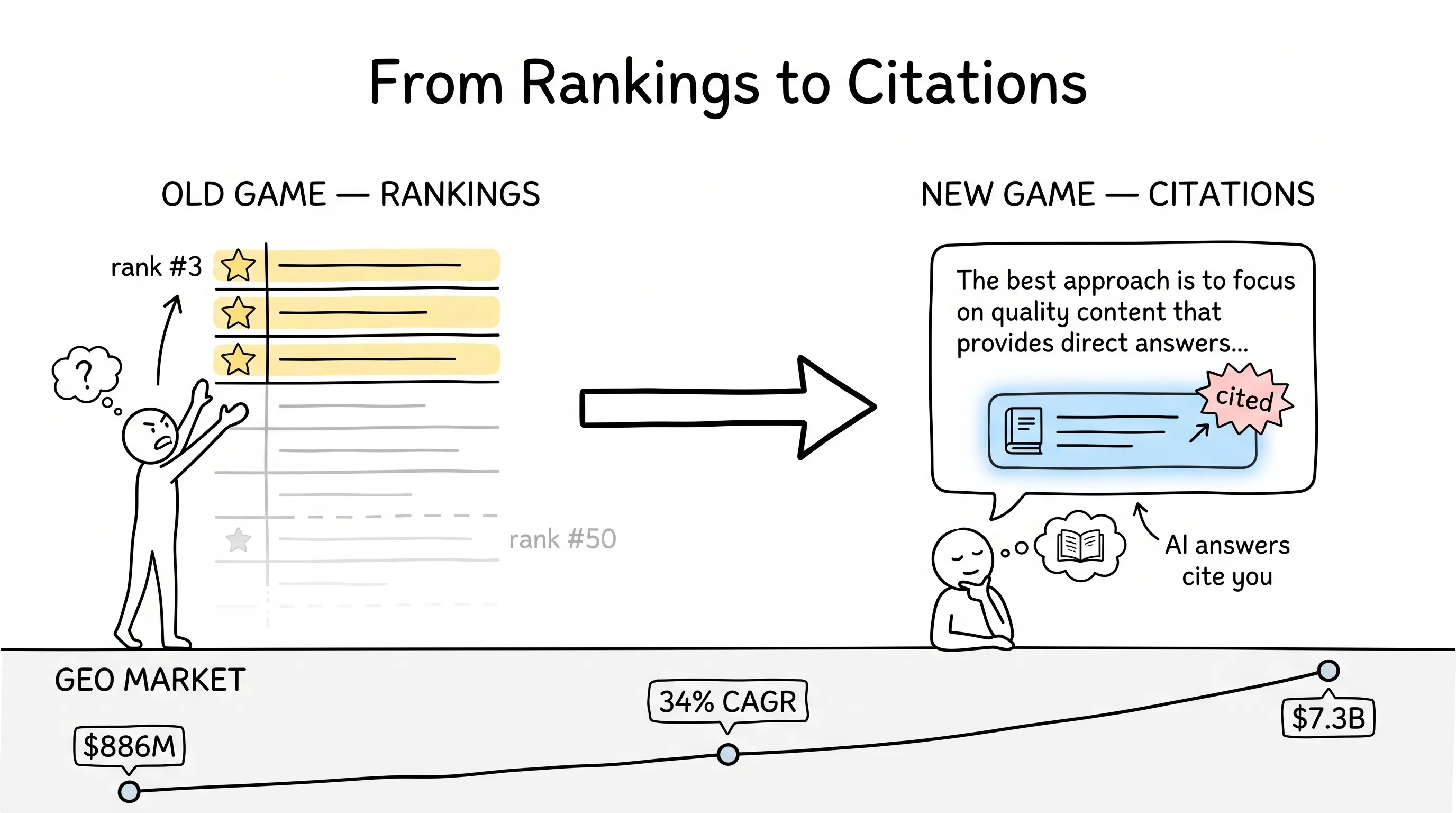
What is generative engine optimization? In the past, you optimized content to feed Google's crawlers, aiming to rank first among a pile of blue links. Now you optimize content to feed AI engines like ChatGPT, Gemini, and Perplexity, aiming to get them to cite you in their answers.
It used to be a contest for rankings. Now it's a contest for citations.
That is GEO.
Some might think this is a tiny niche. Quite the opposite. According to Valuates Reports, the GEO market was worth just $886 million in 2024, and is expected to reach about $7.3 billion by around 2030 — a compound annual growth rate (CAGR) of 34%. In plain terms: it more than doubles every three years.
And on the enterprise side? 65% of organizations are already using generative AI in their regular workflows. Marketing teams have moved even faster: in Superlines' 2025 survey, 86% of teams had already worked AI into their SEO workflows, and 82% planned to invest even more.
Good grief — this isn't experimentation anymore. This is relocation.
Have Users Really Changed?
Some will say: AI search sounds buzzy, but aren't people still using Google?
Fair question. Let's look at it layer by layer.
The outermost layer is young users. Surveys show that roughly one-third of Gen Z searches now happen directly inside tools like ChatGPT, bypassing traditional search engines entirely.
The middle layer is purchase decisions. A 2025 survey from Harvard Business Review put a number on it: 58% of consumers rely on AI for product recommendations. Two years ago, that figure was 25%. Two years — more than doubled.
The innermost layer is content supply. Data from Ahrefs shows that 63% of websites can already receive visits from AI, though the share is still small. Meanwhile, the number of keywords covered by Google's AI Overviews stood at 10,000 in August 2024; by May 2025 it had surpassed 170,000. In less than a year, a 16-fold increase.
So is traditional search dead?
No. 98.1% of ChatGPT users are also still using Google. And about 80% of users on searches with commercial intent will still click through for the details after reading a summary.
So the real picture is this: AI isn't replacing search — it's standing in front of search. Users ask the AI first, the AI consumes your content first, and then the user decides whether to come to you.
Your content has to get past the AI first.
How Do You Get Past It?
Now we come to the most interesting part. The rules by which AI decides whom to cite are almost entirely different from the logic of Google rankings.
Semrush ran a citation study, and the conclusion stopped me in my tracks: 89% of ChatGPT's citations come from pages that rank below position 20 in traditional search.
What does that mean? It means you can rank #3 on Google and the AI might ignore you; you can rank #50 and the AI may still cite you.
What it looks at isn't your ranking — it's whether the content itself explains the problem thoroughly.
Look closer, and each engine has its own tastes. Profound analyzed more than 480,000 citations and found that ChatGPT's favorite source is Wikipedia, at 47.9%; Perplexity favors Reddit, at 46.7%; and Google AI rotates among Reddit, YouTube, and LinkedIn.
But the underlying preference is the same: content that is clearly structured, answers the question directly, and comes with data and sources is easy to cite.
Who benefits most? Small companies, small teams, and specialists in niche verticals.
Think about it: in the past you had to compete with the giants on rankings, backlinks, and budget — ten years of chasing and you'd never catch up. Now, as long as your content is professional enough and clear enough on one narrow question, the AI may speak up for you. This is a rare reshuffle that puts the giants and the small players back on the same starting line.
Is It Worth It? Let's Do the Math
That's the opportunity. Now for the accounting.
What about return on investment? Put a few numbers side by side:
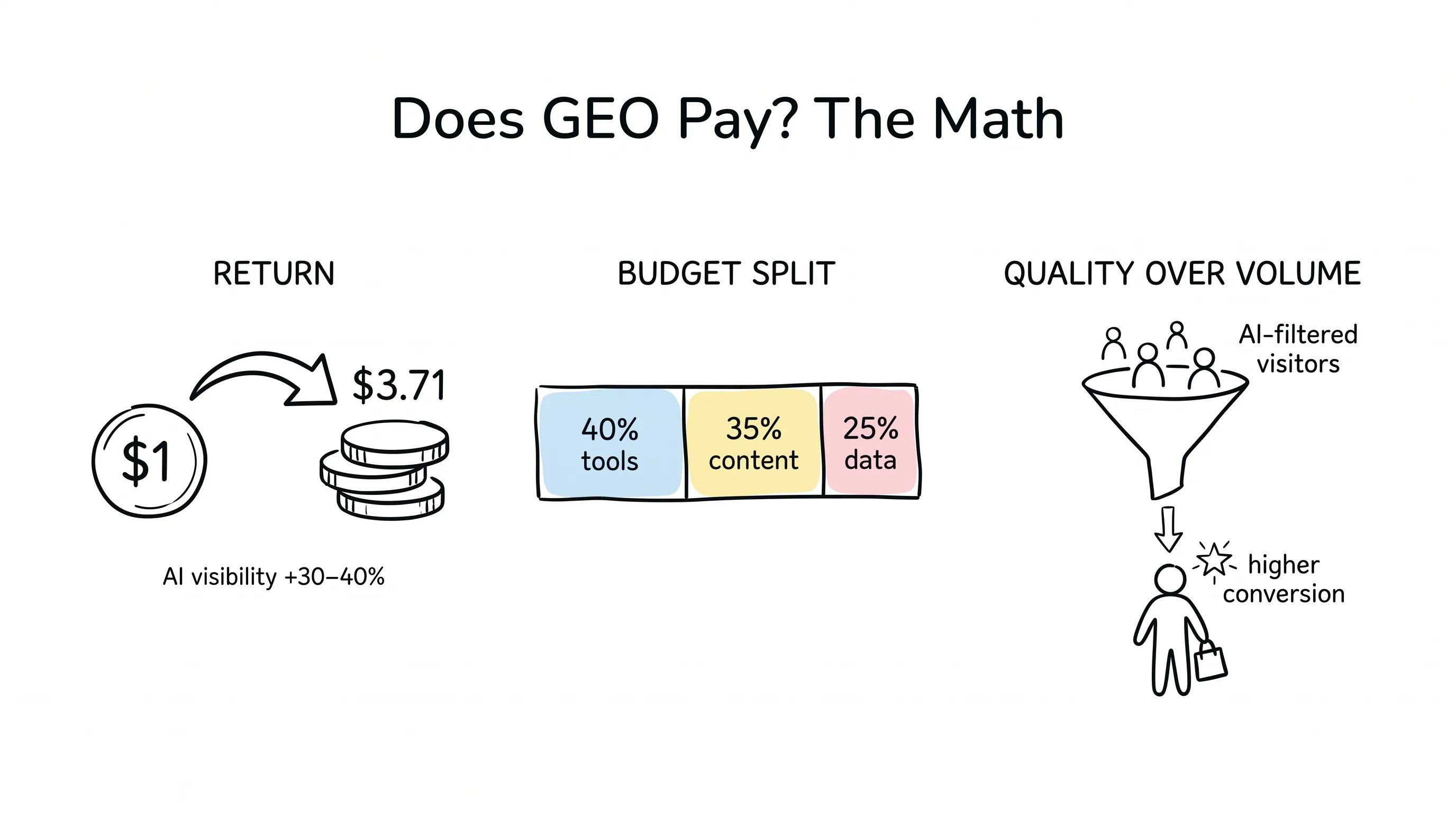
Superlines' effectiveness report offered one set: content optimized for GEO sees average AI visibility gains of 30% to 40%; every $1 invested brings back an average of $3.71 in value. And the content can be reused, cutting creation costs by about 30%.
By industry, it gets more interesting. SaaS and finance are out in front, with adoption rates of 78% and 72% and ROI around 4x. But there's a counterintuitive finding: e-commerce gets the lowest share of AI traffic — just 5% — yet has the highest conversion rate of any sector.
Why? Because the AI has already filtered visitors for you. A visitor who has been educated by an AI's answer and confirmed their need before clicking through arrived with the decision already made.
The traffic is smaller, but every visitor is worth more.
But now let me pour a bucket of cold water.
For all the noise, the actual migration of real money is still early-stage. Only 6.5% of enterprises have put more than half their budget into AI, and nearly half of enterprises spend less than 10% of their SEO budget on AI tools.
So my advice: don't go all in — but you have to start moving. A widely accepted split in the industry is 40/35/25: 40% to tools and infrastructure, 35% to content, 25% to data measurement. Keep doing traditional SEO as usual — that's still an $89 billion foundation — just add a layer on top.
The Metrics Have to Change Too
When budgets move, performance reviews have to follow.
You used to watch rankings, click-through rates, keyword density. That toolkit is failing. Among queries where AI Overviews appear, the top organic result's click-through rate has dropped 32%; for informational sites it's worse — some have lost more than 60% of their traffic.
What do the new metrics look like? Here are the core ones:
AI citation rate — how many times you get cited in AI answers. LLM visibility — of the questions you target, how many surface you. Then there's prompt penetration rate, AI-driven sessions, and the sentiment of mentions — whether AI speaks of you favorably or not.
Who is actually watching these numbers? 67% of leading enterprise teams are already tracking GEO metrics, and about 40% have written them into monthly reports. Smaller teams are slower, but the direction is the same.
Put simply: you used to be graded on "rankings." From now on, you're graded on "being cited."
What Happens Next?
Looking a few years ahead, several trends are basically locked in.
Around 2028, AI-first search will overtake traditional search for informational queries. Zero-click will go from exception to norm. Citation sources will expand from web pages to video and audio — Profound's domain research already shows .com taking about 80% of citations, while .org and authoritative institutions earn more trust on knowledge questions.
The platform landscape will shift too. In 2025 data, ChatGPT holds 59.7% of AI search share, miles ahead of the pack, with Perplexity and Claude chasing behind. No one stays on top forever, so a GEO strategy has to be multi-platform — don't put all your eggs in one basket.
Thirty years ago, the first movers were submitting websites to directories. Twenty years ago, everyone was studying keywords. Ten years ago, the contest was content and backlinks. Today, it's making AI willing to cite you.
Every time one playbook gives way to the next, the early movers eat the meat, the later ones sip the broth, and the stragglers don't even get the soup.
One Last Thing
Back to my friend with the renovation. The plan he ultimately chose came from an article cited in an AI recommendation. Where did that publication rank? I have no idea — probably not high. But the AI cited it, and it won the client.
Over the next few years, the gateway to search will look more and more like this: first the AI's answer, then your click.
Whoever can be found, cited, and trusted by AI holds the ticket to the next round of traffic.
Here's wishing you get in early.
A note on the data: Figures in this article come from public research and surveys published in 2024–2025 by Harvard Business Review, Semrush, Profound, Ahrefs, First Page Sage, Valuates Reports, and other institutions.
Continue reading
Related articles

It's 2026: Stop "Buying" AI Tools for Your Marketing Team — Start "Hiring" AI Agents
This learn article explains how AI agents differ from standalone AI tools in marketing, outlines three agent categories — build-your-own platforms, CRM-native agents, and vertical tools — and covers use cases across SEO, social media, advertising, and reporting, plus criteria for choosing one.

What Is GEO? How Your Brand Gets "Mentioned" in the Age of AI Search
An explainer on GEO (Generative Engine Optimization) for e-commerce and DTC brands: how it differs from SEO and AEO, why AI answers shape brand visibility, and eight practices covering question-focused content, consistent brand messaging, structured pages, external evidence, comparisons, and AI mention tracking.

AI Is Already Making Decisions for Your Customers. Are You on the List?
A learn article explains GEO (Generative Engine Optimization): why AI-generated answers now shape which brands customers see, and how SEO fundamentals, entity clarity, citable evidence, and monthly measurement affect visibility in AI answers.