
Even the IAB Has Now Published an AI Manual for Advertising. The Manual Itself Is Worth More of Your Attention Than What's Inside
An analysis of the IAB's early-2025 generative AI advertising playbook, arguing that the standards body publishing it signals AI has moved from experimentation to mainstream practice in advertising workflows.
A few days ago I was skimming industry news and came across one item: the IAB (Interactive Advertising Bureau) — the US advertising industry's standards-setting body — published a playbook for using generative AI in advertising at the start of 2025.
Oh?
Honestly, my first reaction was to freeze for a few seconds.
What's a playbook? Put plainly, it's an operations manual. Where to start on a task, how to handle each step, how to check the result when you're done — all written out in black and white, and off you go.
When one person needs an operations manual, it means they've never done it before. So what does it mean when a whole industry needs one?
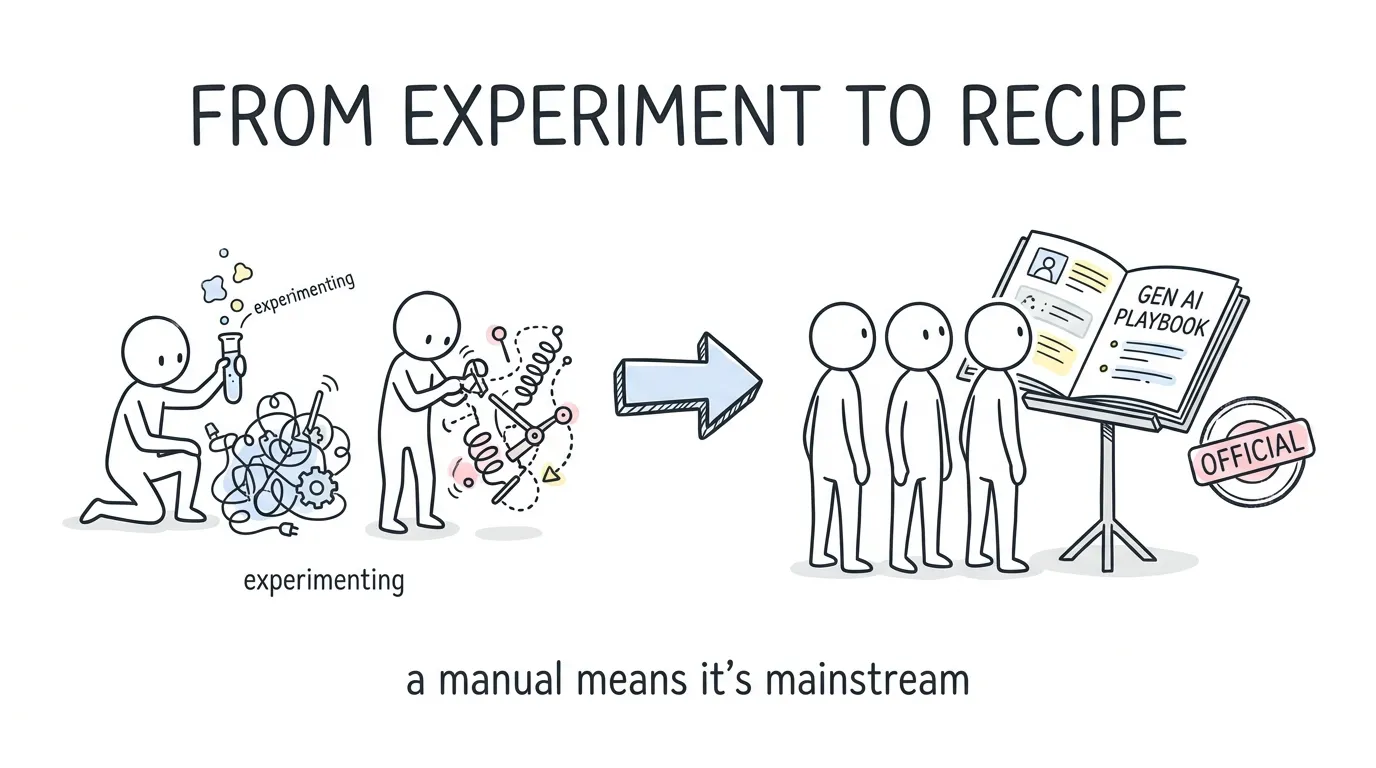
It means this thing has moved from "a few early adopters experimenting" to "the majority following the recipe."
First, look at what's inside. It divides generative AI's uses in advertising into three big blocks: content creation, media buying and campaign optimization, and measurement. Who is it written for? Brands, agencies, technology providers — all three, no one left out. The promised benefits are direct too: creative development cycles get faster, consumer experiences get personalized, and ad optimization gets more granular.
Up to here, it's all standard practice. Industry bodies publish a few guides every year, after all.
But the interesting part is the timing.
Think about it: what kind of moment was early 2025? ChatGPT had already been hot for over a year; everyone in advertising was talking about AI. But when it came to actually putting it to work, every company did it their own way and stumbled in their own way. Some used AI to mass-produce creative assets, some used it to tune their media buying, and some had no idea where to even start.
At this stage, the hardest thing is never a lack of tools. It's not knowing how to use them, how far to go, or how to explain the results to your boss.
That the IAB picked this moment to step in — gathering up the scattered practices across the industry and organizing them into a methodology anyone can consult — in plain English: the people who set the standards for this industry have judged that a replicable path has already emerged, and it's time to set the rules.
That's a hard, unmistakable signal.
Consider this: when does a standards body step in for a new technology? Usually after the practice has converged. During the wild experimentation phase, no standard can be written; only once everyone has run roughly the same distance can you distill something "an ordinary team can follow."
So I'd say the playbook itself may matter more than its contents. It's effectively an official stamp: generative AI in the advertising workflow has gone from an elective course to a required one.
Two more signals sit right next to this one, and they read even clearer together.
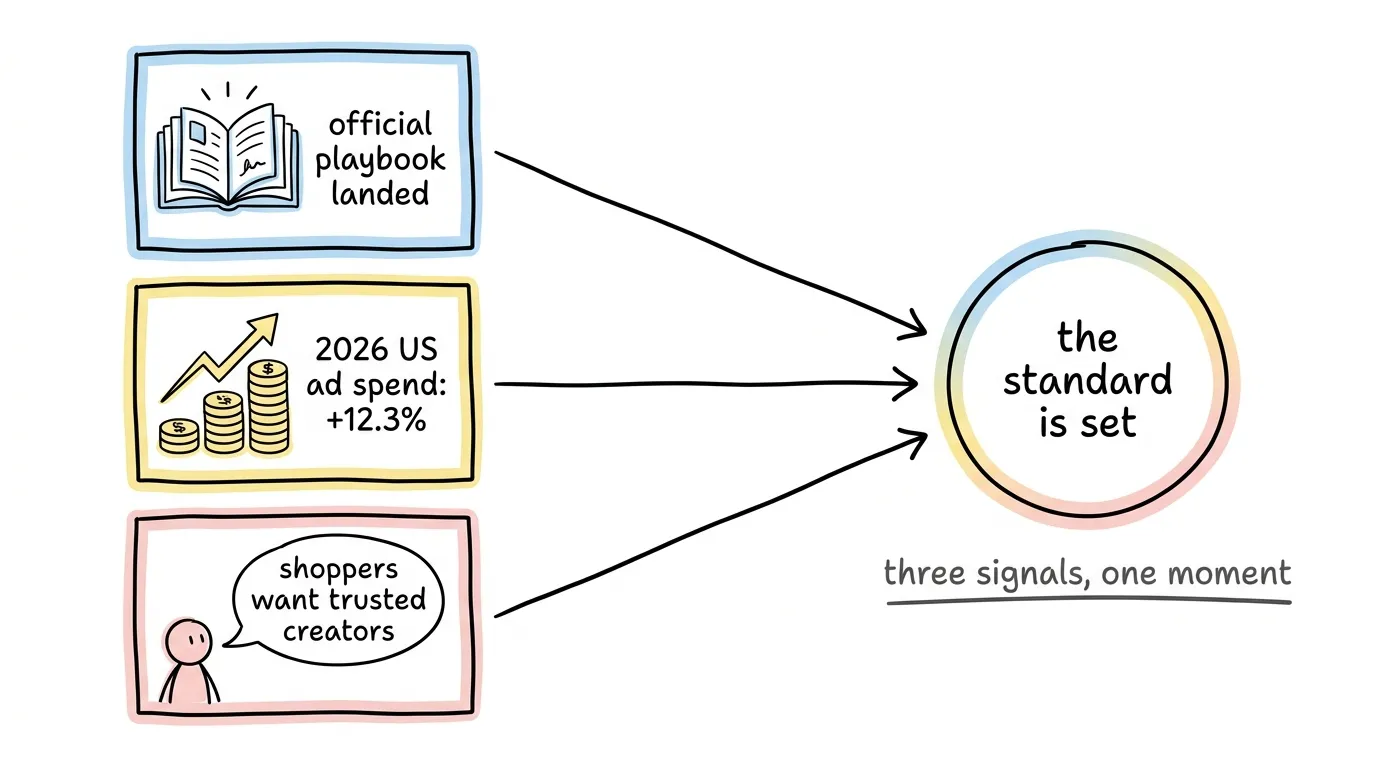
One: the IAB later raised its growth forecast for 2026 US advertising spending to 12.3%. The overall market is growing, and money is pouring into this industry.
The other: the IAB's own consumer-side research found that users want AI shopping recommendations to come with the perspective of trusted creators. In other words, consumers don't just want the algorithm to recommend — they want a person to vouch for it.
Tools are spreading, budgets are expanding, and consumer expectations are rising. Stack the three together and you understand why the playbook landed precisely when it did.
So what should you do?
Say you're a marketing lead at a brand, and your AI advertising project hasn't been approved yet. In the old days, you'd have to scramble to build the proposal yourself, and even then it would keep getting challenged — "why should we believe this?" Now it's different: a methodology from the industry's standards body is sitting right there; take it as your justification for approval. An armchair pitch of your own carries zero weight; with the official manual in hand, your case sells itself.
The only thing worth flagging: before you download it, get clear on one question — which link in the chain are you actually trying to fix? Creative production too slow? Media optimization too coarse? Results you can't explain? Go in with a problem, and work through the chapters finding the one that matches. Don't adopt it just to complete your toolkit; toolkits never solve anything — thinking it through does.
As for the full version, you'll need to register to download it. The framework in the table of contents is already enough to decide whether to go deeper.
Either way, the signal has been received.
The standard is now set. The rest comes down to how fast each player moves.
Continue reading
Related articles

It's 2026: Stop "Buying" AI Tools for Your Marketing Team — Start "Hiring" AI Agents
This learn article explains how AI agents differ from standalone AI tools in marketing, outlines three agent categories — build-your-own platforms, CRM-native agents, and vertical tools — and covers use cases across SEO, social media, advertising, and reporting, plus criteria for choosing one.

Did the Money You Spent on AI Marketing Ever Come Back?
A guide to measuring AI marketing ROI across three layers: ad reports, sales pipeline, and the financial ledger. Covers metrics such as ROAS and CPA, eight dashboard metrics, industry benchmarks, and common measurement mistakes.

How to Pick a Creative Automation Platform: First, Figure Out What These Eleven Actually Do
A learn article sorts eleven creative automation platforms — including Bannerflow, Celtra, Smartly.io, and Storyteq — into four functional groups and proposes five evaluation questions covering publishing reach, automation depth, ease of adoption, team fit, and verifiable evidence.