
AI Personalization: The Hard Part Isn't the Technology, It's the Sequence
A learn article explaining that AI personalization succeeds through sequence, not technology: unify scattered customer data first, then launch two or three high-impact use cases before scaling automation.
A while back, a friend of mine who runs a SaaS company invited me out for coffee. He'd barely sat down before letting out a sigh: the company had set its big direction — make the whole company AI-driven. It was announced in every meeting, big and small, the budget was approved, the tools were bought. Several months later, on the customer side, nothing had changed.
I asked: did you start out planning to go fully automatic — hoping that by tomorrow, every single step of the process would be handed over to AI?
He froze for a second. How did you know?
There's nothing mystical about this. I've watched too many teams fall in exactly the same spot.
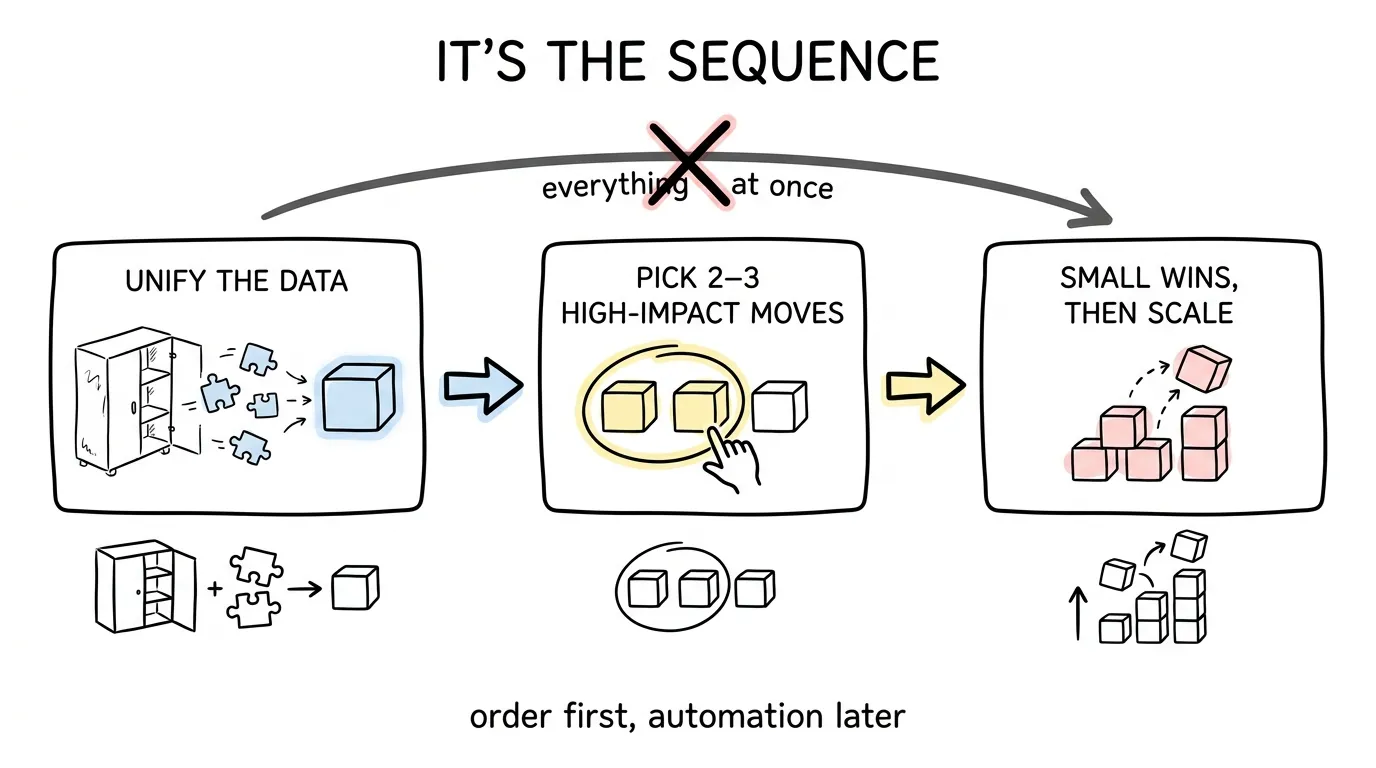
AI personalization sounds mystical. In practice, it's remarkably unglamorous. How unglamorous? Unglamorous enough that it's basically stacking blocks, one piece at a time. The real difficulty lies in the order: which block goes first, and which one after.
What Is AI Personalization?
Put simply, it means getting your system to know each specific person well enough: what they did, what they used, what they bought, where they got stuck. And then, based on all that, giving each of them something different.
We used to do customer segmentation — slice customers into a few groups, push different content to each group. That was already pretty good. But what AI personalization aims for is to go fine-grained all the way down to a segment of one.
So how does AI actually pull that off?
The more clearly it can see your customers, the more precisely it can personalize.
Your Data Is All There — It's Just Scattered
Here's a fascinating fact: the vast majority of companies already hold every piece of information AI needs.
Behavior. Usage. Purchases. The places customers get stuck. Nothing is missing.
So why is there still no personalization?
Because it's scattered.
Sales records sit in the CRM. Subscriptions and payments sit in the billing system. Product usage behavior sits in the product analytics tool. The marketing systems hold yet another set. And customer support records live in yet another completely separate system.
Think about it: a customer who's been dealing with you for six months has a profile that's been cut into five or six pieces, each one locked in a cabinet in a different room. No matter how smart the AI is, it can only enter one room at a time.
What it sees is forever just the leg in the blind-men-and-the-elephant story.
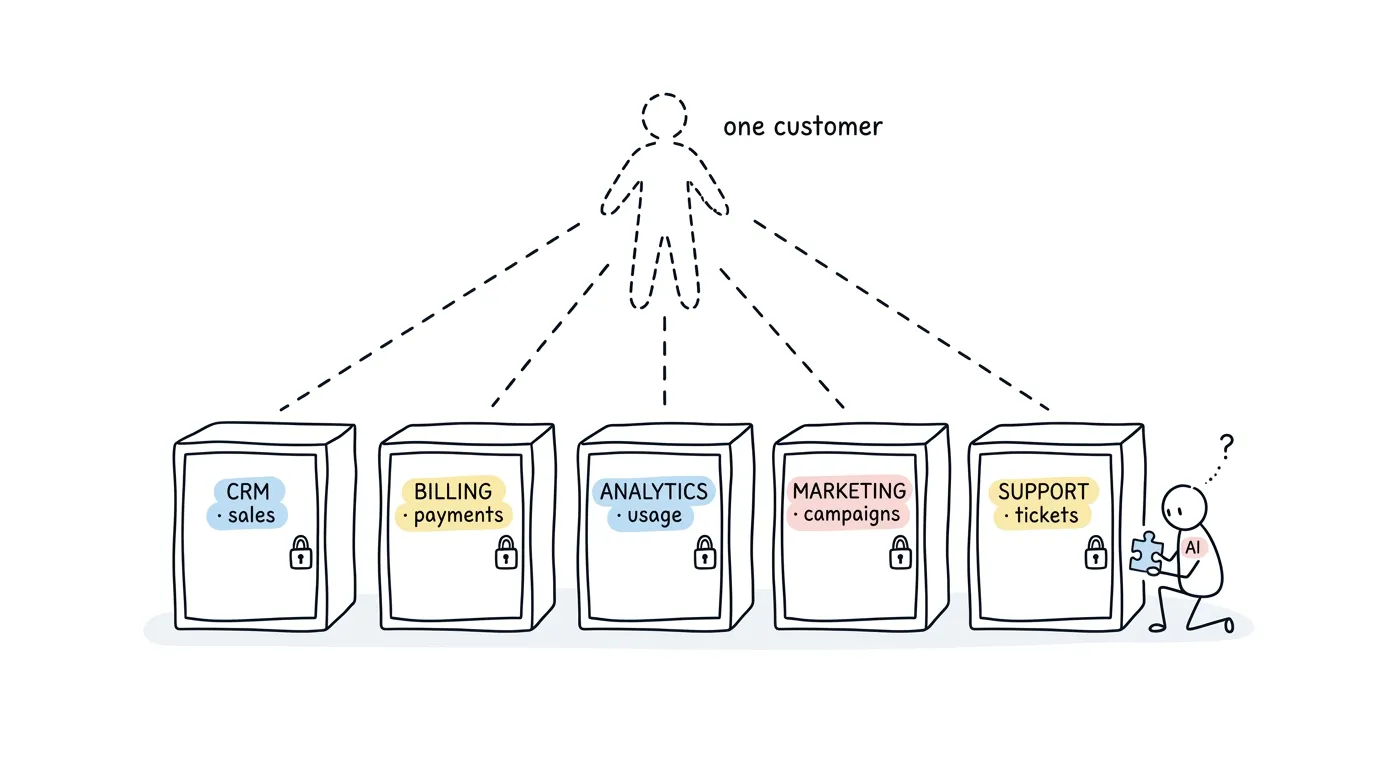
So buying a smarter AI doesn't even enter the picture yet. Open the cabinets first — and connect what's inside.
Take Stock First, Then Pour the Foundation
Two concrete things to do.
First, draw a map of "where all our data lives." List every system that holds customer information: CRM, marketing automation, web analytics, product telemetry, subscription billing, customer support platform. Count them one by one, and don't miss any.
Second, connect all that data into one unified whole. Make sure the same customer is the same person across every system.
Neither of these tasks sounds the least bit cool. They're almost boring.
But this is the foundation. If the foundation isn't solid, whatever you build on top comes out crooked.
I often use this analogy: AI personalization is like cooking a great meal. Heat control matters, of course — but first you need the ingredients, and the ingredients need to be in the same kitchen. If they're scattered across five warehouses, no matter how talented the chef, all he can do is watch, helpless.
Then: Pick and Choose, Don't Roll It All Out at Once
Once the foundation is laid, is it finally time to automate everything?
Quite the opposite.
The biggest mistake at this stage is to wave your hand and launch everything at once. That almost always fails.
The smart move is to pick. Pick the two or three actions with the biggest impact on customer experience and the biggest impact on the business, and start with those. Once they're running smoothly, once you can see results, once the team has confidence — then expand outward.
Why so slow?
Because the technical problems are actually the easy ones to solve. The truly hard part is organizational: does the workflow need to change, do people need to be reassigned, who's responsible when the data goes wrong. These questions can only grow their answers slowly, through one small win after another.
Small wins first, then scale. Let the organization grow along with the confidence.
A Final Word
Looking back at my friend: what he was missing, when you strip it all down, is remarkably plain.
He wasn't missing AI. He was missing sequence.
Build the data foundation first, then pick a few high-impact actions to test the waters, get them running, and then expand. It won't exactly set your heart on fire — but every team that has actually made this work has walked this same unglamorous road.
Get the sequence right, and the job is half done. The other half, leave to time.
Continue reading
Related articles

What Is AI Marketing Automation? It Starts With a 40-Point Gap
A learn article explaining what AI marketing automation is: how learning-based systems differ from rule-based automation, how AI decisioning optimizes message, channel, and timing choices, what data it depends on, and where it applies across the customer lifecycle.

Marketing Automation Is Shifting from "You Do It" to "You Say It"
This article explains how marketing automation is shifting from rule-based platforms that merely execute toward AI agents that plan, create, publish, and review campaigns, covering delegable tasks, underlying technologies, tool categories, adoption steps, and risks such as privacy and automating without strategy.

Rankings Are Taking a Dive, Customers Are Sprinting Ahead: This November, I Re-Ran the Numbers on AI Search
A learn article on how AI search reshapes marketing measurement, covering reported mismatches between rank-tracking tools and live Google results, ChatGPT's business profile test, single-page visitors as high-intent leads, and CRO plus GA4 tracking verification practices.