
How Should Marketers Use Generative AI? Do the Math First
A learn article on how marketers can use generative AI, starting with the difference between predictive and generative AI. It covers use cases such as email subject lines, ad copy, and audience segmentation, along with adoption stages, risks, responsible-AI questions, and regulation.
A few days ago, I had dinner with a friend who has worked in marketing for over a decade. He looked exhausted.
In a meeting, his boss said it's 2026 already, and the company needs to fully embrace generative AI. And then? Then nothing. Where to start, what it can actually do, and whether anything will go wrong if you use it — nobody could say.
I told him: don't rush to embrace anything yet. First, get one thing straight: predictive AI and generative AI are two different things.
So what's predictive AI, then?
It uses historical data to predict the statistically most likely outcome. It excels at pre-defined tasks: finding which customers are likely to churn, calculating what time of day an email gets the highest open rate. A lot of marketing systems have quietly been doing these things for years — you use them every day without even realizing it.
Then what's generative AI?
It's different. It swallows massive amounts of data, learns the patterns and structures inside, and then generates new content. Take customer churn again: predictive AI tells you "who is about to leave," while generative AI writes you a whole campaign for "how to keep them."
One is the strategist; the other does the work.
Alright, distinction made. So what can generative AI actually do for marketers?
I've boiled it down to four ledgers.
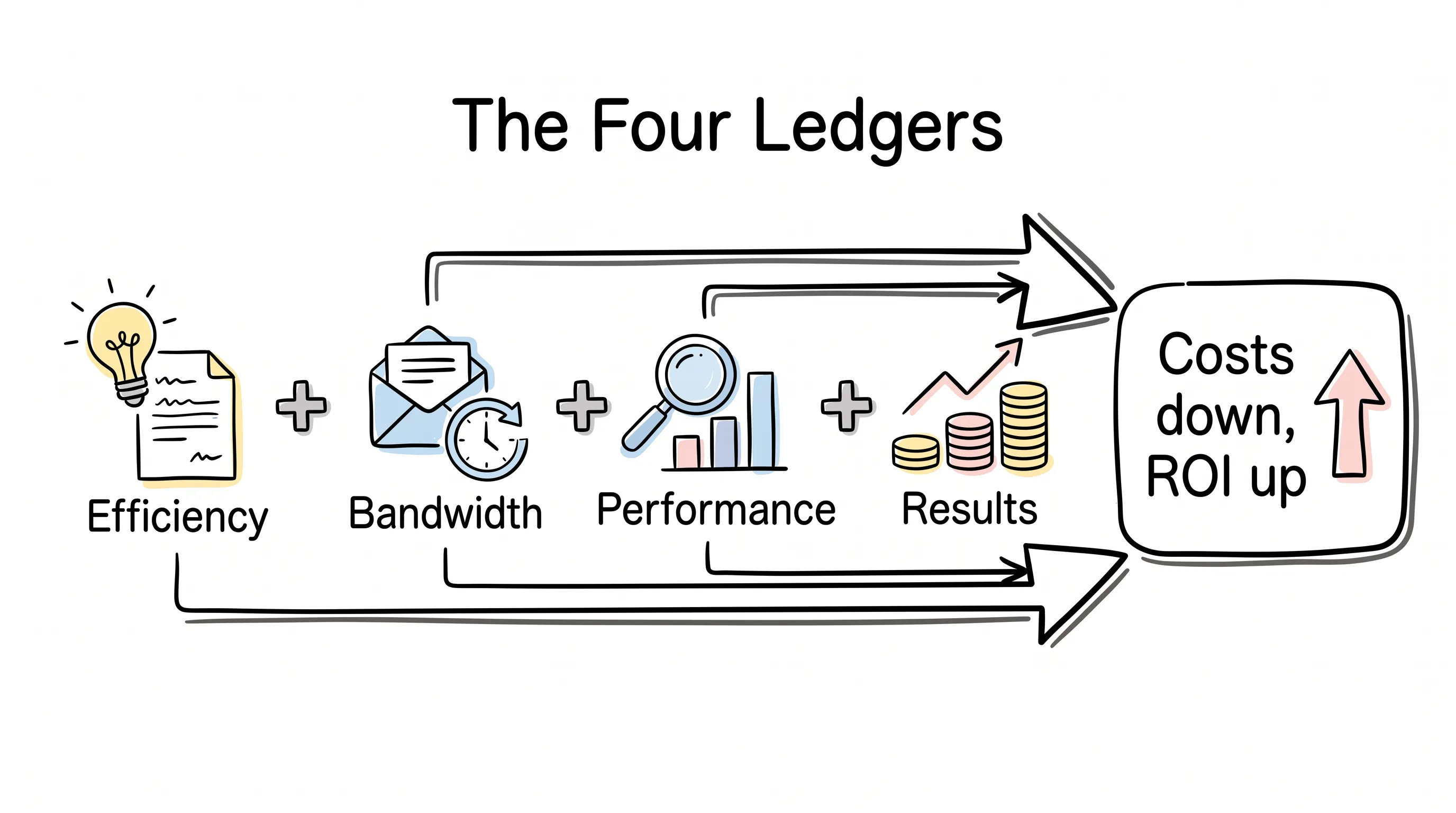
The Efficiency Ledger
In the day-to-day of marketing, huge chunks of time go to repetitive work. Brainstorming content ideas, writing product copy, managing ad placements, answering customer service questions — generative AI can lend a hand with all of it.
There's one example I particularly love. Stitch Fix, an online personal styling service, has generative AI write all of its Facebook and Instagram ad copy. Their claim: before GPT-3, planning an ad campaign and producing the copy took about two weeks. Now? The average copywriter reviews a draft in under a minute, and 77% get approved.
Two weeks, down to one minute.
I don't need to do this math for you, do I?
The Bandwidth Ledger
Efficiency gains are only the surface. The deeper question is: what do people do with the time they save?
Think about how a routine marketing email gets made. You spend a fair amount of time writing at least two subject lines, run a test, then wait for results. If you're lucky, one performs well enough and the campaign moves forward. If you're not, it's back to square one.
Now, generative AI can go through your entire history of campaigns and every segment you've ever sent to, then write a batch of subject lines that have a good chance of performing well.
Writing subject lines is, for all practical purposes, something you can hand over.
And the person who used to spend days tweaking subject lines? They can finally look up and see the road ahead: what role does email actually play in the overall customer experience? How else could the experience improve? Should the email program even continue at all?
Only when machines take over the repetitive work can people take over the judgment.
The Performance Ledger
Generative AI is also far better at handling data than anything before it. Take segmentation as an example.
Traditionally, building an audience meant stacking up conditions: visited the site in the past 30 days, showed interest in sneakers in the past 40 days, engagement score of 75%, lives on the East Coast. The finer you stack the conditions, the more clicks you get — and the easier it is to get it wrong.
Roman Gun, head of product at Zeta, described the difference. The old workflow took a lot of clicks and required extreme care with every field; now you can simply say "I want sneaker enthusiasts on the East Coast," and it draws the segment for you. You can even follow up by asking whether there are other ways to slice this group — and it will offer suggestions.
Half a day of fiddling, down to one sentence.
The Results Ledger
Add up the first three ledgers and you get what CMOs most want to see: costs coming down, ROI going up.
Zeta runs its own operations this way. Its marketing team trained an AI agent that takes an image as input and outputs the HTML code that turns that image into an email. That single use case alone saves roughly 400 hours a month.
Four hundred hours a month. And that's just one use case.
How Far Along Are Marketers, Really?
Honestly? Still in the shallow end.
Jessica Liu, principal analyst at Forrester, puts it this way: predictive AI already firmly holds the reins and gets used every day; generative AI is still at the experimental stage. In heavily regulated industries, frankly, many companies simply don't dare use it in production.
So for now, the use cases that actually land are the low-risk, high-return ones: optimizing email subject lines, writing social media content, quickly converting HTML templates into email versions.
Forrester's other principal analyst, Brandon Purcell, has heard a common thread in conversations with marketers: they don't yet trust these systems enough to let them face customers directly. The systems are good at producing first drafts and iterating fast — but right now, a human must stay in the loop.
Trust is something you can only build one order at a time.
But the Play That Really Pays Isn't Copywriting
Everything above is about "doing one thing faster." The higher value is letting AI do what humans can't.
Take advanced analytics. You can ask questions of your data in plain language — even ask "what reports should I be looking at?" — and it will suggest reports you haven't even set up yet. Data analysis skills that used to take years to build are now available to everyone on the marketing team.
Then there's sentiment analysis. Natural language processing (NLP) reads customer reviews, social media posts, and survey responses to gauge sentiment. Marketing performance becomes something you can sense in real time, and segments can be drawn by emotion and preference.
The Destination: Customer Journeys That Run Themselves
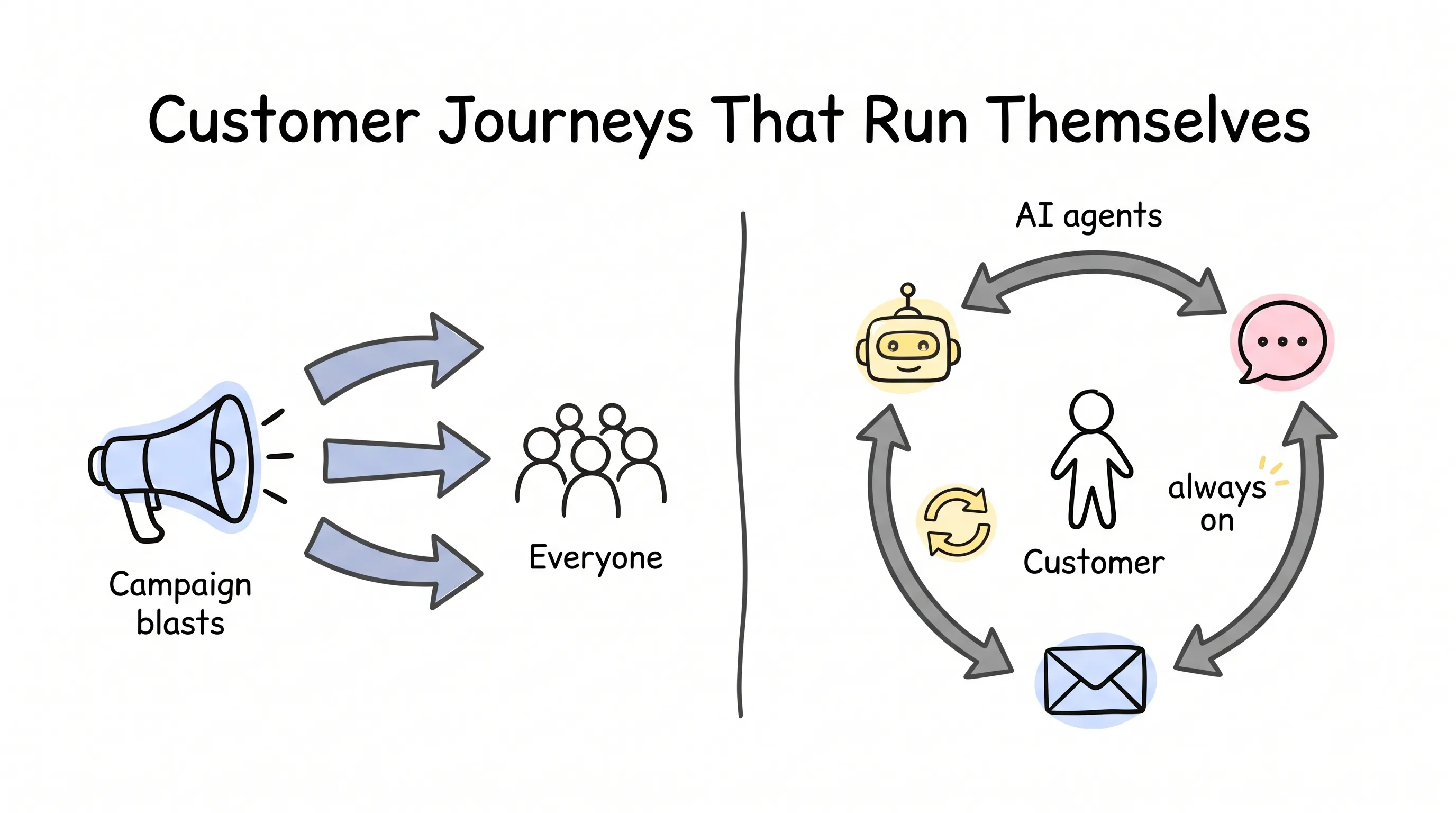
The marketing industry has been calling for one shift for years: moving away from one-way, scheduled campaign blasts toward always-on, automated customer journeys. Marketers stop blasting one way, and customers decide when, where, and how they want to interact.
Janet Balis, who leads EY's marketing practice, says AI today is still being used for optimization within individual functions; over time, it's understanding how those decisions interact with each other that will create real business value and growth. In plain terms: the AI use cases, one by one, eventually have to be strung together.
Zeta is already doing this — they call it agent chaining, multiple generative AI agents working in concert.
Only when this step is truly crossed does the customer journey become genuinely "automated."
First, the Risks and the Rules
Marketing with generative AI is not free. Accuracy, bias, privacy, copyright — every one of these is a real problem.
What's interesting is how demand has changed. Purcell wrote Forrester's first report on responsible AI back in 2016, and he says people trickled in with questions ever since. The turning point came in November 2022, when ChatGPT launched and demand exploded.
What counts as responsible? At a minimum, vendors should be able to answer three things clearly: how the model was trained, what known vulnerabilities exist, and how performance is measured.
Regulators are already moving too. In March 2024, the European Parliament passed the AI Act — beyond transparency requirements, it outright bans certain AI applications such as social scoring, and imposes obligations on high-risk systems like critical infrastructure and education. Judging by how data privacy legislation rolled out year after year, AI-related legislation will only multiply from here.
Want to Get Started? Two Suggestions
First: play with it, but play with intent. Gun's advice is to just try it — but first be clear about what you want it to deliver. Only then will you know what works and what doesn't, and go back to adjust your prompts.
Second: pick platforms that have generative AI built in natively. Building your own AI agents from scratch is a high bar. Zeta ships a full suite of pre-built agents inside its marketing platform, ready out of the box — with the explicit goal of "demystifying" generative AI.
Ramon Jones, chief marketing officer at Nationwide, put it more bluntly: the tools are already astonishing enough; what happens next — how you use them — will decide who wins and who loses this hand of cards.
Finally, Back to My Friend
I ran into him again recently. He said he'd figured it out — no more agonizing over "whether to embrace it." Instead, he picked the smallest scenario he could and got it running: let AI draft his email subject lines, with a human making the final call.
After a month, he said something to me I still remember:
Everyone has the same tools. The difference is who puts them to real work first.
Here's hoping you find your own "smallest scenario," sooner rather than later.
Continue reading
Related articles

It's 2026: Stop "Buying" AI Tools for Your Marketing Team — Start "Hiring" AI Agents
This learn article explains how AI agents differ from standalone AI tools in marketing, outlines three agent categories — build-your-own platforms, CRM-native agents, and vertical tools — and covers use cases across SEO, social media, advertising, and reporting, plus criteria for choosing one.

Did the Money You Spent on AI Marketing Ever Come Back?
A guide to measuring AI marketing ROI across three layers: ad reports, sales pipeline, and the financial ledger. Covers metrics such as ROAS and CPA, eight dashboard metrics, industry benchmarks, and common measurement mistakes.

How to Pick a Creative Automation Platform: First, Figure Out What These Eleven Actually Do
A learn article sorts eleven creative automation platforms — including Bannerflow, Celtra, Smartly.io, and Storyteq — into four functional groups and proposes five evaluation questions covering publishing reach, automation depth, ease of adoption, team fit, and verifiable evidence.