
AI Has Entered the Marketing Department — But 70% Are Still Flying Blind
A learn article on AI adoption in marketing departments: it cites a survey in which 70% of marketers say their companies provide no AI guidance, and argues that AI literacy and well-governed data matter more than enthusiasm, covering CMO trade-offs and team adoption steps.
I recently came across a survey of marketers, and it caught me off guard.
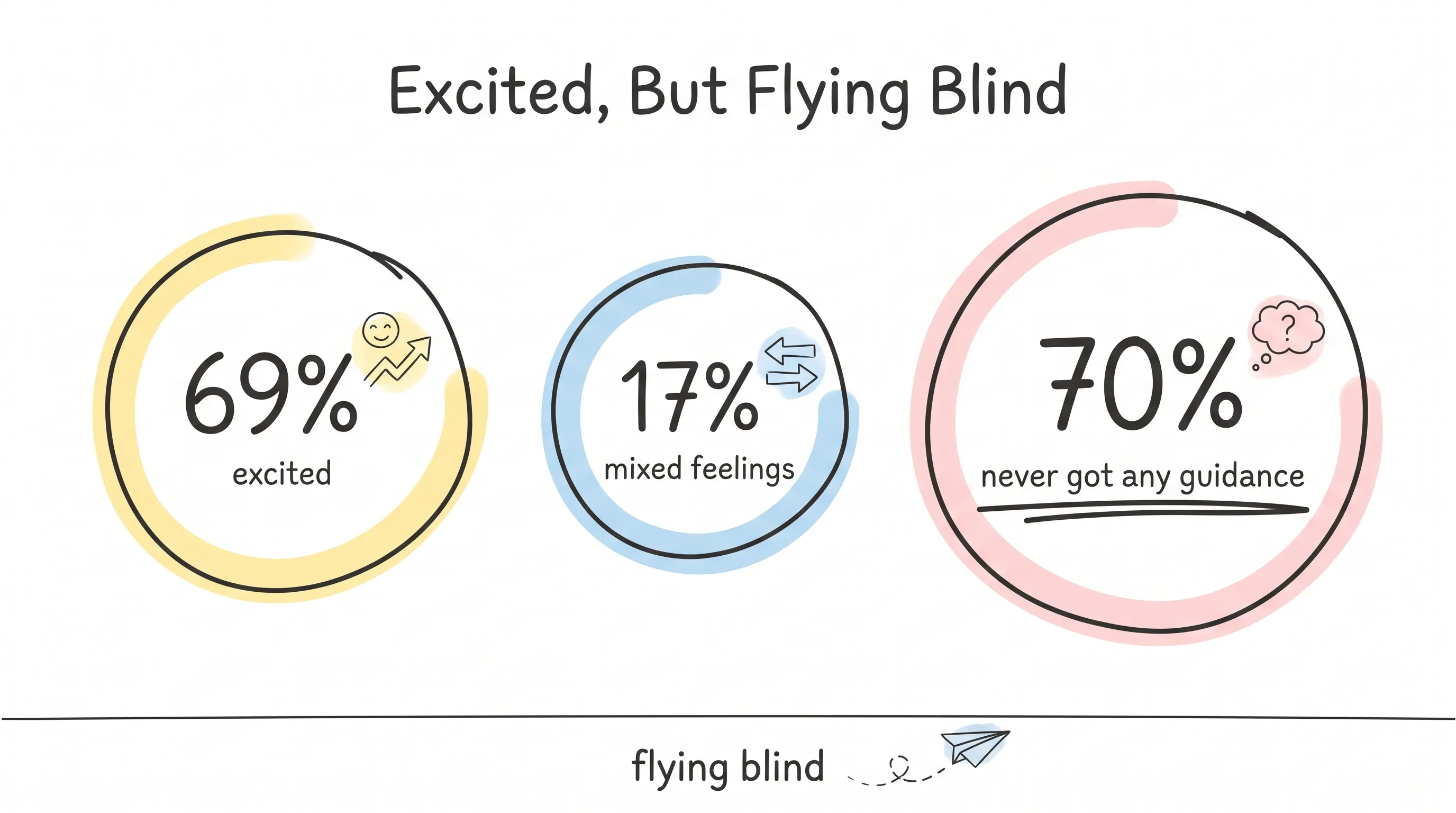
69% of marketers say they're excited about AI. 17% say they have mixed feelings.
But what really stopped me wasn't either of those numbers.
It was this: 70% of marketers say their company has never given them any guidance on using AI.
Not one word. Not one training session.
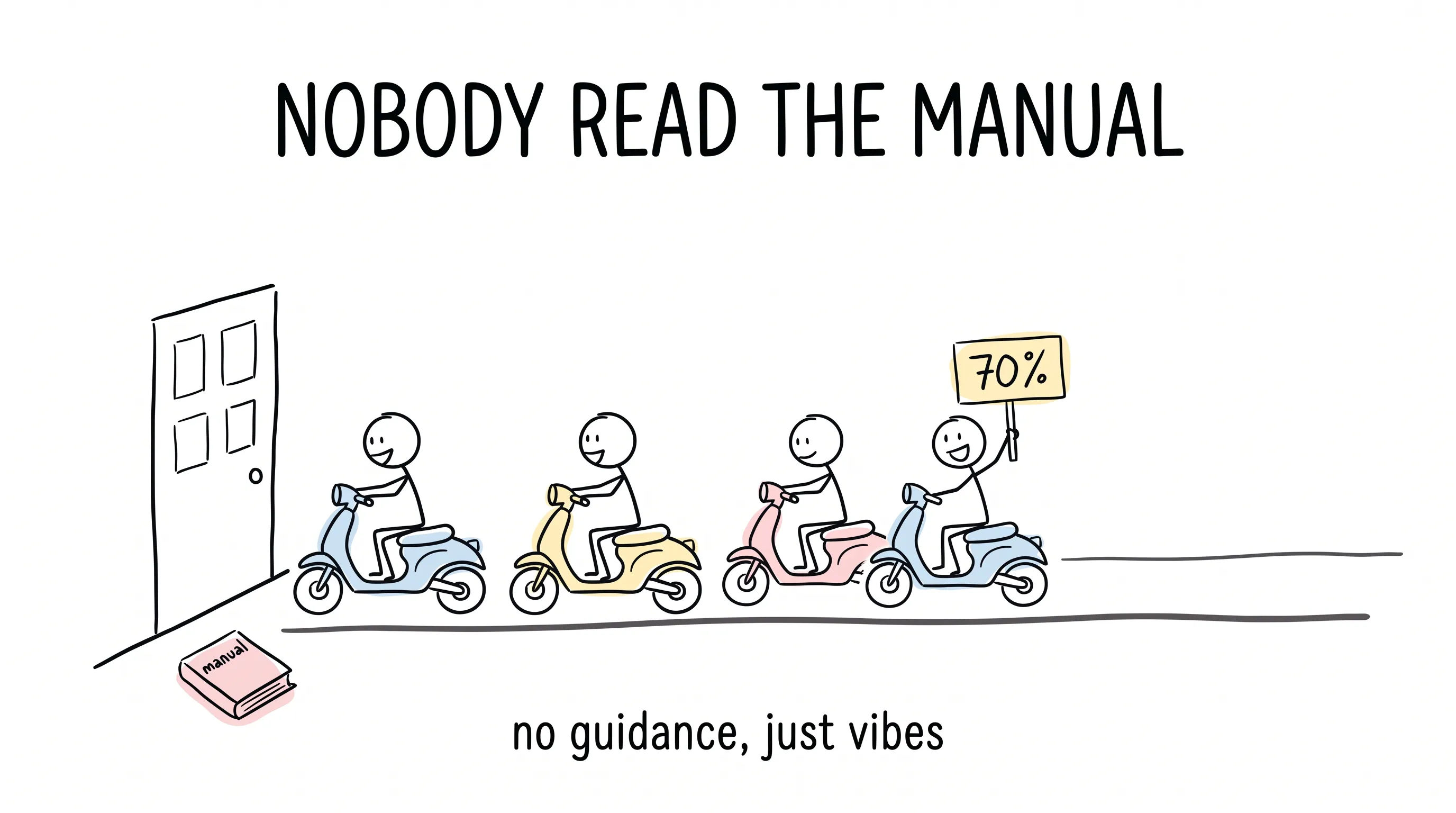
Think about it. Nearly seven in ten are excited, and the same seven in ten are flying blind. What does that tell you? The whole industry is buzzing with enthusiasm, but nobody is teaching the methods. It's like everyone in the office tower bought an electric bike, but nobody ever opened the manual — they just ride by feel straight onto the main road.
Excitement Is Not Capability
So I keep coming back to a feeling: in marketing today, there's a skill quietly going up in value — AI literacy.
What is AI literacy? Put plainly, knowing a few magic-sounding prompts doesn't count. Real capability is knowing where AI can be used, how to use it, and whether what it produces can be trusted.
Your company can't teach you this skill yet. Seventy percent of companies haven't even offered guidance. So the smart marketers have no choice but to figure it out themselves.
There's one more precondition, though, one that's awfully easy to overlook: data.
Informatica, a company that specializes in data management, holds a view I quite agree with: any AI strategy that wants to succeed must be built on high-quality, well-governed data. What does AI eat? Data. Feed it a pile of sloppy numbers, and it will process them into a pile of sloppy numbers — just with nicer wrapping.
Build the road first. Then drive the car.
The CMO's Dilemma
What makes this interesting is that CMOs are facing a genuine dilemma.
On one side, the new technology is a must. Efficiency has to rise, personalization has to get finer, costs have to come down.
On the other side, the things that actually define marketing — not one of them can be dropped.
Which things? Building relationships. Empathy. Ethical judgment. Cultural understanding.
AI writes copy fast, slices audiences finely, and works around the clock without complaint. But it can't take a client to dinner, and it can't read the hesitation behind a half-spoken sentence.
Let me give you an analogy. AI is like a super intern: never sleeps, produces at blinding speed, and organizes whatever data you hand it into something beautiful. But the moments that decide whether a business succeeds — a single line at the dinner table, a single glance at the launch event — the intern doesn't get into those rooms.
Give efficiency to AI. Keep the relationships with people.
Has the value shown up yet? It already has. Time saved, costs down, sharper reads on customers, outreach targeted more snugly than ever. And the use cases are already everywhere: content production, SEO and SEM optimization, email and audience targeting, data analysis, video production, customer profiling.
Four Things That Will Happen Next
Looking ahead, four directions are worth watching.
- Personalization gets finer. How fine? What each person sees will feel like a version written just for them.
- Content production gets faster. What used to take a month of polishing could take a day.
- Data analysis and testing go deeper. What used to be decided by gut call can now be computed.
- The rules of SEO and advertising get reshuffled. AI is changing how people search and how ads get placed. Anyone still counting on the old playbook for traffic had better think hard.
What Should Companies Do? Start with Two Paths
So what do you do at the organizational level? Bain, the consulting firm, once offered five rules that I find sound:
- The consumer has the final say. Don't use AI for the sake of using AI.
- Apply it across the whole marketing pipeline, not just sprinkled at one point.
- Play the long game. Don't expect to board today and see results tomorrow.
- Keep the core scenarios in your own hands. Your core in-house capabilities never get outsourced.
- The CMO must personally lead the charge. This is not a thing you hand down and consider done.
Rules alone aren't enough — you have to land them. Landing takes four steps: first, stand up a cross-functional team that puts marketing, tech, and data people at the same table; then pick out the scenarios most worth doing; then lay out the roadmap and execute them one by one; finally, spend real money on training so employees can actually use it.
Sound simple? Plenty of companies can't get past step one. How many cross-functional task forces have you seen that ended up as a group chat whose only job is posting announcements?
One Last Thought
Some say marketing is art, some say it's science. I think both are right, because marketing was a fusion of the two from the very beginning.
And AI? It makes both sides stronger. The science half gets faster and more precise. The art half — it pulls people out of repetitive drudgery, freeing their hands for real creation.
The first to be phased out will be the marketers who refuse to touch the new tools.
The day the survey came out, most people's reaction was excitement. What I want to remind you of is this: excitement is the cheapest thing. Training and method — those are the expensive ones.
May you be the one who builds the road first, then drives the car.
Continue reading
Related articles

It's 2026: Stop "Buying" AI Tools for Your Marketing Team — Start "Hiring" AI Agents
This learn article explains how AI agents differ from standalone AI tools in marketing, outlines three agent categories — build-your-own platforms, CRM-native agents, and vertical tools — and covers use cases across SEO, social media, advertising, and reporting, plus criteria for choosing one.

What Is GEO? How Your Brand Gets "Mentioned" in the Age of AI Search
An explainer on GEO (Generative Engine Optimization) for e-commerce and DTC brands: how it differs from SEO and AEO, why AI answers shape brand visibility, and eight practices covering question-focused content, consistent brand messaging, structured pages, external evidence, comparisons, and AI mention tracking.

AI Is Already Making Decisions for Your Customers. Are You on the List?
A learn article explains GEO (Generative Engine Optimization): why AI-generated answers now shape which brands customers see, and how SEO fundamentals, entity clarity, citable evidence, and monthly measurement affect visibility in AI answers.