
AI Marketing Daily · 2026-10-12
A 2026-10-12 daily briefing rounding up 13 AI marketing items: the EU AI Act and Digital Fairness Act compliance outlook, a Meta ads AI workflow spanning research, creative, and attribution, B2B skill-based workflows, WhatsApp and ROI benchmark data, and marketing automation platform selection.
Today's 13 items tell one connected story: AI marketing has moved from trying tools to building systems, and regulation is starting to close the net at the same time. The EU has put its 2026 compliance timetable on the table, while a media buyer and a B2B veteran give the same answer: embed AI into research, production, and attribution. ROI numbers are flying everywhere, yet very few teams can actually explain their attribution. Read this one briefing and you'll know which part to fix first.
🎯 Today's Top Story
EU 2026 regulation outlook: the AI Act lands on top of the Digital Fairness Act, leaving one quarter of compliance runway
On September 16, European Commission President Ursula von der Leyen delivered the State of the Union address to the European Parliament, setting the tone for the coming year's legislative agenda. In a long-form piece published in early October, Phiture broke out the parts that matter directly to marketing: the EU AI Act has entered its implementation phase, and the Digital Fairness Act (DFA) — still a legislative proposal — is expected to take full effect in fall 2026, leaving marketing teams the quarter right in front of them to prepare. Brussels is reaching in two directions at once: Canada will become the EU's first quasi-member state, jointly advancing shared models on industry standards and AI research spanning safety, verification, and early warning; meanwhile Australia's social media restrictions for minors are being used as the blueprint for the EU's child-protection framework. And the corroborating evidence is already in: in August of this year, Google reshaped how search results are presented in Europe to sidestep EU fines. Regulation isn't a paper exercise — platforms are already changing their products ahead of it.
Why this matters: two blades fall at once. The AI Act governs transparency in marketing automation and generated content: when apps and games present AI features on store pages and in ads, they face tighter scrutiny, age-gated information accessibility, penalties for undeclared AI use, and in-store algorithmic personalization has to be reworked accordingly. Phiture specifically calls out that AI transparency requirements will directly rewrite in-app ad personalization and store metadata for mobile apps, with misleading content held to the new standard. The DFA governs the floor of marketing tactics. As a standalone regulation it focuses on five intervention areas: banning dark patterns (a decline button smaller than the accept button, pre-ticked consent boxes, fake "only one left" countdowns); restricting dark personalization (manipulative pricing and recommendations built on behavioral data and detected user vulnerabilities, hidden fees, fake crossed-out "original" prices); plugging subscription traps (advance notice before a free trial converts to paid, and cancellation as easy as subscribing — one click); and pressing influencer-marketing disclosure liability directly onto brands and agencies, with commercial-post disclosure requirements covering brands, agencies, and creators — all three.
For marketers, the impact lands job by job. Paid media and ASO teams need to re-review AI labeling across store metadata and ad creative; CRM and growth teams need to rework subscription and cancellation flows; content and social teams need to label generated content; business or legal needs to close the disclosure clauses in influencer contracts. The DFA also carries an easily missed point: attention-design restrictions aimed at users of all ages. Infinite scroll, autoplay, daily check-ins, and loot-box-style reward loops that resemble gambling mechanics are all on the list. Product teams need to install circuit breakers on attention hooks in their interfaces, and — in step with the EU Kids Act's dedicated protections for minors — designs that pull retention through addictive mechanics need replacement plans in place. Subscription apps and games that run on auto-renewal are hit hardest; both revenue systems and product design must be rearranged around the new rules.
How to act. Four things, in order. First, audit your automated decision flows this week — walk through every consent page, subscription page, and paywall, clearing mines item by item against the DFA draft. Second, establish watermarking and disclosure standards for generated content; don't wait for the first penalty case to move. Third, make cancellation one-click and add proactive notice before a free trial converts to paid — this alone protects your renewal reputation. Fourth, add liability clauses to influencer contracts that make the split of disclosure obligations explicit. The Q4 legislative window is exactly this stretch: fix the gray tactics in your conversion funnel first, then backfill content labeling.
My take. Most teams will file this under "legal's problem" and push it back — and that's precisely the opportunity. Compliance itself can be sold as a trust differentiator; the users who finish first will remember that your cancellation didn't take three phone calls. Dark personalization being called out by name means a hidden red line has been drawn: the practice of pushing high-value plans at detected user weaknesses must stop immediately, however good it looks on the conversion report. There's one more ledger to keep: EU standards have always spilled over — California and UK regulators routinely use them as templates — so a global team that fixes things once saves itself rework across three jurisdictions. Using the DFA draft as your Q4 review checklist is the cheapest investment available right now.
🔗 Further reading: Read the full article
🏷 Paid Media in Practice
Three leverage points for AI in Meta advertising: research, creative, backend
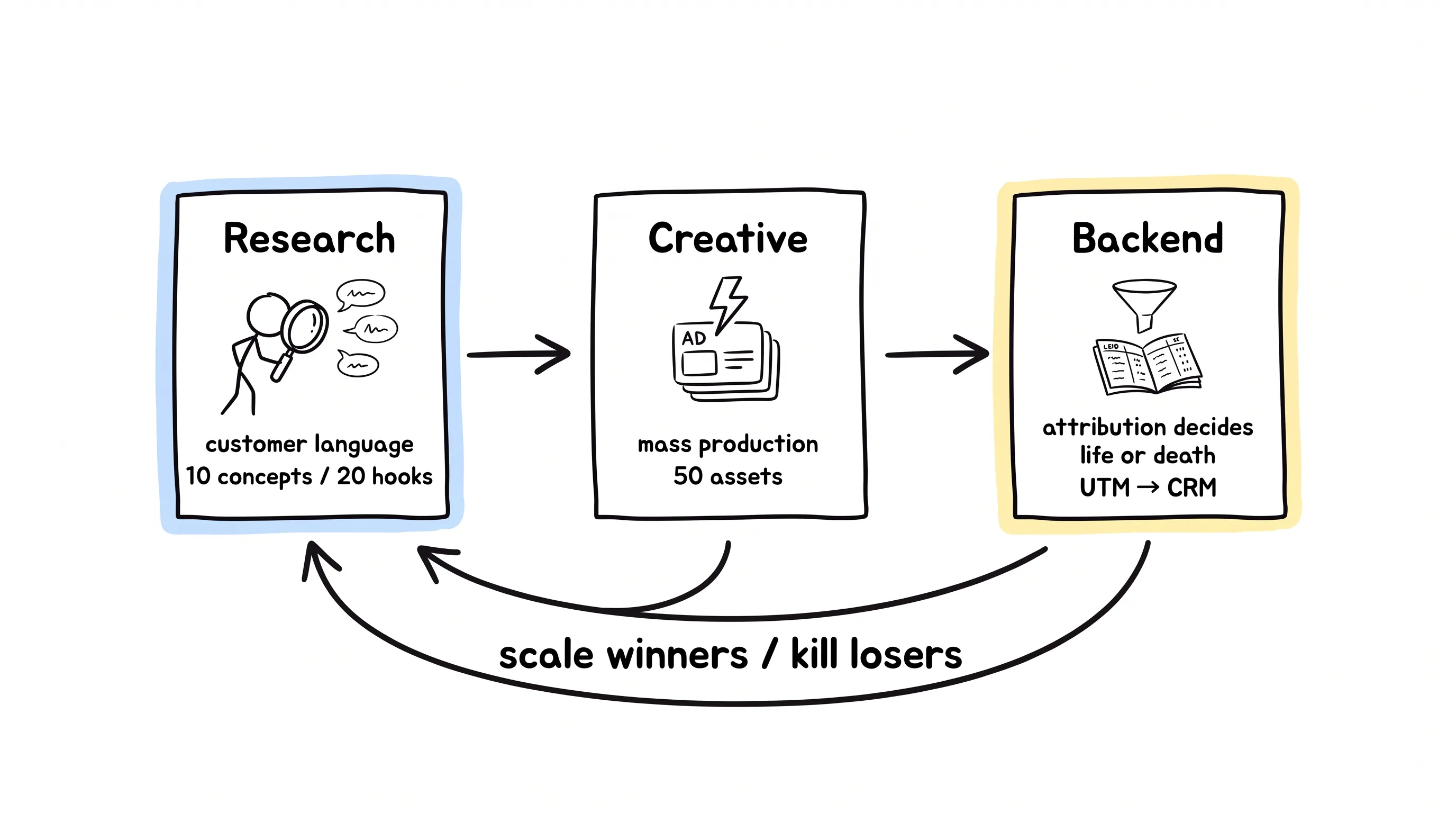
Media buyer Christian Jamal's tutorial pushes back on a popular narrative: that some AI tool or new prompt will make your Meta ads take off. His observation: the paid-media tutorials on YouTube are all building up to one tool, one toggle, while the real reason accounts stay mediocre is thinking wrongly about where AI belongs. His framework puts AI into three stages of the paid system — three puzzle pieces, and the picture won't come together with a piece missing. Research: use Claude's co-work feature as your creative strategist, pulling customers' real language from Reddit, Google reviews, and the Facebook Ad Library to produce a strategy document containing 10 ad concepts and 20 customer-verbatim hooks — you can walk away from your desk and wait for the results. He test-ran it on life insurance, and the model found the industry-wide 30-second quote pitch has numbed users; what customers truly fear is leaving children unprovided for after death, the mortgage landing on a spouse, a claim falling through at the worst moment. Creative built against that industry tone could be shot the same day. Creative: the insurance agency account he serves spends $7,000 a week, climbing toward $10,000, and every asset is generated by HeyGen — not one ad uses live-action footage. His premise: creative fatigue is killing Meta accounts in 2026, and mass production must have attribution underneath it. Push fifty assets at once and can't say which one brought buyers, and you won't dare scale the winners or kill the losers. Backend: wire Claude through MCP into GoHighLevel CRM and Zapier, pass UTM parameters through to custom CRM fields, auto-pull reports, write follow-up sequences, then generate new ad copy from the original chat lines of customers who actually closed. He also built an AI role-play practice bot for new salespeople — fake customers with different objections and price points, feedback after each rep. The three stages presuppose one another: research supplies creative with ammunition, the backend judges creative's life or death, and with any piece missing, the other two just spin idle. Meta's Andromeda algorithm update makes finding buyers more dependent on clean signal — the sharper the research and the cleaner the backend, the harder the algorithm works for you. One caution: the author is a service provider, and his self-reported $115 million in cumulative revenue can't be independently verified.
💬 Don't rush to copy your competitor's hit ad — that's copying the symptom, not the disease: change the audience, the offer, or the price point and the same asset dies. What you can do this week: run one customer-language study with Claude, and patch the UTM trail of your closed leads into your CRM. Until attribution is connected, creative mass production is just burning money faster.
🔗 Further reading: Read the full article
🏷 Workflow Shifts
The B2B marketer's new posture: be the creative director, not the typist
The Exit Five podcast interviewed Corey Haines, founder of Conversion Factory and marketingskills.com, whose open-source marketing-skills repository has passed 21,000 stars on GitHub. The live demos offer several copyable moves: calling the DataForSEO API for keyword research and getting a list in seconds — 10 keywords with roughly 30,000 combined monthly searches, mostly low-competition; pairing that with a programmatic SEO skill to generate 10 landing pages in half a minute, shipping to Vercel via GitHub sync with a single sentence; cross-analyzing Search Console, Fathom, and keyword data to produce a diagnostic report that used to take an SEO consultant charging five figures — which pages perform, which lag, which data sources contradict each other, all in one pass; a RevOps skill that scans HubSpot pipelines, finds funnel breakpoints, and stands up a lead scoring model; and with the open-source Remotion library, producing video in the browser with code — when the pacing is off, just tell Claude and it changes. The technical form of a skill is a single markdown file, stored locally, ideally kept under 500 lines, with evals and a templates directory. The skills marketplace catalog now lists 90,000-plus skills; the credit card company Ramp has accumulated 300 skills built by its own employees internally, breaking company knowledge into a library anyone can call. His repositioning for the profession fits in one sentence: marketers should be creative directors, hand entire execution blocks to AI, and personally hold on to taste and judgment. The time once trapped in pulling reports and making slides now goes back to the creative work itself.
💬 Fastest on-ramp: take the single most repetitive job on your team and turn it into a skill, packaging in your ICP, pricing, and talk tracks — you'll reclaim the time within a week. Small and mid-size teams should build internal tools before touching client-facing content; reporting is obviously the high-leverage starting point, yet most people pile into content mass production instead.
🔗 Further reading: Read the full article
What the predictive-marketing loop actually looks like: five layers, and with one missing it's all noise
On Medium, Stephen Despin breaks predictive marketing into a five-layer closed loop, a machine whose layers interlock. The data layer collects four kinds of signals — behavioral (clicks, scroll, dwell time), transactional (purchases, order value, frequency), contextual (device, location, time of day), and intent (search terms, content engagement) — unified into a CDP (customer data platform: a single consolidated profile of each customer). The pattern-recognition layer finds combinations humans can't see: for example, visitors who browse at night, return within 48 hours, and encounter social proof convert at a 73% higher rate. The prediction layer computes purchase probability, churn risk, lifetime value, and the best moment to reach out — answering "what is the next best action." The personalization layer generates whole pages and whole emails against predicted intent, so the entire site shifts per person; a name-merge template doesn't count. The execution layer has agentic AI directly orchestrating cross-channel journeys — emails fired at engagement peaks, ads tuned in real time, support taking tickets around the clock — not just recommending but doing. The five layers connect head to tail, results flow back into the data layer, and the models get sharper with every pass — the author calls this compounding, not a plateau. The article's numbers (win rates up over 30%, 66% efficiency gain on complex tasks, 84% of salespeople saying AI accelerates engagement, 59% of marketers calling personalization the biggest factor) are mostly unsourced secondhand citations — treat them as directional only.
💬 Before you build, ask one question: is your customer data clean and connected enough. Without a unified profile, the other four layers are pure noise. For sequencing, start with churn prediction — it saves acquisition money you've already spent and pays back fastest — then add purchase prediction.
🔗 Further reading: Read the full article
🏷 Industry Data & Cases
An AI personalization case collection: numbers you can carry into your budget request
penoai assembles a batch of widely circulated personalization results: Amazon attributes 35% of revenue to its recommendation engine; Starbucks' Deep Brew draws on purchase, location, even weather data for 30 million members, lifting marketing ROI 30% — and can target cold drinks ahead of a heat wave; L'Oréal's virtual try-on has been used more than 1 billion times, with conversion rates tripling; Nike's personalized emails click 25% higher; EasyJet mined 20 years of travel data into travel-story emails, doubling open rates with conversions up 30% in some markets; Cadbury had Shah Rukh Khan generate thousands of localized videos, reaching 140 million people with engagement up 32%; Unilever cut content costs 30% and shipped 50% faster; Mastercard leaned on real-time social media trends for targeting, clicks up 37% while cost per click fell 29%; PayPal compressed churn analysis from 6 hours to 30 minutes. The piece also flags the other side of the coin: 41% of consumers find how much brands know about them creepy. Most figures are secondhand statistics — cite with attribution.
💬 The use of this page is to copy numbers when you're making the budget case to your boss. The move actually worth learning is Starbucks': wiring an external variable like weather into the recommendation logic gives you something to work with for local store foot traffic right away. Pick one channel, run an A/B, and only after it validates, roll out across channels.
🔗 Further reading: Read the full article
WhatsApp marketing benchmarks: the industry-by-industry ledger behind a 98% open rate
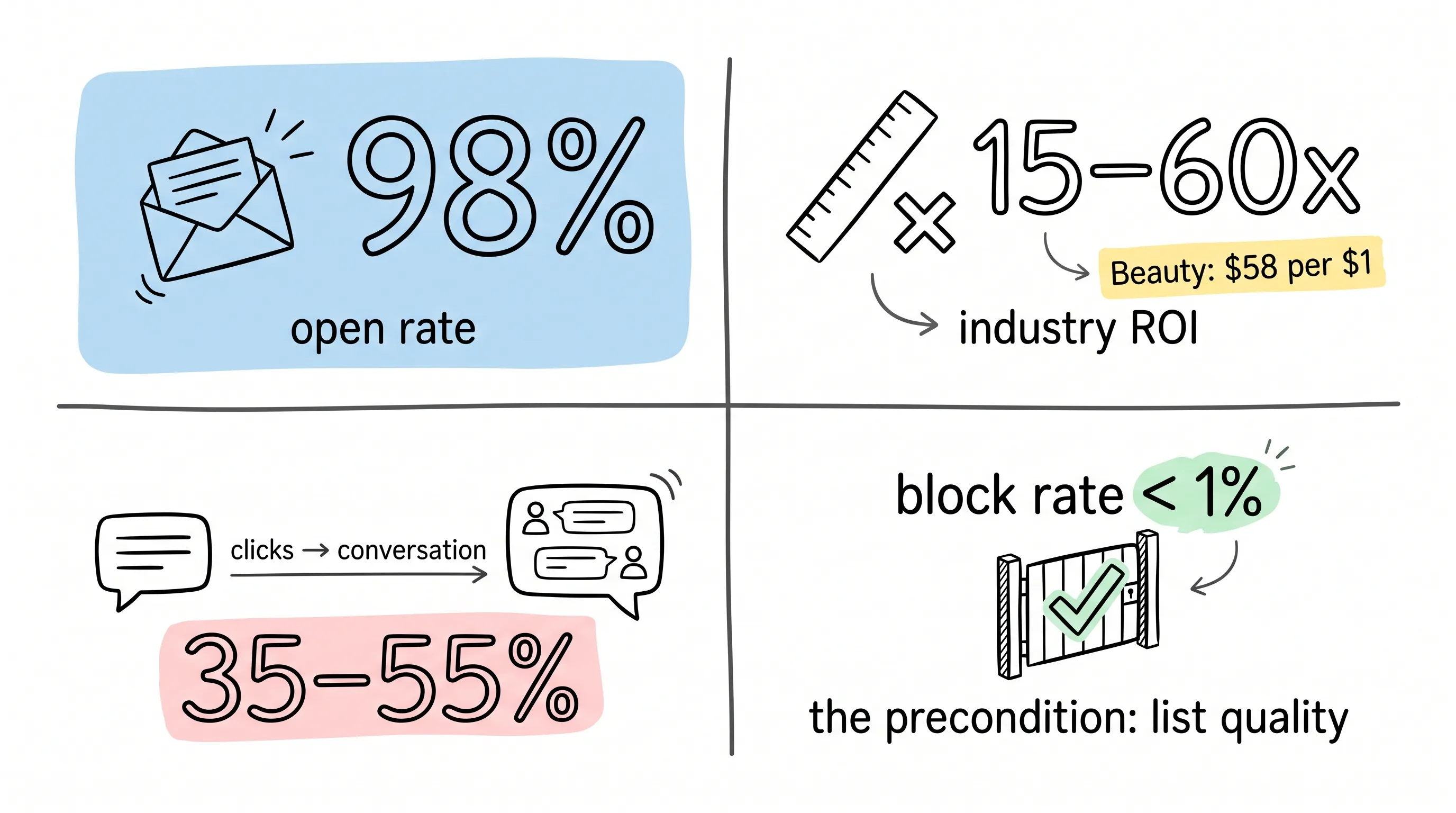
Wetarseel's roundup is comparatively honest about citing sources. Message open rates run 93% to 98%, with 80% opened within five minutes of sending; the industry ROI benchmark (ROWS) sits between 15x and 60x, and abandoned-cart recovery flows often exceed 100x. Beauty returns about $58 for every $1 spent — the highest of any category, thanks to a fixed repurchase cycle and high order values. Meta's Q1 2026 investor briefing shows Click-to-WhatsApp ad spend up 82% year over year, the fastest-growing placement in the entire Meta ecosystem; such ads click at 3% to 6%, with 35% to 55% of clicks becoming real conversations, and a Meta–BCG retail study puts their acquisition cost 30% to 50% below traffic-to-website campaigns. Cost per conversation ranges from $0.95 in India to $5.20 in the US, and the median payback period across 380 stores was 47 days. The German apparel chain Takko had in-store customers scan a QR code into its WhatsApp list — store revenue rose 82% during the campaign, a 36.8x single-campaign return. Indian D2C brands report returns up 200% to 300%, with 57% of new leads already coming from automated journeys. The first precondition in every case is list quality: keep the block rate under 1%.
💬 For repurchase-driven categories, one line of copy does it: "Your serum is running low." That automated reminder flow is already validated at 58x returns in beauty. Teams running Meta ads: this week, take the same creative set, add a Click-to-WhatsApp variant to race against your traffic-to-website ads for two weeks, and let CPA speak for itself.
🔗 Further reading: Read the full article
The payback timetable for marketing AI: what to buy in which month
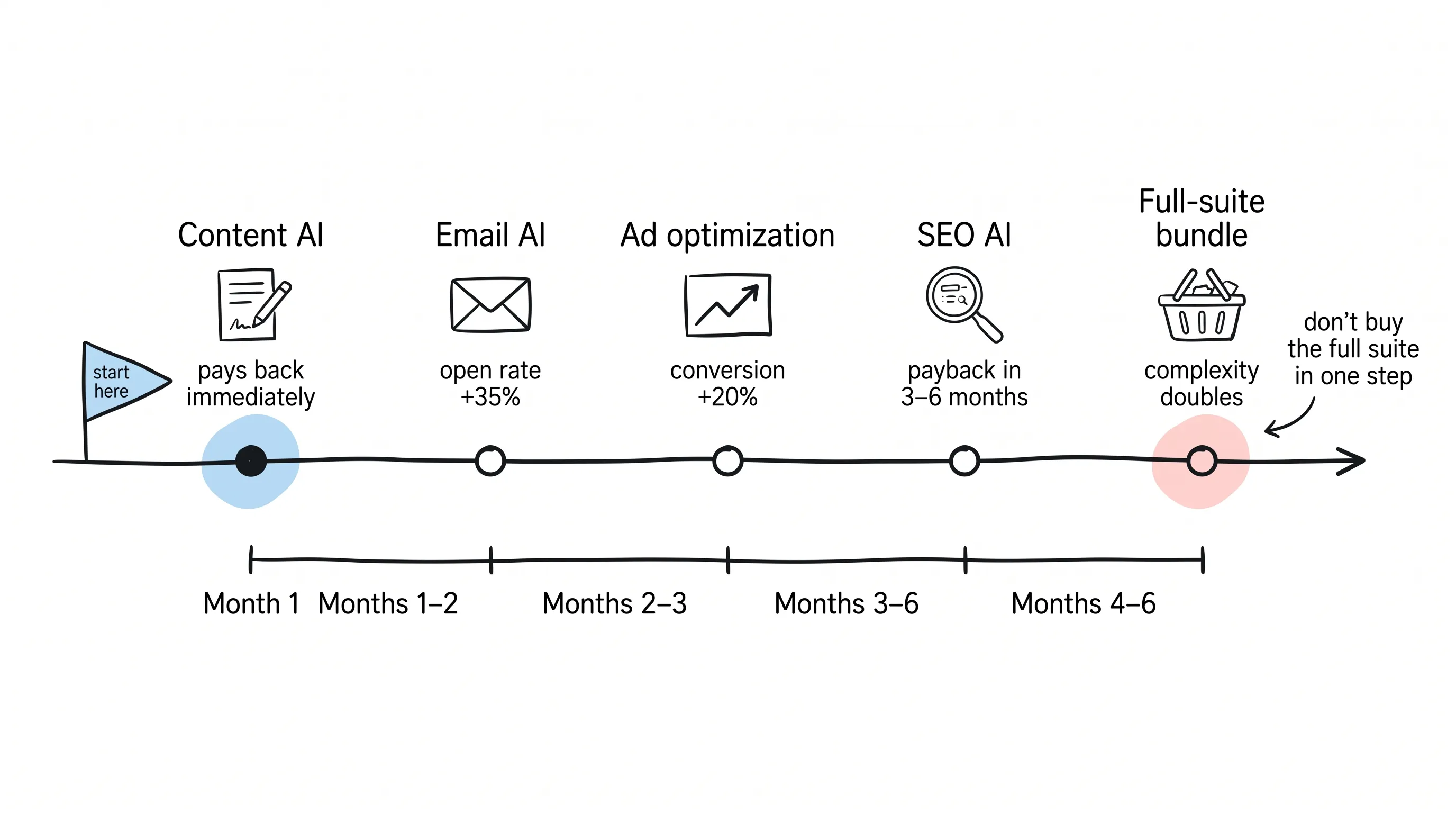
SUPALABS strings the 2025 ROI evidence into a use-case-tiered framework. Microsoft's 2024 study of small and mid-size businesses using Copilot puts returns as high as 353%, with content production 10x faster and teachers saving 9.3 hours a week; 77% of SMBs worldwide are already using AI tools, and 91% of adopters report revenue growth. By use case: AI email subject-line optimization can lift open rates 35%; ad optimization typically brings a 20% conversion lift with a 30% drop in acquisition costs; ROAS improvement ranges from 25% to 40%. The payback periods line up in a queue: content AI pays back immediately, email AI in one to two months, ad optimization in two to three months, SEO AI in three to six months, and the full-suite bundle in four to six months. Note this is a vendor blog; the numbers are mostly secondhand — trace them to the source before formal use.
💬 The real value of this table is the rollout order: in month one, deploy content AI only — lowest risk, fastest payback; in month two, add email subject lines; touch ad optimization only after the first two are running smoothly. On a tight budget, never buy the full-suite bundle in one step — the payback period and the complexity both double.
🔗 Further reading: Read the full article
Five 10x cases and one statistic that stings: 73% of companies can't account for their AI spend
Hashmeta's case collection opens with the bad news: 73% of companies struggle to quantify their AI marketing investment, and only 39% hit expected returns in year one. The case details are useful as reference points. An outdoor-gear e-commerce store went from 8 to 127 content pieces a month, organic traffic up 347%, 4,200 new keywords entering the top ten, revenue up 156%. A project-management SaaS cut first response to new leads from 4.3 hours to 15 minutes — previously about 37% of prospects drifted to competitors while waiting for a reply — and meeting bookings rose 68%. A dental group pushed all six of its locations into the top three of the local map pack, with nearby-search visibility up 289%. An investment-research firm went from 8 to 96 pieces a month, analyst time down 60%, compliance issues at zero. A furniture retailer had AI instantly resolve 84% of inquiries, showroom bookings up 220%, average order value up 31%. All clients are anonymous, and these are vendor self-reports — read them as patterns, not promises.
💬 The 37% of leads lost to competitors is the statistic that stings most; response speed is a free lever you can pull this week — set a 15-minute first-response rule before anything else. One more thing: record your baseline data before turning on AI, or in a year you'll be part of that 73% too.
🔗 Further reading: Read the full article
🏷 Tool Selection
Choosing a marketing automation platform in the AI-discovery era: nine new criteria and the hidden costs
AI Growth Agent's platform comparison is an advertorial, but the problems it raises are real: buyer research is shifting from search result pages to AI answers, and content produced by legacy platforms won't get cited by ChatGPT. There's plenty of usable data in the piece: HubSpot's AI content tool tracks a limit of about 50 prompts and monitors visibility without creating it; Marketo takes 12 to 20 weeks to implement; enterprise platforms' list prices cover less than 30% of first-year total cost of ownership, with overage and implementation fees often doubling the bill; a mid-size B2B automation stack runs $15,000 to $25,000 a year; 5,000 monthly syncs between CRM and the marketing platform cost $299 to $599 through Zapier; and in ABM, the number-one barrier to AI adoption is MarTech integration (47%), ahead of lack of internal expertise (42%). It also cites Forrester's September 2025 data showing the median organic traffic to B2B vendor content already declining year over year.
💬 Before signing any automation platform, price the full cost — add in implementation fees, overage fees, and forced premium support — then ask one question: can you report incremental visibility. If you can't tell existing share of voice from newly earned share of voice, the money is wasted. Remember this piece ranks itself first; discount its conclusions accordingly.
🔗 Further reading: Read the full article
From rules engines to agent orchestration: another ledger for B2B SaaS selection
Marketing So High's review covers the same territory as the previous item from a different angle. Evaluation criteria have shifted from rules-based workflow to AI-agent orchestration: keyword to content to multi-channel distribution in one pipeline, cold outreach with built-in domain warm-up, and full-funnel attribution that credits the entire journey. The cited numbers: McKinsey says AI personalization can lift revenue 5% to 15% and marketing-spend efficiency 10% to 30%; Gartner projects that by 2026, 80% of B2B sales interactions will happen in digital channels; the Marketing AI Institute says AI-using marketers save 2.5 hours a day. The demo question list in the piece is ready to use as-is: is your AI a thin wrapper around a general-purpose LLM or trained on proprietary data; can it demo the complete chain from keyword to content to distribution live; how is domain reputation protected; how does the attribution model credit each touchpoint. Open standards like MCP get named specifically — you buy them to prevent the platform from becoming a data silo two years out.
💬 Save those four questions into your phone — they work against any vendor, and the thin-wrapper question especially. Choose by stage: at seed, pick all-in-one to save on tooling; after Series A, make attribution the priority. For multi-touch B2B, teams still reading first- or last-click attribution are fooling themselves no matter how finely they do the math.
🔗 Further reading: Read the full article
The e-commerce cross-border AI tool map: fix the two leaks first — returns and taxes
FLEX. Fulfillment inventories ten categories of tools for cross-border sellers: demand forecasting (stocking by region and platform), VAT tax automation (the Avalara/TaxJar type), multi-channel inventory sync, intelligent carrier selection, fulfillment automation, AI returns management (predicting high-return SKUs), dynamic pricing, customer behavior prediction, customs paperwork automation, and end-to-end logistics platforms. Alongside, it provides a seven-criterion selection checklist and a five-step rollout: clean data, systems integration, team training, phased pilots, and watching three KPIs (stockout rate, shipping cost per order, fulfillment time). The list is organized by capability category, not a product review — for specific picks, you'll need to compare vendors yourself.
💬 A cross-border seller's profits mostly leak out in two places: returns and VAT. Start with returns prediction — it names which SKUs to delist or rewrite detail pages for; VAT automation comes next, because compliance risk compounds by country. Pilot in one region or one warehouse; don't roll it out network-wide.
🔗 Further reading: Read the full article
🏷 Trends & Fundamentals
Six trends for 2026: read this report as a peer progress bar
DataMites' trends piece lists six: generative content, hyper-personalization, predictive analytics, voice and conversational AI, AI video ads, and AI journey mapping. The quotable numbers are worth more than the argumentation: HubSpot research shows 52% of marketers already use generative AI for content, 50.7% for email, and 68% report positive returns from long-form content strategies like blogs; MarketsandMarkets projects the AI analytics market growing from $13.5 billion in 2023 to $38.8 billion by 2028, a 23.3% compound annual growth rate; 67% of marketers believe AI will visibly reshape roles and processes before 2030. The five closing challenges (privacy, creativity, cost, bias, skills gap) are the part everyone already knows — safe to skip. It's a training provider's SEO blog; read it for the data.
💬 Don't read it as a trends report — read it as a peer progress bar: half your peers are already using generative content, and waiting on the sidelines is itself the risk. Keep the 68% positive-ROI-on-long-content stat; it's good ammunition for convincing the boss to approve a content budget.
🔗 Further reading: Read the full article
Digital Marketing 101: the faster the tools, the more the fundamentals are worth
Copy Posse's Alex Cattoni walks through the beginner framework — 29,000 views, nearly 800 likes. The key points: marketing isn't advertising; advertising is only the acquisition front door, like the sandwich board outside the store, while marketing is the entire experience after a customer walks in — the welcome, the fitting-room follow-up, the outfit suggestions, the post-purchase thank-you note. Set strategy first (who you're selling to, what you're solving, where you'll say it), then pick tactics; stacking tactics without strategy is building without laying the foundation. Direct response is instantly attributable — click, buy, you see the result on the spot — while brand is hard to attribute, its touchpoints a tangled mess: look at micro-conversions like engagement, subscriptions, and content consumption instead, and don't sentence brand content to death on last-click attribution. Push pushes the message at people through ads; pull attracts them with value — you need both. Customers buy outcomes and transformation; feature specs are just the side dishes — when she sells a writing course, the pitch is quitting the nine-to-five and owning your own schedule. Organic traffic trades time for reach, paid traffic trades money for reach — with no budget at the start, do organic first. The AI section's thesis is worth writing down: AI is an accelerator — clearly effective for research, ideation, and performance analysis — but don't let it take over your voice. Content drafted entirely by AI is flooding the feed, and if you blend in, you'll never be seen again.
💬 This episode is one to forward to the new teammate who just took over paid media. Veterans have a self-check too: when you set the KPI for brand content, are you using micro-conversions or last-click? The AI question in one line: hand research and analysis to it — the voice has to be your own.
🔗 Further reading: Read the full article
💡 Today's Overview
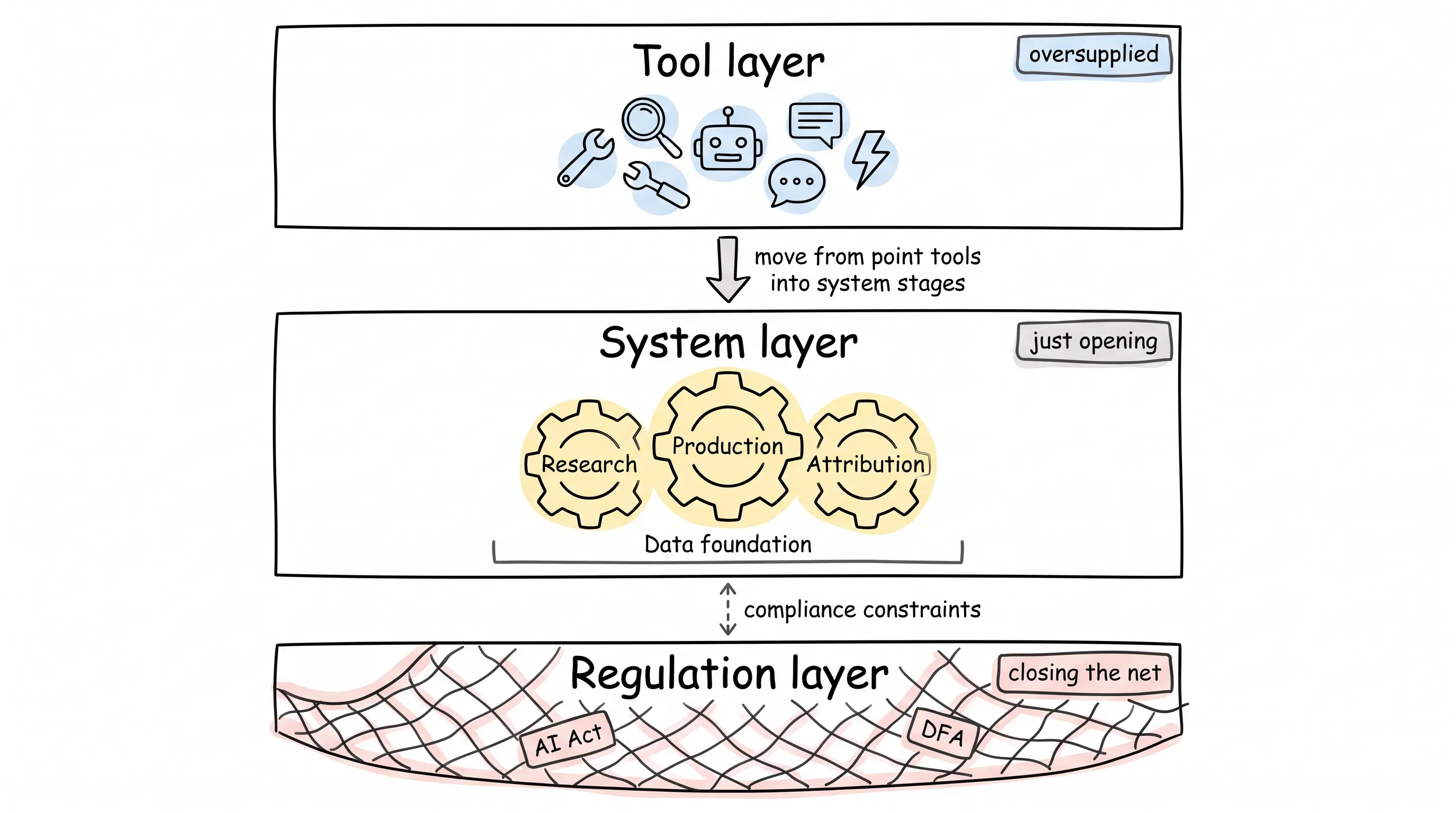
Looked at together, the 13 items share one throughline: the tool layer is already oversupplied, the system layer has just opened, and the regulation layer is starting to close the net. A 353% return, a 58x ledger, 12x output — every vendor's numbers look beautiful, yet the same batch of material conceals the fact that 73% of companies can't account for their AI investment. The difference isn't model quality; it's the data foundation and the attribution chain. WhatsApp's high returns rest on a clean opt-in list; the paid-media cases' high output rests on UTM pass-through into CRM attribution; the B2B skill workflow's high leverage rests on well-packaged ICP knowledge. Putting tools on top of an unfinished system just burns money faster — and the media buyer's line — "AI amplifies who you already are" — was the most expensive sentence of the day.
One layer deeper: several of today's items are actually on the same curve. The Meta buyer's three leverage points, the B2B veteran's creative-director positioning, and predictive marketing's five-layer loop all say the same thing: move AI from a point tool into the system's stages — point-level efficiency gains hit a ceiling, but interlocking stages compound. The evidence is in this same batch too: Starbucks saw ROI rise 30% only after wiring weather data into its recommendation logic; Ramp broke company knowledge into 300 callable skills, and only then did output start rolling. The difference isn't budget — it's whether the data and information were organized first.
The regulation thread lands on the system layer as well. What the EU is restricting is precisely the tactics that profit from an opaque system: dark personalization, subscription traps, undeclared generated content — all process problems, not creative problems. Put differently, compliance retrofitting and attribution building are the same kind of engineering: both require reworking processes, both require leaving records, both feed on the data foundation. Straighten out the system once, and the math works out on both ends.
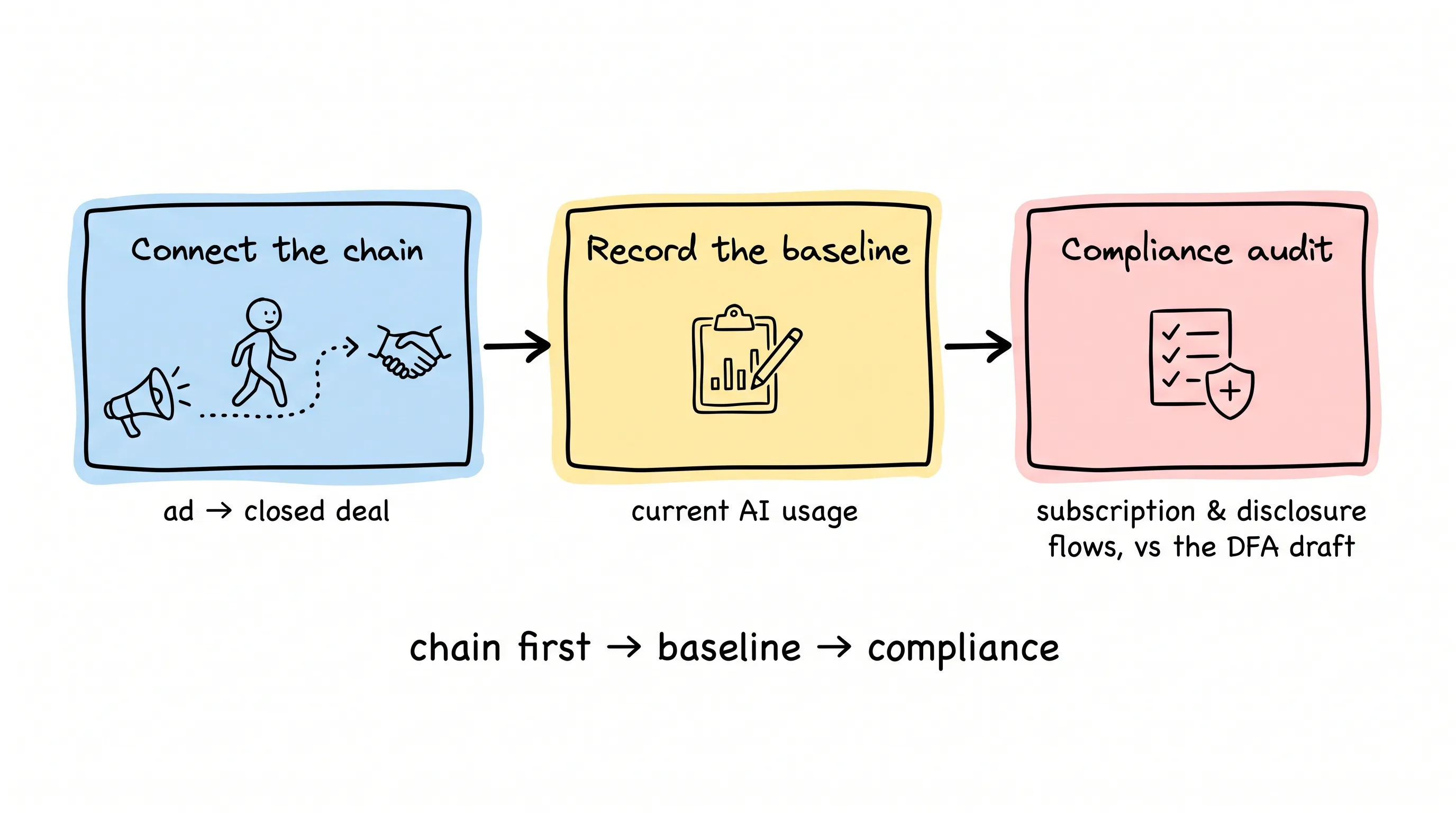
For next week, three things only: connect one attribution chain from ad to closed deal, record a set of baseline data on your current AI usage, and audit your subscription and disclosure flows against the DFA draft. And keep the order — chain first, then baseline, then compliance — because baseline data is the starting point of the payback timetable, and the changes the compliance audit surfaces need attribution to verify they didn't hurt conversion. Tools can wait; the chain and compliance can't.
Continue reading
Related articles
AI Marketing Daily · 2026-11-22
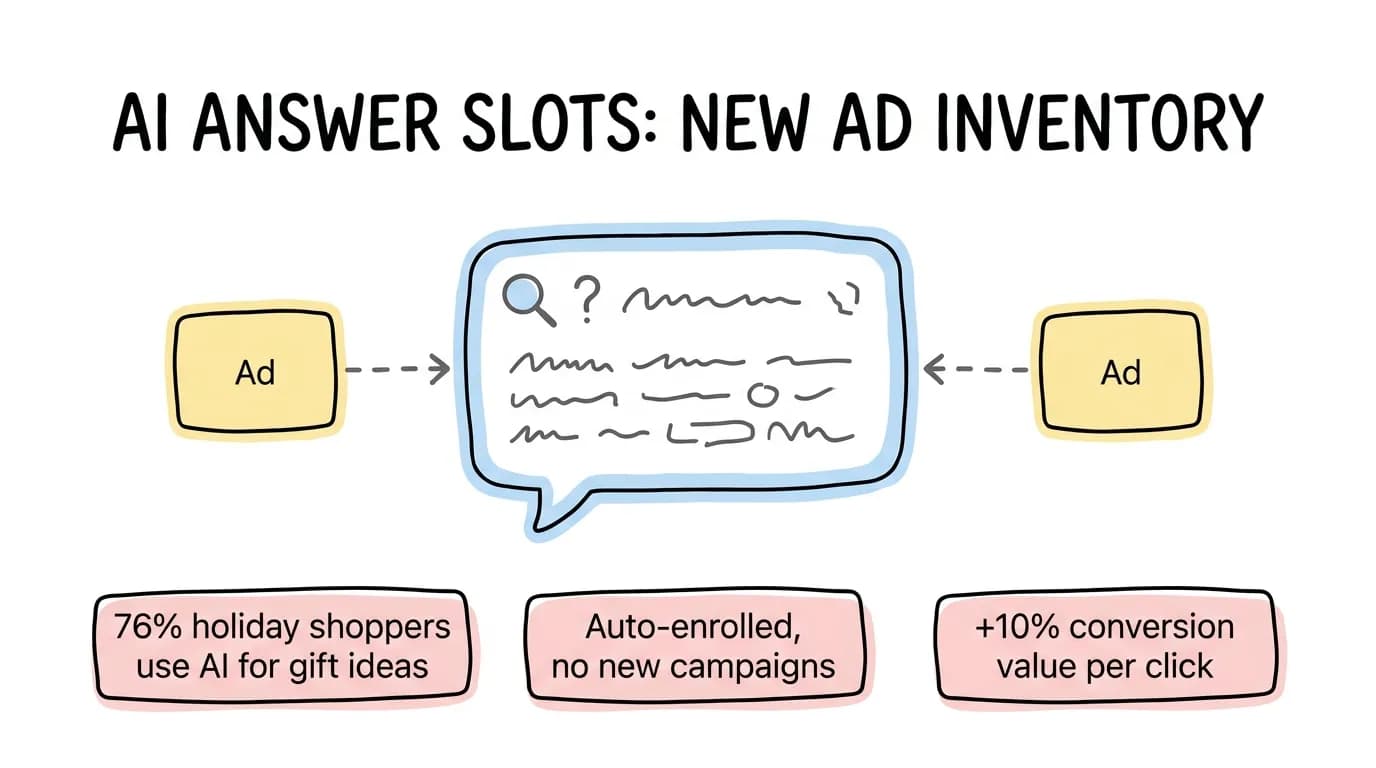
AI Marketing Daily for 2026-11-22 rounds up 20 items led by Microsoft opening Bing AI Overviews to ads and Google expanding AI Mode ads to ten countries, plus GEO guides, ad automation delegation guidance, AI Overviews CTR data, and a legal-risk checklist for AI-generated creative.
AI Marketing Daily · 2026-11-21
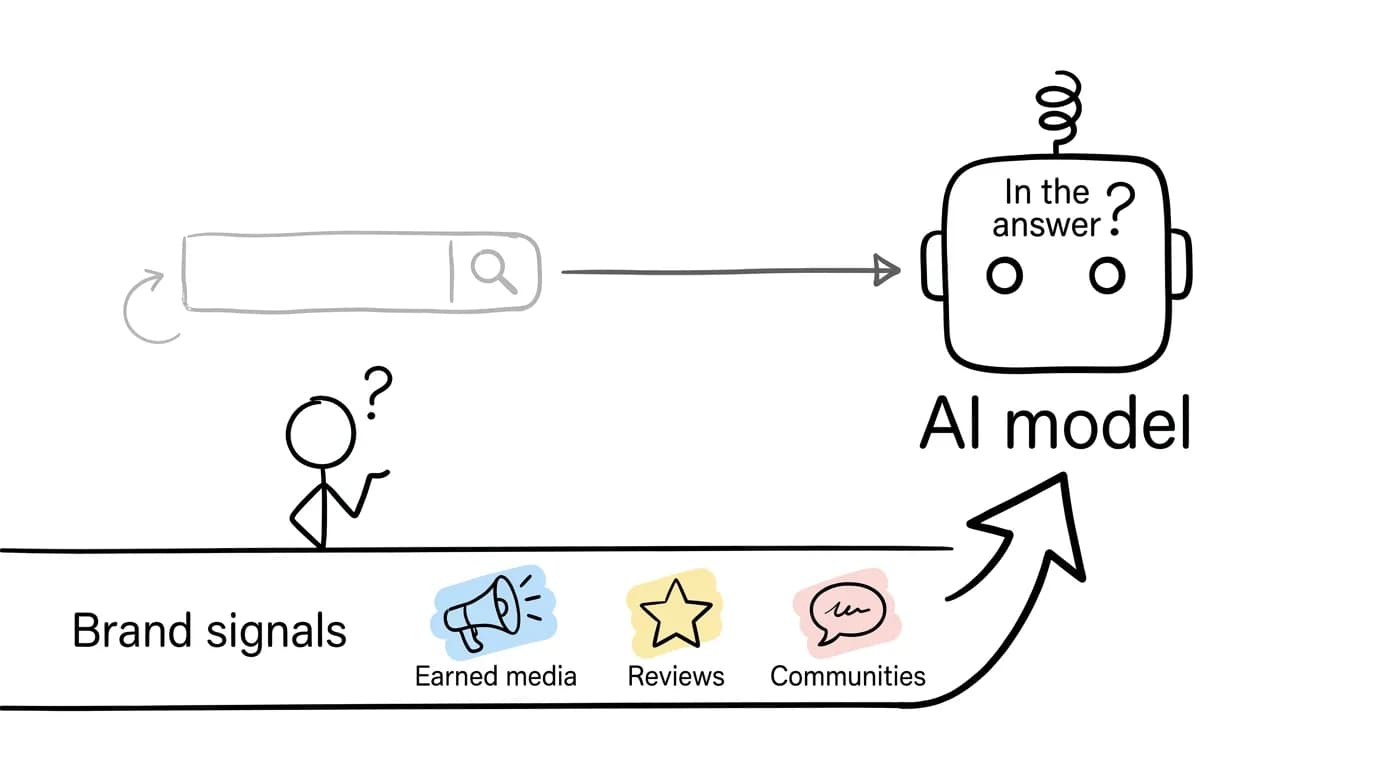
A November 21, 2026 AI-marketing daily covering AI search visibility, GEO methods, Google AI Mode ads expanding to ten countries, Meta's pre-Black Friday changes, agentic shopping, and industry adoption and ROI data.
AI Marketing Daily · 2026-11-20
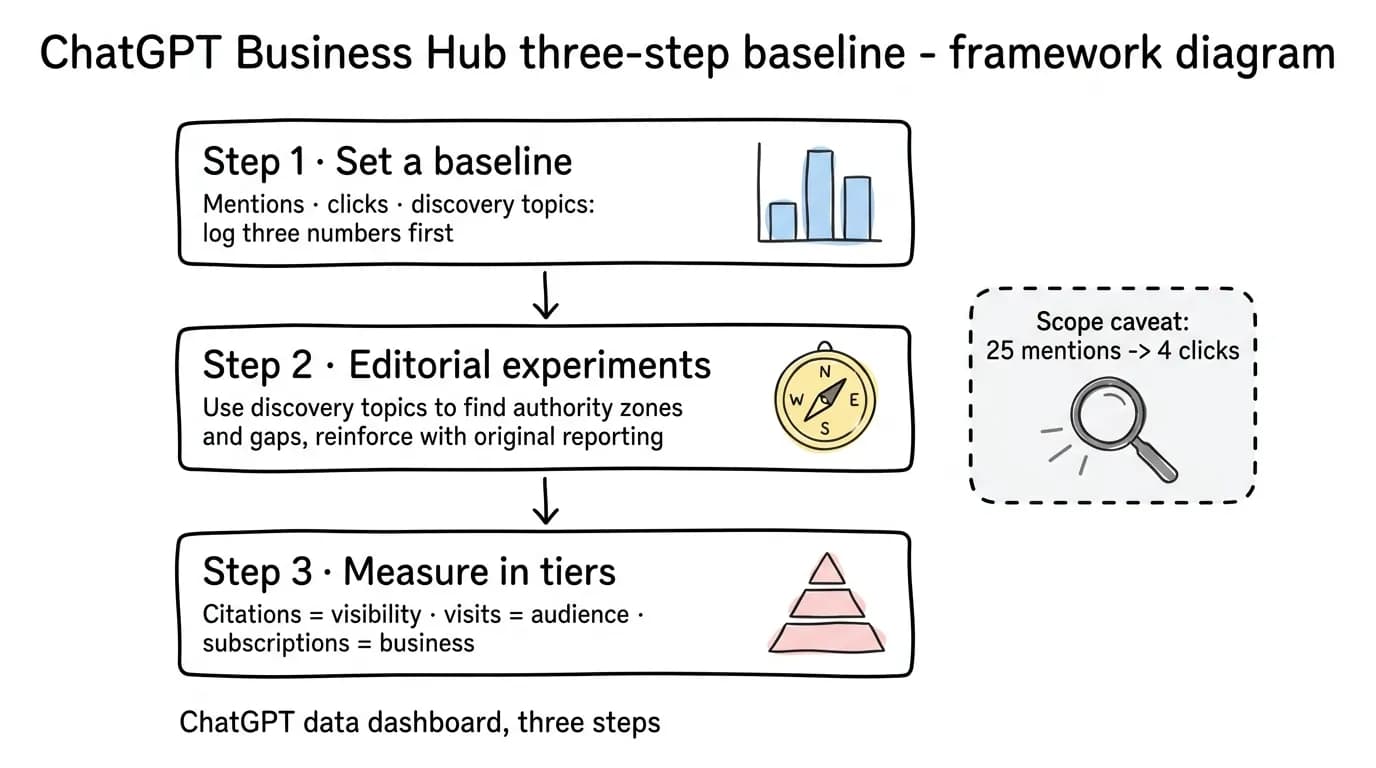
AI Marketing Daily for 2026-11-20 rounds up 19 items centered on measurement: OpenAI's ChatGPT Business Hub dashboard, EU rules for agent-mediated purchasing, Meta pausing four AI terms, and B2B data on shortlists and the dark funnel, each with action advice.