
Why You Lose More Money on Meta Ads the More You Fiddle with AI
This learn article argues that swapping AI tools won't fix underperforming Meta ads; it frames AI as three puzzle pieces—research from customer language, creative volume tied to real angles, and a backend with attribution and follow-up—using examples like Claude, HeyGen, MCP, GoHighLevel, and Zapier.
A few days ago, a friend of mine who runs ads for a living messaged me at midnight.
"Bro, I just switched to a new AI tool."
I asked him: how many is that this year?
He thought about it. "Honestly, I've lost count. Every week someone's hyping something new. This week it's mass-generating 50 ads at once. Next week it's finished videos in one minute. I've tried them all." And his ad account? Still limping along, half-dead as ever.
The money keeps burning. The volume never comes.
I told him: your problem probably isn't the tools at all.
What you're missing isn't a faster hammer. It's a map — knowing where to strike.
Today I want to get to the bottom of this.
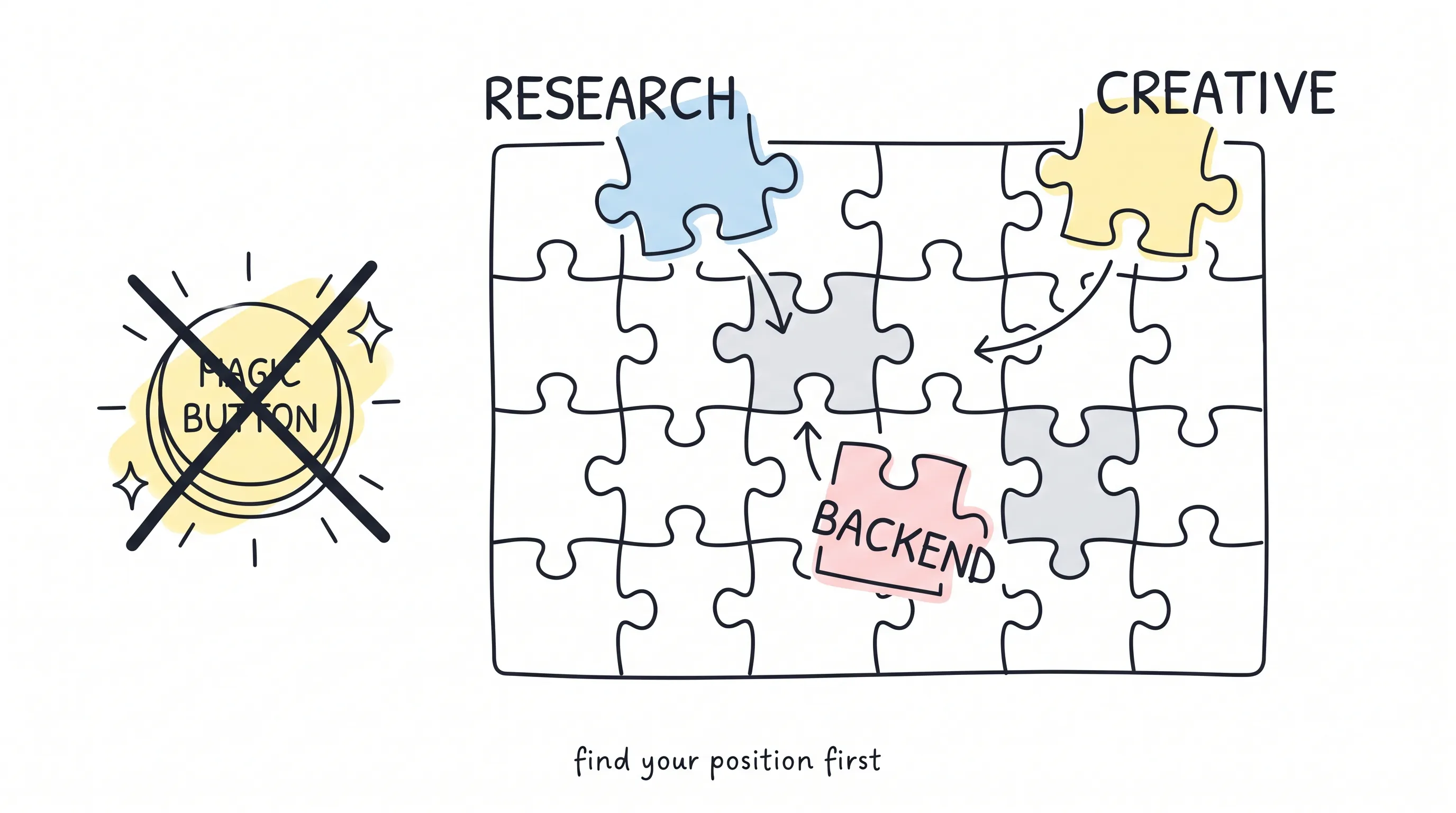
AI Is a Puzzle, Not a Magic Button
What does "using AI for ads" actually mean?
Most people's version is this: find some AI toggle inside Meta Ads Manager and flip it on. Or hunt down the hottest new prompt and paste it in. Or install some agent that claims to be fully automated.
And then? The account keeps performing exactly average.
Why?
Because AI is not a switch hiding inside your ad account. It's a set of puzzle pieces scattered across your entire business.
Think about it. Using Claude to write a better headline — does that help? Sure. But that's one puzzle piece, the same size as every other piece. However bright a single piece is, it can't complete the picture on its own. The picture only comes together once the research, creative, and backend pieces are all in place.
I've seen too many business owners who understand the theory, yet the moment they start doing, they pile every expectation onto a single tool. They stack AI tool on top of AI tool, layered over a bunch of already-broken processes, hoping the tools will fix the processes by themselves.
That's not using AI. That's painting gold over a leaking pipe.
So which puzzle pieces are actually worth money?
Three. Research. Creative. Backend.
Let's take them one at a time.
Piece One: Research. What You're Losing Isn't Money — It's Time
Start with a move I see in almost every Meta ads tutorial out there: open the Facebook Ads Library, dig up the ads your biggest competitors are running, and copy them.
Copy the angle. Copy the style. Even re-do the "why did this take off" analysis the same way.
Makes sense? A little. But it probably won't work.
Why won't it work?
Because what you're copying is other people's symptoms, not their root cause.
That competitor's ad works because of the right audience, the right offer, the right price point. You lift the ad itself, swap in your audience, your offer, your price. You've moved three variables and left the ad untouched.
No wonder it flops.
What you should actually be copying is the words straight out of your customers' mouths.
What does that mean? It's what your buyers complain about on Reddit, what they praise and trash in Google reviews, what they ask over and over in your own ad comments.
That language is the raw material for ad angles.
And this is exactly the kind of work AI can do for you. For example: have Claude play the role of a senior ad strategist, hand it your top few competitors — their websites, their Facebook Ads Library pages, their TikTok, their Instagram, everything you can scrape. Then it packages everything into a strategy document containing 10 ad concepts that are ready to shoot.
Here's the interesting part: you can steer that document however you like. Only my niche? Done. Only high-ticket plays? Done. Only UGC (user-generated content) and founder-on-camera formats? Done. You can even tell it to skip every angle your big competitors are already running and leave only the gaps in the market.
I've watched someone run this whole process on a life insurance offer. Claude dug through Reddit complaints, Google reviews of competitor agencies, hundreds of comments under insurance ads on Facebook — and reached a verdict: the market has gone numb to the "get a quote in 30 seconds" angle. So what are customers actually afraid of? Dying early with no one to look after their kids. Leaving behind a mountain of mortgage debt. Buying a policy only to find out it won't pay out at the worst possible moment.
So the concepts in the document all aimed straight at those fears: a "worst-case scenario" ad showing what happens to an unprotected family; a contrarian ad calling out the industry-wide playbook of selling cheap policies and then denying claims; a trust-based ad where a real salesperson tells a real client's full story. Hooks, formats, scripts — all done.
A 20-page document. 10 concepts. Plus a hook library pulled directly from customers' own words. You can walk away from your desk and come back ten minutes later to collect.
The value of the research piece boils down to one line: replace "what do I guess my customers think" with "what did my customers actually say."
Piece Two: Creative. Volume Is a Necessity — but Volume Can Lie to You
Now, creative. This is probably the most badly mangled piece of all.
What's the mainstream narrative right now? Open an AI video tool, generate 50 UGC ads, push them out everywhere, and one of them is bound to take off.
That's half right.
Creative fatigue really is the number-one killer of Meta accounts right now. If you're still clinging to the same three creatives for six months, you're definitely behind. So yes, volume is necessary.
But people who chase volume alone run into an especially awkward situation: 50 ads go live at once, and in a week you've pulled in a thousand leads. And then?
Which of those ads brought in buyers who actually closed?
No idea.
And if you don't know, you can't kill the losers or scale the winners. You spend more every month than the last, chasing your own tail.
So the order matters: you can mass-produce creatives, but the angles must come from the pain points customers said out loud in the research piece. And your account's backend has to be able to tell you which ads brought in buyers — not just a pile of cheap leads.
And there's one more thing you can't get around in 2026: Meta's Andromeda update (Meta's next-gen ad ranking system). The algorithm is smarter than ever at finding buyers. But its intelligence comes with a precondition: the signals you feed it have to be clean. The better your research and backend, the harder Andromeda works for you. Feed it a mess of badly attributed data, and no amount of algorithmic brilliance will save you.
Here's a realistic benchmark. One insurance agency has every ad in its account generated by HeyGen: the AI avatar looks like a real person, the voiceover is AI, the scripts are AI, and every angle comes from the research piece described above. That account is spending $7,000 a week and climbing toward $10,000 a week.
Not a single one of those ads was shot by a human.
That's wild. But HeyGen is just the front end. What's actually valuable is the system underneath it.
Piece Three: Backend. Where the Water Is Actually Leaking
Finally, the backend. In my view, this is where most business owners bleed the most money — completely unnoticed.
The usual script goes like this: ads launch, leads flow in, and the show kicks off. Then follow-up is slow, sales can't absorb the volume. A few months later the owner sits there cursing lead quality — the conversion rate is only 8%.
But think about it. Are the leads really that bad?
The leads are fine. It's the system catching them that keeps leaking.
Every time the backend leaks, all the effort you put into research and creative gets flushed once.
So what can AI do here? Two very concrete uses.
First, training rookies. At one agency, new sales hires couldn't sell when they started, and the old way was to spend their own money buying real leads to practice on — expensive and painful. Then they built an AI fake customer: different objections, different price points, different temperaments. The rookie gets on the phone with this bot, runs the full script, and the AI gives feedback — what was right, what was wrong, what to change next time. It can practice twenty hours a day if it wants, costing nothing and touching no real customers. After six months of this, the difference between trained rookies and brand-new hires is obvious at a glance.
Second, wiring the system together. For every client they take on, they spin up a dedicated Claude project and dump in the sales call recordings, onboarding recordings, and every piece of business material. Then they use MCP (Model Context Protocol, a standard for connecting AI to external software) to wire that project into the actual tools they use: GoHighLevel for the CRM, Zapier to chain the tools together, Meta Ads Manager in there too.
And now you have an AI that understands this business better than you do. It doesn't chat — it works: pulling data, building reports, writing follow-up sequences in GoHighLevel, then drafting the next ad's copy based on the actual first words of customers who already closed. UTMs flow through Zapier into custom fields in the CRM, and it tells you straight up which ad is producing the most closed customers.
This is precisely where most owners are flying blind: a lead comes in, it closes or it doesn't, moving on. Nobody ever finds out which ad brought the best customers.
How do you use it day to day? Here's how one person does it: whatever he wants done, he says it into his microphone in one breath using WhisperFlow, feeds it to Claude, and gets back a plan he can execute that same day. Writing follow-ups, pulling reports, revising copy, fixing broken automations — all in there.
Five years ago this took a whole team. Now it's one Claude project per client, plus one person and one microphone.
One Last Bucket of Cold Water
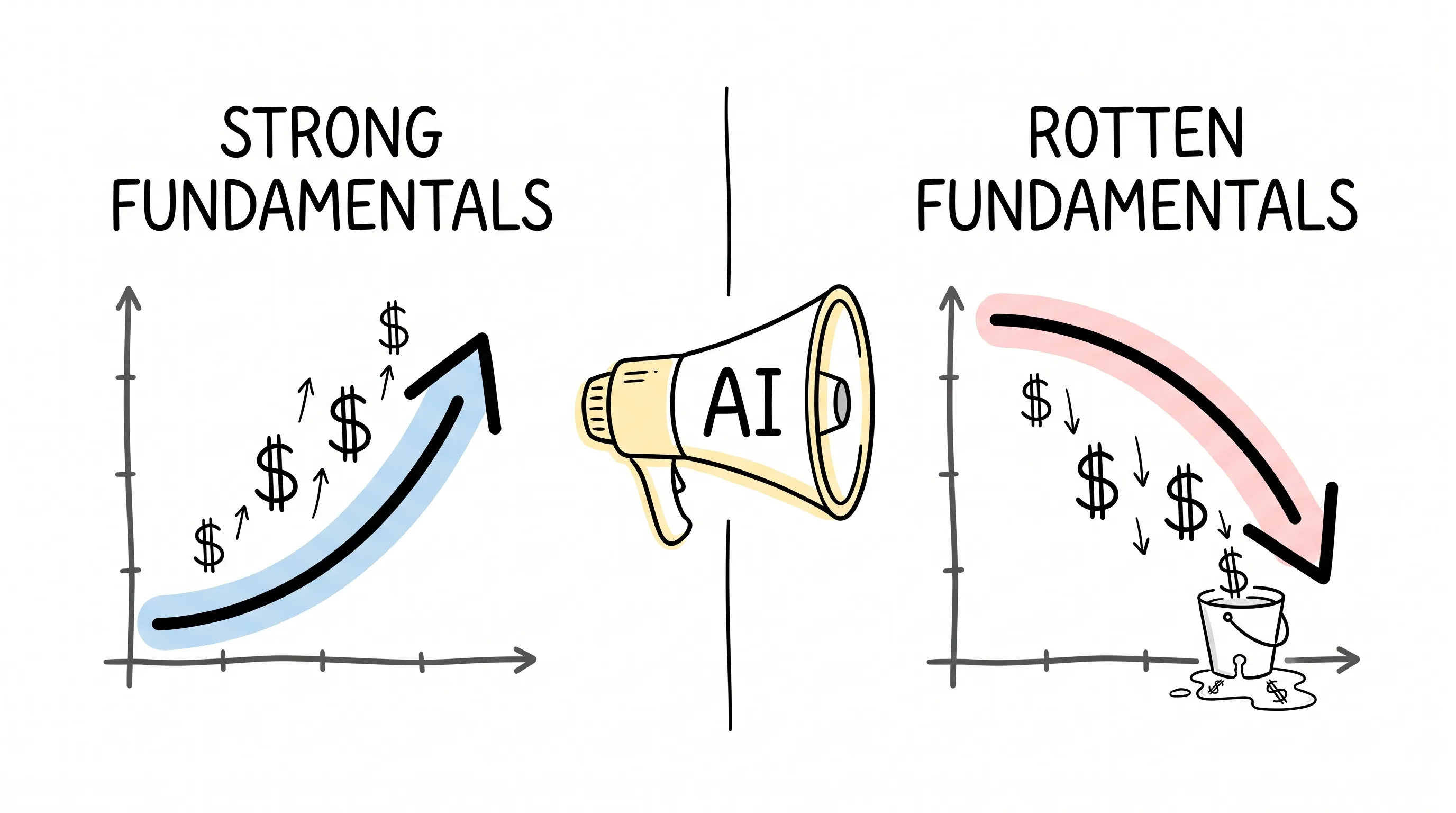
Does AI feel like a cheat code right now? It does. But at its core, it's an amplifier.
Strong fundamentals, AI amplifies your profit. Rotten fundamentals, AI amplifies your losses.
Remember the friend from the opening, swapping tools at midnight? He stopped swapping. He went back and filled in the three pieces — research, creative, backend — one at a time. Last month he told me his account finally started to "make sense."
New tools will keep coming every week. Position doesn't change for years.
Find your position first. Then talk tools.
Here's to finishing that puzzle — soon.
Continue reading
Related articles

It's 2026: Stop "Buying" AI Tools for Your Marketing Team — Start "Hiring" AI Agents
This learn article explains how AI agents differ from standalone AI tools in marketing, outlines three agent categories — build-your-own platforms, CRM-native agents, and vertical tools — and covers use cases across SEO, social media, advertising, and reporting, plus criteria for choosing one.

Did the Money You Spent on AI Marketing Ever Come Back?
A guide to measuring AI marketing ROI across three layers: ad reports, sales pipeline, and the financial ledger. Covers metrics such as ROAS and CPA, eight dashboard metrics, industry benchmarks, and common measurement mistakes.

How to Pick a Creative Automation Platform: First, Figure Out What These Eleven Actually Do
A learn article sorts eleven creative automation platforms — including Bannerflow, Celtra, Smartly.io, and Storyteq — into four functional groups and proposes five evaluation questions covering publishing reach, automation depth, ease of adoption, team fit, and verifiable evidence.