
Are B2B Marketing Automation Platforms Worth It? Run Three Ledgers First
A learn article on whether B2B marketing automation platforms are worth buying, comparing MSH, HubSpot, and Mailchimp by cost, workflow coverage, and company stage fit. It also offers four questions for evaluating vendors and discusses open standards like MCP for future AI interoperability.
A few days ago, in a founders' group chat, someone posted their monthly software subscription bill.
One tool for SEO research, one for AI writing, one for social media scheduling, another for cold email outreach. Add it all up: just under $2,000 a month. The team? Two people.
Some in the group advised him to cut a few. His reply: can't be done — the content still has to go out.
I stared at that bill for a while, then ran him a different set of numbers: at least half of that $2,000 is wages for the data movers.
Moving what? The tools don't talk to each other. Keyword research lives in one pool, articles in another, social and email each in a pool of their own. Every connection between them is handled by manual copy-paste.
This setup has a nickname: the Frankenstein stack. It looks like one whole — until you switch it on and it starts leaking.
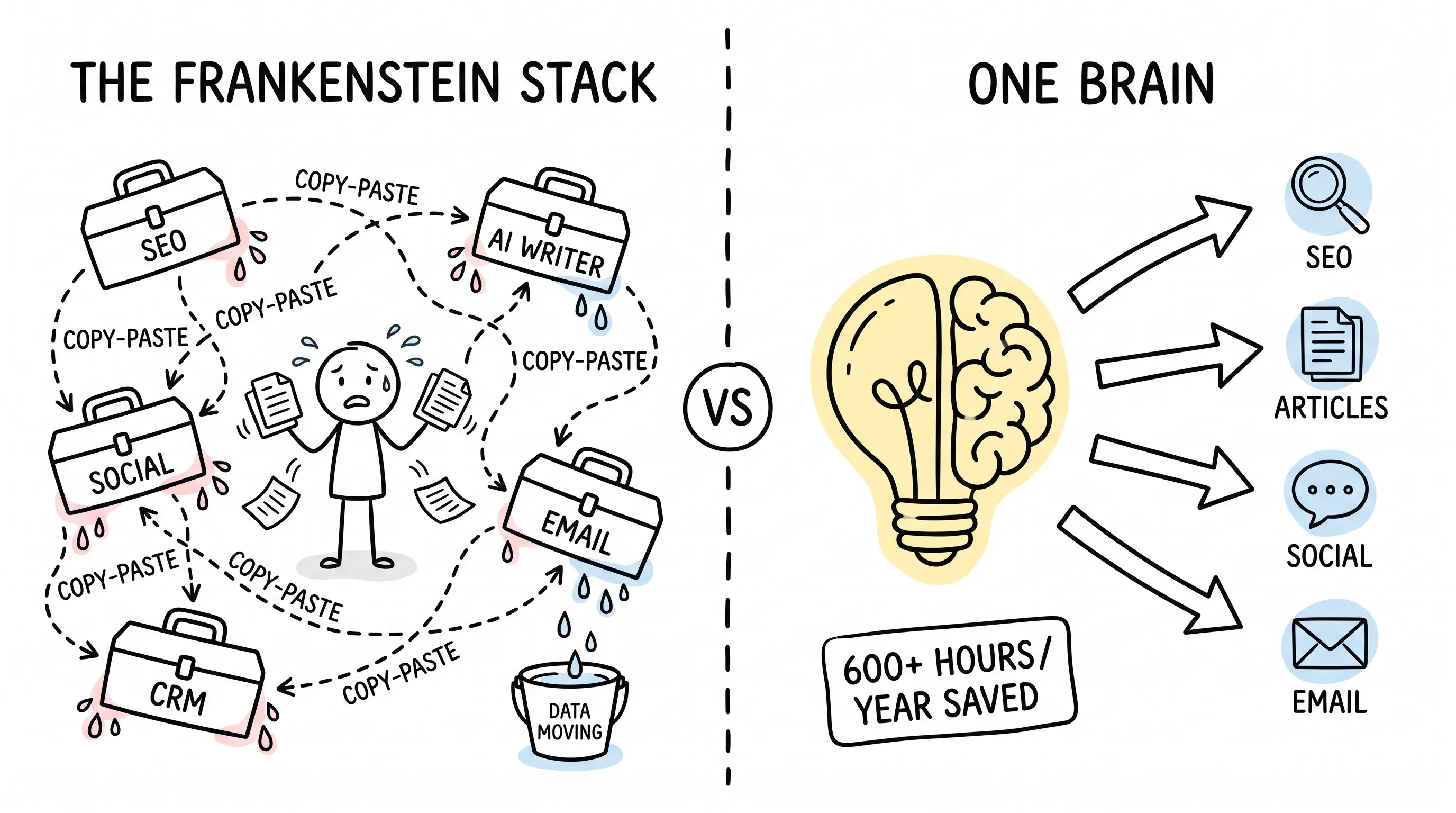
The time spent assembling the stack could have gone into growth.
First, Untangle the Concept
What is marketing automation, exactly?
The picture in most people's heads: a user downloads an ebook, and the system automatically sends three follow-up emails. That's the previous generation of product — rule-based bots at their core. When this, then that. Very obedient, but it can't think, and it can't learn.
The AI marketing automation people talk about now adds a layer of brains.
That brain makes three decisions on its own: what to send, when to send it, and who to send it to. It reads user behavior, company profiles, and market movements, then picks the next best action. Writing emails, writing blog posts, scoring leads — it handles all of it itself.
McKinsey published a study in 2026 with a blunt conclusion: use AI for personalization, and revenue can rise 5% to 15%, while marketing-spend efficiency improves by 10% to 30%.
Here's an even starker number. Marketing AI Institute has tallied it up: marketers using AI save an average of 2.5 hours of grunt work per day.
2.5 hours a day is 600-plus hours a year. For a two-person team, that's a quarter of a hire, for free.
Brutal.
These platforms don't sell features. They sell leverage.
So back to the question itself: worth buying or not?
My take: worth it — but don't buy with your eyes closed. Gartner predicted years ago that by 2026, 80% of B2B buying-and-selling interactions would take place in digital channels. It's now the final quarter of 2026, and that number is proving out. Buyers have moved online; if you're still covering channels by hand, you can't win that fight.
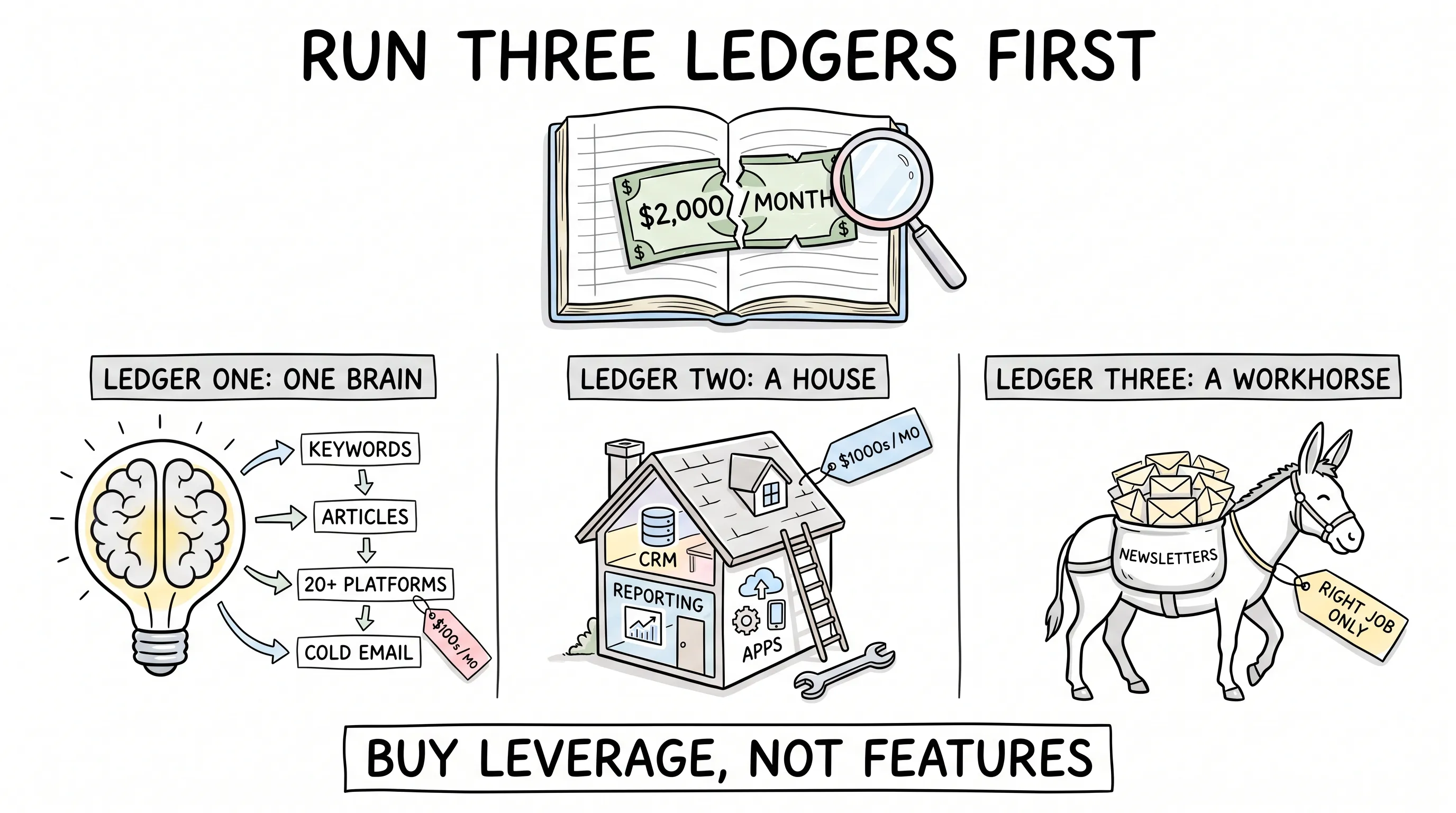
But before you buy, settle three ledgers first.
Ledger One: MSH — Buying "One Brain"
Marketing So High — MSH for short — is the youngest of the three.
At its core is an AI marketing agent called Mavel. You give it a direction, and it runs the entire chain end to end: find keywords, write long-form articles, slice them into dozens of social posts, publish to 20-plus platforms, then hook into cold email outreach — even email warmup is built in.
How does this ledger balance?
A typical small team's original five or six subscriptions easily run $10,000+ a year. Switch to MSH, and it's a single bill, a few hundred dollars a month. The savings are one thing; what's worth more is that the whole chain runs inside one system, the data never has to move house, and you can see exactly which step brought in which lead.
The shortcomings deserve a mention too. It's too young. Heavy lifting like CRM and sales management isn't its job — you'll have to set those up yourself, separately. So its profile is clear: teams from seed stage to around Series A, with one or two people carrying the whole of marketing.
The smaller the team, the sweeter the deal.
Ledger Two: HubSpot — Buying "a House"
HubSpot is the other extreme.
Deep CRM foundations, complete reporting, a huge ecosystem — whatever function you want, someone in the app marketplace has almost certainly built it. Mid-size and large companies set up house here. Steady.
But steady has a price.
Money first. Pricing is tiered by contact count, and then you keep adding various Hubs on top; stack it all up, and several thousand dollars a month is normal.
Then assembly. Keyword research, cold-email warmup — natively it only goes skin-deep on these, so you have to piece them back in with third-party apps, one by one.
The killer issue is the AI. Much of its AI was installed later — bolted on. Bolted on later and grown into the bones are two different things.
It's like renovating an old house. It's a good house, but if you want smart-home features, you have to retrofit room by room — and even then the pieces may not quite cooperate.
Who is it for? Companies from Series A onward. At that stage you have to prove to the board where every cent of marketing money went, and you need thick reporting, deep attribution, a big ecosystem. At that stage, HubSpot is expensive — but it's the kind of expensive you can afford.
Ledger Three: Mailchimp — Don't Make It Do Someone Else's Job
This third ledger is the shortest, because Mailchimp's positioning is clear.
Sending email, running newsletters, managing the customer lists of small businesses — it has done this for decades, steady, and the pricing is honest.
But if you're a SaaS team trying to run B2B cold outreach, produce SEO content, and pull off multi-platform distribution, it's a complete mismatch. It was never designed for those jobs in the first place.
This is the trap many people step into: making the honest workhorse do the trickster's job, then blaming the tool when it goes wrong.
Tools aren't good or bad — they either fit your hand or they don't.
When Selection Day Comes, Ask Only Four Questions
Vendor demos are all beautifully made. Don't get swept along — hammer on these four questions.
- Is your AI a generic large model with a shell slapped on, or has it been specially trained on marketing data?
- Skip the slides. Walk it through live: from one keyword, to article generation, to multi-platform publishing — does the chain break anywhere in between?
- Who looks after my domain reputation? Is cold-email warmup built in, or am I left to find my own plugin?
- Take a real customer journey and show me how your attribution distributes credit to each touchpoint.
These four questions will filter out about 80% of the window dressing.
One Step Further Ahead
Most AI marketing tools today are still stuck at the "you tell it what to do" stage. You say write an article, it writes; you say schedule a post, it schedules.
The next step is: you give only the goal.
For instance: this quarter, qualified leads from organic search, up 15%. Everything else — which keywords to choose, how to schedule the content, where to publish, how to adjust when performance disappoints — it decides itself. This is what's called an autonomous agent: from "you tell it to do the work" to "you give it the goal."
When that day truly arrives, one thing is worth your attention today: open standards.
There is an open protocol called MCP, spearheaded by Anthropic, that lets different AI tools recognize each other and share context. Sounds technical — in plain language, it means this: will the platform you buy today still be able to connect with the new AI that shows up three years from now?
If a platform doesn't recognize these open standards, however good it is today, a few years out it may turn into a data island. Easy to get in; impossible to get out.
Buying a platform is buying an asset. An asset's liquidity determines its backbone.
The Bottom Line
Back to that $2,000 bill from the very beginning.
The founder's problem is really just one: how do two people put out the firepower of ten?
Once that's clear, the math is easy. Early on you want leverage — go integrated, and save the time spent assembling the stack. After Series A you need to prove — go for thick reporting, with attribution the board can actually read. For a small business that just sends email, the honest workhorse is still a fine tool.
Here's hoping every dollar you spend lands where it cuts deepest.
Continue reading
Related articles

It's 2026: Stop "Buying" AI Tools for Your Marketing Team — Start "Hiring" AI Agents
This learn article explains how AI agents differ from standalone AI tools in marketing, outlines three agent categories — build-your-own platforms, CRM-native agents, and vertical tools — and covers use cases across SEO, social media, advertising, and reporting, plus criteria for choosing one.

What Is GEO? How Your Brand Gets "Mentioned" in the Age of AI Search
An explainer on GEO (Generative Engine Optimization) for e-commerce and DTC brands: how it differs from SEO and AEO, why AI answers shape brand visibility, and eight practices covering question-focused content, consistent brand messaging, structured pages, external evidence, comparisons, and AI mention tracking.

AI Is Already Making Decisions for Your Customers. Are You on the List?
A learn article explains GEO (Generative Engine Optimization): why AI-generated answers now shape which brands customers see, and how SEO fundamentals, entity clarity, citable evidence, and monthly measurement affect visibility in AI answers.