
How Did Starbucks Know You Were Craving Something Iced Today?
An explainer on AI personalization in marketing, from Starbucks' Deep Brew weather-based iced-drink pushes to brand case studies, core techniques like collaborative filtering, ROI measurement, and pitfalls around data quality, privacy, and silos.
A few days ago we were in the middle of a heat wave. Five minutes outside, and my back was soaked through.
I walked into the Starbucks downstairs, pulled out my phone, and the app had already pushed an iced Americano and a cold brew to the top of its home screen. Discounted, too.
I froze for a second. How did it know I was hot?
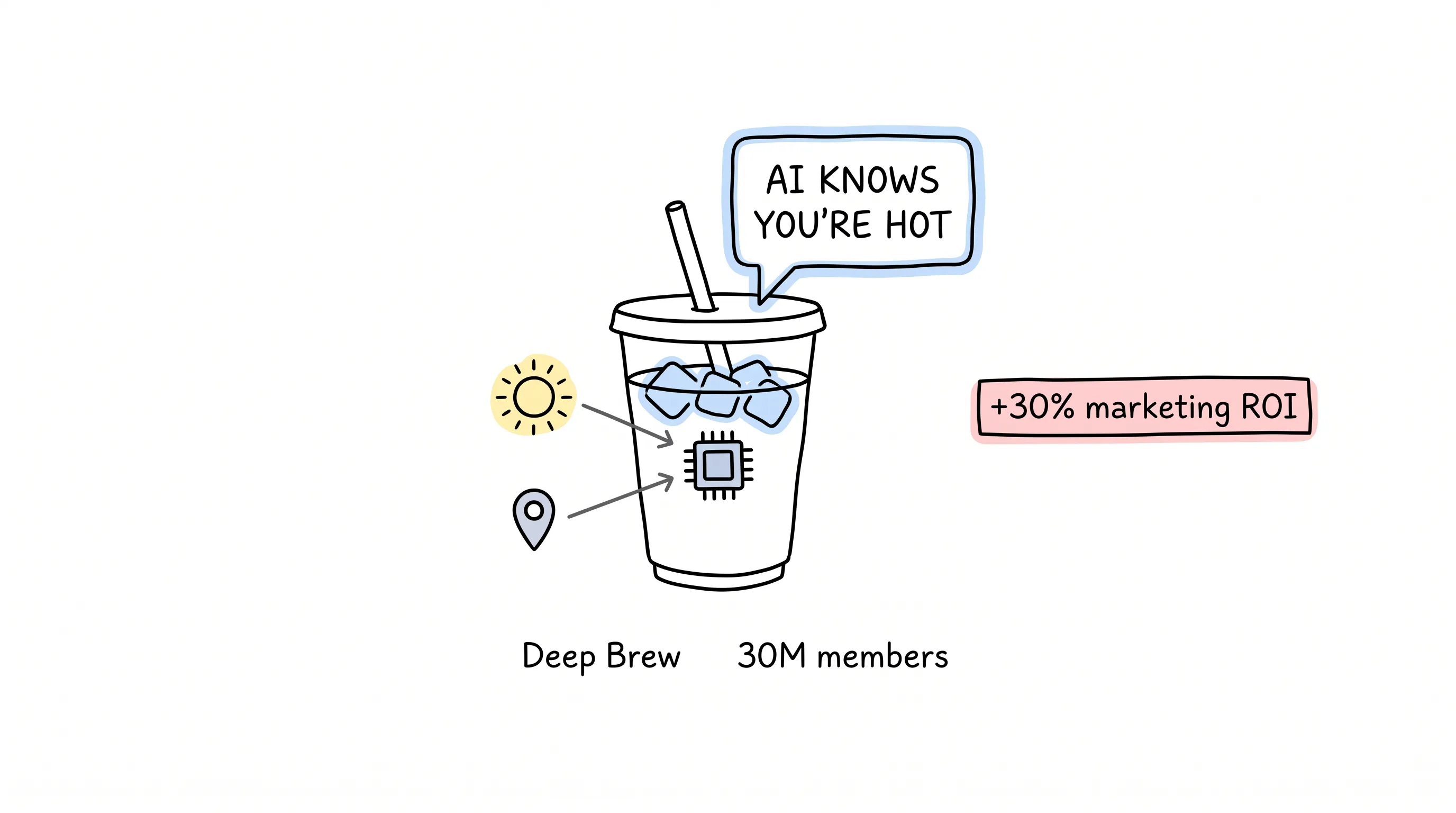
So I looked into it. It wasn't a coincidence. Starbucks has an AI system of its own called Deep Brew. It pulls in data from 30 million loyalty members — purchase history, flavor preferences, location, and even the weather.
The weather. You read that right.
It predicts heat waves. When one is coming, the system pushes iced-drink coupons to users near its stores ahead of time, pulling people in the door.
That play is as practical as it gets.
That day, I bought the iced Americano.
What Is AI Personalization?
Let's get one concept straight first. What exactly is AI personalization?
Put simply, it's having a machine "remember" every single customer for you — and know what they want to eat, buy, or watch before they even ask.
Marketing used to run on "segmentation": slice people into piles by age, region, and spending power, then send each pile the same batch of texts. Like a cafeteria line — everyone gets a portion, and every portion is identical.
AI personalization is a different animal. It's like a veteran waiter. You walk in, and without asking he knows where you sat last time, whether you want extra chili, and roughly what you're in the mood for today. And he isn't flipping through a little notebook — he's computing it on the spot: where you are right now, what device you're using, what time it is, what you bought last time. It's all laid out in front of him.
By the way, a veteran waiter can keep maybe a few dozen regulars in his head. AI can "remember" tens of millions — at the same time.
That's why almost every company serious about growth today treats personalization as a required course.
First, Run the Numbers
Do you think consumers actually care about personalization?
Look at three numbers. 71% of consumers expect brands to give them a personalized experience; 80% say they're more willing to spend when what a brand pushes actually fits them; and 57% will let a good or bad experience decide who gets their money.
Three numbers, one direction: get the recommendation right, and people buy.
Real Money: Three Stories
The logic isn't hard to grasp. What made me go "whoa" were these companies' books.
Story One: Starbucks Again
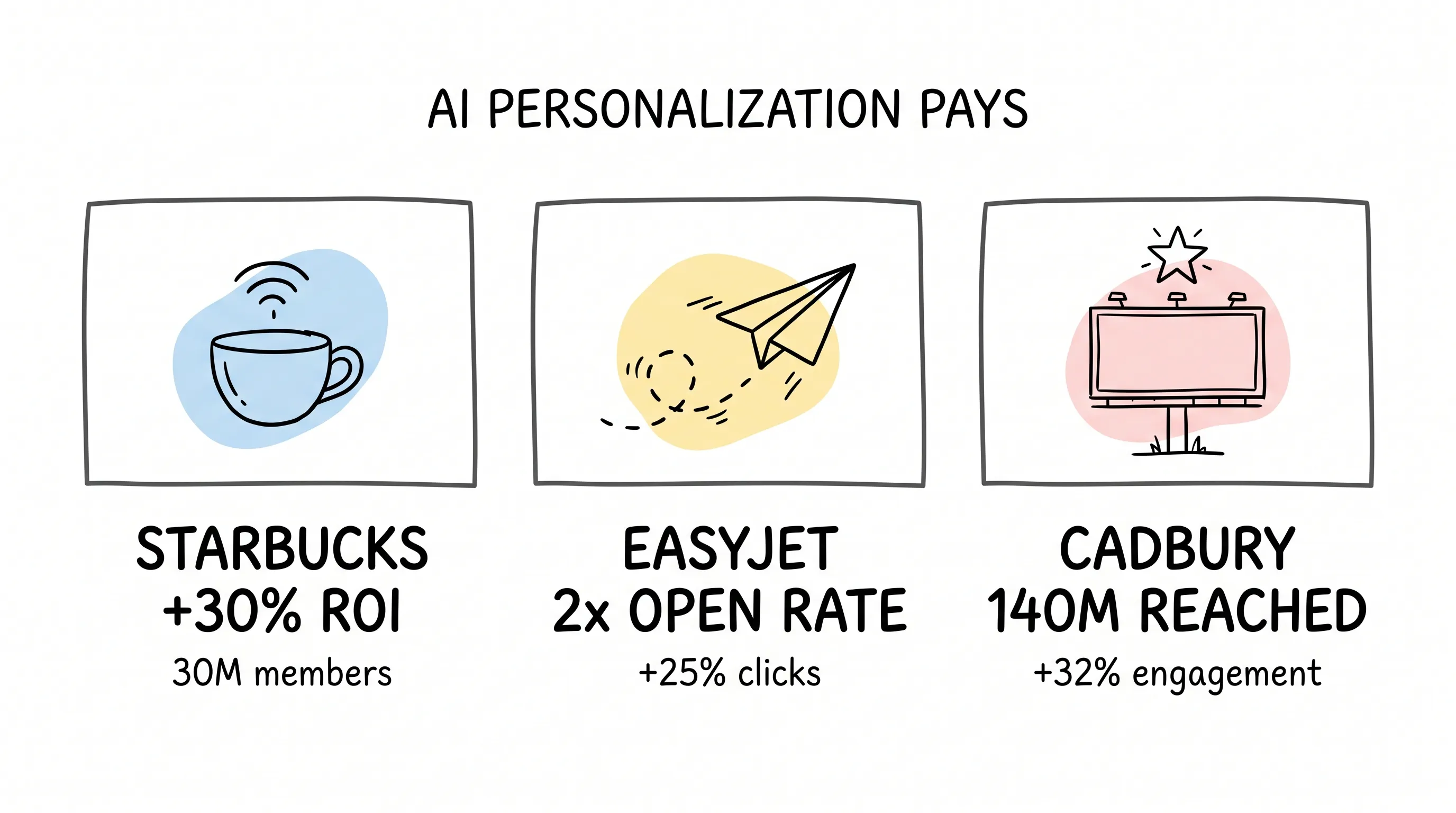
After Deep Brew plugged into data from 30 million members, Starbucks' marketing ROI rose 30%, and user engagement rose 15%.
What does 30% mean? You spend 100 in marketing budget; you used to get 100 back, now you get 130. The incremental return every marketer hunts for — they found it with a recommendation engine.
Story Two: A Budget Airline
EasyJet, the British budget airline. In its 20th-anniversary year, it dug out 20 years of accumulated customer data and wrote every longtime customer a "travel story" email: the year you flew to Madrid, the year you went to Lisbon — for your next stop, how about Barcelona?
The result: open rates were double its usual emails, click-through was up 25%, and in some markets conversion jumped 30% outright.
One email. No discounts, no promotions — it just told you about yourself.
Story Three: An Ad
Before Diwali, Cadbury did something very clever with AI. Using Rephrase.ai's generative technology, they had Bollywood superstar Shah Rukh Khan "appear" in thousands of ad versions, each one promoting a single neighborhood store. Yes — the one around your corner.
That hyper-personalized ad reached more than 140 million people and drove engagement up 32%.
The superstar's face was the same one person; the ad was different for everyone. Not long ago, that was unthinkable.
The Ledger Goes On
And it's not just these three.
Amazon itself says 35% of its sales come directly from its recommendation algorithm. L'Oréal's ModiFace virtual try-on has been used more than a billion times and converts three times as well as standard methods. Sephora's AI chatbot books in-store makeover appointments at an 11% higher conversion rate than other channels.
Stitch Fix, a company that uses algorithms to style your wardrobe: by 2024, AI recommendations accounted for 75% of the selections it sent customers, churn was down 20%, and returns were down 30%.
Netflix goes even harder. 80% of all viewing comes from its personalized recommendations. The company has done the math: its recommendations save users worldwide more than 1,300 hours of "hunting for something to watch" every day. Saved time becomes more viewing, and more viewing becomes lower churn.
Spotify's machine learning models process roughly 500 billion events a day to polish playlists like Discover Weekly. The more people listen, the sharper the recommendations; the sharper the recommendations, the more they listen.
Nike used AI for email segmentation: personalized emails got 25% higher click-through than ordinary ones, and over a few years digital-channel sales doubled. Yum! Brands (the parent company of KFC, Pizza Hut, and Taco Bell) rolled out an AI customer-value model and saw loyalty up 12% and sales up 10% in the first year.
Now look at the money-saving side of the ledger.
Unilever produced content with U-Studio, powered by IBM Watson: content costs down 30%, speed to launch up 50%. PayPal uses predictive models to spot users about to churn — analyzing a batch of users used to take 6 hours; now it takes 30 minutes. Under Armour put 3D foot scanners in its stores: returns down 25%, average order value up 32.5%. Mastercard's Digital Engine "listens" to trends on social media in real time — one campaign saw click-through up 37% and cost per click down 29%.
Then there's the content crowd. In 2023, Coca-Cola and OpenAI ran a project called Create Real Magic, letting users co-create works from the brand's assets with DALL·E and GPT-4 — creative iteration sped up 10 to 30 times. Phrasee uses AI to optimize email subject lines and copy, lifting click-through by as much as 38%. ClickUp rewrote more than 500 articles with SurferSEO, and organic traffic rose 85%.
See the pattern? This isn't an isolated quirk of one industry. Retail, restaurants, airlines, payments, content platforms — the same thing is happening across all of them.
What Is the Machine Actually Doing?
At this point you might ask: is the AI these companies use all the same thing?
There are really just a few core pieces. Let me break them down for you.
First, collaborative filtering. It's the foundation under both Netflix's and Spotify's recommendations. The logic is simple: whatever people with taste like yours also enjoy, that's what gets pushed to you. It doesn't matter that you haven't seen or heard it — someone else has already "taste-tested" it for you.
Second, content-based filtering. You like sci-fi movies, so here come a few more sci-fi movies. Spotify also analyzes each song's rhythm, mood, and lyrics to dig out songs that feel "like the kind of thing you like."
Third, prediction. PayPal uses it to predict who's about to churn and step in early to keep them; Stitch Fix uses it to predict fashion trends and stock up in advance.
One layer up is computer vision and AR. L'Oréal's SkinConsult: take a photo, and it diagnoses your skin. Under Armour's 3D foot scanning runs on the same thing.
And there's reinforcement learning. The system experiments on itself: push something and get ignored, lose a point; push something and get a click, gain a point. A little progress every day, and the pushes keep getting sharper. That's how the Spotify and Starbucks apps "grew" smart.
Lay these techniques side by side and you'll see a clear line of evolution. Early AI was reactive: you bought something, so I push related things. Today the horsepower is in the top layer — the predictive kind.
Smart personalization no longer responds to you; it anticipates you.
How Does the Money Pay Itself Back?
The thing marketers dread most is the boss asking: this money we spent — how do we account for it?
The beauty of this playbook is that it can be measured. Click-through, open rate, conversion, retention — you can always pull out a comparison group. Netflix does it most directly: running dozens of A/B tests at once, changing a single variable in the recommendation algorithm, and watching what happens to watch time and retention. If it goes up, the algorithm gets the credit.
The real jackpot, though, is customer lifetime value, or CLV. The term sounds intimidating; the meaning is simple: how much money does one customer contribute to you in total, from the first purchase to the last.
Companies that have run AI-driven customer-value analysis see retention up 25% and revenue up 15% on average. Industry benchmarks say personalization done well lifts revenue by a general 10% to 15%; in McKinsey's research, the high end reaches 40%.
Why? Because what AI is best at is recognizing the most valuable customers — and then treating them twice as well.
Acquisition keeps getting more expensive. Taking good care of existing customers is the better deal.
But There Are Three Places It Goes Wrong
Let me be blunt up front. This playbook doesn't make money just because you installed some software.
The easiest place to crash is data. AI eats data, full stop. If your data is scattered across seven or eight systems, doesn't reconcile, and is riddled with errors, the recommendations will only get worse. If the foundation is bad, the tower goes up fast — and it's all for nothing.
The second pit is subtler: pushing too far. In a 2022 Accenture study, 41% of consumers said a brand that "knows too much" gives them the creeps. In a 2023 Pew survey, 79% of Americans worried about how their data gets used.
Picture the scene: you mention running shoes in passing while chatting with a friend, and the next day your screen is wall-to-wall running-shoe ads. In that moment, does it feel like "they really get me" — or like "I'm being watched"?
The same algorithm can come across as thoughtful or as invasive. The line between the two is called trust.
The way to stay on the right side of that line isn't complicated: tell users where their data goes, give them the choice to turn it off, and make sure what you push is genuinely useful — not pushed for pushing's sake.
The third pit is inside the company. Personalization is something no single department — marketing, IT, legal, data — can pull off alone. Beyond data silos, there are department silos. I've seen too many companies buy the tools, argue in meeting rooms for half a year, and never actually move.
Back to That Iced Americano
Holding that discounted iced Americano that day, the more I thought about it, the more interesting it got.
It recommended well not because it understands "you" as a person, but because it computes constantly: weather, location, purchase history, push timing — every variable updating in real time. What we call AI personalization is, at bottom, turning "understanding the customer" from mysticism into engineering.
Mysticism runs on luck; engineering runs on iteration. Luck can't be replicated. Iteration can.
From here, these systems will only get more accurate, and consumer expectations will only climb higher. Whoever solidifies their data foundation first and holds the line of trust will be first to turn "anticipation" into business.
As for the rest of us, there's probably no escaping it: the next iced coffee pushed your way might genuinely be the one you wanted.
And may every "recommended for you" you ever encounter be thoughtfulness, not intrusion.
Continue reading
Related articles

It's 2026: Stop "Buying" AI Tools for Your Marketing Team — Start "Hiring" AI Agents
This learn article explains how AI agents differ from standalone AI tools in marketing, outlines three agent categories — build-your-own platforms, CRM-native agents, and vertical tools — and covers use cases across SEO, social media, advertising, and reporting, plus criteria for choosing one.

Did the Money You Spent on AI Marketing Ever Come Back?
A guide to measuring AI marketing ROI across three layers: ad reports, sales pipeline, and the financial ledger. Covers metrics such as ROAS and CPA, eight dashboard metrics, industry benchmarks, and common measurement mistakes.

How to Pick a Creative Automation Platform: First, Figure Out What These Eleven Actually Do
A learn article sorts eleven creative automation platforms — including Bannerflow, Celtra, Smartly.io, and Storyteq — into four functional groups and proposes five evaluation questions covering publishing reach, automation depth, ease of adoption, team fit, and verifiable evidence.