
Everyone Chases Tactics; Nobody Practices the Fundamentals
This learn article explains why marketing fundamentals matter more than chasing tactics, covering strategy versus tactics, brand awareness versus direct response, push versus pull, features versus benefits, and free versus paid traffic, and advises using AI as an assistant rather than a stand-in.
A while back, a friend of mine who runs an online shop invited me out for tea. The first thing out of his mouth: help me think this through — which platform should I be putting money into?
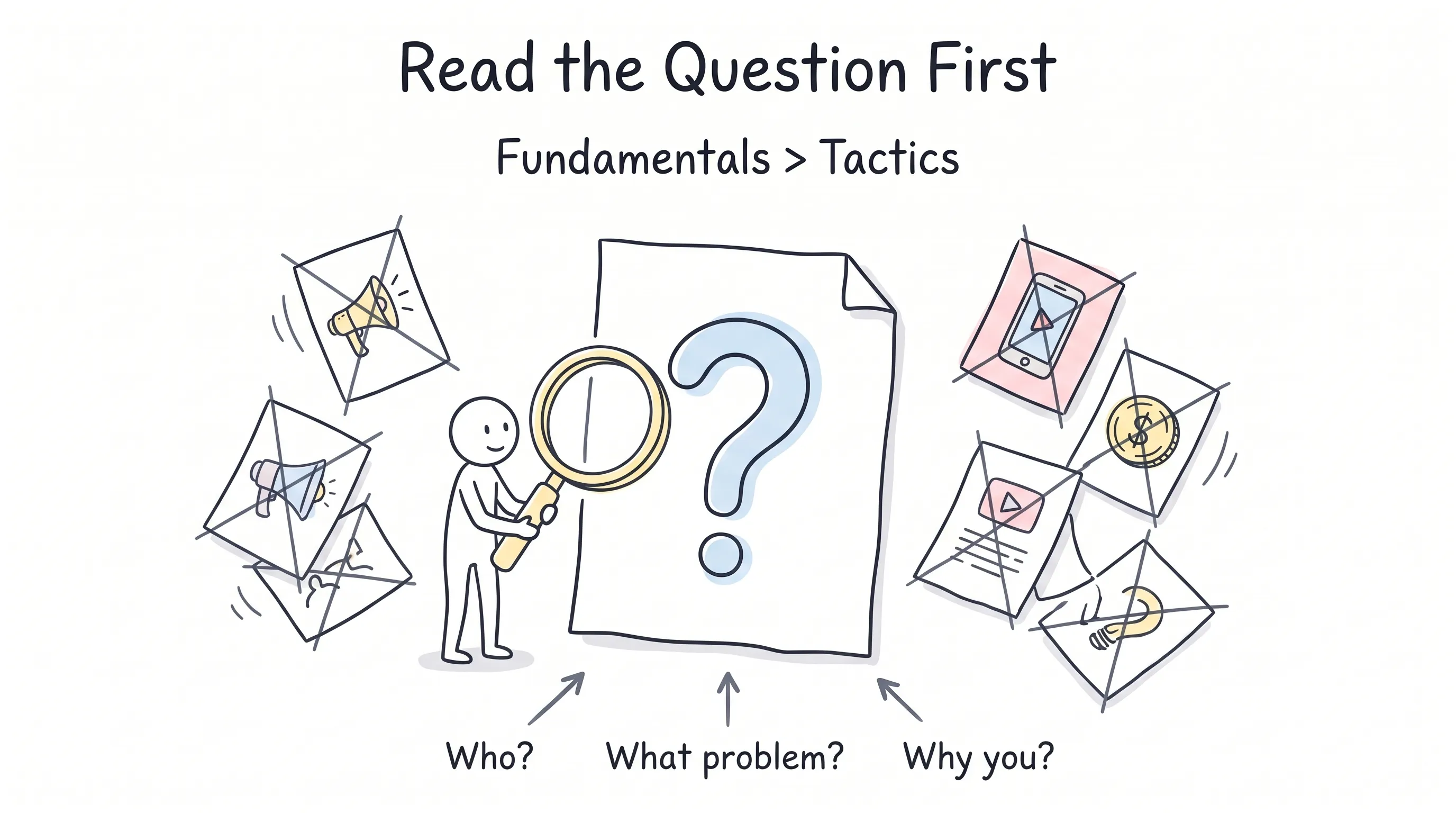
I said, hold on. First let me ask you three questions: Who do you sell to? What problem do you solve? Why should anyone buy from you?
He froze. Thought about it for a long time, then said: just tell me where to spend the money.
You see, that's how most people do business today. Cash clutched in hand, scrambling for channels, tactics, templates for viral hits. As for fundamentals, they assume those are for beginners to chew on — I've been at this long enough, just give me the playbook.
Wrong.
Tactics are answers; fundamentals are the question. If you haven't even read the question right, the prettiest answer still scores zero.
What Is Marketing?
Let's take the first concept apart. Many people treat marketing as a synonym for advertising — they think posting short videos, buying ads, going live, that's the whole of marketing.
It isn't.
Advertising is only a small slice of marketing. Marketing is everything that comes before the ad, and everything after.
Here's an analogy. Advertising is the guy at the door handing out flyers, whose job is to coax people into the shop. Marketing is the restaurant downstairs: the food is solid, the waiter remembers you don't eat cilantro, and at checkout you're sent off with a complimentary bottle of sour plum drink. Next time you want to eat, you don't open an app to compare prices — you just head downstairs.
From the first time a stranger scrolls past you, to following you, to trusting you, to paying, to that thank-you message you chase after the money has landed — that entire chain is marketing.
Advertising walks people in the door; marketing makes it so they can't do without you.
Strategy and Tactics Are Two Different Things
What is strategy? Strategy is answering those three questions from before: what the product is, who it's for, what problem it solves, and where you talk to them.
What is tactics? Tactics are the concrete moves you make to carry out those answers. Whether to make short videos, whether to go live, whether to drive traffic with a daily check-in sheet or a giveaway, how many posts a day.
See — tactics are far more seductive. Doing them gives you things to do, talking about them gives you things to say, and every platform out there is teaching you how to buy ads, day after day. So most people simply skip strategy and head straight for tactics.
It's like building a house without the blueprints. However fast you lay bricks, the higher you stack, the more dangerous it gets.
I once met a man who made leather goods by hand. Every day, without fail, three videos. Over half a year he built up twenty-thousand-plus followers and barely closed any sales. The problem wasn't how well the videos were shot; it's that from start to finish he never got clear on who this thing was for. Twenty thousand followers, twenty thousand people passing by.
Read the question first, then start writing. Slow — but every step counts.
There Are Only Two Kinds of Tactics
Take all of marketing apart, and you get two categories.
The first, direct response. Click here, buy now, order today for an instant discount. Its biggest advantage is instant measurability: either people act or they don't, and you can run the numbers the same day.
The second, brand awareness. It doesn't push you to buy; it first gets you to know me, remember me, trust me — so that on the day you do want to buy, mine is the first name you recall.
Direct response is like a street stall — cash in one hand, goods in the other, and by closing time you know exactly what you made that day. Brand is like the noodle shop downstairs you've been going to for ten years: you can't say which bowl is the best, but switch to another place and you just can't relax.
The second kind is hard to measure, but far more important. What to do? Watch your micro-conversions: how many people open your emails, how many finish your content, how many tag a friend on their own. Like the noodle-shop owner who doesn't only count the day's take — he also counts how many familiar faces came in.
Once the familiar faces add up, the money is only a matter of time.
Push, and Pull
I watched a film once where the protagonist moves through an internet world, chased the whole way by pop-up ads he can't shake. That is "push" at its most typical.
Push means pushing your message at people, whether they want it or not. TV ads, outdoor billboards, feed ads — all in this basket.
Pull means making the content good enough that people come find you on their own. It doesn't rush you to place an order; it first genuinely solves a problem for you, gives the answer in full, and doesn't carve it up behind a paywall to dole it out drop by drop.
Push says: buy mine. Pull says: come here, let me solve this hard problem for you.
You need both. But users today have been pushed at for a decade or two — they're immune. Push can only buy a single exposure; pull is what earns repeat customers.
People Don't Buy the Drill
Here's another easily neglected fundamental: the difference between features and benefits.
What is a feature? What it has. Waterproof. Nine weeks. Comes with 23 templates.
What is a benefit? What does it have to do with me.
A customer buying a drill doesn't want a drill; he wants the hole in the wall. Think one layer deeper: what he really wants isn't even the hole — it's the family portrait that gets hung on it.
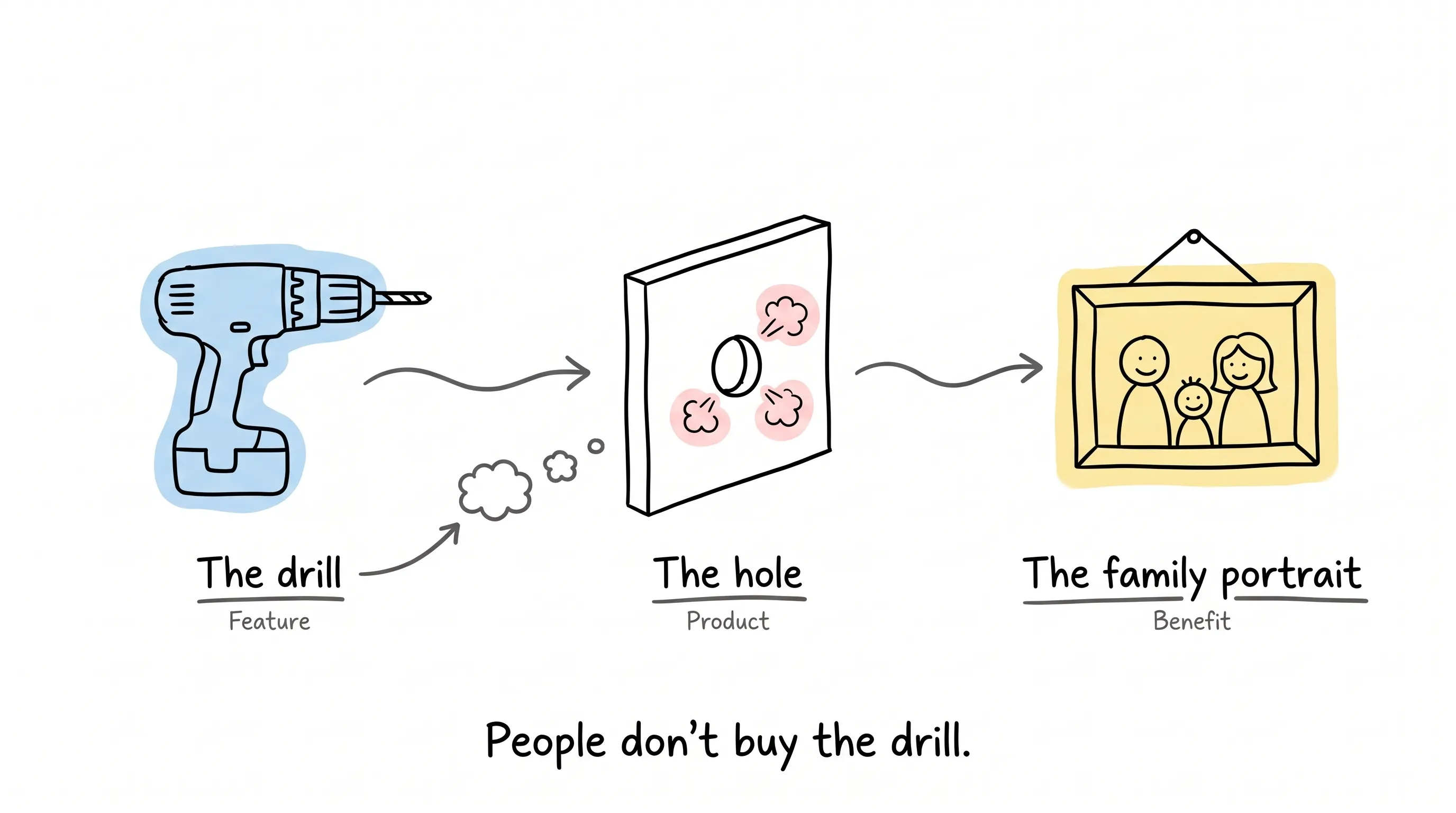
Go look at any page selling a course. The features are spelled out plainly: how many weeks of lessons, how many frameworks, how many communities. These should be written — but they are the side dishes. What actually makes a person hesitate for three seconds and then press the pay button is usually another line: a year from now, you can quit the job that makes you miserable and give your time back to yourself and your family.
The side dishes decide whether you look professional; the main course decides whether they buy.
People don't buy the product; they buy the better version of themselves waiting on the other side of the purchase.
Traffic: Trade Time, or Trade Money
The precondition of all marketing is that someone sees you. And there are only two ways to be seen: free content, paid ads.
Free traffic, you trade time for. Paid traffic, you trade money for. It's that simple.
I know someone who runs a design studio. The first year, not a cent on ads — posted their work piece by piece on social platforms and slowly accumulated. Slow, truly slow, but every bit of budget was saved, and everyone who accumulated was a precisely targeted customer. Only after the business stabilized did they start buying ads to scale.
So don't ask which is better. If you have plenty of money, buy traffic, buy efficiency. If money is tight, then your only asset is time — invest it in content; the compounding beats the interest.
Finally, About AI
A topic you can't dodge. Today, the people still afraid of AI and afraid to touch it are about as many as the people who treat it as an all-powerful stand-in, throw everything at it, then complain the result is as bland as tap water.
Both extremes are hurting their own marketing.
My way of using it is simple: AI is an assistant, not a stand-in. Looking things up, brainstorming, reviewing what content worked — it's fast at all of it; put it to work. But your voice, your judgment, your understanding of people — don't hand those over.
Otherwise you'll find you've blended into a screenful of look-alike content. And in marketing, the thing to fear most is being exactly the same as everyone else.
Back to the Beginning
Later I saw that friend again. He said he never went and researched which platform to buy — instead, he filled an entire page with answers to those three questions.
The strange part: with hardly any ads running, the inquiries started coming in.
Not strange at all. Fundamentals are the kind of thing you can't see in ordinary times — and at the critical moment, they're everything.
Tactics go stale; fundamentals don't.
Here's hoping you, too, learn to read the question right — and soon.
Continue reading
Related articles

It's 2026: Stop "Buying" AI Tools for Your Marketing Team — Start "Hiring" AI Agents
This learn article explains how AI agents differ from standalone AI tools in marketing, outlines three agent categories — build-your-own platforms, CRM-native agents, and vertical tools — and covers use cases across SEO, social media, advertising, and reporting, plus criteria for choosing one.

Did the Money You Spent on AI Marketing Ever Come Back?
A guide to measuring AI marketing ROI across three layers: ad reports, sales pipeline, and the financial ledger. Covers metrics such as ROAS and CPA, eight dashboard metrics, industry benchmarks, and common measurement mistakes.

How to Pick a Creative Automation Platform: First, Figure Out What These Eleven Actually Do
A learn article sorts eleven creative automation platforms — including Bannerflow, Celtra, Smartly.io, and Storyteq — into four functional groups and proposes five evaluation questions covering publishing reach, automation depth, ease of adoption, team fit, and verifiable evidence.