
Microsoft Has Already Done the AI Marketing Math for You: Up to 353% ROI
A learn article reviewing Microsoft and Forrester research on AI marketing automation for small and mid-sized businesses, covering the reported up-to-353% ROI, gains across content, email, and ads, a step-by-step adoption path, and caveats that the figures are vendor-claimed.
A while back, I had dinner with a friend who runs a cross-border e-commerce business.
The moment he sat down, the complaints started pouring out: ads keep getting more expensive, content keeps piling up, hiring keeps getting more exhausting, and the margins keep getting thinner. He said marketing was starting to feel like a money pit.
I asked him: how much of this work have you handed to AI?
He paused for a second and said: a bit here and there, drafting copy and stuff. Never really took it seriously.
I said, don't rush to a verdict. Microsoft actually studied a batch of small and mid-sized companies using Copilot in 2024, and the numbers they came up with gave me a jolt: return on investment, up to 353%.
353%. What does that mean? You put in a hundred bucks and get 353 back.
This isn't a concept demo. It's a number earned with real money by companies just like yours.
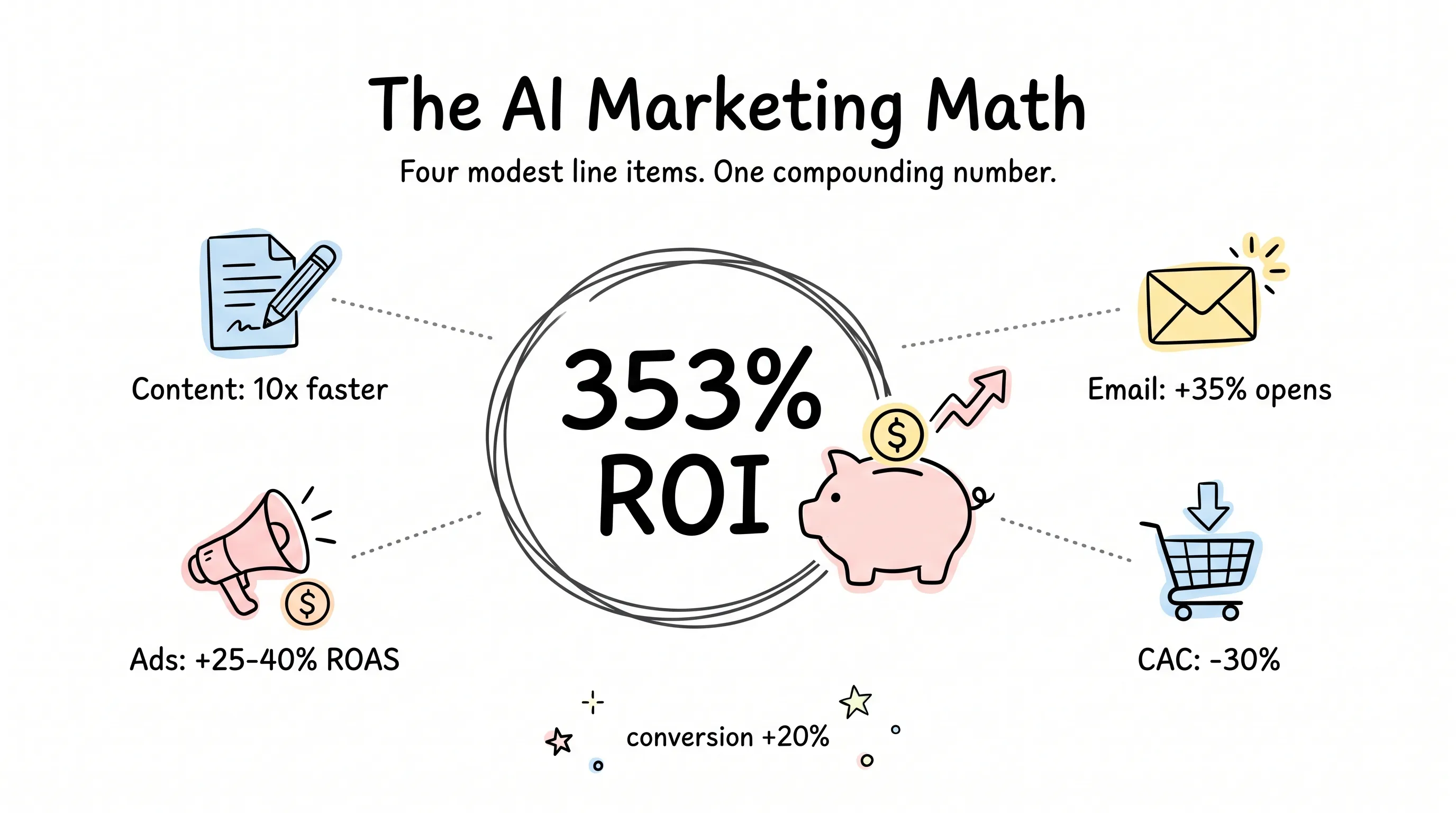
Of course, let me be upfront: this is a research conclusion published by Microsoft and modeled by Forrester, which makes it vendor-claimed data — the numbers run high, as you'd expect. Listen for the direction, don't take it at face value. But the direction itself deserves your full attention.
What Is "Marketing Automation"?
What is marketing automation?
Plainly put: you hand the repetitive, mechanical, pattern-based work in marketing to AI.
Think about what a marketing team's day actually looks like: writing blog posts, making graphics, brainstorming email subject lines, picking send times, tuning ad bids, segmenting audiences, running A/B tests, writing weekly reports... All of this work shares one trait: doing it once is easy, doing it a hundred times is brutal.
In the past, the only way to scale this work was to hire more people. More people means more cost, and once costs climb, quality starts to slip.
Now, AI can take over a big chunk of it. Humans do one thing: set direction, make judgment calls, and hold the final gate.
That's marketing automation.
How Was 353% Calculated?
So how exactly did that 353% get calculated?
I've broken it into line items, and I'll walk you through them one by one.
Item one: content. Writing a piece of marketing content used to take hours. Now AI drafts and humans polish, and the whole pipeline runs 10 times faster. One participant in the study — a teacher — saved 9.3 hours a week with Copilot.
Item two: email. Planning an email campaign used to take several long hours; now you get a plan in minutes, personalized per recipient. One number says it all: AI-optimized email subject lines can lift open rates by 35%.
Item three: ads. AI adjusts bids in real time, expands audiences, and scales creative testing; the efficiency of every ad dollar improves — typically a 25% to 40% lift in ROAS (return on ad spend).
Item four: the whole picture. Companies running the full AI marketing automation stack saw customer acquisition cost (CAC) drop 30% on average, with conversion rates up 20%.
Each item on its own looks modest. But stack all four together and the compounding kicks in.
Saving time saves pennies. Making every step faster is where the real money is.
Why Now?
You might ask: people have been touting AI marketing efficiency for years — why claim that now is the moment to get in?
Two data points.
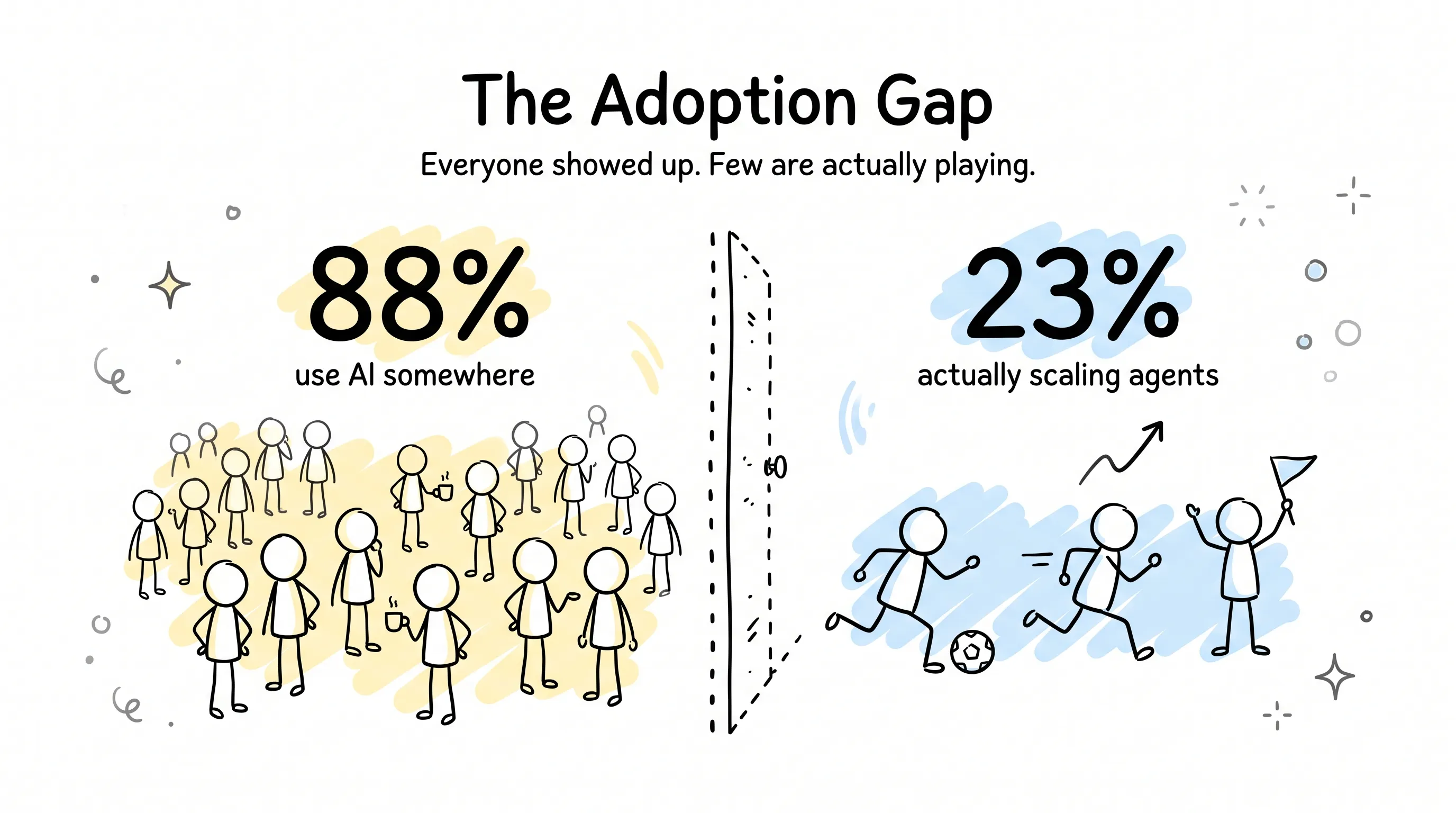
A McKinsey survey in 2025: 88% of companies use AI in at least one function, and 62% are experimenting with AI agents. Sounds like everyone's on board, right?
But only 23% are actually scaling AI agents.
88% have shown up. Only 23% have actually gotten in the game.
Gartner made a prediction in 2025: by 2026, 40% of enterprise applications will have task-specific AI agents built in. It's 2026 now, and that prediction is coming true.
The early-mover advantage has always belonged to the window when "not many people use it yet, but the number is climbing." Once everyone's using it, efficiency gains stop being an advantage and become the passing grade.
The tools are there for everyone. The dividend goes to whoever starts running first.
Where Do You Start?
So where do you start? Here's a path, ordered by how fast it pays back.
Step one: content. The fastest payoff, the lowest risk. Let AI draft, let humans polish. Off-the-shelf writing tools (Jasper, Copy.ai, that category) run tens to a few hundred euros a month, and your content output speeds up immediately. Some teams have doubled or tripled the number of articles they publish per day. Keyword analysis and description generation — the most labor-hungry parts of SEO — take 75% less time.
Step two: email. Choosing send times, optimizing subject lines, personalizing per person, auto-triggering follow-up flows. This step typically pays for itself in one to two months.
Step three: ads. AI manages bidding, expands lookalike audiences, runs tests at scale. Payback in two to three months.
Step four: personalization. Once the first three steps are running smoothly, let AI turn "one-size-fits-all" into "truly personalized," delivering 1:1 content across channels. That 30% drop in acquisition cost I mentioned earlier? It happens mostly at this stage.
One more thing about budget: you don't need to buy the full suite on day one. A writing tool at a few hundred a month is enough to get going — add more once it proves itself. The heaviest step is the full stack, several thousand euros a month, with a four-to-six-month payback. Consider it once you've tasted wins on the earlier steps.
Someone will ask: won't search engines penalize AI-written content?
My take: search engines have always penalized garbage, not AI. Content mass-produced with nothing new in it, the kind that makes anyone who reads it shake their head — whether a human or an AI wrote it, it deserves the penalty. AI drafts, humans add judgment and experience: that's not AI content, that's AI-assisted.
Beyond the Numbers, a Bit of Cold Water
At this point, I have to pour some cold water on it, or this whole piece turns into an ad.
The numbers above — including that 353% — are mostly self-reported or modeled by vendors and consultancies. They can tell you "the direction holds," but they can't guarantee "you'll get there too."
Here's another number to sit with: 77% of small businesses worldwide are already using AI tools, and 91% of them say revenue grew directly because of it, saving over $150,000 a year on average.
That 91% — I have my doubts. Things are never that good for ninety-something percent of people. But flip it around: even the conservative estimates all point the same way. The downside here is "it doesn't work, you go back to how things were." The upside is "the math holds up." That kind of asymmetric bet is worth taking.
One figure from Italy hits hardest: 78% of small and mid-sized businesses there are still under-investing in digitalization. That may be the most interesting thing about AI: for the first time, it lets small companies do big-company work on a small-company budget.
If the math works, do it. If it doesn't, wait a bit longer. But don't skip the math.
One Last Thing
Back to that friend from the beginning.
After dinner that night, he listed the three most repetitive jobs on his content team and let AI try them for a week. Later he told me: not 353%, but clearly worth it.
I think that's the healthiest attitude.
Microsoft's 353% belongs to Microsoft. Your own 353% is yours to work out. Start with the cheapest step — one month, a few hundred — and the cost of being wrong is lower than a single business dinner.
Every window works the same way: those who catch on first take it; those who catch on later wait for the next one.
Here's to being the one who runs the numbers first.
Continue reading
Related articles

It's 2026: Stop "Buying" AI Tools for Your Marketing Team — Start "Hiring" AI Agents
This learn article explains how AI agents differ from standalone AI tools in marketing, outlines three agent categories — build-your-own platforms, CRM-native agents, and vertical tools — and covers use cases across SEO, social media, advertising, and reporting, plus criteria for choosing one.

What Is GEO? How Your Brand Gets "Mentioned" in the Age of AI Search
An explainer on GEO (Generative Engine Optimization) for e-commerce and DTC brands: how it differs from SEO and AEO, why AI answers shape brand visibility, and eight practices covering question-focused content, consistent brand messaging, structured pages, external evidence, comparisons, and AI mention tracking.

AI Is Already Making Decisions for Your Customers. Are You on the List?
A learn article explains GEO (Generative Engine Optimization): why AI-generated answers now shape which brands customers see, and how SEO fundamentals, entity clarity, citable evidence, and monthly measurement affect visibility in AI answers.