
The Customer Hasn't Said a Word, but AI Has Already Computed the Next Move
A learn article explaining predictive marketing: how AI uses behavioral, transactional, contextual, and intent data to forecast customer actions, personalize touchpoints, and automate execution across channels. It also covers privacy and trust considerations and the limits of AI in marketing.
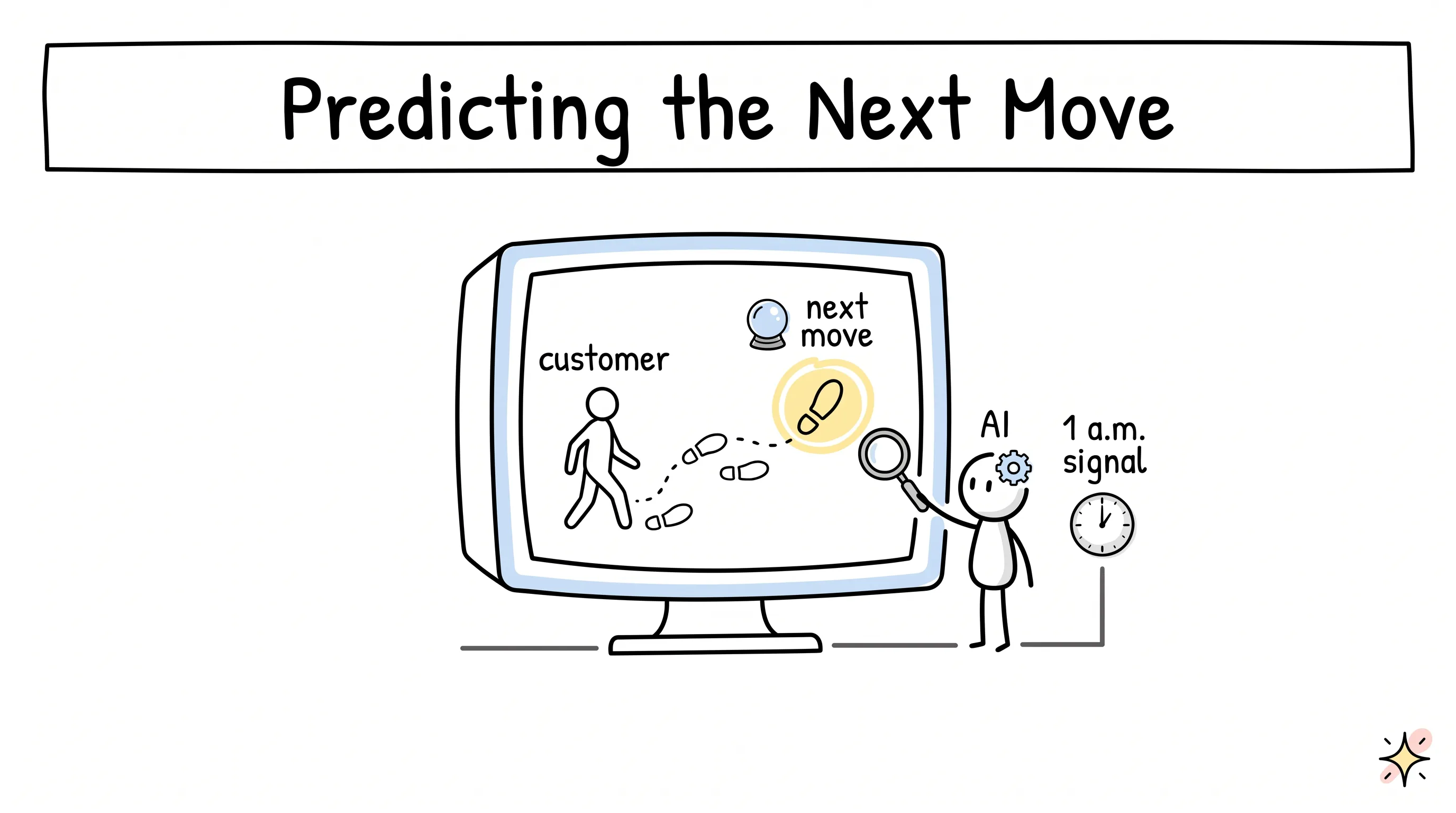
A while back, an old friend of mine who runs an e-commerce business invited me to dinner. Halfway through the meal, he pulled out his phone, showed me a screenshot from his admin dashboard, and said something that sent a chill down my spine.
He said: my operations team is still waiting in line for the weekly review meeting — over there, they've already cycled through three versions of their ads.
Here's what happened. One of his longtime customers opened the shopping cart at 1 a.m., added two items, and paid nothing. At lunch the next day, slacking off at work, the customer went off to compare prices. On the afternoon of the third day, he was hit by a feed ad that looked completely unrelated — and placed the order.
Through that entire process, his team didn't catch a single step. The email went out in a mass blast the next morning; the ads were still the batch scheduled last week; the coupon came three days later, as an afterthought.
Meanwhile, the rival company running its customer journey on AI received a signal at 1 a.m. — "this customer is nearing the tipping point" — pushed real user reviews the next morning, and that "completely unrelated" ad on day three? Computed.
You see, this is what's been happening in the marketing world these past few years: the fast reactors are already losing to the ones who compute first.
What Is Predictive Marketing?
What is predictive marketing?
Put simply: using AI to compute, in advance, what a customer is "going to do next."
Note — computed, not guessed.
What is guessing? It's the operations person going with their gut: "The month is almost over, let's push a coupon to shore up the numbers."
What is computing? It's laying everything out — a person's clicks, time on page, what they've bought, what device they use, which city they're in, what hours they're active — letting the model find the patterns, then handing you a probability: How likely is he to buy? How likely is he to leave? When is the best moment to reach him?
The difference is like the difference between a corner shop owner and a stranger.
The corner shop owner remembers that the kid in the school uniform buys a rice ball every Wednesday after school, and grabs an extra soda on Fridays. So on Friday morning, he stocks an extra case. That's not talent. That's memory plus attentiveness.
Predictive marketing takes "the corner shop owner's memory" and installs it into a system — then has it watch tens of millions of people at the same time.
One owner can remember a few hundred regulars. AI can remember every single one.
That's why, in survey after survey across industries in recent years, the same numbers keep coming back: companies using AI in sales and marketing have lifted their win rates by more than 30%; on complex tasks, AI tools have pushed productivity up by as much as 66%; and 84% of sales professionals say AI has made their interactions with customers noticeably faster.
These figures come from surveys in different years, run by different organizations — no need to quarrel over each decimal — but the direction is strikingly consistent. And one more thing to watch: this is no longer just about "winning a few more new customers."
How This Machine Actually Runs
So what does this system actually look like?
I've taken it apart, and it comes down to five steps, each one linked to the next.
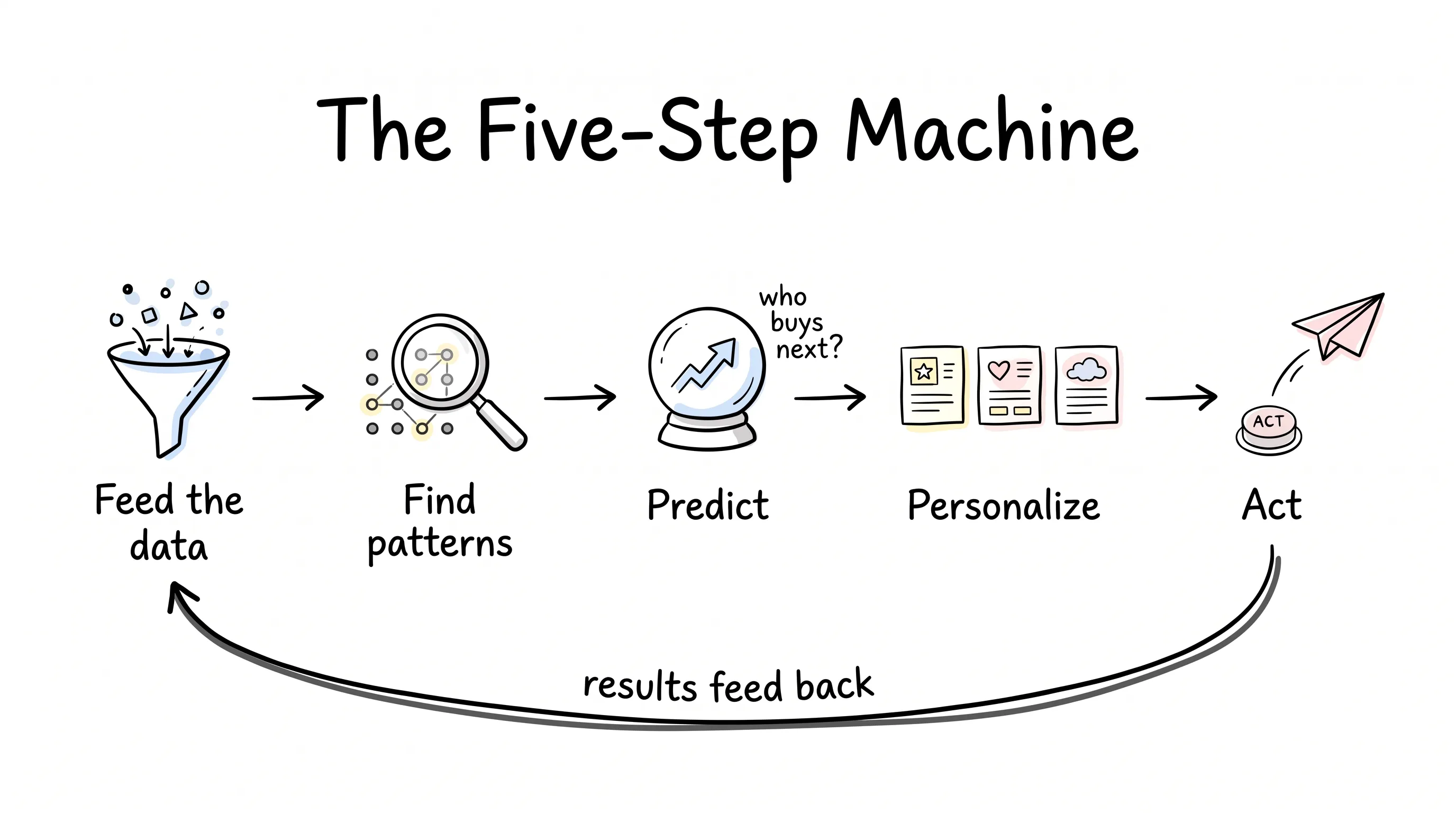
Step one: feed it.
AI can only compute accurately if it's fed fully. Behavioral data — what was clicked, how long someone lingered on a page. Transactional data — what was bought, how much was spent, how often they buy. Contextual data — what device, which city, what hours they come online. And intent data — what terms they searched, what content they viewed.
This data used to sit scattered across different systems, never speaking to one another. That's why so many companies have been doing the same thing these past few years: standing up a CDP (Customer Data Platform) to stitch a single person's traces from every corner into one complete picture.
This step looks boring, but it's the watershed. If the data doesn't come together, AI isn't intelligence — it's noise.
Step two: recognize faces.
With the data in place, the model starts finding patterns. Not the "people who bought A also buy B" kind that anyone can see, but patterns like this: customers who browse at night, open the pricing page twice, and return within 48 hours — show them a real user's review at exactly that moment, and the odds of ordering jump by a wide margin. One estimate put the jump at 73%.
Patterns like this are invisible to the human eye. Facing millions of behavioral records, human eyes glaze over. Models don't.
Step three: play it forward.
Once the patterns are found, you can compute ahead: who's going to place an order next week? Who has quietly cooled off and is getting ready to walk? What product will this customer want next? When is the best moment to strike?
And the most valuable question of all: as the next move, which action should you take with this person? Push a message? Offer a coupon? Or hold off and not disturb them at all?
Step four: change the face.
Once the computing is right, it's personalization's turn. The personalization we talk about today goes far beyond "Hello, Mr. Zhang." Plugging a name into a template — that's just layout.
Real personalization means the same website, opened by a thousand people, looks a thousand different ways; email content is generated on the spot from that person's intent; whether to offer a discount depends not on the calendar but on probability.
Marketing used to talk about "segmentation" — slicing people into 25-to-35-year-olds, first-tier city, cat owners. This whole approach is being bypassed. The model doesn't hand you segments. It speaks directly to one person.
One survey of marketers found that 59% of respondents consider AI-driven personalization the most impactful change in the industry. The first time I saw that figure, I paused for a beat: oh — the consensus has already formed.
Step five: act.
This is the most ruthless step. AI doesn't just make recommendations — it executes.
Emails go out at the moment of highest open probability; ad budgets shift in real time to whichever channel performs best; the support bot answers instantly at 2 a.m.; the entire customer journey adjusts on the spot to a person's behavior.
These systems have a name: agentic AI. It's not an assistant that helps you write drafts — it's an executor that makes the calls and does the work itself. Email, web, app, ads — every channel strung together, with no human pressing buttons in between.
By now you can probably see it: this isn't automation — it's orchestration.
A Flywheel That Gets Sharper with Every Turn
String the five steps together and you get a closed-loop machine: data feeds the model, the model produces predictions, the system executes directly, and the results flow back into the data.
Did today's coupon work? By tomorrow, it's new fuel for the model. Every lap around the loop buys another notch of accuracy.
So the most impressive thing about AI marketing isn't how beautiful any single campaign looks — it's that it never stops. Other teams get more worn down the more they use theirs; this one gets more accurate the more it runs.
This is compounding. Marketing, as a business, has compounding for the first time.
In operational terms, it comes down to a few very practical things: conversion rates go up — the right people receive the right message at the right time; customer lifetime value goes up — demand is spotted in advance, so cross-selling and repeat purchases have something to stand on; churn goes down — the system holds on to people who want to leave before they've left; and as for ad spend, the money only goes where the computed return is highest.
Expectations Have Already Been Raised
But there's one character in this story that's easy to overlook: the customer.
What's driving this round of change isn't actually the technology — it's the customers. Customers have been spoiled by the companies that "compute it just right."
Today's default assumptions are: you should remember what I've looked at, and stop pushing things I've already bought; if I ask something late at night, someone should reply to me immediately; whatever gets placed in front of me should match my life.
They don't need surprise-and-delight personalization. Personalization is the baseline.
If the corner shop owner ever gets a regular's rice ball order wrong, the regular won't kick up a fuss. He'll just walk into the shop next door the next time he passes by.
What Can Predict Can Also Manipulate
Which raises the question. Once technology can compute this far, someone is bound to ask: can we go half a step further?
If you can predict behavior, you can influence behavior. Half a step forward is service. Another half step, and it's manipulation.
How is privacy handled? Can the customer be told why the model recommended this? Will biases carried in the data mean certain people always see certain prices? None of these are technical questions — they are questions of trust.
My judgment is blunt: the market grants no grace period for failures along this line. One data breach, one exposed bias, and customers turn and walk — and they walk away emotional.
So as predictive marketing goes deeper, what's being contested in the end isn't computing power — it's accountability. Whoever can be trusted is the one who earns the right to predict.
A Few Near-Certain Things Ahead
Looking forward, a few things are all but certain.
Fully autonomous marketing systems, where AI runs the entire campaign itself, from starting gun to finish line; emotion sensing, where machines learn to read tone and mood and adjust their wording accordingly; content prepared ahead of the demand spike; entire journeys reshaping themselves in real time at every touchpoint; and ever-finer context — knowing not just who you are, but where you are right now and what you're doing.
Sounds far-fetched. In truth, every single one of these is already being tried by some company.
Finally
Before I wrap up, I owe you a bucket of cold water.
However accurately AI computes, there are three things it cannot compute: genuine temperament, stories that move people, and trust built up over the long run.
Those three are still human work.
So my view hasn't changed: the winners won't be the companies that swap people out for AI. The winners will be the companies that use AI to amplify human judgment. Models handle computing fast; people handle thinking right and keeping it real.
Remember that friend from the dinner at the start? As we parted, he asked me: "If we start catching up now, is there still time?"
I told him: directionally, yes — but don't be timid about the move. Stop trying to catch up by "reacting faster." Start directly from "computing one step ahead."
Here's to you becoming the one who computes first.
Continue reading
Related articles

It's 2026: Stop "Buying" AI Tools for Your Marketing Team — Start "Hiring" AI Agents
This learn article explains how AI agents differ from standalone AI tools in marketing, outlines three agent categories — build-your-own platforms, CRM-native agents, and vertical tools — and covers use cases across SEO, social media, advertising, and reporting, plus criteria for choosing one.

Did the Money You Spent on AI Marketing Ever Come Back?
A guide to measuring AI marketing ROI across three layers: ad reports, sales pipeline, and the financial ledger. Covers metrics such as ROAS and CPA, eight dashboard metrics, industry benchmarks, and common measurement mistakes.

How to Pick a Creative Automation Platform: First, Figure Out What These Eleven Actually Do
A learn article sorts eleven creative automation platforms — including Bannerflow, Celtra, Smartly.io, and Storyteq — into four functional groups and proposes five evaluation questions covering publishing reach, automation depth, ease of adoption, team fit, and verifiable evidence.