
New EU Rules Are Coming: Daily Streaks, Auto-Renewals, and Data-Driven Price Discrimination — That Era Is Over
An explainer of the EU AI Act and the proposed Digital Fairness Act, covering dark patterns, addictive design, data-driven price discrimination, subscription traps, and influencer disclosure rules, and what they mean for app and game growth teams.
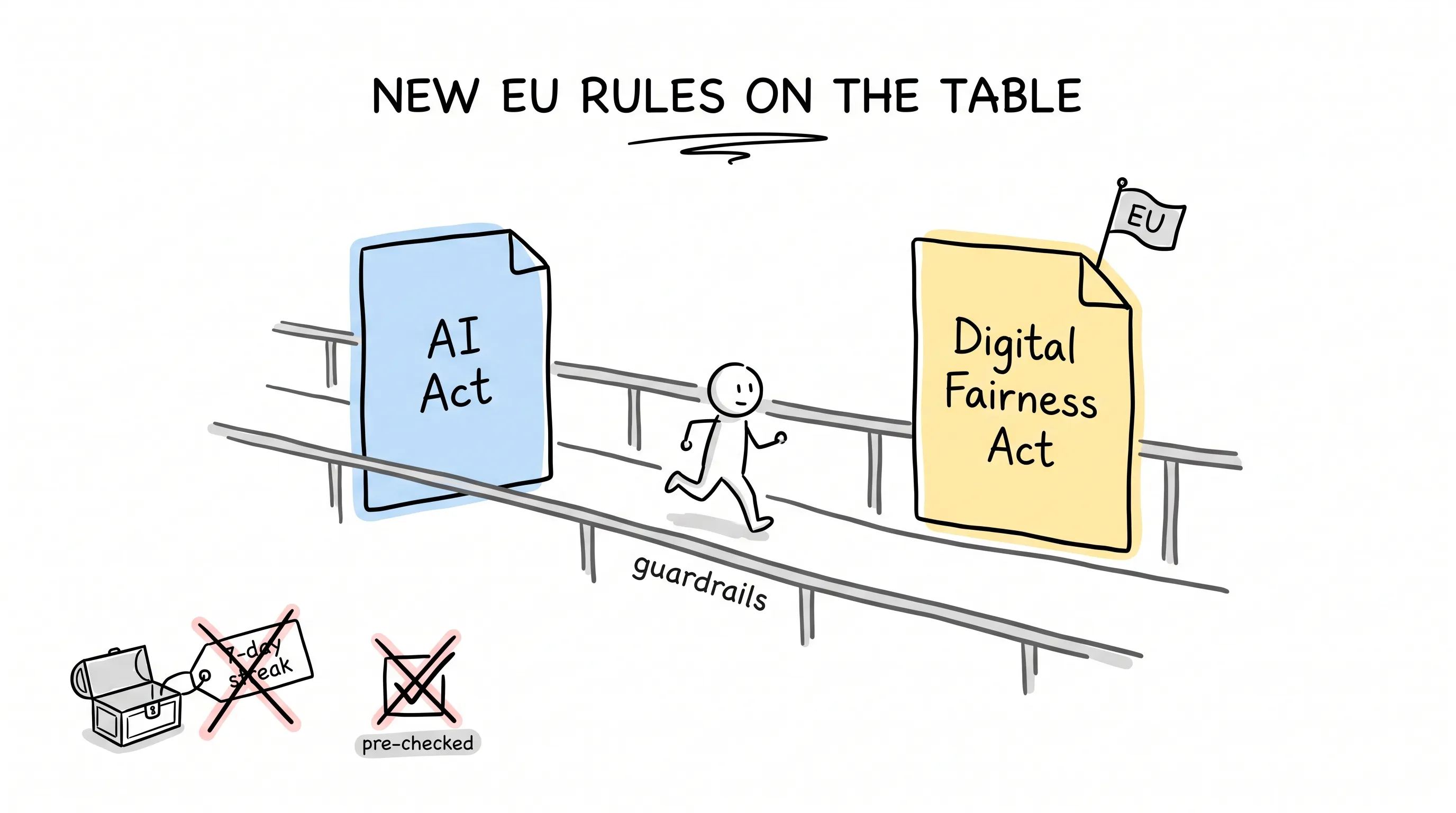
Say you're the growth lead at a mobile game.
Your users open the app every day to check in. Check in 7 days in a row, get a loot chest. What's inside? Random. And to keep the streak alive, plenty of people don't dare skip a single day.
In your retrospective deck, you call this a "retention hook."
Now suppose your main battlefield is the EU. Then let me warn you: that hook — along with a whole pile of old playbooks in your product — is being called out, one by one, in a legal document.
On September 16 this year, European Commission President Ursula von der Leyen delivered the annual State of the Union address to the European Parliament. The speech set the EU's priorities for the year ahead, and a big chunk of it landed on two things: how to regulate AI, and how to regulate digital markets.
I dug through the speech and the legislative agenda that followed it. The more I read, the more I felt that everyone building apps and games should read this stuff carefully.
Why? Because both of these things land right on the nerve center of growth.
First: the AI Act — Guardrails for AI
What is the EU AI Act?
In plain language: it draws safety lines around how AI is developed and used. The EU's calculus is simple — stay in the AI race, but don't let AI hurt people.
For app and game teams, it gets granular: how the AI features in your product are described on the store page, how they're pitched in ads, what age groups can even see them — every one of these will be reviewed line by line.
Put bluntly: before, you could write "AI-powered recommendations" on your store page and nobody checked whether real AI was behind it. Not anymore. Undeclared AI use gets fined; algorithmic personalization in app stores has to follow the new rules too.
Von der Leyen calls these guardrails. Big tech companies themselves have warned, repeatedly, about the risks of AI running wild. Guardrails aren't there to stop you from running — they're there to keep you on the track.
By the way, the EU doesn't want to be only the rule-maker. It's stacking chips on its own AI industry at the same time: building a network of AI factories, bundling supercomputing power, data, and talent together; loosening up both public and private purse strings to invest in Europe's own AI companies; it has even mapped out the use cases for AI — healthcare, transport, agriculture, manufacturing, sector by sector. One line she kept repeating stuck with me:
AI should help people work, not replace them.
One more detail. The EU has been reaching out lately: Canada became its first "associated country," partnering on setting AI standards; and Australia's approach to restricting minors on social media has been taken up as its blueprint. See — even when it borrows homework, it borrows it loud and clear.
Second: the DFA — Calling Out the Tricks, One by One
The document that really hits closest to home for growth teams is another one: the Digital Fairness Act.
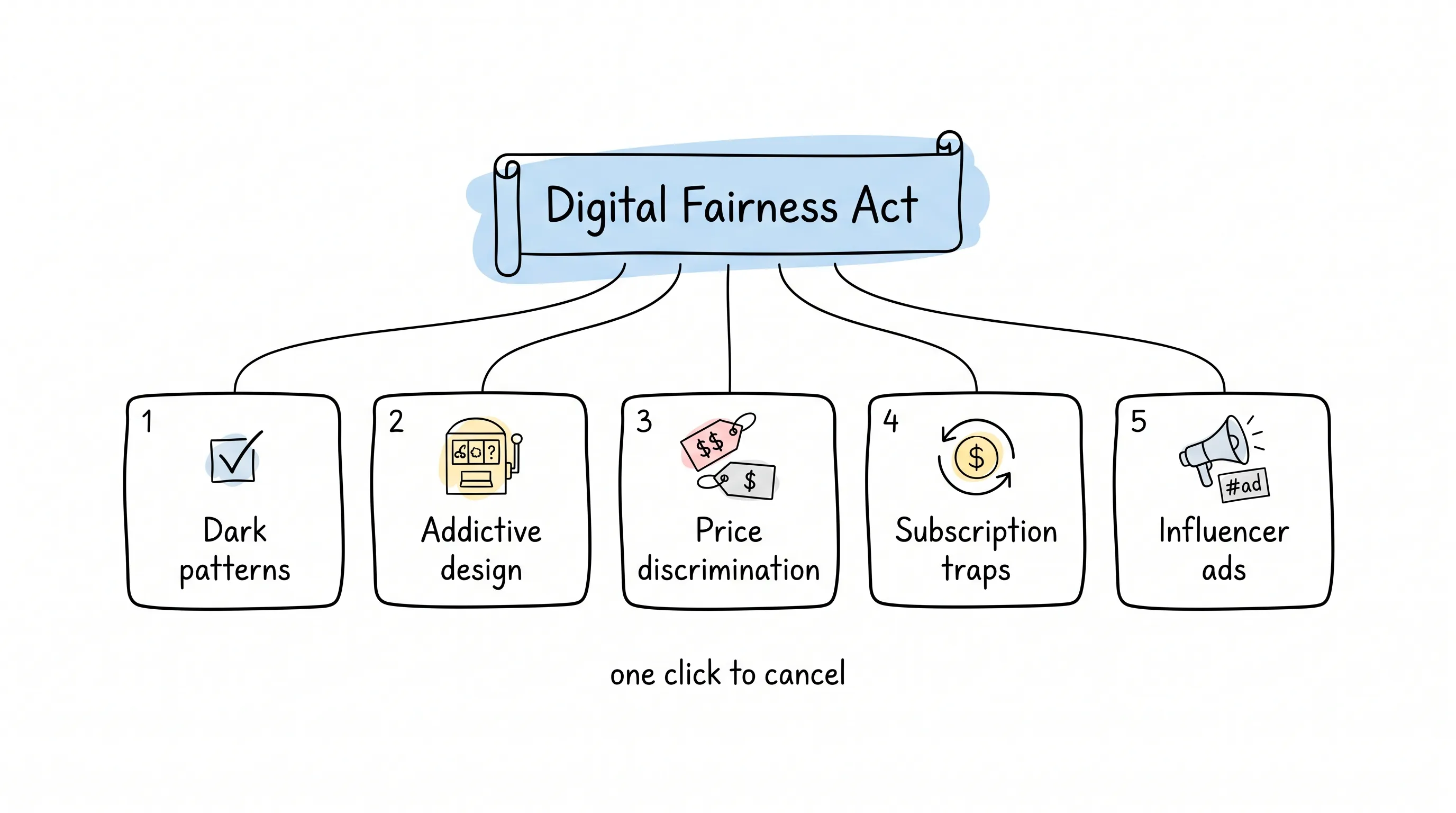
Right now it's still a legislative proposal, expected to formally land this autumn. The act targets the "clever little tricks" in B2C transactions — five directions, and I'll take them one at a time.
First, dark patterns. What are dark patterns? Interface designs engineered to make you "misclick on purpose."
For example, a consent box pre-checked by default. A "Decline" button made deliberately smaller than "Accept." A product page that says "only 1 left" while the warehouse holds 1,000.
From now on, all of these count as violations. Your onboarding, permission screens, and paywalls all need to go through review again.
Next, addictive design. This one hits game teams hardest.
Infinite scroll, autoplay, daily streak check-ins, loot box draws — the mechanics built to keep you hooked are being treated as attention traps by the EU: the Digital Fairness Act wants to give every user a "circuit breaker" built specifically to take these designs apart. Minors get stricter treatment — a companion EU Children's Act bans addictive hooks aimed at kids outright.
Yes, loot-box-style, gambling-adjacent reward mechanics are on that list. That "check in 7 days in a row for a loot chest" from the opening — remember it now?
Third, data-driven price discrimination (charging different users different prices based on their data profiles).
Setting your price — or curating your recommendations — based on your browsing history, or even on the system's guess that "you're prone to impulse buys," is about to be restricted. Hidden fees, and "reference-price discounts" that inflate the price first and then slash it, count as violations too.
The signals are already showing. In August, Google changed how it presents search results in the EU. Regulation isn't "coming soon" — it's already underway.
Fourth, subscription traps.
Free trial ends, not a peep, straight to paid. This trick is far too common. Not anymore: before a trial converts to paid, users must be notified in advance.
Cancellation has to be as easy as signing up — one click to cancel, or at least just as smooth. Stop counting on money made from "users forgot to cancel."
Fifth, influencer marketing.
From now on, when brands, agencies, and influencers publish commercial content, disclosure requirements get stricter — and they carry direct legal liability. Promoting unsuitable products to minors will be pinned down by the Digital Fairness Act together with the Digital Services Act.
The Rules Have Changed. What Do You Compete On?
Put these five directions side by side and you'll see they all point at the same thing:
Money made off information asymmetry and human weakness is getting harder to earn.
Growing in the European market from here on means competing on real ability: is the product genuinely good, is the price genuinely fair, is the recommendation genuinely relevant.
I don't think that's a bad thing. Only where the playbook dividend dies does real product strength get its turn.
Back to that opening check-in loot chest. If it genuinely brings users joy, keep it — just state the rules clearly. If it exists only to keep people hooked, fix it, and soon.
The EU has dealt a new hand, and the rules are on the table.
May you play — and last — a long time under the new rules.
Continue reading
Related articles
Is Investing in Influencers Actually Worth It? I Broke Down These Dozens of Numbers and Ran the Math for You
A learn article that compiles industry data on influencer marketing, covering market size, ROI measurement practices, nano versus mega creator pricing and engagement, platform budget allocation, AI tooling, and ad disclosure compliance.
The EU Is Handing the Pause Button Back to You
The EU's draft Digital Fairness Act targets dark patterns, addictive design, undisclosed influencer ads, silent subscription renewals, and game spending by minors, while keeping dynamic pricing legal but banning drip pricing; fines could reach 6% of annual turnover.
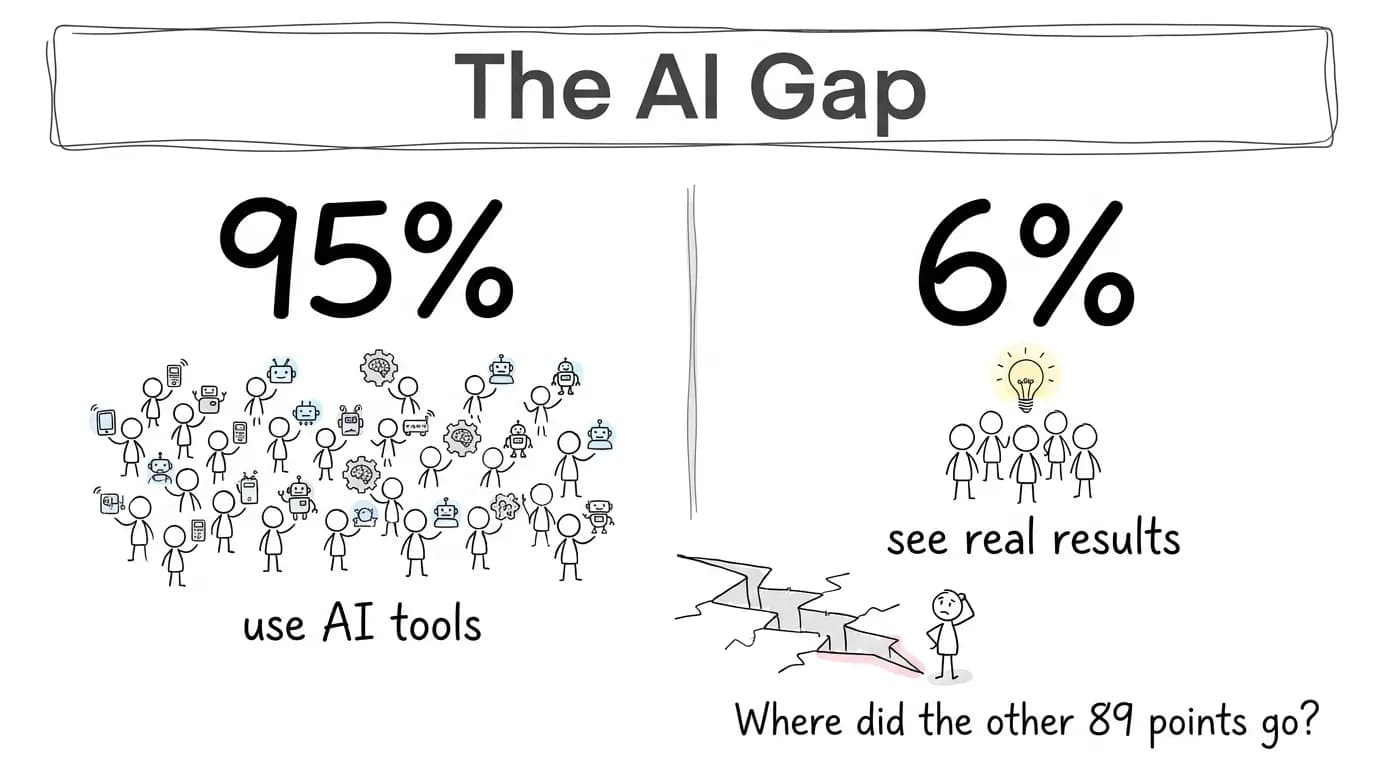
95% of Companies Use AI. Only 6% See Real Results. What's the Gap? Kolsquare's New Report Nails the Answer
A recap of a Kolsquare webinar on AI in influencer marketing, covering adoption gaps, AI-labeled content engagement, AI influencer limits, and generative engine visibility. It also outlines four practical moves for 2027 planning.