
Cross-Border E-Commerce Is Getting Rebuilt by AI
A learn article describing how AI and automation can be applied across cross-border e-commerce operations, including demand forecasting, multi-channel inventory syncing, logistics selection, tax and customs filing, pricing, and returns handling, along with common adoption pitfalls such as messy data and disconnected.
A while back, I had dinner with a friend who runs a cross-border e-commerce business.
He sells home goods. His factory is in Ningbo, and his products ship to the US, Germany, and France. He has a store on Amazon, an independent storefront on Shopify, and listings on eBay. Sounds pretty glamorous, right?
But not long after we sat down, the complaints started pouring out.
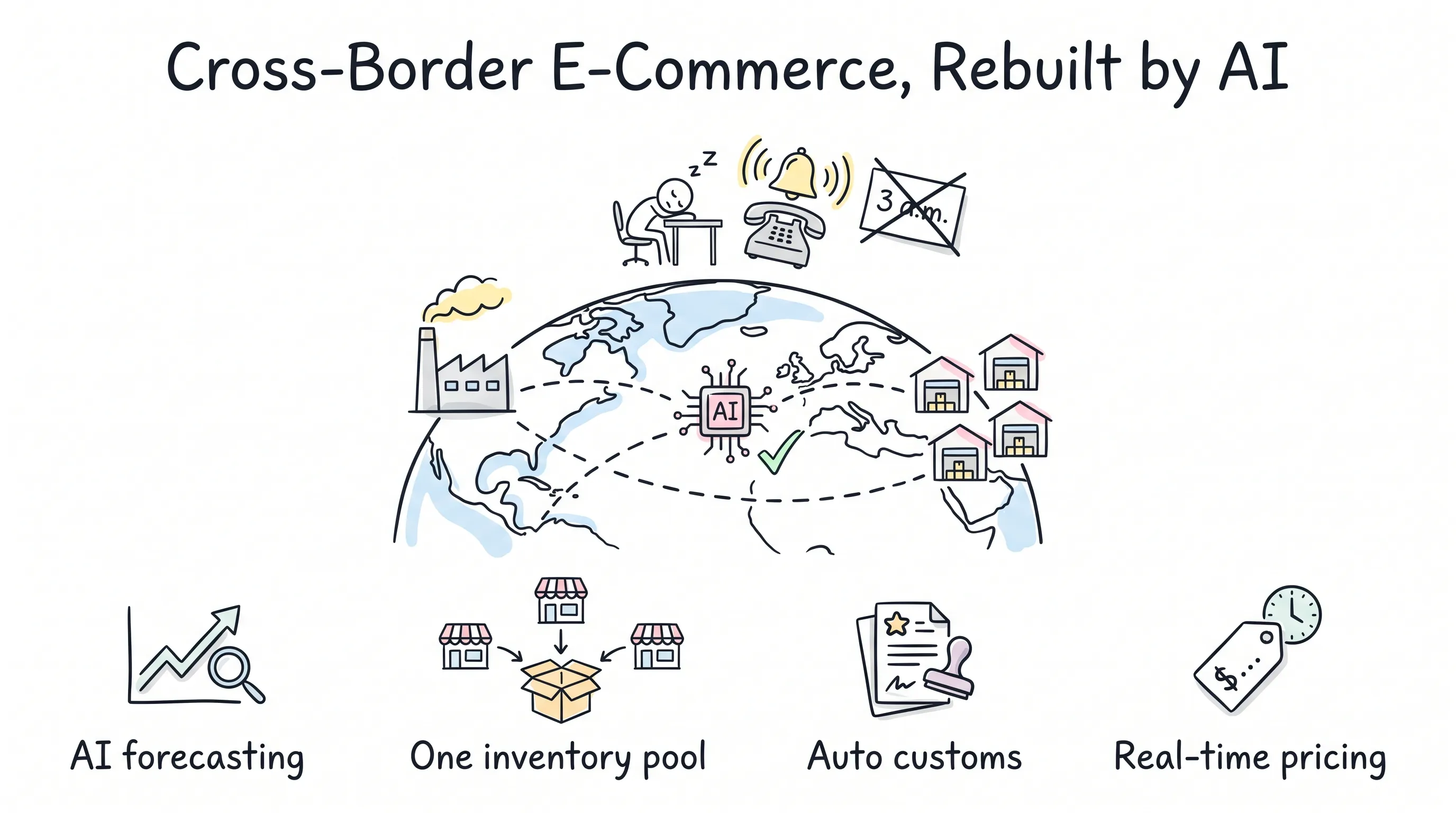
Last month, a shipment bound for Germany got stuck at customs. Why? A single field on the customs declaration form had been filled in wrong. That one field left more than 2,000 items sitting at the port for over ten days. Storage fees burned away day after day, customers hounded him for their orders, and there he was at 3 a.m., still on the phone with his freight forwarder.
He said something that stuck with me: "I'm running a global business, but I worry like a babysitter."
I laughed at the time. But once the laugh faded, I gave it some serious thought: this might be exactly the reality for most cross-border sellers.
So What Exactly Makes Cross-Border So Hard?
What do I mean by hard? Picture domestic e-commerce as a one-meter-wide road; cross-border is six meters wide.
At home, you face one market, one language, one tax system. Cross-border? You face a whole pile of markets, a pile of languages, a pile of tax systems — all at once.
One set of rules in the US, another in Germany, yet another in France. VAT has to be calculated, duties filed, returns handled, and inventory kept across several warehouses. Every action, multiplied by the number of countries, then again by the number of platforms, makes the workload grow exponentially.
Take the simplest example: returns.
Domestically, a return is simple: the courier picks it up, the warehouse inspects it, it goes back on the shelf — done in two days. A cross-border return? The goods come back from the German warehouse, go through quality inspection, then someone decides whether to scrap them, refurbish them, or restock them — and the inventory system has to be updated in sync, or the sellable quantities shown on Amazon and Shopify will be wrong.
Every step needs a human watching. Humans watching means mistakes. And one mistake costs you exactly the kind of story above — 2,000 items stuck at a port.
So here's the question: is there a way out of this?
There is. And it's what I want to talk about today: using AI and automation to turn "humans watching" into "machines watching."
What Does It Mean to Run Cross-Border with AI?
First, let's clear something up, so there's no misunderstanding. I'm not talking about using AI to write your listing copy — that's just scratching the surface.
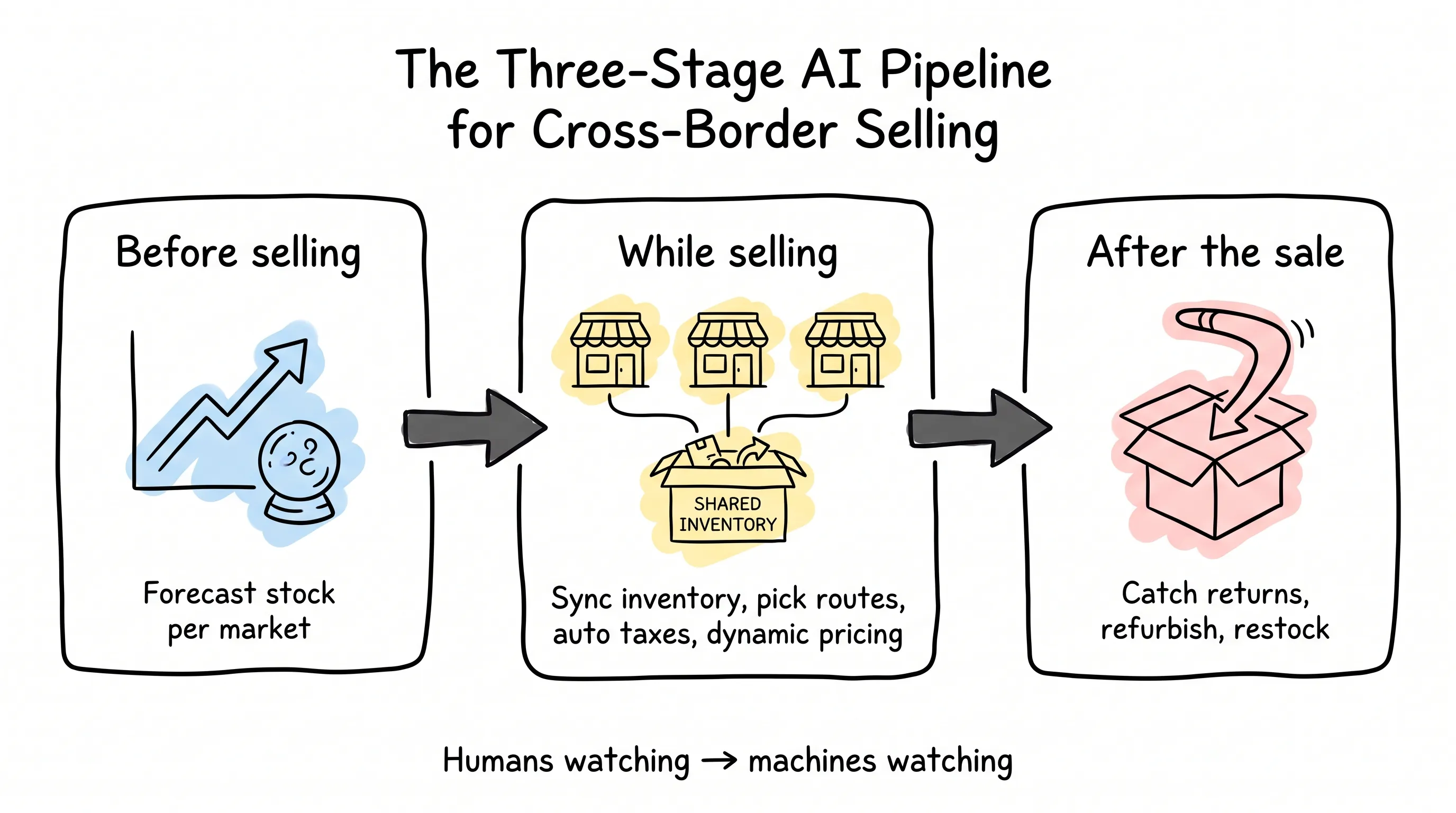
I'm talking about handing the entire cross-border pipeline to systems. Break the pipeline down and it's simply three stages: before the goods sell, while they're selling, and after they've sold.
Stage one, before selling: forecast with precision.
Before anything sells, you have to answer one question: for each country, each platform, how much stock do you hold?
Sellers who stock by gut feeling end up with half their warehouses piled with merchandise that won't move and the other half stocked out every day. And what does a stockout mean? It means the ranking you fought so hard to climb evaporates within two weeks.
AI forecasting does exactly this: it takes your sales data from the past few years, adds seasonality and market trends, and calculates how much stock each region should hold. One extra SKU ties up your capital; one SKU short hands free traffic to your competitors. On this math, the machine beats your gut every time.
Stage two, while selling: keep it running smoothly.
A few pieces to this.
Inventory. Your goods are listed on Amazon, Shopify, and eBay at the same time; sell one unit, and all three counts have to drop. Update them by hand? You'll slip sooner or later. With automatic system synchronization, one inventory pool governs every channel.
Logistics. For the very same order, which warehouse ships it, which carrier takes it, and which route it travels — cost and delivery time can swing by a wide margin. AI picks the optimal option the second you place the order.
Taxes and customs. This is where my friend tripped and fell. The VAT rules differ between Germany and France, and they change constantly. Tools like Avalara and TaxJar do precisely this: calculate taxes automatically, file taxes automatically, generate customs documents automatically. The field your shaky hand filled in wrong — a machine won't.
Pricing. For the same product, what to charge on the US site versus the European site has to account for competitor prices, local demand, and first-mile freight (the cost of shipping goods from your factory to the overseas warehouses). A human adjusting prices once a week counts as diligent; a machine can watch the market and adjust in real time.
Stage three, after the sale: catch what falls.
Returns. AI can tell you in advance which SKUs have abnormally high return rates, so you can go take a look: is the listing description wrong, or has the quality slipped? And once returns arrive at the warehouse, the inspect-refurbish-restock workflow can be automated too — otherwise the cost of reverse logistics (everything involved in moving goods backward from the customer) will eat a big chunk of your profit.
See the picture? Forecast with precision before selling, keep things smooth while selling, catch what falls after. That is the complete puzzle of running cross-border with AI.
I Ran the Numbers for Him
After hearing all this, my friend still hesitated. He asked: "Wouldn't these systems cost a chunk of money too?"
So I ran the numbers for him.
He runs inventory and orders with three ops people. Three people managing inventory and customs paperwork for four countries costs 600,000 yuan a year in salaries — and that's before counting the cost of errors. One customs filing mistake last year: storage fees plus fines, and nearly 100,000 yuan was gone.
And the systems? A few tens of thousands of yuan a year. Three people can then manage a business in eight countries, with an error rate approaching zero.
AI doesn't make you spend an extra chunk of money — it takes the money you were already spending on headcount and on mistakes, and spends it somewhere else instead.
He didn't say anything more after hearing that. The second week after he got back, he started trying it out.
That said, I owe him a bucket of cold water. There are three pitfalls in adopting AI tools, and more people fall into them than climb out.
The first pitfall: the data is dirty. AI forecasting feeds on historical data. If your sales records are a mess and your SKU names aren't even consistent, the messier the input, the wilder the output. So clean up your data first.
The second pitfall: the systems are silos. One system for inventory, one for logistics, one for finance, none of them talking to each other — all you've done is add a few more tools to babysit. Connect them first, then scale up.
The third pitfall: the team doesn't know how to use the tools. The dashboards mean nothing to them, and when AI makes a suggestion, nobody pays attention. Even just piloting in one country, one category, for three months first — let the team get comfortable, then roll it out.
Small, careful pilots are the steadiest path I've seen.
One Last Thing
A few days ago, I ran into that friend again.
He said customs barely needs his attention anymore — the system clears it automatically, with an error rate lower than his most reliable operations person. At 3 a.m., he no longer answers the phone. His sleep quality has improved a lot.
The cross-border pie keeps getting bigger, but the rules for dividing it keep getting more complicated. Whoever hands the complexity to machines frees up their energy for what's actually valuable: product selection, supply chain, brand.
In this wave of AI rebuilding the cross-border business, the ones who get it running first will leave those who don't far, far behind.
Here's to sleeping soundly — one day sooner.
Continue reading
Related articles

What Is an AI Marketing Agent? From "Using AI" to "Delegating to AI"
A learn article explaining what an AI marketing agent is, how it differs from rule-based automation, and which repetitive tasks such as lead qualification, reporting, and campaign monitoring can be delegated while humans keep key decisions.

Marketing Automation Is Shifting from "You Do It" to "You Say It"
This article explains how marketing automation is shifting from rule-based platforms that merely execute toward AI agents that plan, create, publish, and review campaigns, covering delegable tasks, underlying technologies, tool categories, adoption steps, and risks such as privacy and automating without strategy.

When AI Does the Creative, Mistakes Come in Batches Too
A learn article on the risks of using generative AI for marketing creative across brand, legal, compliance, and operational layers, with case examples and seven practices for review, rights clearance, documentation, and vendor governance.