
$1 In, $58 Back: Let Me Run the Numbers on WhatsApp Marketing for You
A learn article examines reported ROI figures for WhatsApp marketing, including a cited 58x return for beauty brands, and outlines the preconditions behind high returns such as consent-based lists, segmentation, automated flows, and account quality ratings.
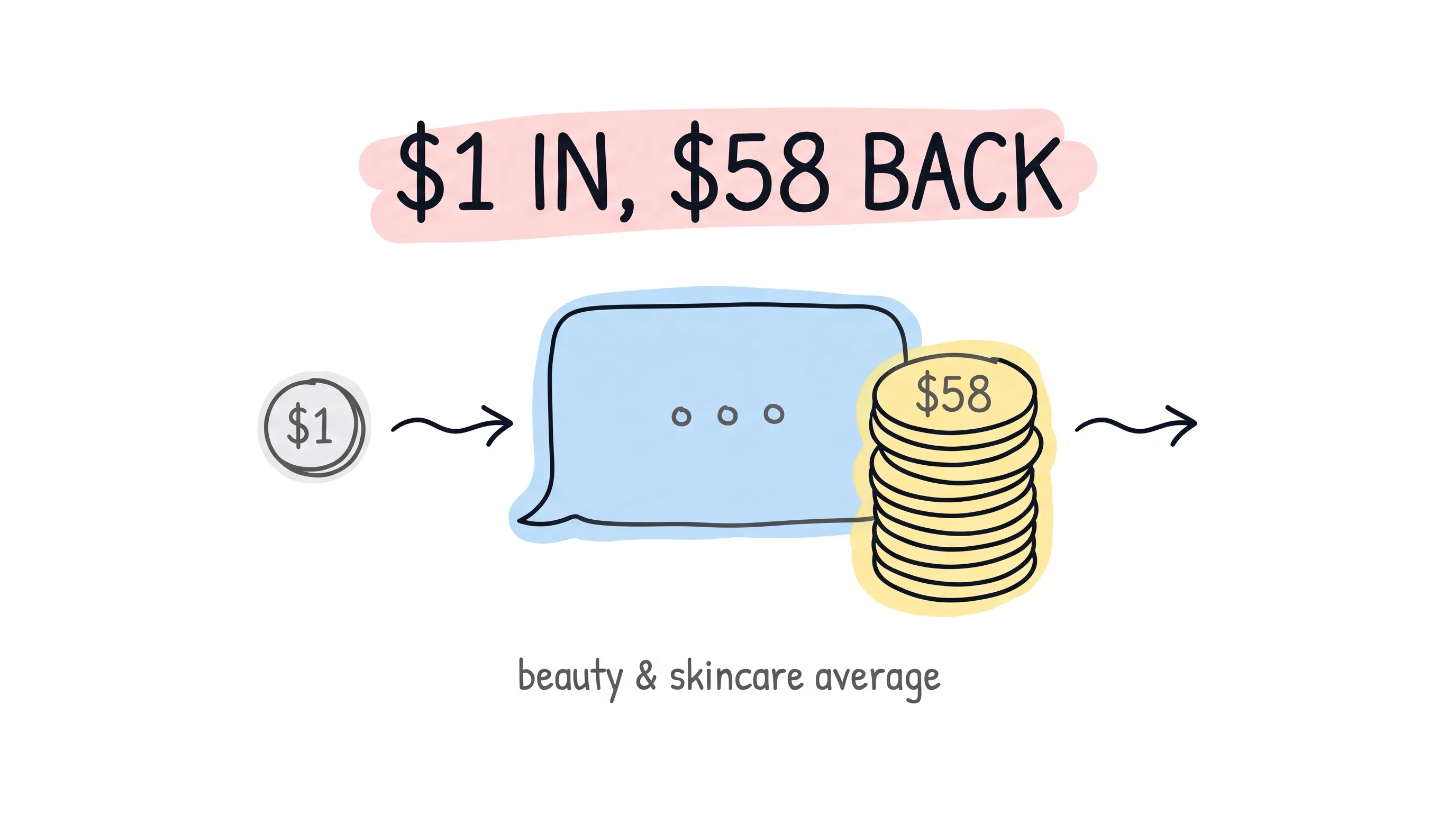
$1 in, $58 back.
What does that mean? You spend $1 on marketing, and you get $58 back.
This isn't a joke. It's the average return beauty brands get from marketing on WhatsApp. According to industry data compiled by Kanal for Q1 2026, beauty and skincare brands take back roughly $58 for every dollar they spend on WhatsApp. The highest of any industry.
The first time I saw that number, my reaction was the same as yours: really?
Honestly, I had my doubts too. Search "WhatsApp marketing ROI" online and you'll surface a pile of scary numbers. 3x, 50x, 100x. The problem is, nine out of ten of those articles never tell you where the numbers came from.
No source, no brand, no explanation—just a big number thrown at you.
Don't believe a single one of them.
So today, I want to do one thing: talk only about numbers that come with a source, a case, and math you can actually check. When a vendor is bragging about its own numbers, I'll tell you outright: that's vendor-claimed. Let's run this math honestly, from top to bottom.
What Does WhatsApp Marketing ROI Actually Mean?
Concepts first.
What is WhatsApp marketing ROI? Plain and simple: for every dollar you spend, how many dollars come back.
The industry has a name for it: ROWS—Return on WhatsApp Spend. Industry benchmark data puts the range at roughly 15x to 60x. Flows like abandoned-checkout recovery, when run well, can clear 100x. There's an even more direct way to put it: a single broadcast message brings in $2 to $6 in revenue on average.
How does it stack up against email? Industry data shows WhatsApp returns run 5 to 8 times higher, with acquisition costs 67% lower.
Why is this channel an order of magnitude ahead of email and SMS?
Three reasons.
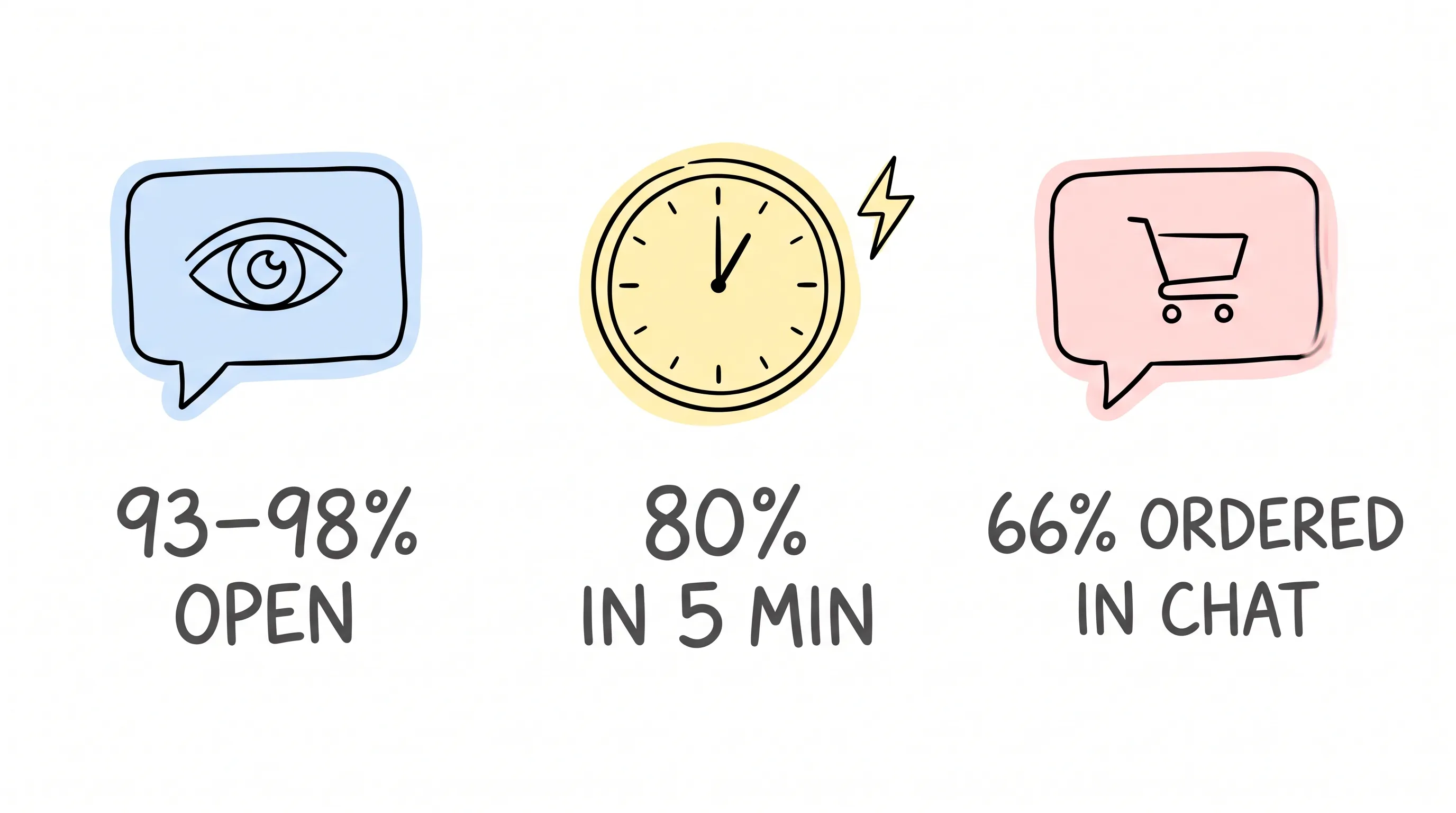
First, nearly everyone opens. Opt-in marketing messages post open rates that hover between 93% and 98%, year in and year out. In email marketing, if your open rate touches 20%, you'd be throwing a parade.
Second, they get opened fast. Chatarmin's data shows roughly 80% of WhatsApp messages are opened within 5 minutes of being sent. Five minutes. Email can sit in an inbox for a week.
Third, people will actually buy inside a chat. In Chatarmin's 2026 benchmark survey, 70% of consumers said they'd rather buy from brands they can message directly, and 66% said they had actually placed an order after interacting with a brand on WhatsApp.
Nearly everyone opens, opens instantly, and buys on the spot. The returns grow out of these three things.
Alright. Let Me Tell You 3 Stories
Numbers are dry. Stories give them flesh.
Story one: a European apparel chain.
The retailer, Takko Fashion, had an old headache: crowds of customers walked into its stores every day, bought, and walked out—and not one of them stayed within reach. How do you turn walk-ins into people you can keep reaching?
Ask them to fill out a form? Download an app? Either way, it dies halfway.
Takko's fix was beautifully simple: a barcode at the register. Customers scan it at checkout and, within seconds, they're on the brand's WhatsApp list, with a coupon landing right in the chat window. The back end ties into the CRM, so it's crystal clear who joined at which store, and when.
The result? Per a case documented by Chatarmin, the chain's offline revenue rose 82% during the campaign. In another comparable retail campaign tracked on the same platform, return on ad spend hit 36.8x—$1 in, nearly $37 back.
Powerful.
Think about it: why does a quick scan to join WhatsApp outperform asking customers for their email?
Because in a chat window, there's no password, no verification email, no app download. Any step that adds friction kills conversion.
Story two: India's direct-to-consumer brands.
AiSensy (a WhatsApp Business API platform) tracked data from a cohort of Indian D2C brands: after moving into WhatsApp marketing, their returns improved 200% to 300% relative to traditional channels.
But what really caught my attention was a different number.
In that same study, about 57% of new leads were already coming from automated WhatsApp flows.
57%. Let that sink in. For many brands, WhatsApp has quietly moved from the flank to the front line. It's not a supplemental channel—it's a primary source of leads.
Story three: the 58x from the opening.
Why beauty, of all categories?
Two reasons.
First, repeat purchases. Nobody buys just one bottle of serum in a lifetime. Skincare runs out and needs restocking. And that's exactly when a "your serum is running low" nudge lands squarely in the repurchase window.
Second, high average order value. High repeat purchase stacked on high AOV, and total returns naturally leave every other category in the dust.
If you run any repeat-purchase business—supplements, pet food, coffee—this "running low, time to restock" automated nudge is the model most worth stealing.
The Fastest-Growing Ad Format
There's one more shift you need to know about.
On its Q1 2026 investor call, Meta disclosed that Click-to-WhatsApp ad spend grew 82% year over year—the fastest-growing ad format in Meta's entire ecosystem.
How do these ads actually perform? Here are a few sets of numbers:
Click-through rates run 3% to 6%, roughly 2 to 3 times that of ordinary ads that send people to a website (Meta Marketing Science data). Of the people who click, 35% to 55% actually start chatting with the brand (data from Meta's 2026 Conversations event). And in a joint Meta and BCG study, D2C brands using these ads saw acquisition costs 30% to 50% lower than routing traffic to their own websites.
The price per conversation varies widely: roughly $0.95 in India, roughly $5.2 in the US. So your costs depend heavily on which market you're advertising in.
Kanal compiled data from 380 stores running these ads: the median CAC payback period is 47 days.
If you're already advertising on this system, one test is worth running: on the same budget, what happens to your costs when you swap the landing page for Click-to-WhatsApp? That's not a guess—it's Meta's own reported numbers.
That 58x Isn't a Freebie
By now you might be tempted: so if I jump on WhatsApp, do I just sit back and collect a return worth tens of times my money?
No.
I have to say this up front: beneath every high-return case above lie five shared preconditions. Miss any one of them, and the returns can turn ugly fast.
One: the list is clean. Every case starts from users who genuinely agreed to be contacted. In Ominiflow's report, accounts that cold-send to scraped numbers find themselves throttled within weeks.
Two: segment before you send. Blast the same message to everyone and your click-through rate will collapse. In Kanal's benchmark guide, it's personalization—names, products the person has browsed, audience segmentation, A/B testing—that pushes CTR up.
Three: guard your quality rating. Meta assigns a quality rating to every business account; let it slip and your sending volume gets throttled immediately. For block rate, the industry rule of thumb is to keep it under 1%—go over, and you should stop sending right away.
Four: rely on automated flows, not one-off blasts. Remember the 57% from story two? Welcome flows, abandoned-checkout recovery, win-back flows—leads grow steadily out of these automated flows, not out of manual blasting.
Five: get officially verified. Accounts with the official green or blue checkmark carry more trust—and higher click and reply rates to match.
The channel itself doesn't produce returns. The list, the segmentation, and the automation do.
You Can Run This Math Yourself
Enough about other people's numbers. Let's talk about yours.
The formula is simple:
WhatsApp marketing ROI = (revenue from WhatsApp − total investment) ÷ total investment
Watch out—three things tend to get left out of total investment: the messaging fees Meta charges by category (marketing, utility, and authentication messages are billed; service replies are free), the subscription fee for whichever WhatsApp platform you use, and, if you run ads, the ad spend.
Here's an example, from an Ominiflow 2026 benchmark calculation:
Send 10,000 marketing messages at roughly 0.88 rupees each, for about 8,800 rupees in messaging fees. 15% of recipients click through, and 5% of those place an order at an average of 2,000 rupees—about 150,000 rupees in revenue.
Run the math, and it comes out positive.
But—and this but matters—with the same formula, swap in a cold list and skip segmentation, and your click-through rate might not even touch 5%. The same business flips from profit to loss.
Same math, different list—opposite result.
One Unusual Market
One more thing—a rather special market: Pakistan.
In Pakistan, email inboxes are basically ignored, but WhatsApp lives on nearly every phone. Local vendors' claimed data says the Pakistani merchants they serve see message open rates up to 98%, delivered and opened within five minutes, with reach up to 3x higher than email—and a reminder: this is vendor-claimed data, not independent research. Take it as a directional signal, nothing more.
Feedback from two merchants on the platform tells a similar story: a brand running a Shopify store said conversions took off in the first month after switching on automated flows; an automotive merchant said moving support into a shared WhatsApp inbox cut response times by 60%.
These are individual customer testimonials, not audited case studies. Fine for direction; don't treat the numbers as promises.
The Moves Most Likely to Sink Your Math
Finally, a few common ways to die.
Blasting lists you scraped or bought. The fastest way to die: at best you get throttled, at worst your account gets banned.
Using the wrong message category. Disguising promotional messages as utility notices is a common reason for review rejection—and it goes on your account's record.
No segmentation, send to everyone. Low click-through, high opt-outs and blocks.
Staring only at open rate. WhatsApp open rates are almost always high—so high they tell you nothing. What actually decides the business is revenue metrics, like ROWS.
One Last Thing
Back to the number we started with: $1, $58.
Now you can see it more clearly: the 36.8x retail campaign, the 200% to 300% uplift, the 58x beauty return—underneath them all sits the same foundation: a real, consent-based list, smart segmentation, and tireless automated flows.
So don't be in a hurry to envy that 58x.
Nurture your list until it's clean, segment it finely, build your flows. Then the number you calculate will truly be yours.
Here's hoping that the next time you run the numbers, they land on your side.
Continue reading
Related articles

What Is an AI Marketing Agent? From "Using AI" to "Delegating to AI"
A learn article explaining what an AI marketing agent is, how it differs from rule-based automation, and which repetitive tasks such as lead qualification, reporting, and campaign monitoring can be delegated while humans keep key decisions.

Marketing Automation Is Shifting from "You Do It" to "You Say It"
This article explains how marketing automation is shifting from rule-based platforms that merely execute toward AI agents that plan, create, publish, and review campaigns, covering delegable tasks, underlying technologies, tool categories, adoption steps, and risks such as privacy and automating without strategy.

When AI Does the Creative, Mistakes Come in Batches Too
A learn article on the risks of using generative AI for marketing creative across brand, legal, compliance, and operational layers, with case examples and seven practices for review, rights clearance, documentation, and vendor governance.