
When Is AI Marketing Money Actually Well Spent? Let Me Walk You Through 5 Case Studies
A learn article retells five company-claimed AI marketing case studies spanning SEO content, lead response, local search, research repurposing, and AI customer service, and advises recording baselines, counting full costs, and judging results by the quarter.
A while back, I stumbled across a set of numbers that stung.
One industry survey says 73% of companies can't tell what effect the money they've poured into AI marketing has actually produced. Only 39% reach their expected returns within the first year.
Huh? Wasn't everyone calling AI the miracle cure for marketing? How come more than half of them can't even work out the math?
I can't independently verify those figures, but I trust the direction they point. Because for the past two years, the question I've been asked most often is: I want to use AI too — but how do I know whether it's actually working?
Talk is cheap. No lectures today — first, let me tell you 5 stories.
One thing up front: the numbers below are all case-study-claimed figures from the companies' own retrospectives — I can't verify them one by one. Treat them as reference, not promise.
Story 1: An Outdoor Gear Retailer Whose Traffic Grew Four and a Half Times
A mid-sized outdoor gear retailer, 8,500 SKUs. Who are its rivals? Giants like Amazon, plus a pile of entrenched vertical stores.
How did it used to do content? A two-person content team grinding out 6 to 8 articles a month.
8,500 SKUs, 8 articles a month. Think about it: all those tens of thousands of search needs, just left hanging there for nothing.
Then it brought in AI for SEO: automated keyword mining, batch-generated product guides and comparison articles, and fixed its on-site technical issues along the way. Note: nobody was laid off. AI does the executing; humans only set the direction.
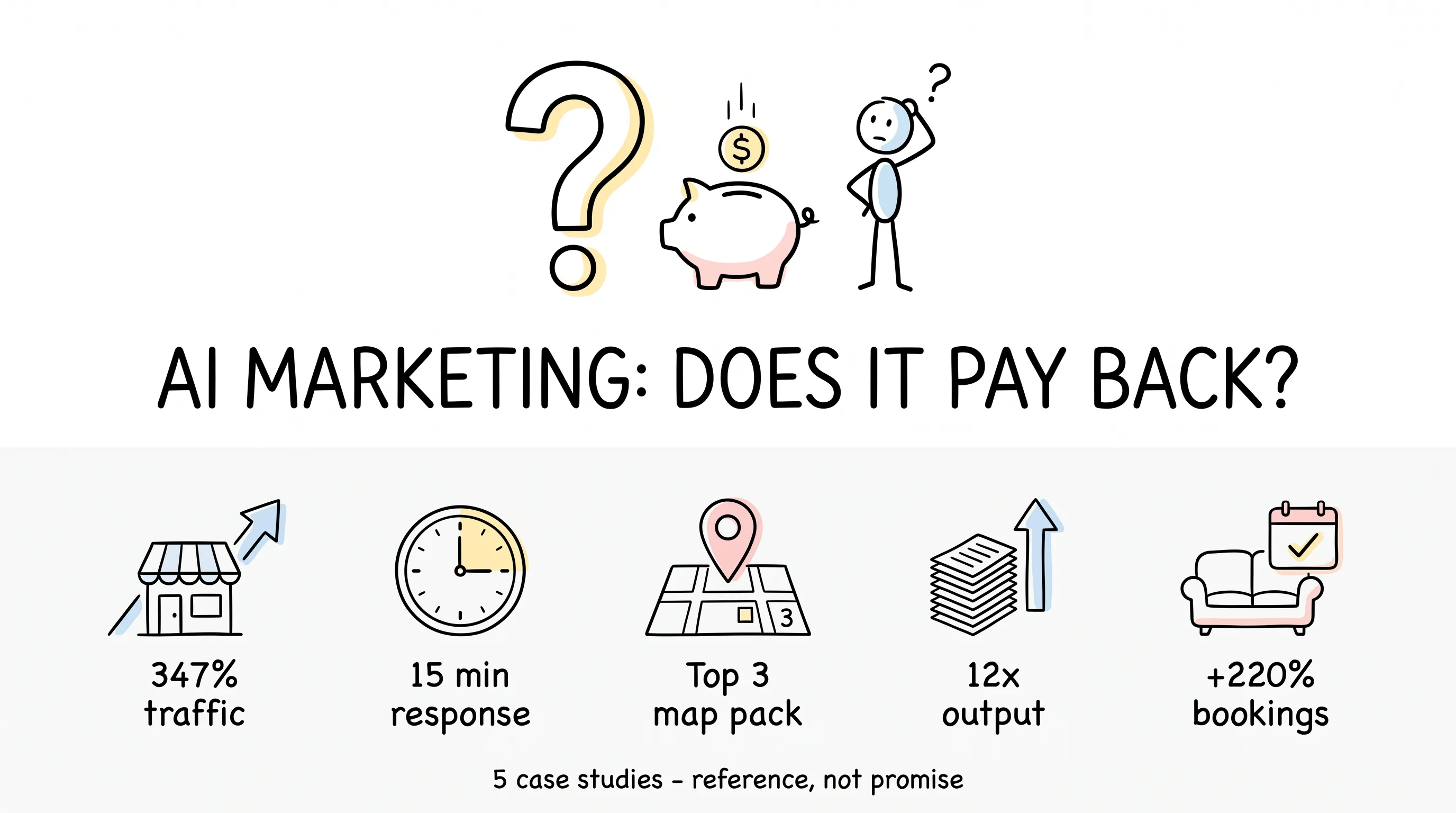
After 8 months, the case company's own retrospective numbers: organic traffic up 347%; 4,200 new keywords cracking the top ten of search results; monthly output pushed from 8 articles to 127; time from publish to ranking cut from 45 days to 12; revenue from organic traffic up 156%.
What does 347% mean? Roughly four and a half times the original.
Where did this story win? My read: it won on volume. The long-tail keyword battlefield can't be won by stacking up humans — AI's marginal cost is nearly zero. Write the words nobody else wrote, and you pick up the traffic for free.
Story 2: A Software Seller That Got 94% Faster at Responding
A project management software company, a 35-person sales team, selling to mid-sized and large enterprises.
Where was the problem? Slow.
A new lead comes in, and on average sales takes 4.3 hours to respond. One that arrives after hours? Tomorrow's problem.
Ever tried to buy something late at night and gotten nothing from customer service? Then you get it. By the case company's own estimate, 37% of potential customers went off flirting with a competitor before anyone replied.
In this line of work, 4.3 hours basically equals handing customers to your rivals on a platter.
Then it deployed AI intake: every lead gets a response within 60 seconds — email, web chat, SMS, social media, all caught. And the AI remembers what you said on which channel, so you never have to repeat your needs. It screens first, warms people up first, and once the conversation is far enough along, hands the person — together with a conversation summary — over to sales.
6 months: first-response time compressed from 4.3 hours to 15 minutes — 94% faster; qualified meetings booked up 68%; lead-to-opportunity conversion up 41%; average deal size up 23%. Sales capacity grew 40%, without hiring a single extra person.
Why did deal size grow too? Sharper screening. High-value customers were recognized and caught at the first moment — good deals stopped leaking from the very start.
What's brilliant here? AI didn't replace sales — it eliminated the "waiting" step. Reps no longer waste breath on cold leads; they only talk to warmed-up prospects. Brilliant!
Story 3: A Dental Group Whose Six Clinics All Made the Top Three
A dental group, 6 clinics in the same city.
For dental practices, where do customers come from? Local search. "Dentist near me," "dental implants in such-and-such district." However good your hands are, if you're invisible in the search results, you might as well not exist.
Its sorry state: the 6 clinics' listings were in disarray — phone numbers and addresses that didn't match across various directory platforms, and pitifully few reviews. Competitors with worse dentistry were more visible online. Infuriating, right?
Then it used AI to manage local search: clinic info across 80-plus directory platforms, once an inconsistency is found, gets auto-corrected within 24 hours; satisfied patients are identified and asked for a review at a well-chosen moment; and each clinic gets content generated just for "its own neighborhood."
10 months: core keywords for all 6 clinics made the top three of the map pack (the map-based local results search engines show at the top); exposure on "near me" searches up 289%; new-patient inquiries from organic search up 167%; monthly reviews grew from 12 to 47, average rating from 4.2 up to 4.7.
What's the key? Local search isn't a contest of single clever moves — it's dozens of details "all done right," year after year. One clinic, a human can still keep an eye on it. Six clinics? That dumb-but-diligent grind is exactly what AI is best at.
Story 4: An Investment Research Firm That Multiplied Its Output 12 Times
A firm producing investment research for institutional clients. In this trade, content is the business, and opinions are the brand.
Its problem was textbook: the experts genuinely have the goods in their heads, but no time to write. 6 to 8 research pieces a month, and no more could be squeezed out. Hire analysts? Too expensive. Outsource to writers? Professional quality collapses.
Then it built a system: analysts do research as usual, and their output can be nothing more than a few bullet points, or even a voice recording. AI takes these "raw materials" and turns them into articles, social media posts, email newsletters, slide decks, video scripts. One hour of insight, pressed into five or six formats of content. The industry is regulated, so the system also has built-in compliance checks — every claim is automatically traced back to its data source.
12 months: monthly output from 8 pieces to 96 — a full 12 times; organic traffic to the research portal up 412%; business inquiries driven by content up 178%; time analysts spend writing down 60%; and best of all, compliance issues dropped to zero. Mind you, they used to need three or four rework rounds a month.
AI amplifies the expert; it cannot replace the expert. The opinions remain human — the grunt work is AI's.
Scale and quality — two things that usually fight each other — were both online at the same time this once.
Story 5: A Furniture Retailer Whose In-Store Bookings Rose 220%
A furniture retailer, 14 physical stores. Foot traffic was falling, and its online rivals' digital experiences were painfully good.
Its pain point: plenty of people wanted to ask questions, and it couldn't catch them all. Website, email, social media, phone — inquiries poured in from every direction. Evenings and weekends, exactly when customers are most active, there was nobody on at all. Get ignored mid-conversation, and the customer turns around and goes to the next store.
Then it deployed AI customer service, online around the clock. Note: not one of those rigid bots that make you "press 1 for a human." It remembers what you talked about last time, and understands you when you say "I want a warmer color palette for the living room." It can recommend furnishings directly based on your floor plan, budget, and preferences, book you a designer who suits your taste — and even brief the designer on your needs in advance.
7 months: 84% of inquiries resolved without passing through a human; qualified in-store bookings up 220%; online-to-offline conversion up 156%; customer satisfaction from 7.2 up to 8.9; average order value up 31%. Recommend well, and people buy more.
If you do this for the sake of cutting costs, it will most likely fail. Its value lies in this: at 11 p.m., when a customer wants to ask something, there's a tireless "person" there.
The experience gets better first; only then does the business follow.
Five Stories, One Flavor
That's all five stories. Did you catch a whiff of the same flavor?
Let me gather them up — roughly four.
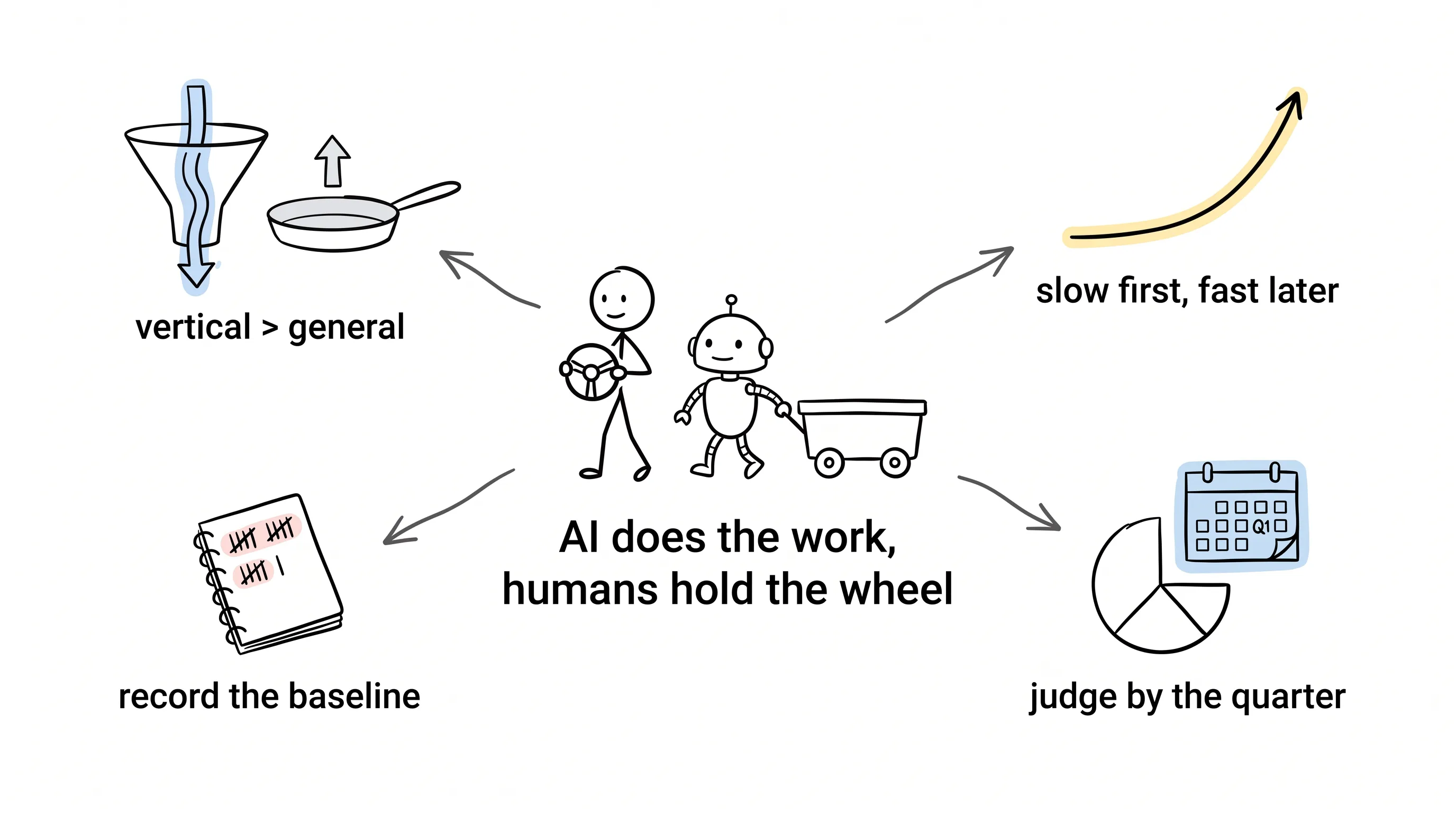
First, AI does the work, humans hold the wheel. In none of the 5 cases did anyone hand strategic judgment to AI. AI handles the executing, the amplifying, the never-tiring; humans handle judgment, taste, and making the call. The ones that crash are precisely the ones that do it the other way around — they hand over even the steering wheel.
Second, AI that knows the trade beats general-purpose AI. A model trained on dental data is simply fiercer than the "knows a little of everything" generalist tool. How vertical you go is the dividing line of results.
Third, it gets smarter the more you use it. Look back at these cases: their curves are all slow first, fast later. The first two months look like nothing is happening; then the system learns and sharpens, and the returns accelerate. Those who expect same-day results after buying will mostly be disappointed.
Fourth, record the books first. Every case that could be clearly reviewed had baseline data recorded before work began. If you didn't keep the baseline books, then afterward, trying to prove AI was useful, all you have left is your mouth.
So How Do You Do the Math for Yourself?
Back to the question at the start: your AI marketing — is it actually working?
Here are three steps. Clunky as they sound, they work.
-
Record your baseline first. Before you start, write down your current traffic, conversion rate, customer acquisition cost, response times — item by item, in black and white. Nobody can do this step for you.
-
Then count the full cost. Don't just compare the AI service fee against one content editor's salary. Recruiting, training, management time, software, turnover risk — count all of it. Once you've done the math you'll most likely find that whether AI is expensive depends on what you compare it against.
-
Finally, judge by the quarter. Things like SEO compound. Watching month by month, you'll get anxious; pull back to a full quarter, and it starts to make sense.
Finally, Keep Your Guard Up
When you look at case studies, remember one rule: whatever only shows you pretty numbers and can't explain the method details deserves a question mark.
The case is someone else's; the method is what might actually become yours.
In the 5 stories above, the numbers are as claimed by the case companies — treat them as reference, that's all. When it's really your turn: record the baseline first, then test in small steps, and let the data speak.
May every cent you spend on AI make a sound you can hear.
Continue reading
Related articles

It's 2026: Stop "Buying" AI Tools for Your Marketing Team — Start "Hiring" AI Agents
This learn article explains how AI agents differ from standalone AI tools in marketing, outlines three agent categories — build-your-own platforms, CRM-native agents, and vertical tools — and covers use cases across SEO, social media, advertising, and reporting, plus criteria for choosing one.

What Is GEO? How Your Brand Gets "Mentioned" in the Age of AI Search
An explainer on GEO (Generative Engine Optimization) for e-commerce and DTC brands: how it differs from SEO and AEO, why AI answers shape brand visibility, and eight practices covering question-focused content, consistent brand messaging, structured pages, external evidence, comparisons, and AI mention tracking.

AI Is Already Making Decisions for Your Customers. Are You on the List?
A learn article explains GEO (Generative Engine Optimization): why AI-generated answers now shape which brands customers see, and how SEO fundamentals, entity clarity, citable evidence, and monthly measurement affect visibility in AI answers.