
AI Marketing Daily · 2026-11-11
AI Marketing Daily for 2026-11-11 rounds up 13 items centered on AI search visibility, led by a four-strategy GEO playbook tied to patent numbers, plus AEO benchmarks, local AI recommendation data, an acquisition email launch, ROI statistics, and the EU Digital Fairness Act draft on influencer marketing.
Today's throughline is tightly focused: AI search visibility has moved from slogan to engineering discipline. The headline story is Go Fish Digital turning GEO into an enterprise-grade, four-strategy playbook with patent numbers attached; HubSpot adds AEO measurement benchmarks, and SOCi brings quantified data from 3 million local queries. Also in today's edition: the EU takes aim at influencer marketing, Claritas bakes real-time optimization into acquisition email, and Presenc's statistics put AI marketing ROI at a median of 3.2x. Five of the 13 items bear directly on AI visibility — start with the lead story; if you're rushing to schedule, jump straight to Today's Takeaways for this week's action list.
🎯 Today's Headline
GEO Goes from Alchemy to Engineering: Go Fish Digital Publishes a Four-Strategy Playbook with Patent Numbers Attached
What happened
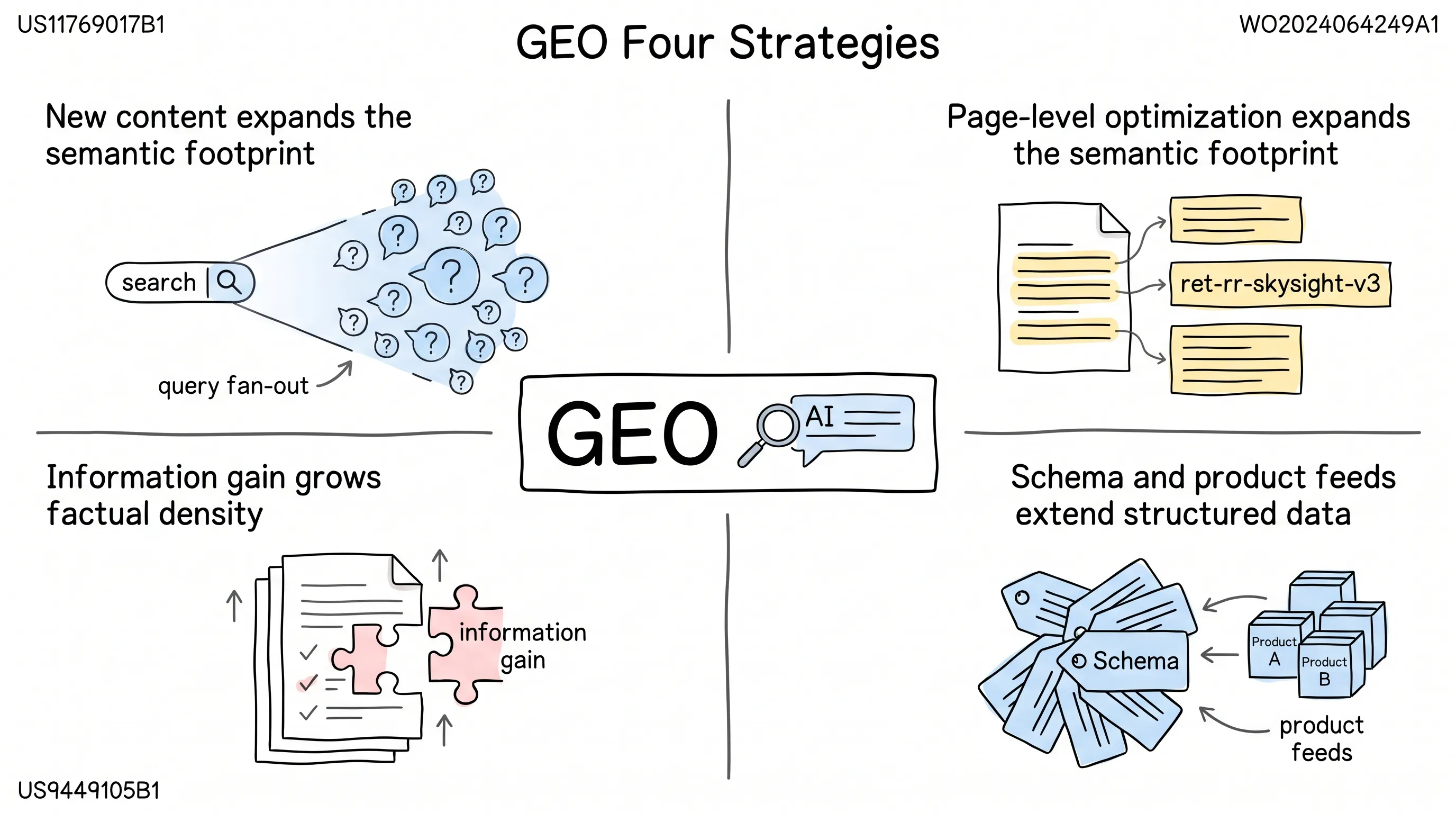
SEO-focused technical agency Go Fish Digital has published a long-form 2026 edition of its GEO (Generative Engine Optimization) playbook. The piece defines GEO as the practice of making content retrievable, re-rankable, and quotable inside AI answers, covering Google AI Overviews, AI Mode, ChatGPT, Perplexity, and Copilot. All four strategies come with technical grounding. Expand your semantic footprint with new content, mapped to the query fan-out (how one query fans out into many related searches) patent US11769017B1; expand it further with page-level optimization, citing observed behavior of ChatGPT's reranker (the system that re-orders retrieved passages before answering), ret-rr-skysight-v3, which rewards comprehensively authoritative sections. A third strategy grows factual density through information gain, mapped to patent WO2024064249A1; the fourth extends structured data with schema and product feeds, mapped to the vocabulary-aware search patent US9449105B1. The article ties GEO directly to acquisition: the highest-value queries for lead generation cluster around pre-purchase research — vendor comparisons, service evaluations, pricing, "best agency" searches. When content gets cited at these moments, the brand has built trust before the buyer ever reaches its website. And it brings receipts from its own book of business: AI-driven traffic up 43% month over month, AI-referred conversions up 83.33% monthly, and AI leads converting at 25 times the rate of traditional search leads.
Why it matters
GEO has been talked about for a year, yet most coverage stops at generic advice — publish more, add FAQs. Traditional SEO justifies its results with keyword rankings and SERP impressions; neither is visible inside AI answers, so teams suddenly find themselves without a dashboard. The value of this piece is that it anchors method to patent claims and reranker behavior — turning GEO from received wisdom into auditable engineering. The bigger gap sits at the prompt layer: traditional SEO had two visibility channels — rankings and impressions — yet companies cannot see which queries are pulling their content into AI answers. The piece is blunt: until dedicated measurement tools mature, visibility has to be pieced together from log analysis, semantic analysis, and AI Overview tracking. That judgment also explains why HubSpot and SOCi are both scrambling to own measurement — items 2 and 4 today are exactly that evidence.
What it means for marketers
SEO teams need to rebuild their workflow from the skeleton out. Keyword research gives way to prompt research; ranking reports give way to citation frequency and prompt coverage. The unit of content production drops from the page to the section: FAQs, comparison tables, stat blocks, glossaries, schema markup, and updated dates — the goal: every section should be liftable wholesale by an AI as a ready-made answer. The measurement stack changes with it: AI referral traffic, citation frequency, prompt coverage, AI visibility rate, and assisted conversions. For agencies, this is good news: the work is labor-heavy and the data messy, in-house teams can't shoulder it alone, and paid outsourcing demand will grow. For brands, first decide who will watch ChatGPT-User logs and Ahrefs' AI Overview data — right now almost nobody is looking at either. One new hiring signal too: people who understand technical SEO and can write SQL to pull logs are the GEO era's first scarce hires.
How to use it
The six-step workflow can start this week. Step one: run a 3-gram baseline of your own site in Screaming Frog, and while you're at it, run a competitor with more traffic. Step two: compute the set difference between the two n-gram sets to find semantic clusters your competitor covers and you don't. Step three: pull three verification sources — ChatGPT-User access records in server logs, AI Overview visibility in Ahrefs, and the AI Performance report in Bing Webmaster Tools. Step four: feed all the exports into a ChatGPT project for topic clustering. Step five: have ChatGPT reverse-engineer buyer prompts — note that the inferred queries only hold up once real data goes in. Step six: split work into two buckets — for existing pages, close gaps item by item with a section-level coverage matrix; for new pages, prioritize by likelihood of surviving the reranker. How granular does it get? The author even names the columns of the mapping table: semantic cluster, representative queries, intent, mapped URL, match strength, missing sub-questions, schema to add, internal and external links, update date, evidence source. Each sub-question is scored on a three-tier scale — covered, needs deepening, missing — cell by cell. The post-launch metrics are listed in the piece too: AI referral traffic, citation frequency, and prompt coverage, plus form submissions and demo requests on the conversion side. Teams without Screaming Frog: the article links a free n-gram Chrome extension. Get it running first; refine later.
My take
The 25x conversion gap is the most eye-catching number of the day, but it's the agency's own case study — don't paste it straight into your budget model. What is replicable is the methodological skeleton: an n-gram baseline plus a competitor set-difference, then logs used to reverse-engineer real queries. None of it depends on an expensive tool stack, and a mid-sized team can produce a first version in two days. GEO's early-window dividend goes to execution density: whoever first turns section-level gap-filling into an assembly line eats the citation gains first. One implicit threshold is worth naming out loud: the outputs of this game are large volumes of FAQs, comparison tables, and stat blocks. Batch-generating them is easy; quality control still bottlenecks on humans, the fact-checking step cannot be skipped, and don't expect a fully hands-off pipeline. The observation that rerankers favor comprehensively authoritative sections deserves a spot on the content team's wall.
🔗 Further reading: Read the full article
🏷 Marketing Tools
HubSpot Sets a Benchmark for AEO Measurement: Look at the Market First, Yourself Second
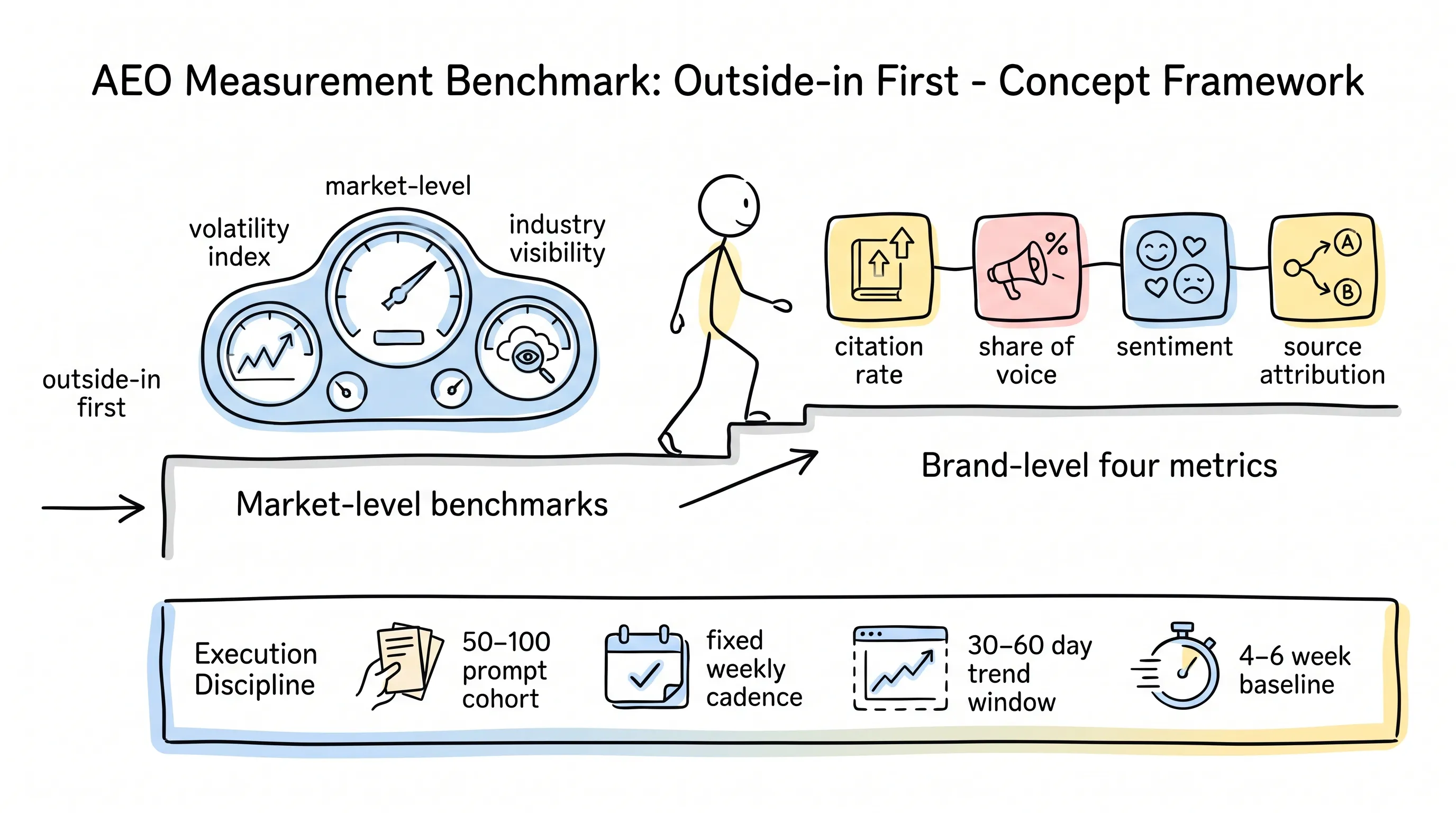
HubSpot has published a guide to its AEO benchmarking methodology, structured at two levels. Market-level benchmarks track a volatility index and industry visibility; brand-level benchmarks track a four-metric set: citation rate, share of voice, sentiment, and source attribution. Diagnose outside-in, so you don't mistake a market-wide engine swing for your own problem — or the reverse. Each of the four has a job: citation rate tells you whether you've earned the right to be cited at all; share of voice shows whether competitors are stealing the naming rights; sentiment separates awareness problems from discovery problems; source attribution reveals where the answers are actually coming from. That last metric produces a striking data point: in finance answers, third-party review sites like NerdWallet and Bankrate rack up more citations than Bank of America and JPMorgan combined. Supporting data: HubSpot surveyed more than 3,000 CRM purchasing decision-makers in 2026 — 42% use AI search during evaluation, and their purchase intent runs 36% higher; Pew's data shows that when Google AI Overviews appear, click-through rates fall from 15% to 8%. The operating discipline is spelled out in detail: a fixed prompt cohort of 50 to 100 queries, stratified by intent, run on a fixed weekly cadence, 30-to-60-day trend windows, and no targets until a 4-to-6-week baseline exists. The piece also cites a 2026 arXiv paper warning that AI answers carry high run-to-run variance — a single sample can mislead, and reports should flag uncertainty. Recommendations are split into two buckets: evidence-backed moves (answer-first content updates lifted HubSpot's own AI citations by 56%) and hypotheses still to be validated — with the distinction made explicit in every report. The case study section: HubSpot filled a Reddit citation gap in the French and German markets, and within a month mention rates rose from 0% to 33.5% in France and to 17.1% in Germany.
💬 How marketers can use this: a 50-query prompt cohort can be built this week — it's the only labor-intensive piece of the whole method; after that, re-testing takes half an hour a week. In reporting, remember outside-in first: an engine swing can't be blamed for your content quality. Answer variance is high, so don't make decisions off a single-day screenshot — bank at least a full month of data.
🔗 Further reading: Read the full article
GEO Keyword Research Changes Units: From Keyword to Prompt
A full transcript is now available for a 12:48 tutorial from the YouTube channel Surfside PPC. The shift in one sentence: AI answers now occupy the space above the blue links, so the goal changes from ranking highest to being cited and recommended by AI answers. The hands-on chain is complete: use Answer the Public or ask ChatGPT directly to surface real queries; use a spreadsheet to map queries against existing articles and videos — you don't need a new page for every query; "best of" and comparison queries work but use them with restraint, and don't rank yourself No. 1 in your own roundup; track referral traffic from ChatGPT, Perplexity, and Gemini directly in GA4 — chatgpt.com shows up as a source, and UTM parameters make it sharper. The tool round-up comes with prices: Otterly at $29 a month watches 15 prompts; Frase and Daygno each have their own lane. The creator leaves one honest confession: on a tight budget, searching for yourself once a day may beat a paid tracking tool; and the foundation of getting cited is still content quality — answer directly, write clear titles, and interlink video, blog, and social. He offers his own example: Google AI Mode cited his channel and Ben Heath on the query "how to learn Google Ads."
💬 Smaller teams can follow this one directly: add a prompt tracking sheet to GA4 and you've built the minimum closed loop of GEO monitoring at zero cost, saving the $29 monthly tool fee. Reddit gets called out as the high-leverage spot — assign someone to answer questions seriously in industry subreddits, which beats buying a tracking tool. Run the manual version for two weeks first, decide on the purchase once the data is in; many teams will find they never needed those 15 prompts.
🔗 Further reading: Read the full article
AIS Media's Enterprise GEO Primer: Being Ranked No. 1 No Longer Matters
A GEO guide published in March by agency AIS Media sorts out four concepts — SEO, AEO, AIO, GEO. GEO is the outermost framework, and AIO covers just one battlefield: Google AI Overviews. The piece's judgment is blunt: SEO competes for ranking positions; GEO competes to be extracted, cited, and synthesized by AI as it generates answers. In the zero-click era, brand presence shifts from rankings to citations. Data points: AI Overviews trigger on nearly 48% of tracked queries, up 58% year over year; Perplexity counts over 45 million users, and ChatGPT 800 million weekly actives. Four content optimization elements: semantic clarity, statistical backing, attributed expert quotes, and structured formatting — with a special callout that specific numbers get cited by AI more readily than vague phrasing. Using a fictional whey-protein fitness brand, the author demonstrates how a GEO-optimized article gets cited wholesale in an AI answer. The outlook section calls out multimodal answers and agentic AI recommendations: when agents pick vendors for users in the future, what they'll look at is your GEO footprint — SERP rankings move to the back seat.
💬 It works well as concept-framework material for internal team training — four concepts cleared up in one diagram, saving you the organizing time. But be clear about its quality: every section ends by pivoting to the agency's own services, the case study is invented, and the numbers shouldn't be quoted elsewhere. The genuinely valuable line is that specific numbers get cited more easily than vague phrasing — go back and audit the phrasing granularity of your own key pages.
🔗 Further reading: Read the full article
HubSpot's Five-Step AI Writing Method: Turning Fact-Checking into an Assembly Line
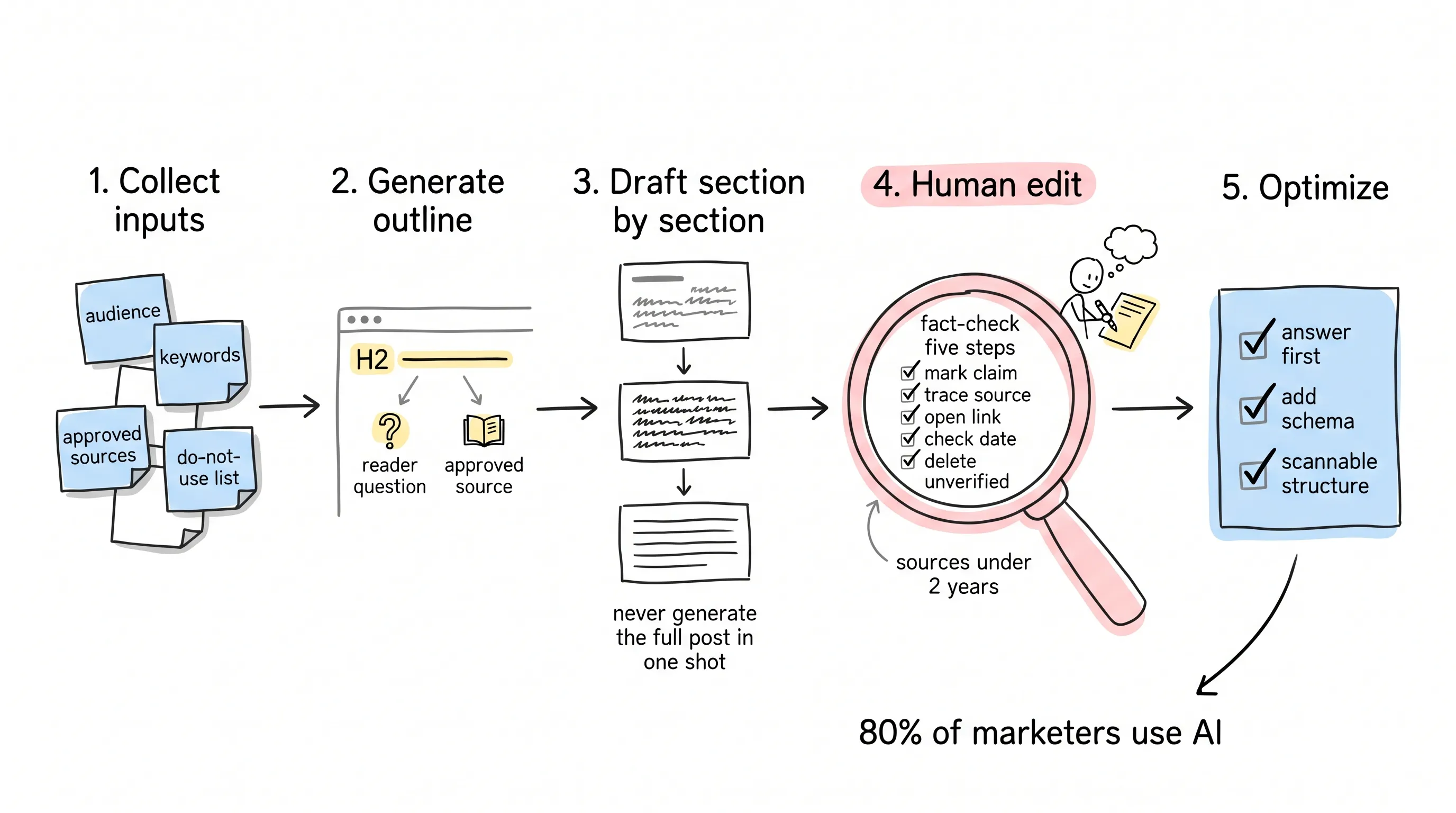
A long-form HubSpot guide lays out five steps for human-AI collaboration on blog writing. Step one: collect inputs — audience, goals, keywords, approved sources, sample copy, format, privacy red lines, and a do-not-use list. Step two: generate the outline, with each H2 mapped to one reader question plus one approved source; the piece shows side-by-side demos of vague prompts versus specific prompts. Step three: draft section by section, never generating the full post in one shot. Step four: human editing. Step five: optimize for search and AI answers — answer first, clear titles, add schema, structure that's scannable. The data: 80% of marketers already use AI for content, and 62.7% believe brands need more distinctive, human-centered content; more than half say AI has made content so easy to produce that homogenized competition is actually intensifying. Human editing is the finale: a five-step fact-check — flag every claim, trace it to a primary source, open the link yourself, check the date, and cut anything unverifiable (all numbers, quotes, and product features count as claims, and sources must be under two years old). Then inject original value AI can't fabricate, using proprietary data, customer stories, expert quotes, and product screenshots. Finally, build a voice profile to lock in the brand's tone. The compliance section is solidly sourced: Google officially requires AI content to pass human review; NIST lists 12 risks of generative AI; and the US Copyright Office ruled in January 2025 that purely prompt-generated work doesn't constitute the authorial contribution copyright requires.
💬 Lift this one straight into a team SOP — you won't need more than three edits. The two rules most worth locking in are section-by-section drafting and one approved source per section; hallucination rates drop visibly. One note on the copyright point: purely prompt-generated output isn't copyrightable, so if a competitor copies it you have no recourse — keep the human-written parts as brand assets.
🔗 Further reading: Read the full article
Personalization Is Now Mass-Produced; Creativity Is the Scarce Seat
A MarTech opinion piece. When every brand can mass-produce personalized variants with AI, relevance itself stops being a differentiator. The author takes aim at assembly-line personalization workflows: the creative team comes in last and produces only headline and image variants — which is precisely the work AI can already do. His argument: move creative strategy to the front and define the experience itself first. Spotify Wrapped serves as the proof: first a concept worth anticipating, then a decision about what the technology must do. Two recent cases supply the reference frame: McDonald's Magic Stories made families the protagonists of animated tales, driving per-person brand interaction time up 238% with content reuse above 50%; Dove's Real Beauty DNA, built with Pinterest, reached 27 million people, with female participation 21.4% above benchmark and brand association up 2.9 percentage points. The Dove lesson: brands must walk into personalization carrying their own convictions — a brand that merely replays user preferences gets assimilated by the algorithm. The piece closes with a three-question framework: What is the creative concept? Where are the behavioral boundaries of personalization (including when not to personalize)? How is value defined and measured?
💬 At your next personalization review, force the team to answer those three questions first — no answer, cut the budget; that single rule can save a pile of wasted spend. The McDonald's case offers the most practical lesson: put users inside the brand narrative, and what's valuable is the 238% interaction time, not the click-through rate — set the measurement frame correctly on day one. One more thing: personalization doesn't need to be everywhere. In sensitive contexts like health information, every extra line of personalization is an intrusion; subtraction is a creative judgment too.
🔗 Further reading: Read the full article
The Human-AI Division of Labor Gets a Tiered Yardstick: The Closer to the Customer Relationship, the More Humans Should Lead
MarTech proposes a Human-AI Content Connection framework. Content splits into four tiers by customer trust level: trust and relationship maintenance, authority building, product and technical understanding, and revenue generation. The closer to the relationship, the more humans should lead; the more transactional, repeatable, and scalable the work, the more AI is worth. Across the workflow, it splits ideation, development, distribution, and optimization with role recommendations: ideation leans hardest on human experience and association — AI can only recombine what already exists; in development, most competitors hand work to AI and skim it once, so sticking with human rigor becomes the differentiator; distribution hinges on data accuracy and segmentation; optimization is where AI has the biggest impact — handing real-time tuning to machines is uncontested. The author singles out B2B: relationships rest on person-to-person trust, and if executive-signed communications get AI-penetrated, the trust damage is very hard to repair once customers see through it.
💬 Map the four-tier table against your own content matrix and mark the human-AI ratio for each tier — it's an hour's work, and the output doubles as your team's AI governance document. The development point is counterintuitive: when everyone is using AI for first drafts, slow careful work becomes the scarce thing. From today, review client letters and search-engine articles under two different standards — word by word for the former, by density for the latter.
🔗 Further reading: Read the full article
🏷 Product Launches
Claritas Bakes Real-Time Optimization into Acquisition Email
Claritas has launched Email Advantage, an acquisition-focused email product. Unlike the traditional test-then-send model, it keeps learning while the campaign is running, adjusting audience targeting in real time off conversion data — even cold-start lists can self-correct mid-send. Subject line testing runs by segment: different segments receive different versions, replacing the old practice of picking a single winner for the full list. The same AI audience definitions can be reused across email, digital advertising, and social, automatically triggering coordinated cross-channel campaigns and eliminating the duplicate labor of rebuilding audience packages channel by channel. Under the hood, it relies on an Identity Graph for email-to-consumer identity resolution, and validates each touchpoint's incremental contribution with cross-channel attribution plus holdout groups (control audiences held back to isolate true lift). The product logic comes from an explanation by its SVP, Quinn Jalli. (This item is adapted from a vendor press release — limited depth, news brief only.)
💬 New-customer acquisition teams should zero in on segmented subject lines: the single-winner-for-everyone approach permanently sacrifices open rates in small high-value segments, and per-segment variants claw that money back. Reusing one audience definition across channels is also worth testing — what it saves is the media team's hours spent rebuilding audience packages. Before you buy, write the holdout group into the contract terms; if a vendor can't explain incrementality, don't sign no matter how cheap the annual fee.
🔗 Further reading: Read the full article
A GenAI Brand Campaign Case Book: Seven Cases, No Data — Use It as an Inspiration Library
A case compilation from agency Byten21. It opens with McKinsey data: enterprise GenAI usage doubled from 33% to 65% within a year. It collects seven cases: Chupa Chups let users design their own lollipop fantasy worlds; Cadbury inserted users into a 200-year-old classic ad; Coca-Cola's Create Real Magic, built with OpenAI and Bain, used GPT-4 plus DALL-E to create from the brand archive — with selected works on the Times Square big screen; the Barbie AI selfie generator rode PhotoRoom to go viral; plus AWE Reality Multipass, Canal+'s Prompts of Love, and the agency's own Neon Hero. It closes by sorting four categories of risk: content errors and bias, consumer pushback, copyright, and cybersecurity. (This item runs thin — bestdaily didn't capture the full text; written up from the summary.)
💬 All of these are 2023–2024 vintage cases, not a single performance number among them — don't cite them as trend evidence. What's useful is the playbook tags: the shareable UGC generator route has been validated repeatedly, and the Coca-Cola paradigm of brand archive plus open co-creation still has reference value. It's an efficient flip-through when hunting inspiration for a brand campaign; just backfill your own data sources before anything goes into a proposal.
🔗 Further reading: Read the full article
🏷 Industry Data
SOCi's 3-Million-Query Benchmark: AI Recommendation Rates Have Caught Up with Google's Local Pack
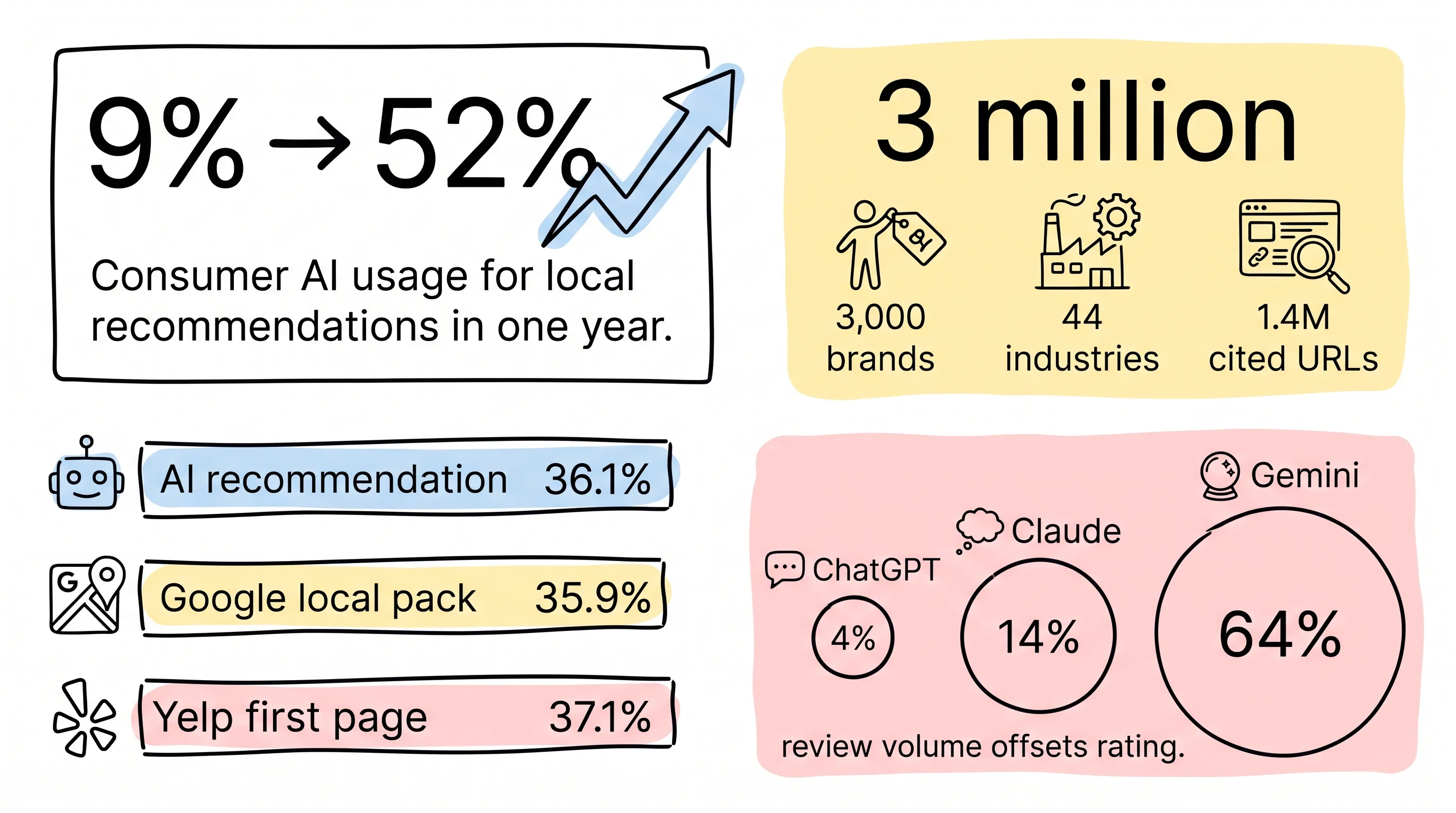
A SOCi-sponsored study — the dataset covers roughly 3,000 US multi-location brands, 44 industries, 3 million local queries, and 1.4 million unique cited URLs. Start with this set of numbers: the share of consumers using AI tools for local recommendations rose from 9% to 52% in a year; the average brand recommendation rate across AI platforms is 36.1%, on par with Google's local 3-pack at 35.9% and Yelp's first page at 37.1% — last year that figure was just 7%. The methodology is transparent: recommendation rates are tested with a fixed prompt — "recommend 10 businesses of a given type." Review signals work as a dual driver: recommended brands average about 4.2 to 4.3 stars, with ratings declining linearly by rank; review volume can offset rating gaps, but the offset rate (how much extra review volume buys back a rating point) differs wildly by platform — on ChatGPT a 4% increase in reviews offsets 0.2 stars, Claude needs 14%, and Gemini needs 64%. Three citation sources dominate: Google Maps, Yelp, and brands' own local landing pages — run your site's local pages the way you'd run a physical location. The study also finds roughly half of brands missing a Facebook store page — a visible gap worth closing; and working from your own brand's citation profile to find lists competitors ignore can pick up share too.
💬 Multi-location brands can lift these numbers straight into next quarter's deck — the 9%-to-52% year change is enough to convince a conservative boss, with one sentence noting the SOCi sponsorship. Sequence actions by cost-effectiveness: close gaps like missing Facebook store pages first, then push the review flow on Google Maps and Yelp. Gemini's 64% offset rate says review-count inflation barely works there; stars are worth more than volume, and the money-saving path is defending the ratings of your flagship locations.
🔗 Further reading: Read the full article
Presenc AI's Round-Up: Median AI Marketing ROI Climbs to 3.2x
AI visibility tooling vendor Presenc AI has compiled 2026 statistics. Median ROI is 3.2x, up from 2.1x in 2024, with top organizations above 5.7x; global AI marketing cost savings run about $94 billion, or 12.3% of total marketing spend. By use case: AI ad optimization leads at 4.1x, predictive lead scoring is at 3.8x, and GEO with AI visibility monitoring sits at 3.4x but tops improvement magnitude (+113%) — a $72,000 average annual investment returning $245,000. Industry differences are in the open: tech and SaaS top the range at 4.3x; manufacturing bottoms out at 2.1x yet improves fastest year over year (+89%). On efficiency: content production costs down 44%, reporting labor down 52%, campaign planning time down 38%; mid-sized teams save $70,100 and 314 hours a month — about 1.9 full-time equivalents. AI-augmented campaigns versus traditional: conversion rates up 27%, CPA down 19%, launch 34% faster. The learning-curve effect is clear: teams running AI for more than 18 months see 2.4x the ROI of their first six months. Methodology: a proprietary survey of 2,140 respondents, layered with Forrester's 2025 Q4 and Gartner's 2026 CMO surveys; the page states plainly that all figures are self-reported and subject to reporting bias — a disclosure rare in stat round-up content.
💬 A CFO proposal can cite this page directly — quoting the self-reported-data disclaimer along with it actually reads as professional. The 3.4x GEO track plus the +113% improvement slope is the strongest budget-justification combo of the day. One caution on the learning curve: don't evaluate AI tools quarterly — ugly first-six-month numbers are normal, so stretch the review window to at least a year.
🔗 Further reading: Read the full article
The B2B SaaS Agency List: Four Screening Criteria More Useful Than the Names
RZLT has compiled a 2026 list of 11 B2B SaaS AI marketing agencies, with the author openly declaring the conflict of interest that their own shop made the list. One uniform set of four screening criteria: a dedicated SaaS practice, public case studies with SaaS clients within 24 months, a pricing model a founder can actually read, and a methodology that survives a long sales cycle. Exclusion criteria too: anything propped up by vanity metrics, opaque pricing, or where SaaS is merely one of twelve verticals — all out. Industry context: the median B2B SaaS sales cycle is 84 days, the mean 134 — 22% longer than in 2022. Match by ARR stage: Seed to Series A — look at Tuff and Kalungi; Series A to C — GrowthSpree, with transparent $3,000/month pricing; Series B and up — Refine Labs and Metadata.io, the latter starting at $50,000/month in ad spend; enterprise with six-figure ACVs — Ironpaper. Two standout details: GrowthSpree pipes Google, LinkedIn, and Meta ad data in real time into the HubSpot pipeline via an MCP server for ROI attribution; BreakingB2B folds LLM citation optimization into its traditional SEO services.
💬 Start your agency search by copying those four criteria, in writing, into the RFP — it saves two weeks of one-by-one intro calls. Matching by ARR stage is pragmatic: early-stage teams shouldn't touch spend-led agencies with $50,000/month minimums, and the 84-day median sales cycle means the selection itself deserves a real validation window. The MCP-server real-time attribution detail is worth a dedicated round of questions: can your agency actually line up ad spend data with pipeline? If they can't answer, cross them off.
🔗 Further reading: Read the full article
🏷 Policy & Funding
EU's Digital Fairness Act Draft Lands This Week: Influencer Marketing Gets the Screws Tightened
In an AFP exclusive, the EU will publish the draft Digital Fairness Act on Wednesday, released by consumer protection lead Michael McGrath, to close the gaps between existing data-protection, AI, and content regulation. A string of clauses bear directly on marketing: dark patterns — interface designs that steer users toward the seller's preferred choice — are banned; drip pricing is banned, with the highest total price shown before checkout; brand-influencer collaborations tighten, with creators required to clearly label videos and posts as advertisement or commercial collaboration; brands may not use influencers to push children to buy directly or to nag their parents into buying; games may not offer pay-to-win mechanics to minors; free trials must be flagged before they expire; and users gain the right to switch off autoplay and irrelevant notifications. The draft lands this week; there's still a buffer before it takes effect, but the runway multinationals leave for legal and agency alignment has always been shorter than it looks. (Draft stage — details may still be revised.)
💬 Teams selling into the EU should move this week: labeling obligations in KOL contracts and compliance clauses in brief templates are cheaper to fix now than after the Act takes effect — it saves a round of legal fees. E-commerce teams should self-audit pricing pages for drip pricing, and subscription businesses should check trial-expiry reminders; both are non-compliance points a user can spot at a glance. Child-facing brands are the most sensitive — write the purchase-solicitation red lines straight into the brief and leave nothing to front-line improvisation.
🔗 Further reading: Read the full article
💡 Today's Takeaways
Taken together, the 13 items tell one story: AI search visibility has entered its engineering stage. The lead story delivers a GEO workflow with patent numbers; HubSpot adds the measurement benchmarks, SOCi brings quantified local-scenario data, Surfside teaches the keyword-to-prompt mechanics, and AIS Media provides the concept primer. Five steps at different heights, building the same staircase. The advantage of reading this set in one sitting: the concept layer, method layer, measurement layer, and data layer all arrive together — teams no longer have to patch it together from scraps. With concept adoption complete, competition moves to measurement and execution density. That's today's clearest signal.
The second signal is that the human role is being re-priced. The personalization piece says creativity is now the scarce seat; the human-AI framework says the closer to the customer, the more humans should lead; the HubSpot writing guide turns fact-checking into a five-step assembly line. Once AI floors the cost of production, everything valuable lives on the human side: judgment, verification, creative concepts, relational trust. Teams that accept this pricing logic find that the harder they push AI, the more their people are worth; teams clinging to the cost-cutting narrative will watch the savings get eaten alive by homogenized content.
The third signal is regulation entering the field. The EU is coming for influencer marketing and dark patterns; compliance costs now belong inside the ROI model, and cross-border budgets just gained a line item. Don't swipe this away as legal news — labeling obligations and pricing transparency hit your ad creatives and conversion paths directly.
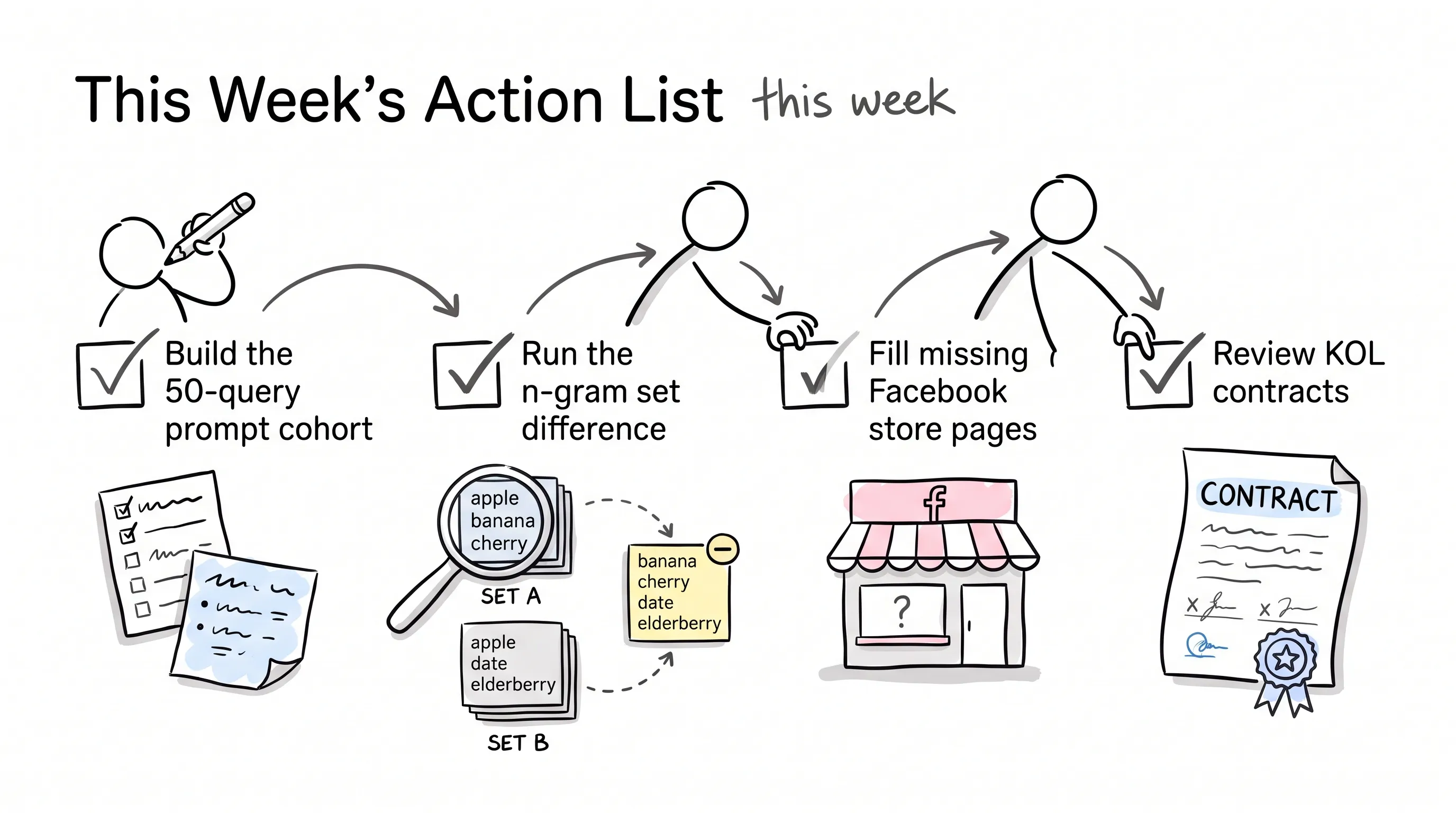
This week's action list: build the 50-query prompt cohort, run the n-gram set difference, fill in missing Facebook store pages, and review KOL contracts. These four cover most of today's essentials — start with whichever one you like, just don't leave them all for next week.
Continue reading
Related articles
AI Marketing Daily · 2026-11-22
AI Marketing Daily for 2026-11-22 rounds up 20 items led by Microsoft opening Bing AI Overviews to ads and Google expanding AI Mode ads to ten countries, plus GEO guides, ad automation delegation guidance, AI Overviews CTR data, and a legal-risk checklist for AI-generated creative.
AI Marketing Daily · 2026-11-21
A November 21, 2026 AI-marketing daily covering AI search visibility, GEO methods, Google AI Mode ads expanding to ten countries, Meta's pre-Black Friday changes, agentic shopping, and industry adoption and ROI data.
AI Marketing Daily · 2026-11-20
AI Marketing Daily for 2026-11-20 rounds up 19 items centered on measurement: OpenAI's ChatGPT Business Hub dashboard, EU rules for agent-mediated purchasing, Meta pausing four AI terms, and B2B data on shortlists and the dark funnel, each with action advice.