
Everyone Is Doing Personalization. Why Does Nobody Remember Your Ads?
A learn article on why personalized ads often go unremembered: when every brand can be relevant, relevance stops standing out. Using Spotify Wrapped, McDonald's Magic Stories, and Dove x Pinterest as cases, it argues creativity should decide what is worth making while AI handles relevance.
A few days ago, a friend of mine who works in marketing invited me to dinner.
Halfway through, he suddenly sighed: Our company has everything — data platforms, audience segmentation, behavioral targeting, AI-generated content. Every piece of content we send out is relevant to the user. And yet I keep feeling like our stuff is becoming more and more like products off an assembly line.
I said: That's not surprising. What you're making are variants. Not creativity.
He asked: What's the difference between variants and creativity?
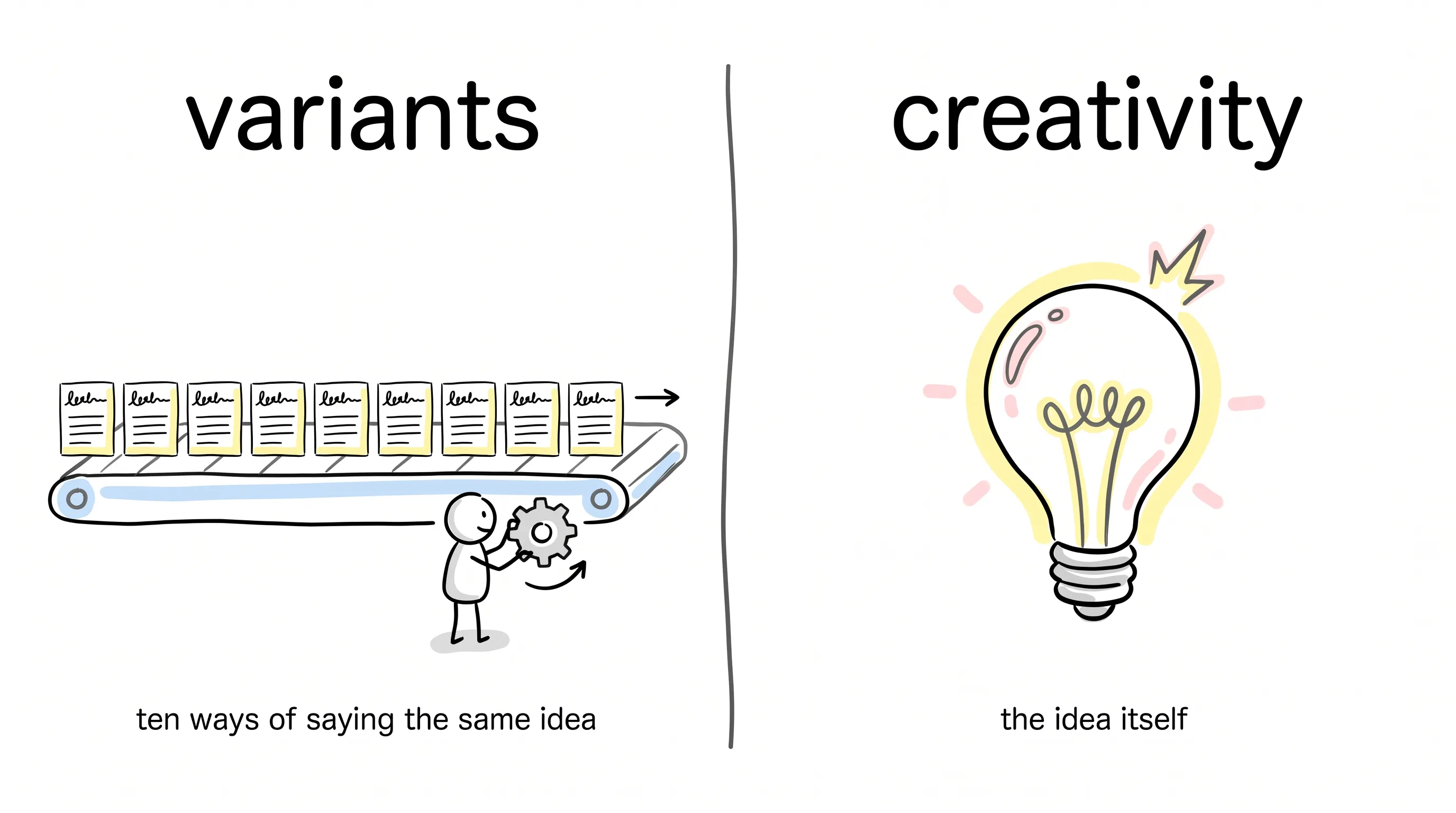
I said: A big difference. A variant is ten different ways of saying the same idea. Creativity is the idea itself.
Hold on. Let me start from the beginning.
What Is Personalization?
Personalization means using data to tailor content for each individual. You search for running shoes once on an e-commerce platform, and for the next three days, every app pushes running shoes at you. You just finished a series, and the platform immediately recommends the next one. And yes, it's all relevant.
But here's the problem.
When every brand can achieve relevance, relevance stops being worth anything.
It's like 20 years ago, when you addressed a customer by name in an email and the customer felt you cared. Today? You have to misspell a name in an email for the customer to feel you cared. Because everyone else gets it right.
So when relevance becomes the standard, the real scarcity is being remembered.
Creative Teams Are Standing in the Wrong Place
So why do so many brands do personalization and still fail to make anything memorable?
Because their creative teams are standing in the wrong place.
How do most brands do personalization? First they design the experience, they set the audience segments. Then they call in the creative team: All right — give me 10 headline variants, 5 image variants, and 3 button copy variants.
In other words, creativity is the last step of the assembly line.
And it's precisely that step that AI does faster and better than anyone. Ask AI for 10 headline variants and it's a matter of seconds. Ask a creative team for 10 headline variants and they'll just draw a blank. Because the real creative decision was already made earlier in the process.
Let Me Tell You 3 Stories
So what's the right way to do it? First, let me tell you 3 stories.
The first story: Spotify.
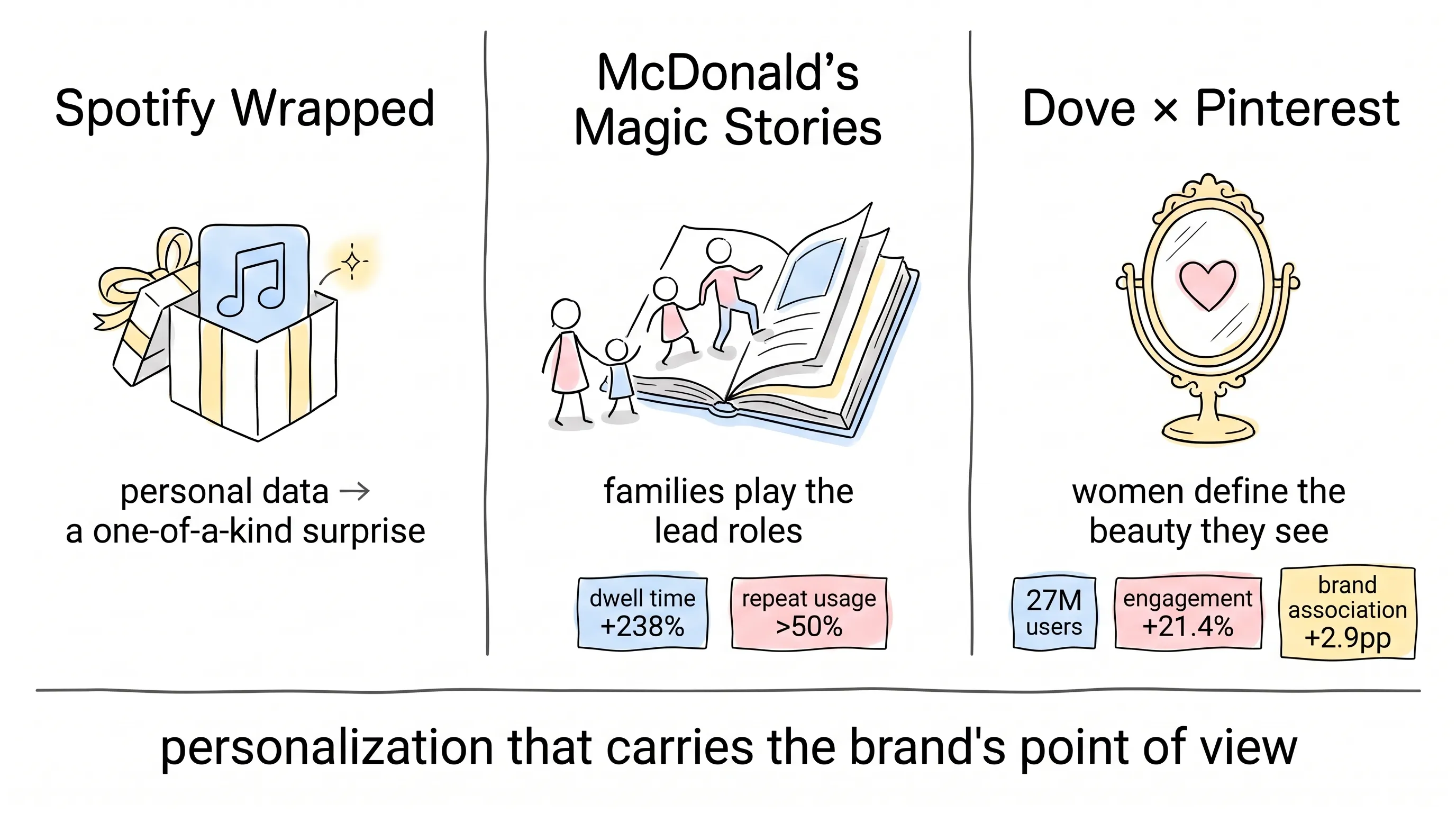
Every year-end, Spotify Wrapped turns each user's listening habits for the year into an annual report everyone wants to show off. Musical taste is personal data — about as ordinary as it gets. But the same creative idea, applied to each individual, becomes a one-of-a-kind surprise. Wow. That's impressive.
The second story: McDonald's.
McDonald's wanted to solve a problem: how to get families to come back more often?
What's the conventional approach? Send coupons, run points programs.
McDonald's didn't do that. It started from a creative workshop and asked a question: What do families want most?
The answer: time together as a family.
So it built Magic Stories. This experience lets a family of three step into the same animated world and play the lead roles in a story that belongs only to them. With AI-created illustrated characters, plus loyalty points and an app as the foundation, the story can keep growing.
The result?
Average brand dwell time per person rose 238%. Repeat usage exceeded 50%.
238%. Even I was stunned the first time I saw that number.
Where does technology come in? Technology is there to catch the world the creative builds. And where does creativity come in? Creativity comes in the insight that a family wants to watch a story together.
The third story: Dove.
You probably know that Dove has spent years challenging narrow beauty standards. But as AI increasingly decides what images people see, Dove partnered with Pinterest on an experiment: let women define for themselves the beauty they want to see.
Participants chose images and traits to generate their own personalized content. That content could be shared — and at the same time, their choices fed back into Pinterest's recommendations.
The interesting part: this personalization isn't "whatever you like, I'll show you." It's "whatever you believe, I'll help you say it."
The result? It reached 27 million Pinterest users. Women's engagement beat the platform benchmark by 21.4%. And Dove's "Real Beauty" brand association rose by 2.9 percentage points.
Brands Need a Point of View
These 3 stories hide the same lesson: personalization can't just carry your preferences — it also has to carry the brand's point of view.
Many brands do personalization and turn it into flattery. You like this, so I'll push it. And in the end? The brand becomes a waiter with no opinions. You like it, so I can give it to you. But why do you like it? No idea.
But a brand should have its own identity, its own point of view. Not every brand has to take sides, but every brand has to stand for something. Something it genuinely believes in, that others can recognize at a glance.
What a brand should do is let people experience its point of view through personalization. Don't let the algorithm guess what you like and just push it.
Creativity's Job Is to Answer 5 Questions
So what exactly should creative teams do in personalization?
Simply put: don't wait for the experience to be designed before you step in. Answer these questions first:
- Under what circumstances should the experience react?
- What should it remember?
- When should it introduce something new?
- What can the user control?
- What never changes?
One more thing that might be counterintuitive: personalization isn't better when there's more of it.
Imagine someone who is seriously ill, searching online for treatment options. What does she need? Useful information, and a clear next step. And is what she needs an AI-generated "You've got this — keep going!"?
More understanding doesn't mean more caring. Sometimes, knowing when to shut up matters more than knowing how to express yourself.
Finally
Back to my friend's confusion at the start.
Technology will keep getting better at making content relevant. AI is already doing this better and better, and it will keep getting better.
But "what's worth making" — that decision belongs to creativity.
McDonald's thought about a family wanting to watch a story together. Dove thought about women wanting to define beauty for themselves. These two ideas will still hold true even if technology improves tenfold someday.
Technology is responsible for putting content in front of everyone. Creativity is responsible for making everyone willing to stop and pay attention.
Continue reading
Related articles

It's 2026: Stop "Buying" AI Tools for Your Marketing Team — Start "Hiring" AI Agents
This learn article explains how AI agents differ from standalone AI tools in marketing, outlines three agent categories — build-your-own platforms, CRM-native agents, and vertical tools — and covers use cases across SEO, social media, advertising, and reporting, plus criteria for choosing one.

Did the Money You Spent on AI Marketing Ever Come Back?
A guide to measuring AI marketing ROI across three layers: ad reports, sales pipeline, and the financial ledger. Covers metrics such as ROAS and CPA, eight dashboard metrics, industry benchmarks, and common measurement mistakes.

How to Pick a Creative Automation Platform: First, Figure Out What These Eleven Actually Do
A learn article sorts eleven creative automation platforms — including Bannerflow, Celtra, Smartly.io, and Storyteq — into four functional groups and proposes five evaluation questions covering publishing reach, automation depth, ease of adoption, team fit, and verifiable evidence.