
So how do you actually do the math on AI marketing?
An explainer on calculating AI marketing ROI, citing a 2026 State of AI Marketing survey: median ROI of 3.2x, use-case comparisons such as ad optimization and AI visibility monitoring, monthly cost savings for mid-size teams, and industry differences, with a note that the data is self-reported.
A few days ago, a friend of mine who works in marketing took me out to dinner.
He told me that at the end of last year, his company pushed him to invest in AI. He bought AI tools for writing copy, AI for running ads, and AI for analyzing data. The money went out the door, and his boss asked: did it earn itself back?
He had no answer.
I told him: don't worry. I recently came across a survey published by Presenc AI that lays out this math pretty clearly. But don't take my word for it yet — let me walk you through the numbers.
First, the big picture
What is ROI?
Return on investment. Put in one dollar, see how much you get back — that's your multiple.
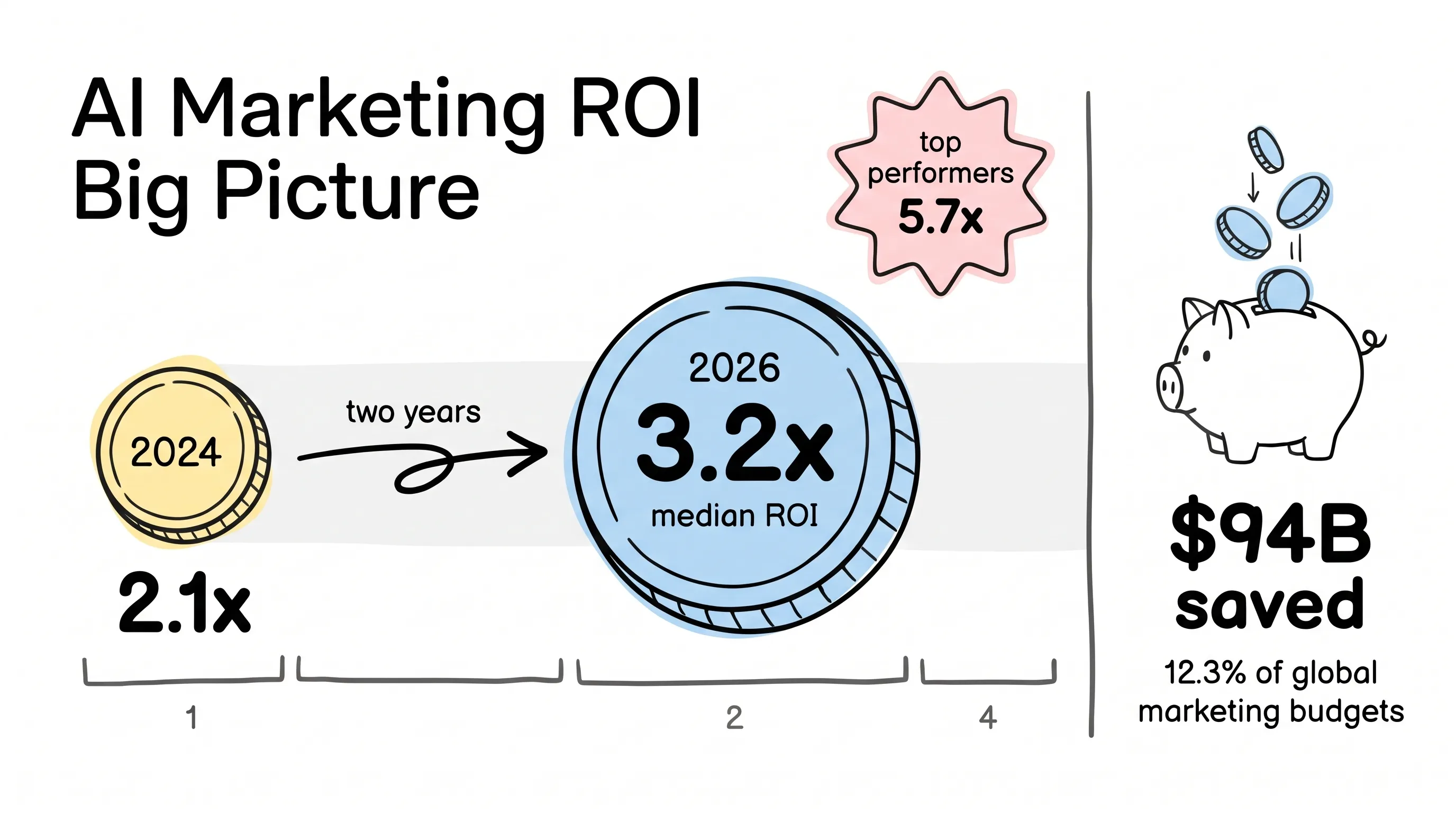
In 2026, the median ROI of AI marketing is 3.2x.
For every dollar you put in, you get back 3.2.
Is that higher or lower than you'd expect? Honestly, my first reaction was: decent, not exaggerated. But when I looked further, I let out a 'wow'.
In 2024, that number was just 2.1x.
In two years, from 2.1x to 3.2x. Why? Because people using AI are getting better at it. Measurement methods are maturing, and the tools are getting stronger.
The top performers are already above 5.7x.
And globally, the money AI has saved in marketing adds up to about $94 billion. That's 12.3% of total global marketing budgets. Money that was supposed to be spent is being saved — or redirected elsewhere — because of AI's efficiency.
But don't celebrate yet.
Some earn 4.1x, some only earn 2.1x
At this point, you might ask: 3.2x is the average — what's my share?
Good question. The money has never been evenly distributed.
The survey breaks it down by use case. Let me read you a few:
Ad optimization, 4.1x, the highest. Using AI to adjust ad placement — whom to target, how much to spend, when to run — algorithms are much faster than manual work, and far more accurate.
Predictive lead scoring, 3.8x. What is predictive lead scoring? It's where AI runs the numbers first: out of this pile of potential customers, who is most likely to buy? You spend your time on the people most likely to convert.
AI visibility monitoring, 3.4x.
Wait — why call this one out separately? Because it has a story.
AI visibility monitoring: up 113% in two years
What is AI visibility?
Think about it: before people buy something now, they ask ChatGPT, ask Claude, ask Perplexity. How the AI answers determines whether your brand has a chance to appear in the answer.
AI visibility is how often and how accurately your brand is mentioned in AI answers.
In 2024, the ROI of this was 1.6x. Now it's 3.4x.
That's a 113% jump in two years. Extraordinary. It's the fastest-improving AI marketing use case of all.
Why? Because it has moved from experimental to mature. How to measure it, how to attribute it — there are established playbooks now.
The barrier to entry is also low. Average annual investment is $72,000, with a return of $245,000. That's why everyone is playing catch-up.
How do you measure it? There are dedicated platforms — Presenc AI, for one — that do exactly this: monitor how your brand is being mentioned across major AI platforms, track competitive share of voice, and hand you actionable recommendations. More on that later.
Now, the savings side of the ledger
ROI is about the money you earn back. But AI has another side: the money you save.
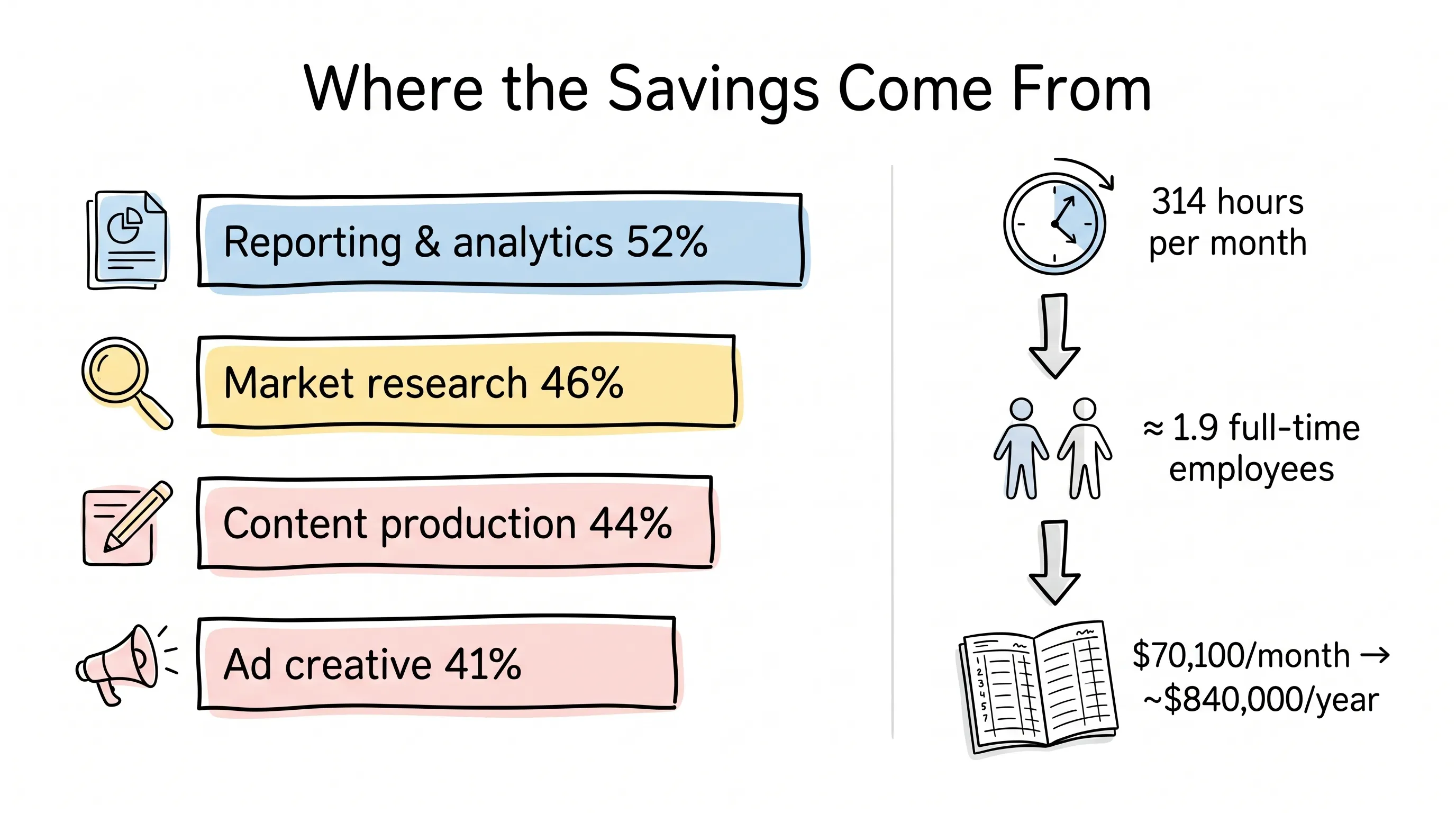
In the survey, a typical mid-size marketing team saves $70,100 a month. Over a year, roughly $840,000.
Where does the saving happen?
The biggest savings are in reporting and analytics: 52%. AI automatically compiles data, builds charts, and generates insights — work that used to require a whole team of analysts moving data around all day. Content production costs also fell 44%, ad creative fell 41%, and market research fell 46%.
Add it up: 314 hours a month. That's roughly 1.9 full-time employees.
Think about it: a mid-size marketing team that used to keep two people busy moving data and writing weekly reports. Now AI does it. Those two people are free to work on strategy and creative.
The longer you use it, the more you earn
One more thing I find particularly interesting, and something many people overlook.
The survey split teams into two groups: those using AI for over 18 months, and those under 6 months.
The 18-months-plus group's ROI is 2.4x higher than the under-6-months group.
Yes, that's the learning curve.
The comparison with traditional marketing is similar. In controlled A/B tests, AI-assisted campaigns delivered 27% higher conversion rates, 19% lower customer acquisition costs, 34% faster launches, 22% higher ad click-through rates, and 15% higher customer retention.
Teams in their second year of using AI outperform first-year teams by 41%.
What does that tell us? That AI isn't a tool you buy and use. It's more like an asset that requires long-term investment. The AI models are learning your data, and your team is learning how to collaborate with AI. Both sides are compounding — the longer you go, the bigger the advantage.
Teams that think "let's buy a tool and see what it does" will probably give up within six months, concluding "AI doesn't work." What a waste.
Which industry benefits most?
Not every industry is the same.
The biggest winner is tech, at 4.3x. Why? Their customers live entirely on digital channels, and their data is abundant and complete — every optimization AI makes can be seen.
Finance is 3.8x. E-commerce is 3.5x, where AI recommendation engines lift average order value by 18%.
The lowest is manufacturing, at 2.1x. Customers live on traditional channels, data is scattered, and AI's optimization moves are hard to see.
Healthcare is 2.8x, professional services 2.5x.
But manufacturing has an anomaly: it's the fastest-growing, up 89% year over year. The starting point is low, but the whole industry is going digital, moving customers online, slowly catching up.
Finally, some honest talk
This data comes from the 2026 "State of AI Marketing" survey, with 2,140 respondents; plus a Forrester study on AI marketing, a Gartner CMO budget survey, and A/B tests from 480 organizations.
And all of this data is self-reported. Don't take it all at face value, but it's worth a look.
Back to that dinner.
I told my friend: the math isn't done that way. AI marketing isn't a question of "whether to buy" — it's a question of "whether to buy, how long to use it, and how well you use it."
He asked: where should I start?
I said: start with a free brand audit and see what you look like in AI answers today. Platforms like Presenc AI offer exactly that entry point.
One day, your boss may ask you too: "did the AI marketing earn itself back?" I hope by then, you'll already know how to do the math.
Continue reading
Related articles

What Is GEO? How Your Brand Gets "Mentioned" in the Age of AI Search
An explainer on GEO (Generative Engine Optimization) for e-commerce and DTC brands: how it differs from SEO and AEO, why AI answers shape brand visibility, and eight practices covering question-focused content, consistent brand messaging, structured pages, external evidence, comparisons, and AI mention tracking.

AI Is Already Making Decisions for Your Customers. Are You on the List?
A learn article explains GEO (Generative Engine Optimization): why AI-generated answers now shape which brands customers see, and how SEO fundamentals, entity clarity, citable evidence, and monthly measurement affect visibility in AI answers.

Google Is Stuffing Ads Into AI Search: These Recent Stories Are Really One Story
A news roundup linking recent AI marketing stories—Google adding ads to AI Mode, Amazon's Ads Agent, ChatGPT image updates, a UK startup tracking brand mentions in AI answers, and an AI ransomware warning—arguing that control over ad data and visibility is shifting toward platforms.