
In the AI Search Era, Keywords Need a Different Play
A learn article explaining how AI search changes keyword strategy: shifting from rankings to citations in AI answers, researching prompts instead of keywords, earning citations through clear content, and tracking visibility in GA4.
A few days ago, I searched Google for one question: how to get started with Google Ads.
The page came up, and I paused.
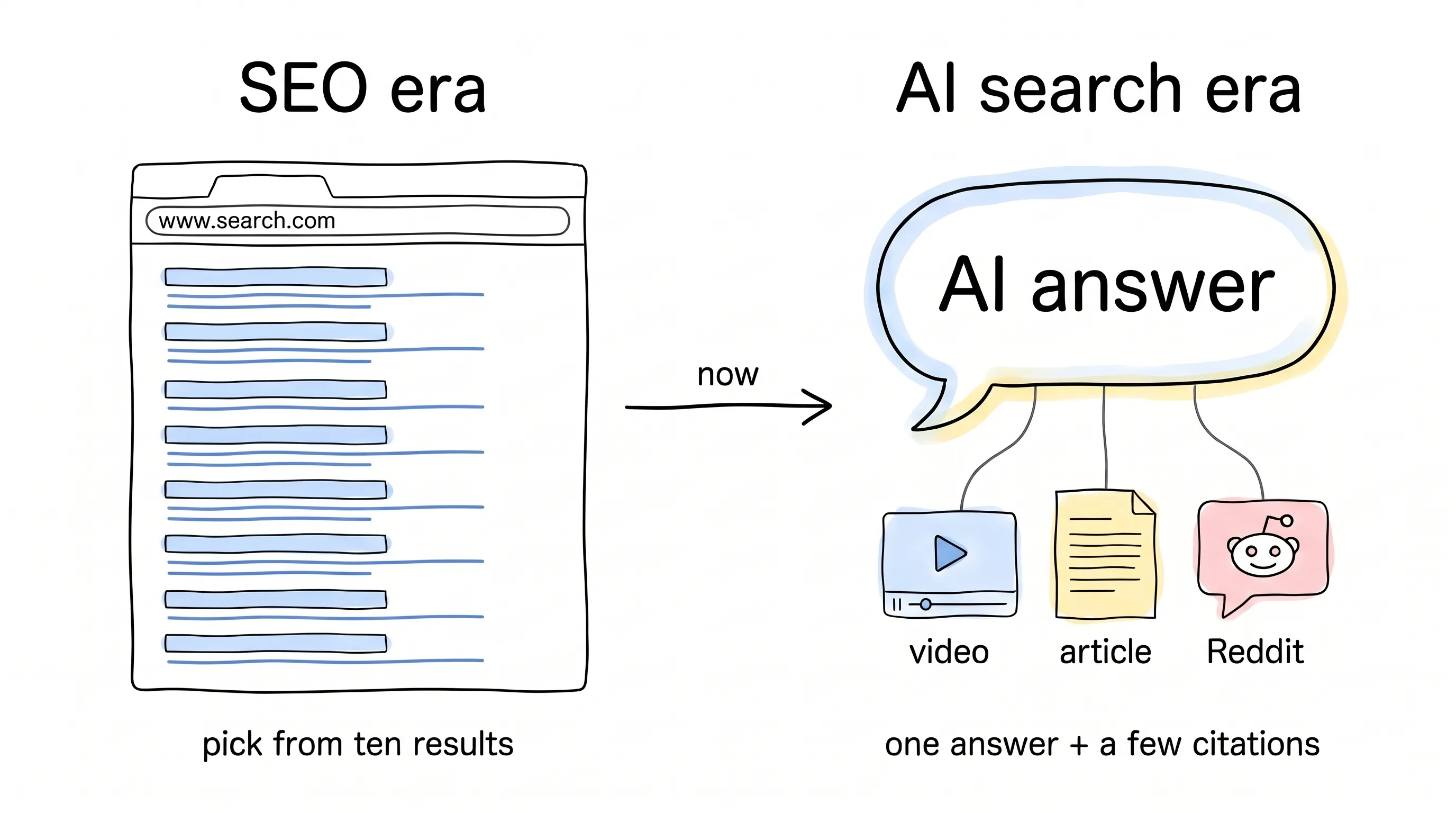
At the top, there were no ten blue links. Instead, there was an AI-written answer, with a few cited sources hanging underneath: several videos, a few articles, and a Reddit thread.
Ten blue links had become a single answer, plus a few sources.
I dug in and found that a marketing agency, Surfside PPC, had explained this whole thing better than anyone. Today, I'm passing it on to you.
What Is GEO?
Let me start with the conclusion.
In the past, you searched a word and Google gave you ten results, each with its own title, description, and link, and you picked through them at your leisure. Now? An AI hands you a synthesized answer directly, then picks a few sources to attach to it.
What does that mean?
It means if you're cited, you exist. If you're not cited, you're invisible. Wow — that's a huge change.
What is GEO? Generative Engine Optimization. Some people also call it AI keyword research. Simply put: it's about getting AI to cite you and recommend you when it answers questions.
You might ask: does that make SEO useless?
No. The goal has changed.
The Goal Has Changed: From Rankings to Citations
Let me tell you a story.
Surfside PPC, an agency that teaches Google Ads. When they searched "how to get started with Google Ads," Google's AI mode listed every cited source: Reddit threads, YouTube channels, all visible one by one. And Surfside PPC itself was right there.
When the founder saw this, he said one thing: this is my goal.
What does that mean? It means that when people ask these questions, ranking high is no longer enough. What you want is to be cited and recommended in AI answers.
Rankings still matter, of course. But citations are a new layer.
Even better, he asked a follow-up: what if I want to learn on YouTube? In the AI answer, his channel ranked first. He was surprised — Ben Heath, a big YouTube name in Google Ads, wasn't included at all. And Solutions 8, which ranked second, he had originally thought their content wasn't that diligent about publishing. You see, AI's answers are completely different from what you'd guess.
From Keywords to Prompts
So how do you research this? The most crucial step: the object of research changes from "keywords" to "prompts."
What's a prompt? The words people actually ask AI.
For example, someone asks: "What's the best tool for analyzing PPC ad performance?"
How do you know people will ask these? Two ways.
One, use a tool like Answer the Public to see real questions directly.
Two — more direct: ask ChatGPT. You say: "Give me 25 questions people commonly ask about Google Ads." It will most likely give you a list very close to reality.
Then what? Take a spreadsheet and align the prompts with your existing content, one by one.
For example, your site has a best CRM article, your channel has a best CRMs for 2026 video, plus best CRM for local service businesses and best CRM for accountants. When someone asks "what's the best CRM for small agencies," you check the table — already covered.
That's enough. Don't write a new article for every prompt. Covering them inside your existing content is enough.
"Best of" and Comparison Prompts: Don't Get Greedy
"Best of" and comparison prompts are very valuable. Buyers make comparisons inside AI — this is their real habit.
But there's a limit here.
First, don't make 50 comparisons. Only make the 3-4 core comparisons you genuinely need. For example, if you teach Google Ads, then do the comparisons like "how to learn Google Ads" and "Google Ads courses." Don't go do comparisons like "the best tree service companies" that are completely unrelated to you — that's not your field, and AI won't think you're all that helpful.
Second, when you build your own list, don't put yourself first. Put yourself third, fourth, fifth. AI is getting smarter and smarter at recognizing self-promotional lists.
Citations Are Earned
When AI pulls these citations, it looks at Reddit, YouTube, Quora, LinkedIn, and articles on your own website — especially websites that are well-known in the industry.
Let me give you an example. A SaaS brand wanted to be cited in "best tool for X" prompts. The most effective way was getting users to say good things on Reddit. One line from a real user — "we use this, and it works great" — beats a hundred lines of your own advertising.
So here's a painful truth.
Half of doing marketing is building a good product.
If the product itself is good, users will really say good things on Reddit. If the product isn't good, no matter how much content you write, it won't hold up.
So how do you earn citations?
Make your answers clear and direct, so the model can lift them straight out. Use headings and lists. Don't make AI guess what you want to say.
Tracking: It's in GA4, and There's Plenty of Tools
So how do you know how you're doing?
Two ways.
One, GA4 (Google Analytics 4). In the traffic acquisition report, you can see referral traffic from ChatGPT, Perplexity, and Gemini. For example, if someone clicks a link in ChatGPT, it shows up in the source. Surfside PPC itself has received traffic like this, and users have even commented: "Google Gemini recommended this video." That's a good sign.
Two, dedicated AI visibility tracking tools. Otterly, $29 a month, handles 15 prompts. Frase has AI search tracking, plus an AI agent to help you optimize rankings. Daygno can generate a free report showing whether your brand is "invisible" across the various AI channels. This space is pretty lively — Gracker, HubSpot, Visby, Bluefish, Semrush are all in it too.
But Surfside PPC's own attitude is refreshingly honest: don't rush to throw money at this yet. He says he searches manually every day to check the citation situation, then looks at the data in GA4. This field is still too new, and he doesn't know how much these tools can actually deliver, so for now he keeps his head down making content.
Actually, there's one more detail: when you do searches inside ChatGPT, Claude, or Perplexity yourself, most are informational queries, not transactional. So being cited in informational searches is the goal.
Finally: Keep Your Head Down and Make Content
So how do you start? Spread your content out.
Your website, YouTube, social media — all need content. A video, an article, a podcast, social content. These pieces link to each other; don't leave them isolated.
Spread your content into a web, every node linked to the others. When AI walks the web, it can find you.
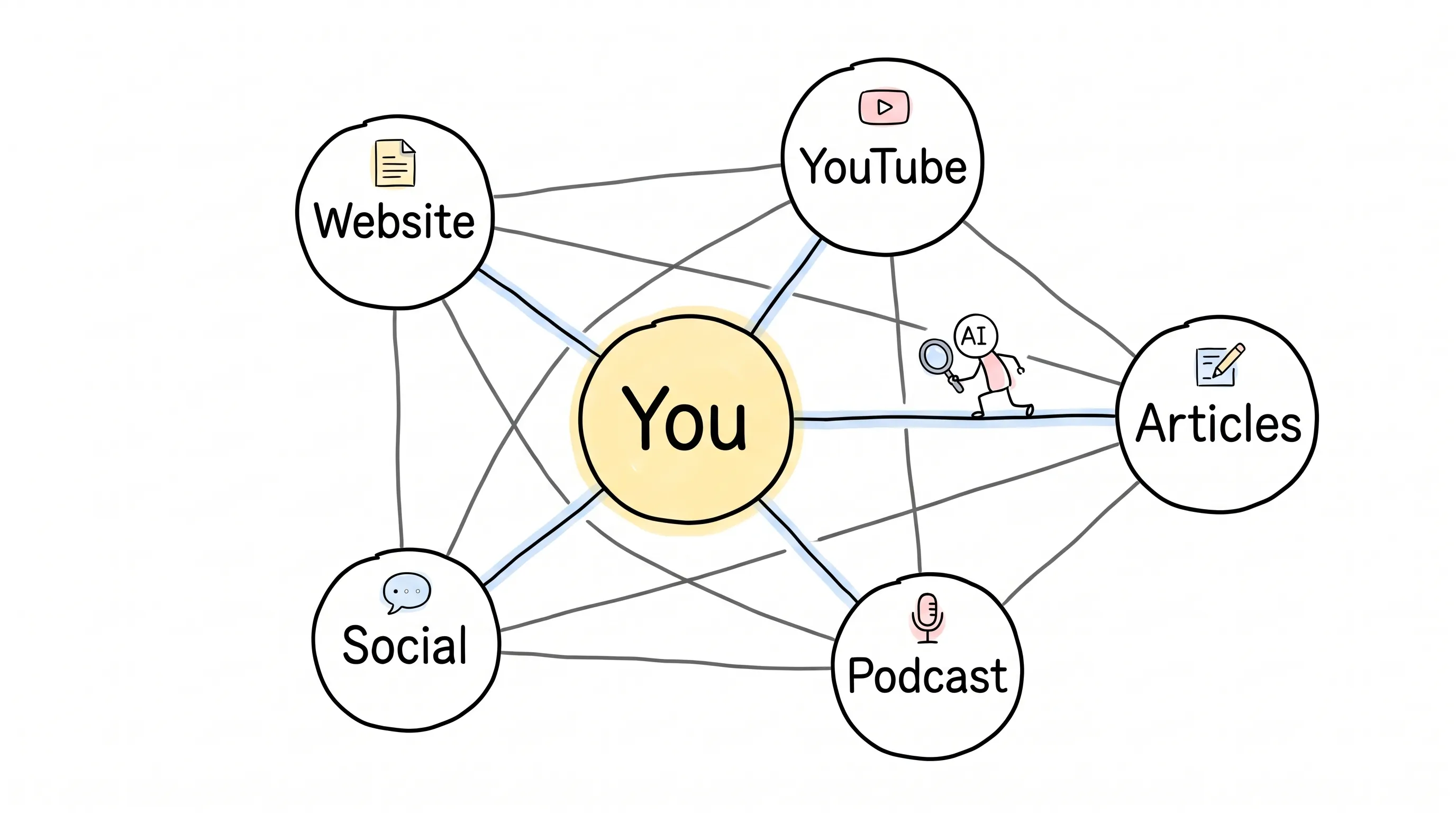
Surfside PPC itself went from 20 videos to 100 videos, covering 100 topics, plus 100 articles interlinked with each other. This content is the easiest source for AI to cite.
SEO hasn't changed. The only thing that's changed is spreading good content where the models can find it.
Continue reading
Related articles

It's 2026: Stop "Buying" AI Tools for Your Marketing Team — Start "Hiring" AI Agents
This learn article explains how AI agents differ from standalone AI tools in marketing, outlines three agent categories — build-your-own platforms, CRM-native agents, and vertical tools — and covers use cases across SEO, social media, advertising, and reporting, plus criteria for choosing one.

What Is GEO? How Your Brand Gets "Mentioned" in the Age of AI Search
An explainer on GEO (Generative Engine Optimization) for e-commerce and DTC brands: how it differs from SEO and AEO, why AI answers shape brand visibility, and eight practices covering question-focused content, consistent brand messaging, structured pages, external evidence, comparisons, and AI mention tracking.

AI Is Already Making Decisions for Your Customers. Are You on the List?
A learn article explains GEO (Generative Engine Optimization): why AI-generated answers now shape which brands customers see, and how SEO fundamentals, entity clarity, citable evidence, and monthly measurement affect visibility in AI answers.