
The Second Half of Search: Being Cited by AI Is Worth More Than Being Clicked
An educational article introducing GEO (Generative Engine Optimization) and how it differs from SEO: ranking for clicks versus being cited inside AI-generated answers. It outlines what AI engines tend to cite—clear statements, verifiable data, attribution, and structure—and how brands can adapt.
A few days ago, I looked up a question. Just a casual question, typed into ChatGPT.
The answer came out right away. I didn't click a single link.
I closed the page and sat there for a moment. Where exactly had all that "searching" just happened? Not on a search results page. Not on page one. I hadn't clicked anything at all.
I mentioned this to a friend, and it turned out he's the same. "I basically don't Google anymore," he said. "I just ask AI."
Friend, if you're doing the same, then what I want to talk about today is about you.
The second half of search has already begun.
What Is GEO?
You might be thinking: search has changed, so isn't this just a variant of SEO? A new buzzword for the same thing?
Actually, no.
What is GEO? GEO, short for Generative Engine Optimization, is a dedicated approach: it makes AI engines like Google AI Overviews, ChatGPT, and Perplexity pull your content out, cite it, and weave it into the answers they generate.
The work it does looks similar to SEO, but it's fundamentally different.
SEO fights for ranking. It gets your page placed high up, so users see you in the results list, click through, and you earn a blue-link click.
GEO fights for being cited. AI won't send users to your page. AI reads your page, extracts the most reliable, clearest, most quotable parts from it, and then weaves them into a new answer it writes itself. Your brand, your data, your viewpoints become the raw material inside an AI answer.
Put simply: SEO is about getting users to come to you. GEO is about getting AI to use you as material when it answers on the user's behalf.
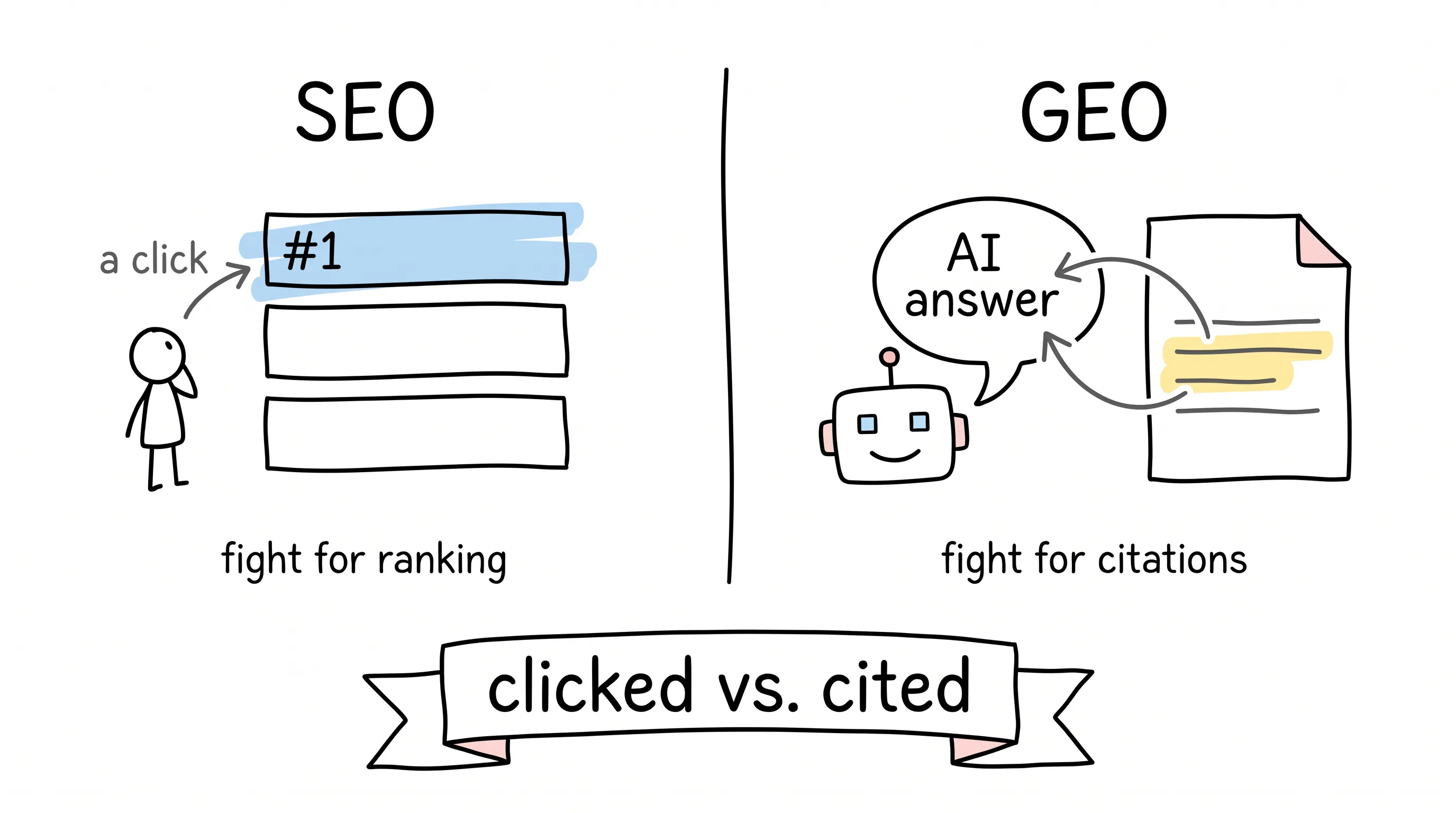
The difference between these two is bigger than you can imagine.
For businesses that run on content, this is not an elective course. It's a requirement.
Why Now?
You might ask: I hadn't heard much about this before — why is it suddenly everywhere?
Let me run three quick numbers for you.
First number: Google's AI Overviews. Data from 2026 shows that nearly 48% of tracked searches triggered an AI Overview, with year-over-year growth of 58% in key industries. In other words, today when you search a business question, there's roughly a fifty-fifty chance that the very first "answer" you see is AI-generated.
Second number: Perplexity. By the end of 2025, this AI search engine had more than 45 million active users. What it does is let you ask directly and get an answer directly — no more flipping through ten web pages.
Third number: ChatGPT. In 2026, ChatGPT reached 800 million weekly active users. Add Microsoft Copilot, which is deeply embedded in enterprise office software and pushes AI search straight into the daily workflows of hundreds of millions of people.
Run those three numbers and you'll notice one thing: the entry point for asking questions has moved from the "search box" to the "AI chat box."
And once it moved, the answer became that one paragraph AI writes directly.
Whoever gets cited in that paragraph exists. Whoever doesn't, doesn't.
How Do AI Engines Decide Whom to Cite?
This is the crux of the whole thing. You might wonder: how do AI engines choose? Is there some internal blacklist?
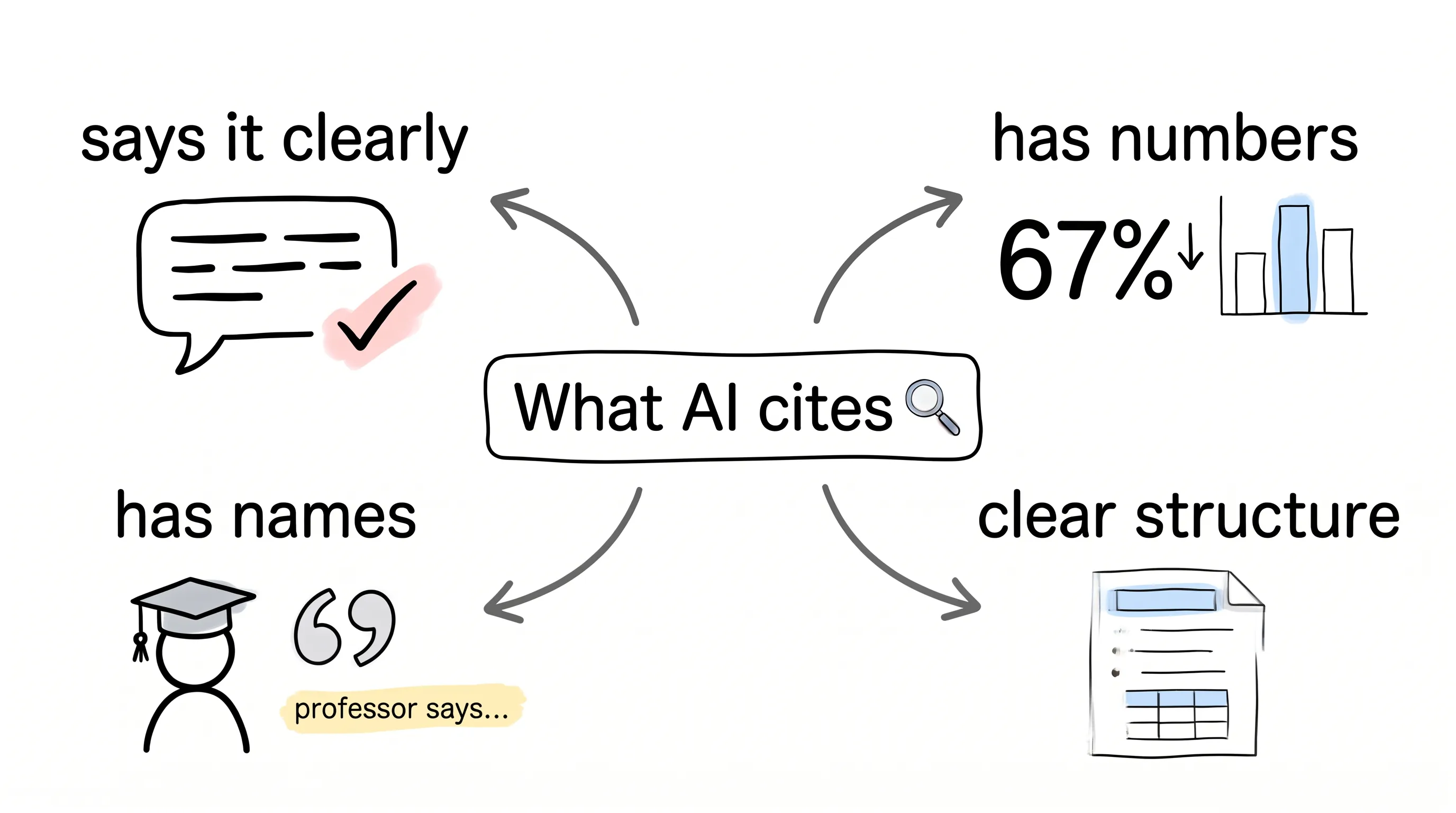
Actually, if you look at how AI-generated answers actually behave, you'll find that these engines' preferences are remarkably stable and predictable. Let me walk you through four of them.
First, it likes content that "says things clearly." AI extracts information through semantics. If you write vaguely, burying your key points under modifiers, AI will struggle to pull them out. If you state things directly, use consistent wording, and layer your logic, AI can extract them with ease.
Second, it likes content that "has numbers." The data AI loves to cite most is the kind that's specific and verifiable. Say "zero-trust architecture can significantly reduce security risks," and AI may just ignore you. Say "a 2024 survey found that organizations adopting zero-trust architecture saw 67% fewer intrusion incidents," and AI will lift that sentence straight into its answer.
Here's the thing — same meaning, completely different reaction from the AI.
Third, it likes content that "has names." AI trusts content with expert attribution, cited sources, and a clear institutional identity. Quote "a university sports nutrition professor says…" and AI will judge the content as reliable.
Fourth, it likes content with "clear structure." Pages with headings, lists, tables, and FAQs let AI locate things fast. A pile of unstructured paragraphs is hard for AI to pull from.
Put those four together, and you have the AI's "taste list."
AIS Media, the publisher of this guide, breaks the method into four steps: first, audit — pick out the assets in your existing content that AI is most likely to cite; second, restructure — make your content easier for AI to extract; third, create original research — produce data that only your company has, so AI has no choice but to cite you; and finally, distribute — make sure these platforms all know you.
Look at those four steps: not one of them is "keyword stuffing." They're all doing one thing: making AI cite you.
A Case Study
Let me give you an example.
A user asks an AI: "What protein powder suits women over 50 who want to build muscle but are prone to bloating?"
If AI can't find good content, all it can give is a generic answer, based on training data and a pile of unstructured web pages. Not specific, no citations, no brands.
But if a brand has published the article in advance: in 2024, 120 women aged 50 to 65 took part in a double-blind trial, taking hydrolyzed whey protein with added digestive enzymes — 42% less bloating, 18% more lean body mass growth. Plus a direct quote from a university sports nutrition professor.
How would AI handle that data? It wouldn't copy your article over. It would rewrite your data, quotes, and brand into an answer tailored specifically for this new user.
The user reads the answer and finds it credible. Most of the time, they won't click through to that brand's website. But they remember: hydrolyzed whey protein with digestive enzymes, 42% less bloating. That's enough.
See, this brand didn't rank first anywhere in the search results. It just won the vote inside the AI's answer.
That is the power of GEO.
Is Ranking #1 Still Worth Anything?
Here's an uncomfortable truth.
Traditional SEO logic goes: users see the results and click the first one, so the #1 position takes 25-30% of clicks, the #2 takes 15%, and the tenth gets almost nothing. That's how the game has been played for the past 20 years.
AI search has taken that logic apart.
When an AI answer appears, the first "answer" the user sees is already remarkably complete — it answers the question directly, and it even answers the follow-up questions too. At that point, the user's urge to click drops sharply.
Looking at early data since AI Overviews launched, queries that trigger an AI Overview show a clear drop in click-through rate. Especially for informational and research queries — precisely the ones that used to drive the bulk of SEO traffic for business websites.
In other words: you rank first, but the users don't come. Why? Because AI has already given them the answer.
This is what you'd call a hollow victory.
The goal of GEO is no longer "how to rank first." It swaps in a different question: how does AI write me into the answer?
You can rank fourth, and as long as you're cited, you're far better off than ranking first without being cited.
A Few Common Questions
Someone asks: will GEO replace SEO?
No. SEO still needs doing, because AI engines also need to find information from structured, indexable pages. GEO adds one more layer on top of SEO: "making AI cite you."
Someone else says: then what's the difference between GEO and AEO, AIO, and all those terms?
These terms are easy to mix up. AEO is Answer Engine Optimization — it aims to win the "direct answer box" in search results. AIO is AI Overview Optimization — it targets Google's AI Overviews specifically. GEO is the broadest of them all, covering every generative AI platform: ChatGPT, Perplexity, Claude, Gemini, Copilot, and whatever comes next.
AIO is just one battlefield. GEO is the whole war.
What Happens Next?
This field is still very early. But a few things are already clear.
First, multimodal. AI answers will soon come with images, charts, and video. If you have high-quality multimedia content and solid structured markup, you've opened another door to being cited.
Second, agents. AI agents will do things for you: research, price comparison, booking, sending emails. When you ask an AI agent to "help me pick an enterprise software vendor," the one it recommends is most likely the one that did its GEO well.
Third, personalization. AI answers will increasingly target specific individuals. If your brand can bind itself to a specific scenario, audience, and outcome, you'll win those "exclusive" citations.
AI is getting to know your brand right now.
Closing
I didn't click a single link that day. But I remembered the one that got cited in the answer.
That's the second half of search.
The next round of search competition has shifted from "being clicked" to "being cited."
And here's a wish for you: may you always be the one AI cites.
Continue reading
Related articles

It's 2026: Stop "Buying" AI Tools for Your Marketing Team — Start "Hiring" AI Agents
This learn article explains how AI agents differ from standalone AI tools in marketing, outlines three agent categories — build-your-own platforms, CRM-native agents, and vertical tools — and covers use cases across SEO, social media, advertising, and reporting, plus criteria for choosing one.

What Is GEO? How Your Brand Gets "Mentioned" in the Age of AI Search
An explainer on GEO (Generative Engine Optimization) for e-commerce and DTC brands: how it differs from SEO and AEO, why AI answers shape brand visibility, and eight practices covering question-focused content, consistent brand messaging, structured pages, external evidence, comparisons, and AI mention tracking.

AI Is Already Making Decisions for Your Customers. Are You on the List?
A learn article explains GEO (Generative Engine Optimization): why AI-generated answers now shape which brands customers see, and how SEO fundamentals, entity clarity, citable evidence, and monthly measurement affect visibility in AI answers.