
Picking an AI Marketing Agency for B2B SaaS: Don't Pick the Biggest Name — Match Your Stage
A guide to choosing an AI marketing agency for B2B SaaS, presenting four evaluation criteria and profiles of 11 agencies matched to different company stages.
A while back, a friend of mine who runs a SaaS company took me out to dinner. Halfway through the meal, he pulled out his phone and showed me a list of agency names. So, he asked, which one should I pick?
I turned the question around: what stage is your company at?
Just closed our Series A, he said.
Then this isn't a "which one" question, I told him. It's a "which ones match your stage" question. The biggest names aren't necessarily right for you. Choosing an agency isn't about chasing celebrities; it's about finding teammates.
Afterwards, I went and studied the 11 AI marketing agencies taking their work seriously. Every one of them serves B2B SaaS, but each one has grown out of a different "stage." Today I'll walk you through all 11, along with my take on each.
What Is an AI Marketing Agency?
First, let's define the term.
What is an AI marketing agency? It's a marketing company that has rebuilt its workflow around AI. Research, content production, ad buying, reporting — AI lives inside every step, instead of hanging on the homepage as a badge.
Badges are for people to look at. Workflows are what do the work.
But think about it: no matter how fast AI gets, B2B business doesn't speed up. By 2026, the median B2B SaaS sales cycle is 84 days, the average is 134 days, up 22% from 2022. Enterprise deals above $100,000 drag past 180 days.
AI can hand you landing page copy in days, but it can't sit through a committee's three-month sign-off. If an agency's methodology only knows how to grab leads and doesn't know how to walk a long-cycle deal through its process, you hand over your money and most likely buy back a stack of lead lists nobody ever follows up on.
So before you pick an agency, measure with four yardsticks first.
The Four Yardsticks
First: is there a dedicated SaaS practice? Note the difference between "B2B SaaS is one of our twelve verticals" and "this is all we do."
Second: are there public case studies from SaaS clients within the last 24 months? Success stories from three years ago can't support today's judgment.
Third: can a founder understand the pricing at a glance? Monthly fee ranges, pilot engagements, packaged products — all fine. A few dollar icons plus a "get a quote" button — not fine.
Fourth: can the methodology survive a long sales cycle? It needs to understand pipeline metrics, understand ABM, and understand that "the people who buy your product aren't one person — they're a committee."
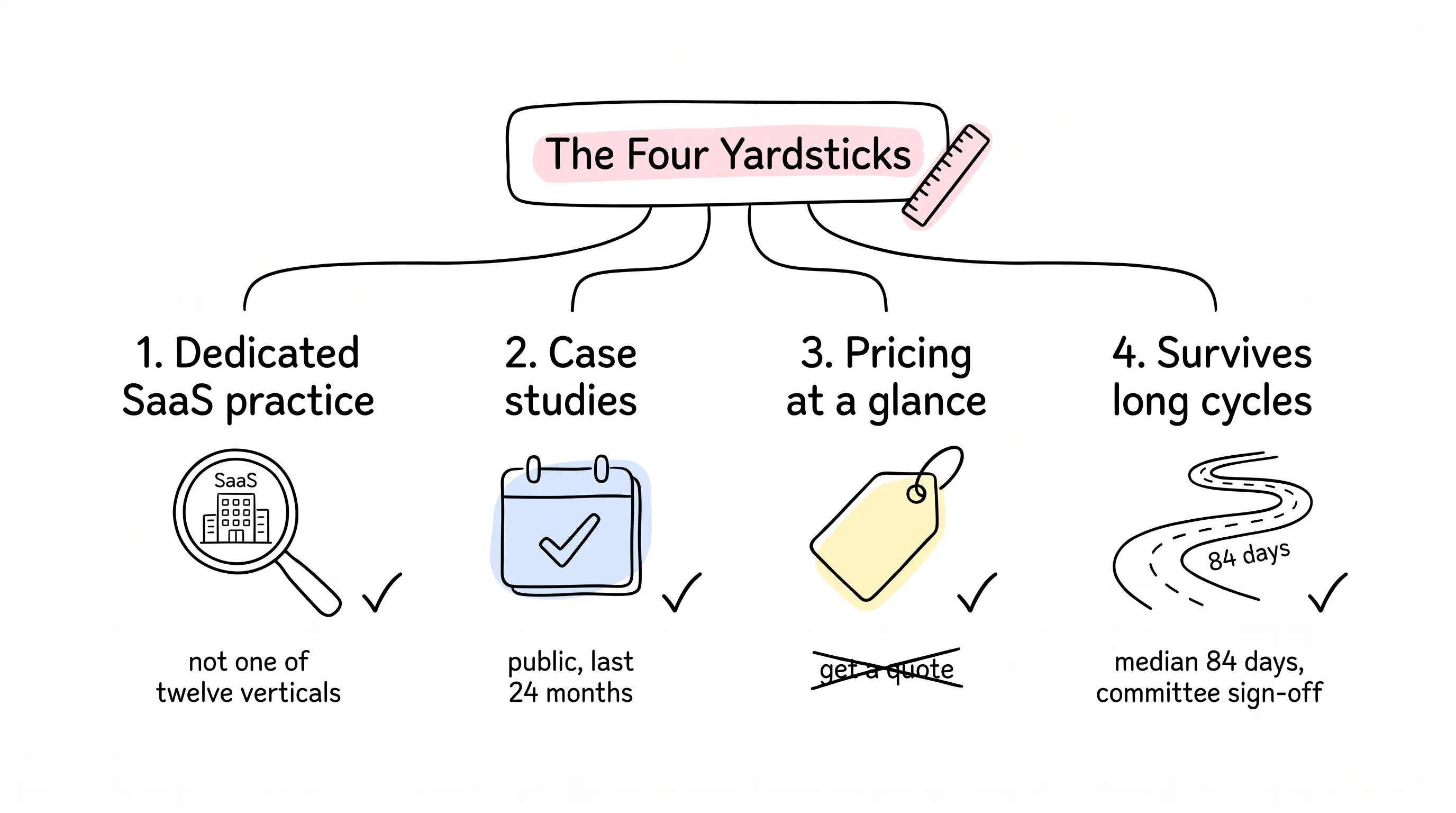
All 11 agencies passed these four gates.
Full disclosure. These 11 were originally compiled by RZLT — which is itself an AI marketing agency, and it listed itself in the lineup, disclosing the conflict of interest. I think disclosing beats pretending it doesn't exist. Treat it as the 11th agency, measure it with the same four yardsticks; if it clears them, pick it, if not, cross it out.
The 11, One by One
RZLT
RZLT is an AI-native agency with offices in Europe — Zagreb, Lisbon, London, and Sofia — focused on B2B SaaS, fintech, AI startups, and ecommerce.
Their workflow was rebuilt from scratch around LLMs. Research with AI, content production with AI, reporting with AI.
One example. For RPA by Workato (a Robotiq.ai product on the Workato platform), they ran a complete motion: a full site revamp serving both technical and non-technical audiences; a complete SEO and AEO system; more than 100 A/B-tested Google and LinkedIn ads; plus an ABM layer that reached Workato's users directly through LinkedIn and email.
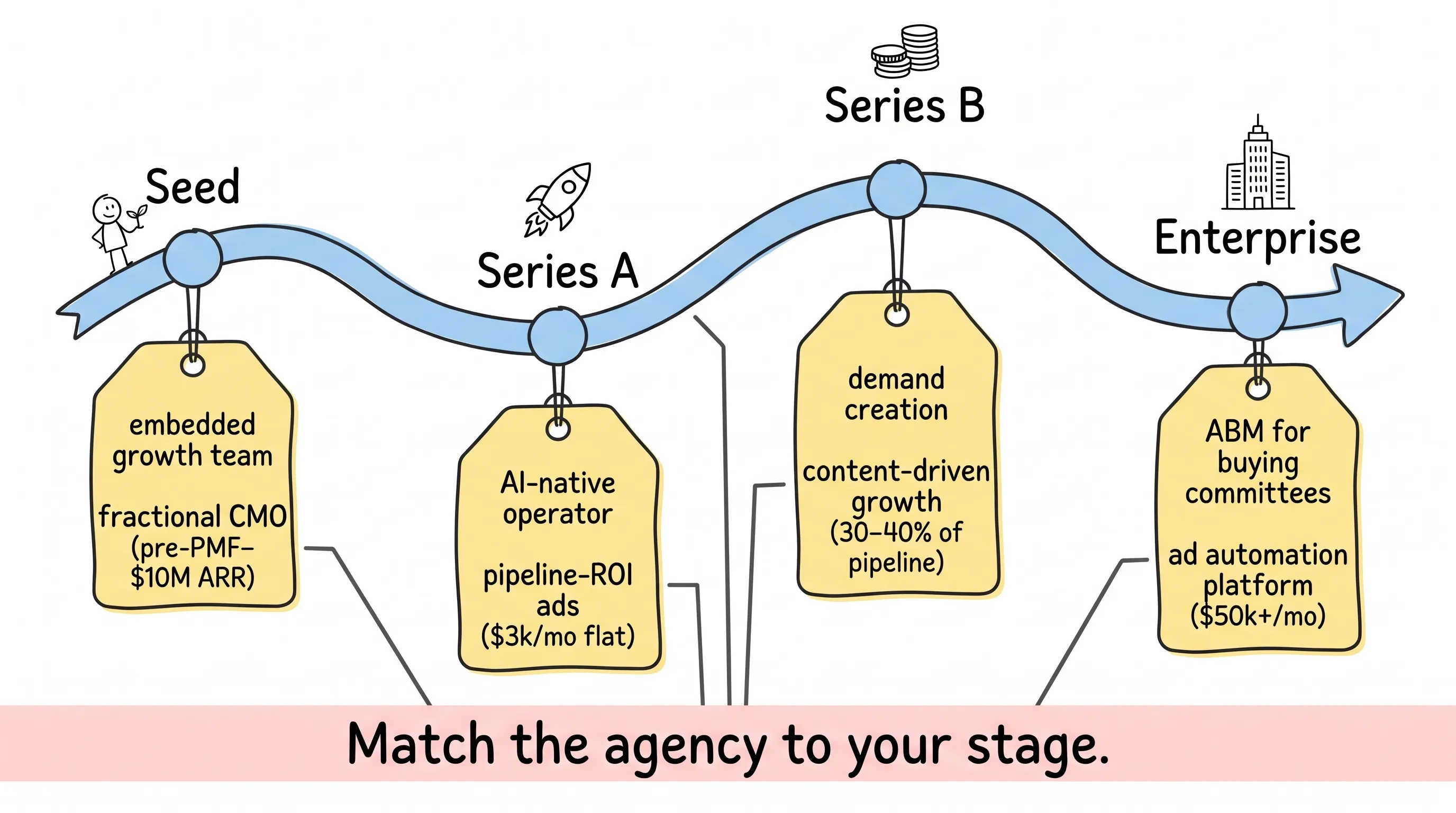
A fit for SaaS teams from Seed to Series C. What you're buying is a senior operator, not an account coordinator. Pricing: hybrid of projects plus monthly retainer, negotiated per engagement.
GrowthSpree
GrowthSpree did something pretty hardcore: they built their own MCP server that pipes Google Ads, LinkedIn Ads, and Meta straight into HubSpot's pipeline data, in real time.
What does that mean? It means they optimize for pipeline ROI, not CPL.
A $50 lead and a $50 SQL (sales-qualified lead) are two different things. The first means "someone saw an ad." The second means "someone is willing to take a sales call."
A fit for Series A to C SaaS companies with ARR between $0 and $50 million. Pricing: $3,000 a month, billed monthly, no percentage of ad spend. That kind of transparency is rare in this industry.
Kalungi
Kalungi acts as the "marketing department" for early-stage SaaS: a fractional CMO plus an outsourced marketing team.
The founders are former marketing leaders from Microsoft and Avanade. Their methodology is called T2D3: revenue triples, triples again, then doubles, doubles, and doubles.
What is T2D3? Revenue jumps along that rhythm. Aggressive — but every step is earned on the ground.
Their sweet spot is pre-PMF to $10 million ARR. Founders who need a senior marketing leader but aren't ready to carry a full-time CMO yet.
They also publish more SaaS marketing content than most agencies. Before you've even signed, you can read your way through their playbook. Pricing: standard monthly retainer, plus performance-linked models. That's rare in this industry too.
Refine Labs
Refine Labs, founded in 2019 by Chris Walker, based in Boston.
They were among the first to build out the "demand creation" methodology inside B2B SaaS. What is demand creation? It's no longer waiting for customers to fill out your forms — you actively create the demand.
The old game was "lead capture." A prospect typed their name into a form, and sales counted them as a lead. Refine Labs says: wrong. The people who actually decide to buy your product are in the dark — in "dark social," in private group chats, in podcasts, in the comment sections of LinkedIn creators.
So they work with SaaS clients to move budget away from forms and toward podcasts, LinkedIn creators, and the invisible sharing moments. Their research team has also published self-attribution surveys and data on buying committee influence, widely cited in the industry.
A fit for Series B and beyond, for SaaS companies that have already moved past traditional lead gen. Pricing: high-ticket monthly retainer, not public.
Omniscient Digital
Omniscient Digital does "content-driven growth."
Their approach leans heavily on research: topic modeling, SERP analysis, intent mapping — every step aimed at pipeline stages, not traffic.
What does "aimed at pipeline stages" mean? It means a single article isn't chasing 100,000 views; it's chasing "will the people at this stage move closer to paying because of this piece?"
Clients include Adobe, Loom, Jasper, and ClickUp.
A fit for SaaS companies past PMF that want organic search to reliably own 30% to 40% of pipeline. Pricing: custom monthly retainer, not public.
Tuff
Tuff, out of Denver, is an "embedded growth team."
What does embedded mean? They don't hand you a strategy report — they sit inside your team and run experiments. Paid, SEO, CRO, lifecycle, round after round, move fast, test fast.
They explicitly reject the "fractional CMO" positioning. Strategy reports? They don't write them. They sit in your team and do the work.
A fit for Seed to Series A SaaS still hunting for their first scalable channel. Pricing: monthly embedded team, with project sprints also available.
Single Grain
Single Grain is Eric Siu's digital marketing agency, in Los Angeles and Austin, doing SEO, paid media, content, and CRO.
Clients include Amazon, Salesforce, and Uber.
They have something nobody else on this list has: the Marketing School podcast and the Leveling Up newsletter. What do you call that? Built-in distribution. When you make content for clients and they push it out, it may sink without a trace; when they push it out, there's a podcast and newsletter audience behind it.
A fit for mid-market to enterprise SaaS that wants a multi-channel agency with reach of its own. Pricing: multi-channel monthly retainer, scoped to engagement.
Ironpaper
Ironpaper, New York, specializes in complex enterprise SaaS sales.
They do ABM, sales enablement, and content scoring. Their approach is heavy: persona research, intent data. The people who buy your product may number five or more: the IT team, the CISO, compliance. You fire off one ad, and five people have five different thoughts — and five different reasons to veto.
If you're selling a six-figure ACV, the buyer is a group of five or more, and ARR is above $50 million, then look at Ironpaper. Pricing: enterprise monthly retainer, scoped to engagement.
Metadata.io
Metadata.io sits at the intersection of "software and services."
Their platform automates the management of LinkedIn, Meta, Google, and display advertising. Their framework is called "demand journey": budgets automatically adjust toward pipeline results — which channel to shift toward, which campaign — the machine does the math.
Think about it: you're spending $50,000-plus a month on ads, buying people, time, and judgment. Metadata.io gives the judgment to the machine and saves the people for strategy.
A fit for Series B and beyond, SaaS spending $50,000-plus a month on ads. Pricing: platform subscription plus strategist services, tiered by spend.
NoGood
NoGood, New York, founded in 2017.
They do performance marketing, SEO, content, and creative. Client list: TikTok, Nike, Intuit, Spring Health.
They serve both B2B and B2C. What's the upside? Cross-industry ammunition. B2C plays are fast, but B2B cycles are long — they've trained at both tempos.
They've also built their own AI tools for creative testing and content production, which makes experimentation on paid channels much faster.
A fit for Series B and beyond, SaaS looking for seasoned multi-channel operators. Pricing: multi-channel monthly retainer, scoped to engagement.
BreakingB2B
BreakingB2B is Sam Dunning's B2B SaaS SEO and web agency.
Their specialty is organic search that brings pipeline, not traffic numbers.
Now they also do AI search visibility and LLM citation optimization. What's an LLM citation? Buyers have started doing their research with ChatGPT and Perplexity. They ask the AI: "Who does this well in this space?" Whoever the AI names has the better odds.
Buyers have started asking AI, not searching web pages. If you haven't taken this shift seriously yet, you could forfeit an entire future channel.
A fit for Series A and beyond, SaaS serious about organic search and willing to commit 6 to 12 months. Pricing: monthly retainer, 6 to 12 months minimum.
Three Common Threads
Eleven agencies later, the shared traits show.
First: proven AI-native workflows. Not badges — AI genuinely lives inside research, content production, and ad buying.
Second: verifiable pipeline attribution. They don't say "we brought you so many leads"; they say "we brought you so much pipeline."
Third: public evidence from real SaaS clients.
So how do you vet an agency? Three questions.
Ask for case studies — ones with revenue outcomes attached. Ask about their AI stack — they should be able to spell out exactly which AI they use. Ask them to do the math — to explain how campaigns tie back to CAC payback and NRR.
One more thing: pricing. An agency that won't put its pricing structure into a single sentence hasn't earned the right to be evaluated.
Back to That Dinner
So the dinner ended.
My friend never told me which agency he picked. But he said he finally knew what to ask: not "how great are you," but first, "at our stage, how many companies like us have you taken there?"
Choosing an agency means choosing a match for your stage.
May every dollar of marketing budget you spend be traceable all the way into your pipeline.
Continue reading
Related articles

It's 2026: Stop "Buying" AI Tools for Your Marketing Team — Start "Hiring" AI Agents
This learn article explains how AI agents differ from standalone AI tools in marketing, outlines three agent categories — build-your-own platforms, CRM-native agents, and vertical tools — and covers use cases across SEO, social media, advertising, and reporting, plus criteria for choosing one.

What Is GEO? How Your Brand Gets "Mentioned" in the Age of AI Search
An explainer on GEO (Generative Engine Optimization) for e-commerce and DTC brands: how it differs from SEO and AEO, why AI answers shape brand visibility, and eight practices covering question-focused content, consistent brand messaging, structured pages, external evidence, comparisons, and AI mention tracking.

AI Is Already Making Decisions for Your Customers. Are You on the List?
A learn article explains GEO (Generative Engine Optimization): why AI-generated answers now shape which brands customers see, and how SEO fundamentals, entity clarity, citable evidence, and monthly measurement affect visibility in AI answers.