
What Exactly Is GEO? The Four Levers Go Fish Digital Laid Out
An explainer on GEO (Generative Engine Optimization) covering four levers—semantic footprint, page-level optimization, factual density, and structured data—for getting content retrieved and cited in AI answers, with tooling steps and case results reported by Go Fish Digital.
Let's start with a scenario.
You're the head of marketing at a company. Last month, a prospect sent you a demo request. You're curious: how did they find out about us?
Ask them, and they won't say "I searched for some keyword and clicked through to your page." They'll just tell you: I asked AI yesterday.
So what did they ask? They pull out their phone and show you a long prompt: "For our industry, what solution should we pick? Which company is more reliable?"
And the AI's answer mentioned you.
That's exactly what we're talking about today: GEO, Generative Engine Optimization.
What is GEO?
Put simply, it's a set of methods for making AI systems willing to retrieve, cite, and recommend your content when they answer users' questions.
What is traditional SEO? Getting web pages to rank high in search results. What is GEO? Getting AI to treat you as source material when it writes its answers.
Google AI Overviews, Google AI Mode, ChatGPT, Perplexity, Copilot — these AI answers are all crawling, filtering, summarizing, and citing web pages behind the scenes. Whether your content gets picked is what GEO is about.
For brands, the goal has changed. It's no longer enough to "show up in search results" — you need to become the material AI trusts when it answers questions.
Bottom line first: buyer behavior has changed, and so has the role of content
Prospects today no longer just search short keywords. They ask AI a bunch of specific questions: Which companies are worth considering? Which strategy should I choose? How do I compare options? What should I do next?
So content is no longer just about "ranking." It has to be clear, complete, and trustworthy enough that AI can use it directly.
What is a high-value prompt?
The questions closest to the deal. For example:
- How do I compare two vendors?
- Is this service reliable?
- Which tool or platform fits me?
- How do I implement it?
- Is it worth the price?
- Which is the "best agency" or "best tool"?
If your content shows up at these moments, AI will build trust on your behalf before the user ever reaches your website. That's why things like semantic footprint, factual density, and structured data deserve serious work.
Which types of pages are most worth optimizing?
The ones closest to the deal: service pages, product pages, comparison pages, case-study pages, demo pages, proposal pages, plus high-intent blog posts. These pages sit closest to conversion, and they're the ones most worth citing in AI answers.
Why does prompt mapping matter so much? Because AI search is driven by questions, not keywords. Map buyer prompts to your existing pages, and you can see at a glance: which business questions are already covered, which pages need stronger answers, and which content needs to be built. Three things, one list.
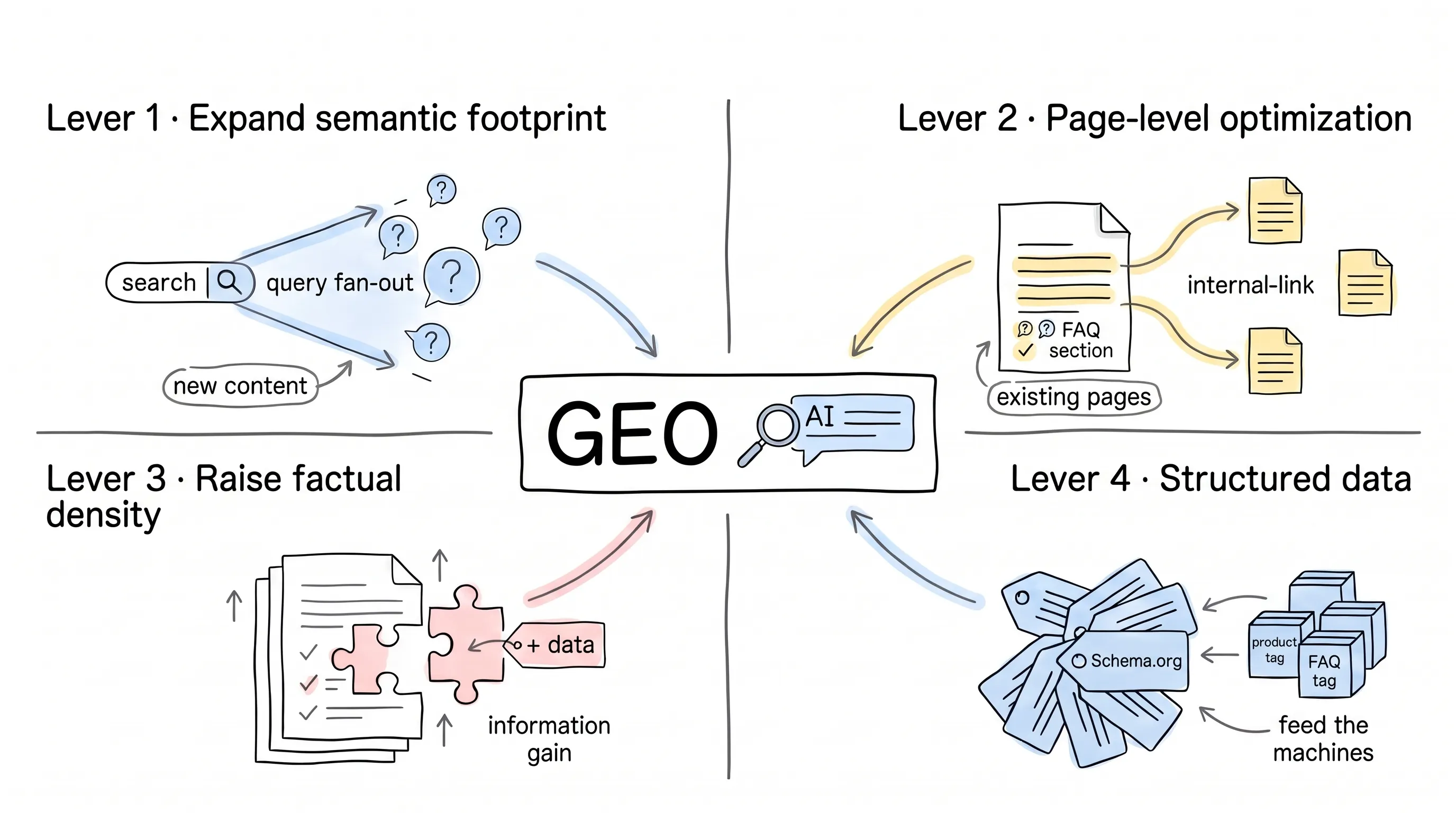
Lever 1: Expand the semantic footprint (new content)
What is query fan-out?
AI doesn't just match the exact sentence you searched. It splits one question into a dozen variations and fetches semantically similar content. Behind this is patent US11769017B1.
So the era of one keyword per page is over. You need to cover topic clusters, related entities, and adjacent questions.
How do you find these gaps?
With data, not guesswork. The toolchain looks roughly like this:
- Use Screaming Frog to crawl your own site's n-grams and bigrams — that's your existing semantic baseline.
- Find a competitor with more traffic than you and run the same analysis. The n-grams they have and you don't are your gaps.
- Analyze server logs for the ChatGPT-User agent, and you can see at a glance which pages are being cited by ChatGPT right now.
- Use Ahrefs to see which pages perform well in AI Overviews and which competitor pages are stronger.
- Use Bing Webmaster Tools' AI Performance report to see which pages are cited in Microsoft Copilot and Bing's AI summaries.
- Export these datasets as CSV, drop them into a ChatGPT project, and let it cluster, expand, and reverse-engineer the prompts real users would ask.
- Match each cluster against existing pages: optimize what fits, build new pages for what doesn't.
No Screaming Frog? Go Fish Digital released a free n-gram analysis Chrome extension worth trying.
One detail worth noting: for clustering and adjacent expansion, the machine gives you many candidates, but humans need to vet them. For the topic "cannabis industry SEO," adjacent topics like Dispensary SEO, CBD compliance, and local cannabis marketing are reasonable; but for "Shopify SEO," pulling out App integrations and Shopify speed optimization starts to drift off course. Data gives you the direction; the judgment is still yours.
Lever 2: Expand the semantic footprint (existing pages)
Building new content alone isn't enough. ChatGPT has a reranker called ret-rr-skysight-v3, and industry research has found that it clearly favors detailed, high-authority paragraphs over a few shallow lines.
What is page-level optimization? Adding FAQs, internal links, and structured sections to existing pages, writing every section so it's "worth being excerpted on its own."
The concrete approach: map each cluster to the closest page and tag it as one of three tiers — strong match, partial match, or no match.
Keep the strong matches. Build new pages for the no matches. Focus on the partial matches: those pages are one step away from being cited.
For each page, build a granular coverage matrix: break out the page's sub-questions, compare them one by one, and classify them as covered, needs deepening, or completely missing. Then fill the gaps: FAQs, definition boxes, comparison tables, pros and cons, exclusive data, glossaries — embed the schema, and finish with a freshness check.
Lever 3: Raise factual density (information gain)
What is information gain? It's a term Google's patent (WO2024064249A1) repeatedly emphasizes: AI prefers content that provides new, verifiable information that no one else has rather than repeating what already exists.
So your content needs data, citations, case studies, and original viewpoints.
How do you do it? Three steps:
- Find the queries and adjacent topics competitors cover that your pages don't — that's the information gain gap.
- Use Ahrefs or Go Fish Digital's Barracuda tool to analyze the passages cited in AI Overviews, and check whether your pages have equivalent paragraph-level answers. If not, fill them in following the structure of those passages: definitions, data-backed points, tables.
- Audit what competitors cite — research reports, government documents, .edu sources — these are high-authority grounding signals. You need citations of equal or greater strength.
Lever 4: Build out structured data
What is structured data? It's information that lets machines directly read your product, brand, and company.
ChatGPT parses content with lexical-aware retrieval, which corresponds to patent US9449105B1 and Google's MUM (Multitask Unified Model, a multimodal AI model). The clearer your structure, the more easily AI treats you as an authoritative source.
The core idea in one sentence: feed LLMs as much structured data as you can.
The concrete checklist:
- Audit your merchant feed: product images, prices, SKUs, inventory, business hours, address, coordinates. Missing fields are AI blind spots.
- Audit Schema.org: products (Product, Offer, Review), organizations (Organization, LocalBusiness, Place), and content (FAQPage, HowTo, Article, Dataset). Validate with Google Rich Results Test.
- Align knowledge graph entities: company name, brand name, product categories, locations, services — keep them consistent.
- Don't just feed text — put images, videos, and multimedia in there too. MUM is multimodal, and visual content can be cited by AI answers as well.
- Structured data isn't "set it and forget it." Expired SKUs, broken images, and stale information all drag down grounding.
Does all this actually work? Look at the numbers
Honestly, these numbers deserve a close look.
A marketing agency called Go Fish Digital ran this whole playbook on its own website: prompt mapping, competitor benchmarking, fact-dense content, and query fan-out expansion. The results: AI-driven traffic up 43% month over month, AI referral conversions up 83.33% month over month, and AI leads converting at 25 times the rate of traditional search leads.
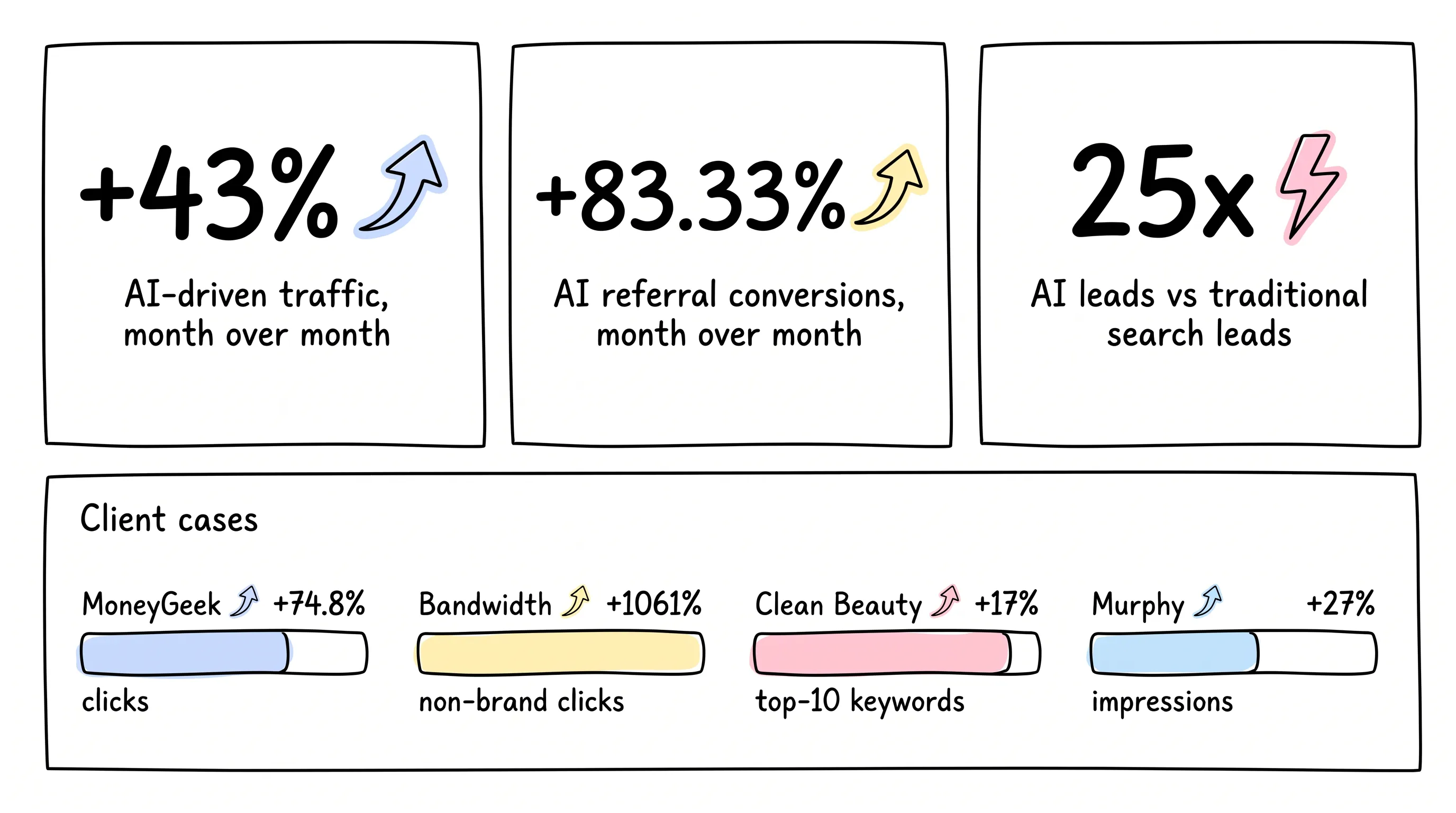
Twenty-five times. Read it again.
Client cases tell the same story:
| Case | Strategy | Results |
|---|---|---|
| MoneyGeek | Semantic mapping, entity alignment, internal links across 4,000+ pages | +74.8% clicks, +50.6% impressions |
| Bandwidth | High-intent non-brand optimization tied to demand generation | +1061% YoY non-brand clicks, +691% impressions |
| Clean Beauty Collective | Technical SEO, topical relevance, Barracuda insights | +17% top-10 keywords, +48% SERP feature visibility |
| Murphy & Prachthauser | Semantic optimization, Digital PR, authority building | +27% impressions, +23% new users, +21% sessions |
Notice a pattern? Behind all of these numbers is the same thing: content organized around buyer prompts, not around keywords.
Finally, a real-world question: where is GEO's biggest gap right now?
At the prompt layer.
Traditional SEO has rankings and impressions — you can see where you place. GEO? You don't know which prompts will surface your content.
Inside AI systems, you're a black box.
What to do? For now, visibility can only be pieced together from log analysis, semantic analysis, and AIO tracking. That covers part of it, but enterprise-level needs are giving rise to dedicated data tools and custom workflows.
Until dedicated tools arrive, logs plus semantic analysis plus AIO tracking is the closest you'll get to the full picture.
Oh, one more heads-up: if you want to run the demo above yourself, note that it uses a small dataset (blog against blog). For enterprise-scale websites, the same approach can be handled with scripts — at higher data volumes, ChatGPT will choke.
How do you measure whether GEO is working?
Watch these metrics: AI referral traffic, citation counts, prompt coverage, AI visibility rate, assisted conversions, form fills, demo bookings, proposal requests, MQLs, and conversation-to-conversion rate.
Will GEO change?
Yes. AI adoption and user behavior are both evolving, and the questions people ask are getting longer, deeper, and more task-oriented.
But the underlying requirement won't change: rich enough semantics, hard enough facts.
And there's a plain, simple logic underneath it all: AI can only cite content that has already been published and structured. Unpublished content is invisible to AI. So content is the foundation of GEO, not an optional extra.
Wrapping up
Back to the question we started with: when a user asks AI "which vendor is worth choosing," is your name in the answer?
If the answer is no, then the four levers we covered today — semantic footprint, page-level optimization, factual density, and structured data — are your starting point.
Start by feeding AI something it has never been fed before. And here's to seeing you in AI's answers soon.
Continue reading
Related articles

It's 2026: Stop "Buying" AI Tools for Your Marketing Team — Start "Hiring" AI Agents
This learn article explains how AI agents differ from standalone AI tools in marketing, outlines three agent categories — build-your-own platforms, CRM-native agents, and vertical tools — and covers use cases across SEO, social media, advertising, and reporting, plus criteria for choosing one.

What Is GEO? How Your Brand Gets "Mentioned" in the Age of AI Search
An explainer on GEO (Generative Engine Optimization) for e-commerce and DTC brands: how it differs from SEO and AEO, why AI answers shape brand visibility, and eight practices covering question-focused content, consistent brand messaging, structured pages, external evidence, comparisons, and AI mention tracking.

AI Is Already Making Decisions for Your Customers. Are You on the List?
A learn article explains GEO (Generative Engine Optimization): why AI-generated answers now shape which brands customers see, and how SEO fundamentals, entity clarity, citable evidence, and monthly measurement affect visibility in AI answers.