
The Closer Content Sits to the Customer, the More a Human Should Write It
A learn article introducing a Human-AI Content Connection framework that layers marketing content by trust impact and assigns human versus AI roles across four workflow steps. It argues that content closest to customer relationships should be written by humans.
A while back, a friend who runs a B2B business told me something that left him rattled for a long time.
It was the end of the year, and he wanted to write a holiday greeting to his clients. Someone taught him a prompt: wish them a happy holiday, have your family send greetings to theirs, say this year was great, list three of our proudest achievements, and close with the line: "nothing matters more than your success." The output looked good. He changed a word or two and sent it out.
And the result? His most important client replied: this letter was written by AI, wasn't it?
She already knew the answer.
Think about why she asked. Because the letter was too "perfect" — perfectly mass-produced. By the second line, something in her gut had already started to sound the alarm. By the time she asked the question, a hairline crack had already run through that relationship.
Later I figured out one thing: when a client asks "did AI write this?", the answer no longer matters. What matters is that she has started to suspect the letter was never really meant for her.
Marketing, at Its Core, Is Trust
Let's be blunt about this.
Marketing communications run through every stage of the customer relationship. Every touchpoint either deposits into the trust account or withdraws from it. The thicker the trust, the steadier the relationship, the longer the business.
These days, AI's efficiency is genuinely tempting. But the vast majority of companies are just getting started with human-AI collaboration: they bank efficiency in the short term and fail to accumulate trust in the long run. Earning efficiency is easy. Accumulating trust is hard.
So you need a charter. That's what the Human-AI Content Connection framework is for: rebalancing the strengths and weaknesses of humans and AI — taking efficiency in the short term, banking trust in the long term.
How does it rebalance? It starts by layering content, then breaks the process into steps.
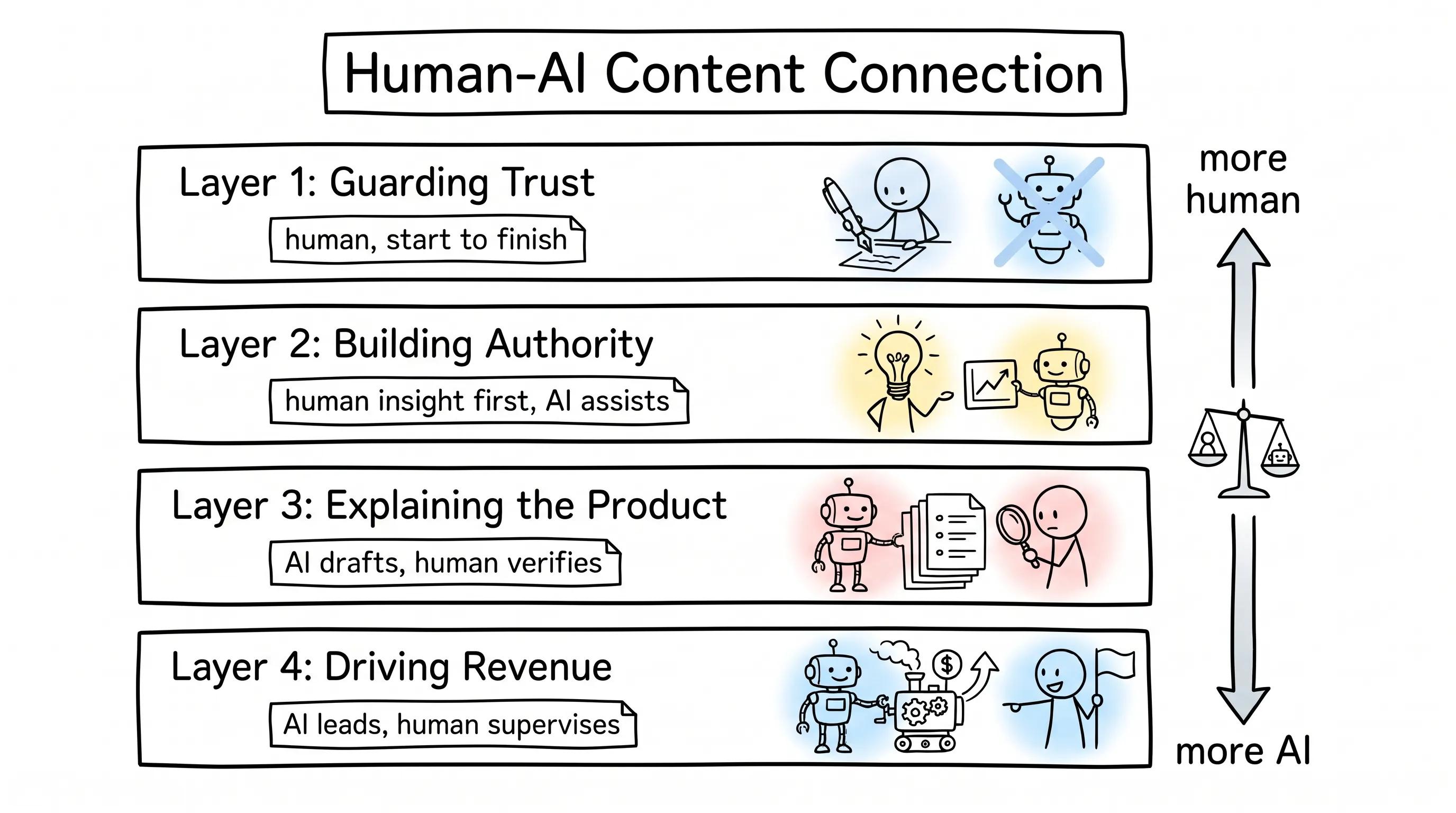
The standard comes down to one sentence: the more a piece of content affects customer trust, the more a human should call the shots; the more transactional, repetitive, and scale-driven it is, the more valuable AI becomes.
Content Comes in Four Layers, Each with Its Own Rule
What are the four layers? Let me walk you through them one by one.
Layer One: Guarding Trust
Executive letters written by hand, thank-you notes, top-level communication with key clients. This is person-to-person correspondence.
This kind of content must be written by a human, start to finish. Why? Because real money is at stake. AI can assist, but the final product must not carry any trace of AI. Even a hint of it, and readers will sense a template instead of sincerity. In an established relationship, that's what betrayal feels like.
Layer Two: Building Authority
Thought leadership content. Viewpoints, interpretations, analysis, judgment.
AI can help analyze and help express. AI's ability to produce explanatory charts and visuals is genuinely strong. But the original insight must come from a human first. When it comes to opinions, everything AI gives you is someone else's.
Layer Three: Explaining the Product
Manuals, tutorials, training, troubleshooting, release notes. Content that helps customers use the product well.
This kind of content is time-sensitive and high-volume, which makes AI a perfect fit: setting context, drafting first versions — all the process work goes to it. But there's a landmine: hallucination. A spec that AI confidently invents, published on the official website, becomes a brand incident. So the rule is hard: every fact and figure must be verified line by line by a human before publishing.
Layer Four: Driving Revenue
Sales communication. The kind with a call to action: outreach, follow-ups, nurturing, proposals, cross-selling, payment reminders.
Humans own supervision and judgment; AI owns analysis and optimization, pushing recent conversions up. At this layer, AI delivers results the fastest.
The Process Comes in Four Steps, Each with a Different Mix
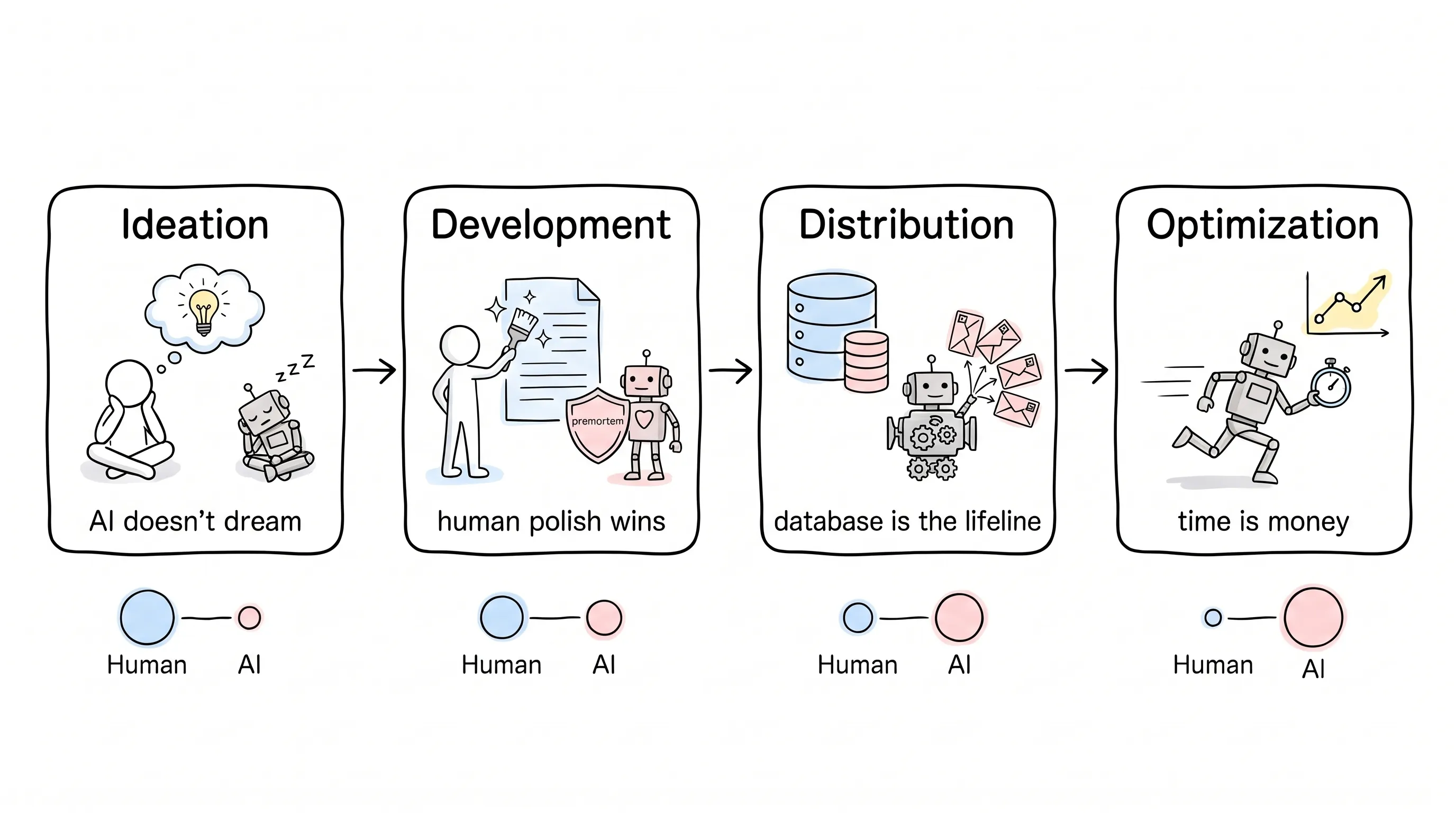
The same piece of content, from idea to publication, also passes through four steps: ideation, development, distribution, optimization. How much of each step should be human and how much AI differs step by step — and it's not a fixed rule; adjust it to the content's intent.
Ideation: AI Doesn't Dream
Ideation is the most important step, and often the hardest. If it doesn't feel hard, you're probably not doing it right.
What is ideation? It's coming up with the core concept that can move a customer, and articulating it clearly. What does that depend on? On complex human experience: association, doubt, curiosity, scrutiny that gets closer with each pass — until it crystallizes into a concept that feels both fresh and familiar to the customer.
AI? AI can analyze data in an instant, deliver a high-scoring answer based on existing content at astonishing speed, and optimize in real time. (AI never sleeps. But AI doesn't dream either.)
That's the fundamental difference. AI excels at answers that already exist; humans are responsible for ideas no one has seen.
Development: When You Care, You Win
Development is turning the idea into something publishable. AI has a very handy use case here: premortem (stress-testing a plan before you act), which helps you flag conclusions and recommendations that don't hold up.
But here's the interesting part: many of your competitors hand development entirely to AI and give it a quick glance before publishing. Go the other way — do a genuinely human-led polish — and you stand out.
Don't be afraid of seeming odd. Put your passion into it. Passion is contagious.
Distribution: The Database Is the Lifeline
At the distribution step, the most important asset is the database. If the contact details are wrong, the best content never reaches the customer. The math is clear: don't skimp a single cent on accuracy.
Then, let AI act as the engine, segmenting the database by communication style — who to reach out to, and how.
Optimization: Time Is Money
At the optimization stage, AI's contribution is the largest. It analyzes performance fast, offers recommendations, makes adjustments, helps you find prospects matching the ideal customer profile, and then, with increasingly precise content, moves them forward step by step. Especially for revenue-driving content, time is money — and AI is in its element here.
The Higher the Stakes, the More You Need a Real Human
Compress the whole framework into one sentence: the closer content sits to the customer relationship, the more it should read like a human wrote it.
For the trivial, highly repetitive work, hand it to AI generously and save your human hours. But anything that touches trust? A human must stand on the front line.
So, back to that holiday greeting. The problem wasn't whether AI wrote it well. The problem was that you used it in the wrong place.
That letter, from start to finish, should have been written by you.
Even if it's clumsy. Even if it rambles.
Clumsy, at least, is real. AI can save you time, but it can't carry trust for you.
Continue reading
Related articles

What Is AI Marketing Automation? It Starts With a 40-Point Gap
A learn article explaining what AI marketing automation is: how learning-based systems differ from rule-based automation, how AI decisioning optimizes message, channel, and timing choices, what data it depends on, and where it applies across the customer lifecycle.

Marketing Automation Is Shifting from "You Do It" to "You Say It"
This article explains how marketing automation is shifting from rule-based platforms that merely execute toward AI agents that plan, create, publish, and review campaigns, covering delegable tasks, underlying technologies, tool categories, adoption steps, and risks such as privacy and automating without strategy.

Rankings Are Taking a Dive, Customers Are Sprinting Ahead: This November, I Re-Ran the Numbers on AI Search
A learn article on how AI search reshapes marketing measurement, covering reported mismatches between rank-tracking tools and live Google results, ChatGPT's business profile test, single-page visitors as high-intent leads, and CRO plus GA4 tracking verification practices.