
The New Question Facing Multi-Location Brands: Will AI Recommend You?
A data-backed guide to how AI platforms recommend local businesses, covering survey findings on rising AI visibility, the impact of ratings and review counts, key citation sources such as Google Maps and Yelp, and four steps for multi-location brands to improve their chances of being recommended.
A few days ago, I asked AI to recommend a coffee shop near me.
It gave me a list of 10. As I scrolled through them one by one, a question suddenly hit me: why these 10?
Is your store, your brand, on that list of 10?
This one is worth chewing on.
SOCi's Local Discovery Index survey found that 52% of American consumers use AI tools at least once a month to find local restaurants, stores, and service providers. A year ago, that number was only 9%.
Nearly 6x growth in a single year.
Why is it climbing so fast? Because the role of tools like ChatGPT and Gemini has changed — from "the thing that writes your weekly reports" to "the one you ask for directions." On top of that, Google built AI Overviews into its search results page and outfitted Google Maps with Gemini-powered Ask Maps (that happened earlier this year), so it's only natural that people now turn to AI and ask for answers outright.
If you run a local business today, whether AI recommends you is no longer a bonus — it's the entry ticket.
So what makes AI recommend you? That's a tricky one. The algorithms of traditional search engines can, in theory, still be reverse-engineered and largely dissected by the industry. AI can't be. It makes millions of probability judgments inside a black box, and no one can say exactly how any single one was computed.
But there's always a way around: look at the outputs and find the correlations. With enough data in hand, it becomes obvious which factors strongly correlate with "showing up on the list over and over."
SOCi did exactly that.
How Do You Test It? Ask the Dumbest Question
SOCi's method is wonderfully dumb, and surprisingly effective: just ask — "Please recommend 10 businesses of type X in market Y."
That's the whole prompt.
Why 10? Because AI normally serves you only 3 to 5. Asking for 10 specifically lets you split the rankings into three tiers: those in the top 5 are "likely to be recommended"; those ranked 6 to 10 are "at risk of falling off the list"; those beyond rank 10 are simply labeled "invisible."
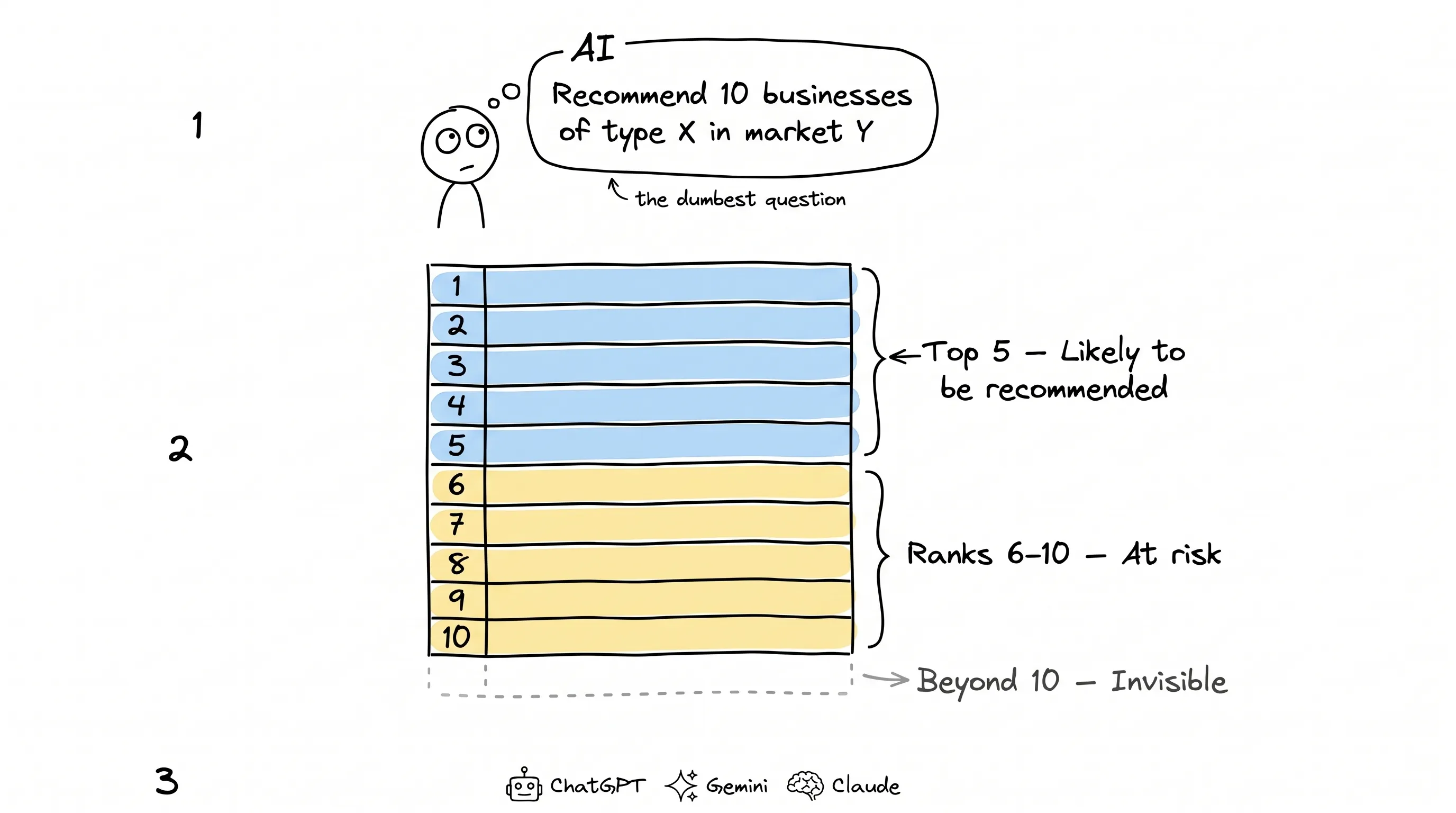
If you can't crack the list even with the simplest possible question, longer and more elaborate prompts will leave you even further out.
They tested ChatGPT, Gemini, and Claude — the three platforms with the largest user bases. Gemini also stood in for Google AI Overviews, AI Mode, and Ask Maps, since they're all driven by it underneath. The scale of the data: roughly 3,000 US multi-location brands across 44 industries, 3 million local queries run, and 1.4 million unique source URLs captured.
Finding 1: AI Has Caught Up with Traditional Search
The January 2026 edition of the Local Visibility Index showed: brands appeared in the Google local 3-pack (the three highlighted business listings at the top of local search results) 35.9% of the time, and made the first page of Yelp 37.1% of the time. The same year, the average visibility of those same brands on AI platforms? Only 7%.
Ten months later, average AI visibility has climbed to 36.1%.
AI is quietly taking over traditional search's territory piece by piece.
The gap between industries is sizable. They split the brands into five major categories: AI visibility was highest for Retail and Local Services, lowest for Property Management and Food & Beverage, with Financial Services in the middle. Interestingly, this ranking largely lines up with how those categories perform in traditional search.
In other words, the AI landscape is looking more and more like the traditional search landscape.
Finding 2: Ratings and Review Counts Make or Break You
When AI recommends you, it looks at two things about you: your star rating and your review count.
Ratings first. Among brands ranked in the top 5 (likely to be recommended), the average rating was: Gemini 4.32 stars, ChatGPT 4.24 stars, Claude 4.22 stars. Among brands ranked 6 to 10 (at risk of falling off the list), the average rating dropped straight to around 4.0 stars.
And across the whole dataset, ratings decline linearly with rank — there's no cliff between rank 5 and rank 10, just a steady slide.
A 0.2-star gap is the gap between the front row and falling behind.
But review counts can claw that back. This is where their math comes in:
If your rating is 0.2 stars lower than a competitor's, you need only 4% more reviews than they have to catch up on ChatGPT; 14% on Claude; and on Gemini? A full 64%.
One platform weights ratings more heavily; another weights review count more. In other words, AI uses review count to gauge how reliable your rating is — a 4.0-star rating backed by 100,000 reviews carries high confidence; a 4.0-star rating with only 3 reviews is basically noise.
So "work on ratings and review counts together" — it sounds like old advice, but the data now actually backs it up.
Finding 3: Whoever Gets Cited, Wins
When AI answers local questions, it doesn't rely on memorization — it relies on grounding (anchoring answers in verified source data) plus web search. All three major platforms now ground local information, supplemented by web search.
The foundation is still Google Maps. Claude uses the Google Places API. ChatGPT, while it has been reported to access Google data through third parties as well, counts Yelp as its most important local data partner.
Google Maps and Yelp are the two powerhouse sources of AI's local answers.
In third place come business websites. Especially the location landing pages that multi-location brands build for each individual store — the page that says "what this store offers and where it is."
So how do you measure the weight of these sources? SOCi used two metrics: breadth (how many brands have been cited by that source) and depth (how many locations that source covers). Google Maps, business websites, and Yelp — the three major sources — cover nearly all brands and nearly all locations. Some sources are more industry-specific: Apartments.com is a fixture in the apartment management industry, while Bankbranchlocator.com shows up in banking circles.
Then there's a category of "shared cross-industry territory": Yellowpages, Facebook, BBB.org. AI will go check these, but often can't find complete profiles.
The gap is right here — and so is the opportunity.
Their earlier analysis found that roughly half of US brands have at least one location without a Facebook storefront page. That means completing and fully fleshing out profiles for every location could, by itself, be a relative competitive advantage.
Want to Win? Four Moves
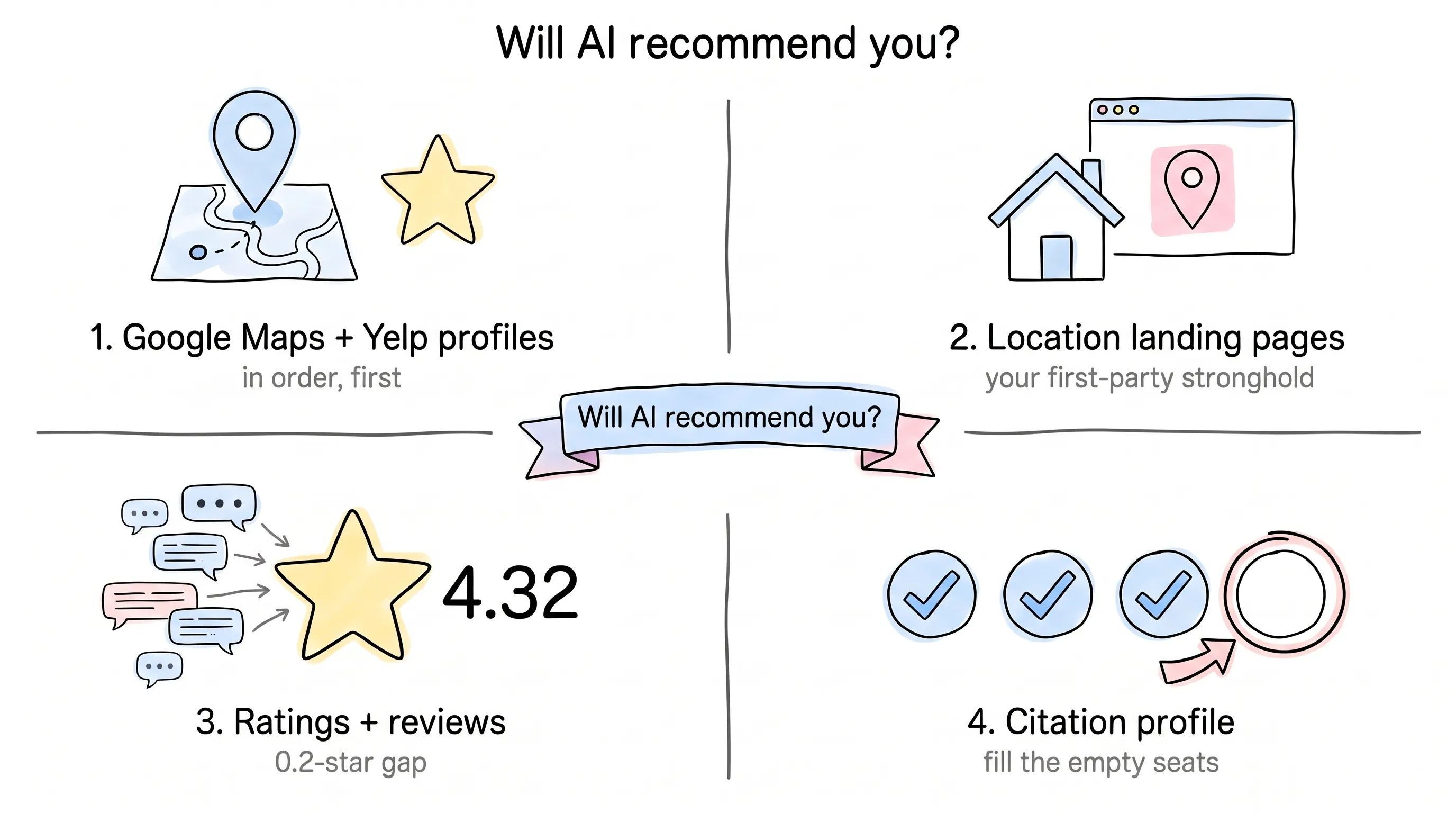
One: get your Google Maps and Yelp profiles fully in order first.
Two: treat your own website and every location landing page as a core asset — and run it that way.
Don't rely on third-party platforms to score you. Your website is your first-party stronghold — you can build far more semantic relevance there than on any third-party platform. That's exactly what makes it key to establishing your brand entity (a distinct, recognizable entity that search engines and AI can identify) and distinguishing each location.
Three: push your rating up and keep your reviews rolling in.
Four: study your own "citation profile."
When AI answers a local question, it typically cites 3 to 6 sources. Once you've sorted out the most important platforms, look at your citation profile: which sources do your competitors occupy while your position isn't covered? Filling the seats nobody else has claimed is your most cost-effective AI visibility gain.
One Last Line
AI models keep iterating, and tomorrow's playbook may not be the same as today's. But the question "will AI recommend you?" has already moved from nice-to-have to existential.
Is your store on that list of 10? Worth checking today.
Continue reading
Related articles

It's 2026: Stop "Buying" AI Tools for Your Marketing Team — Start "Hiring" AI Agents
This learn article explains how AI agents differ from standalone AI tools in marketing, outlines three agent categories — build-your-own platforms, CRM-native agents, and vertical tools — and covers use cases across SEO, social media, advertising, and reporting, plus criteria for choosing one.

What Is GEO? How Your Brand Gets "Mentioned" in the Age of AI Search
An explainer on GEO (Generative Engine Optimization) for e-commerce and DTC brands: how it differs from SEO and AEO, why AI answers shape brand visibility, and eight practices covering question-focused content, consistent brand messaging, structured pages, external evidence, comparisons, and AI mention tracking.

AI Is Already Making Decisions for Your Customers. Are You on the List?
A learn article explains GEO (Generative Engine Optimization): why AI-generated answers now shape which brands customers see, and how SEO fundamentals, entity clarity, citable evidence, and monthly measurement affect visibility in AI answers.