
AI Marketing Daily · 2026-10-30
AI Marketing Daily for 2026-10-30: ChatGPT's new ad placements with a hedge-test plan, Kantar survey data on marketer AI budgets versus consumer trust, and multiple AI marketing tool roundups covering selection criteria and AI visibility monitoring.
Today in one line: ChatGPT's ad slots are officially on marketers' pitch lists, and this week's data is a reminder that consumer trust in AI recommendations hasn't caught up with the budgets. Tool roundups take up half of today's ranking — selection anxiety is now the industry's default state. The headline gives you a test plan you can run this week; the tools section maps the entire 2026 selection landscape in one pass.
🎯 Today's Headline
ChatGPT ads are open for business: don't move budgets yet, run a hedge test first
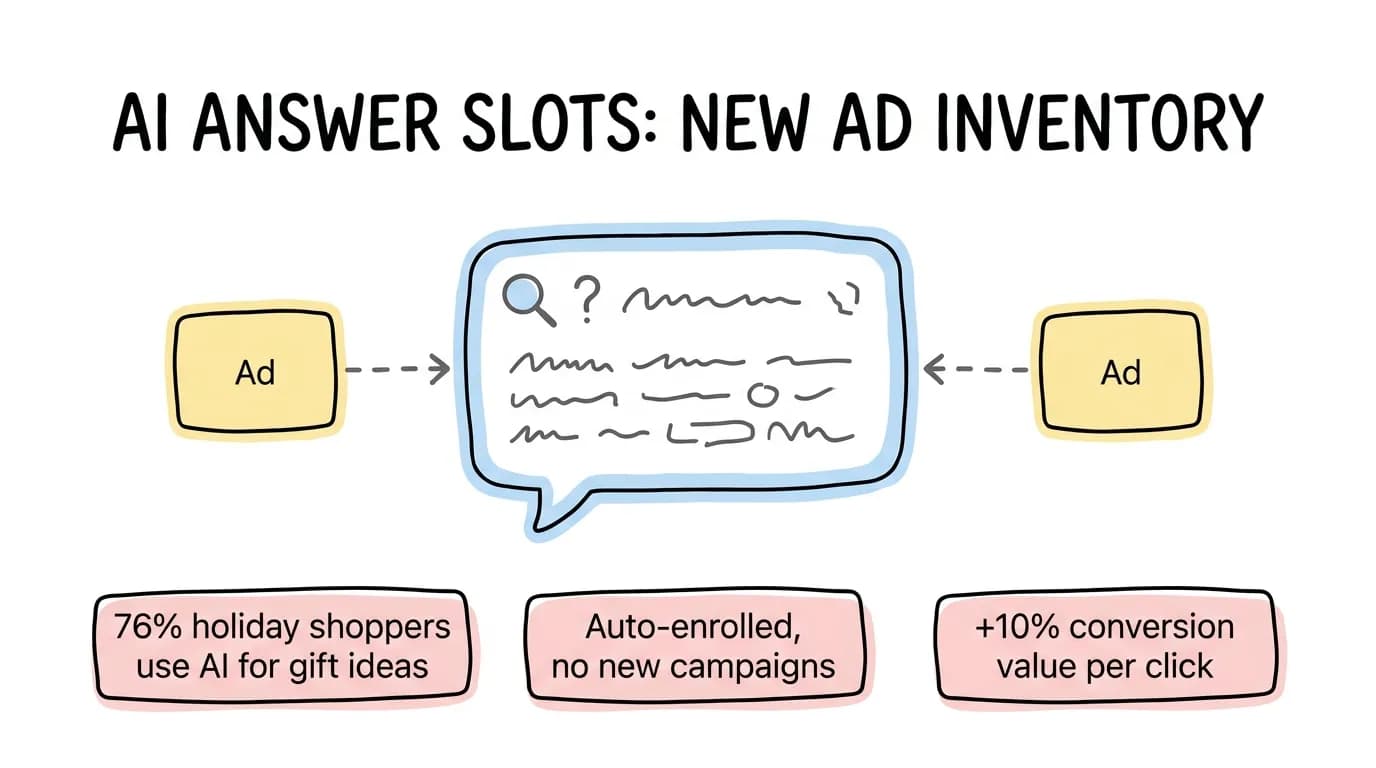
What happened. ChatGPT has started showing ads to regular users: placements appear below relevant answers, clearly labeled as sponsored, with an ad unit that includes the advertiser's name, logo, headline, short description, landing page, and image. Two gates matter most: ads serve only on Free and Go plans — Plus, Pro, and Business subscribers and users under 18 never see them — and on October 5 OpenAI announced a new visual ad format, to be tested first inside image generation. A new distribution channel has taken shape, and a freshly published practitioner's guide breaks ChatGPT ads against Google Search ads across five dimensions: buying logic, control, creative format, measurement and attribution, and audience coverage.
Why it matters. For two decades, search-ad budgeting rested on one assumption: users type keywords, and you bid to buy that intent. ChatGPT ads break the first half of that assumption. There is no keyword auction — ads are matched to conversational context, and impressions are not guaranteed. The "front door" of traffic moves from the search box to the conversation, and no amount of bidding guarantees your brand shows up in any specific dialogue. For B2B and high-ticket categories that live on search-intent capture, this is the first time a rival of real scale has taken a seat next to Google's search share.
What it means for marketers. By role: media buyers now maintain an entirely different buying logic — keyword research and negative lists are useless on the ChatGPT side, replaced by answer quality and contextual matching. Creatives face a much narrower unit: Google responsive search ads let you feed 15 headlines and 4 descriptions for the system to mix, while the ChatGPT unit carries a single headline and description, so the margin for trial-and-error shrinks and one weak ad has no understudy. Analysts will find that Google's conversion attribution machinery has run for over twenty years, with data-driven attribution splitting credit down to individual clicks, while measurement on the ChatGPT side is still in its infancy — short-term comparisons tilt toward Google by default. Brand teams face a new exposure: an ad inside an AI answer gets judged as part of the answer, and off-key brand voice does more damage there than in a feed. And one easily missed detail: paying subscribers are exactly the higher-purchasing-power cohort — and they never see ChatGPT ads, which materially shapes the channel's audience profile.
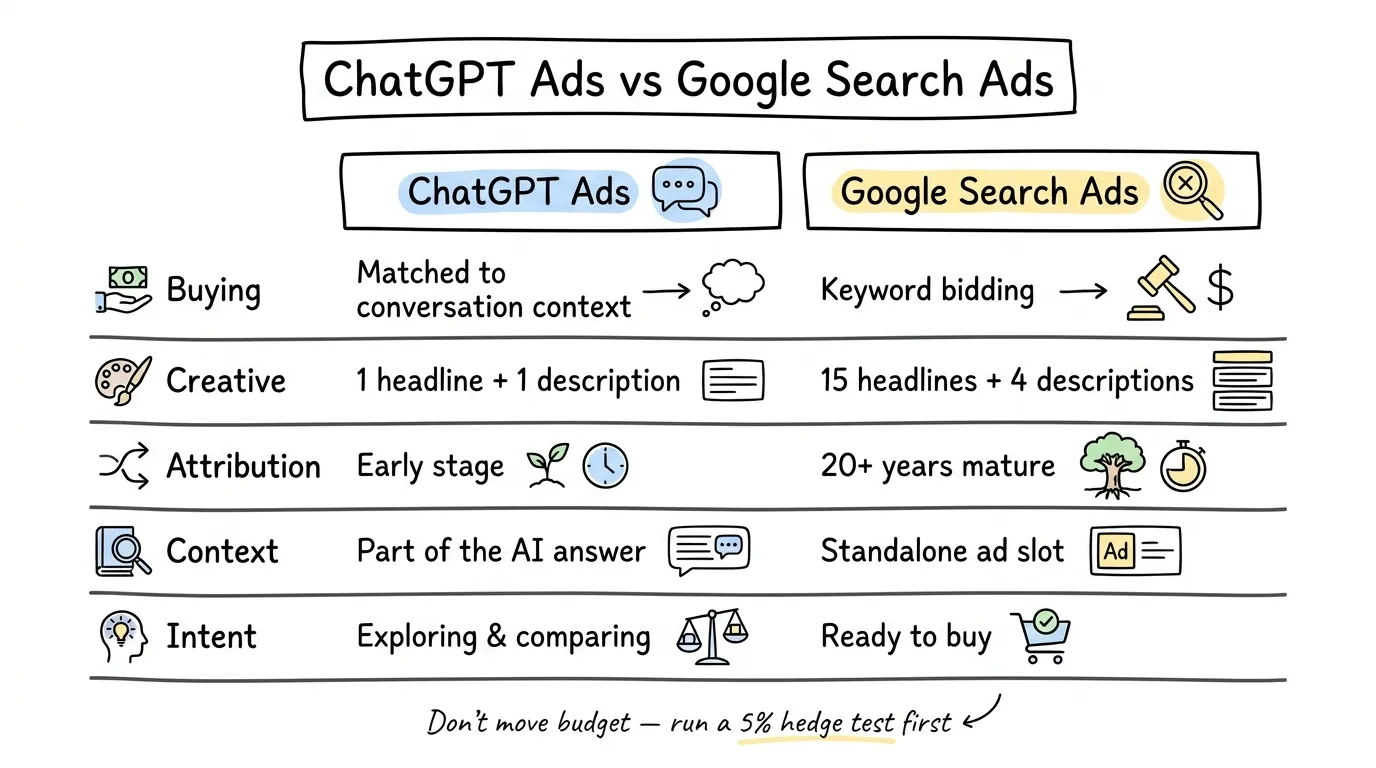
How to use this. Here's a hedge test you can start this week. First, don't move budget — carve out a small experimental allocation (cap it near 5% of total search budget) and freeze the main account's budget and bidding so the two datasets stay clean. Second, align the design on both ends: same product, same landing pages, same conversion goal; run standard search campaigns on Google while ChatGPT creative is written around conversational scenarios, each side with its own UTM and conversion events. Third, switch the creative axis: not a slogan but something that reads like a helpful answer — open by naming the problem the user is trying to solve, keep the landing page consistent with the ad's promise, and show the product or its result in the image. Fourth, compare only relative values: CPM and cost per conversion, never absolute scale — the reachable audiences differ too much for volume comparisons to mean anything. Fifth, set a review checkpoint at four to six weeks before deciding whether to scale, with one manual check-in per week so premature optimization doesn't muddy the sample.
My take. The biggest value of this shift isn't a verdict on ChatGPT ads — it's that it forces every media team to build "intent capture" and "scenario matching" as two separate capabilities. Intent capture competes on keyword assets and bidding efficiency; scenario matching competes on answer quality and content assets; they demand different org muscles and vendor ecosystems. The data is still thin, and whoever builds the test infrastructure first will be a quarter ahead when the channel scales. Conversely, teams parking all search budget on Google aren't at risk today — they're at risk the day the platform order flips. One middle-of-the-road view worth keeping: these channels aren't zero-sum. Google keeps absorbing explicit, high-intent demand while ChatGPT absorbs exploratory, ambiguous demand; the real question isn't either-or, it's how you split budget ratio and creative systems between the two.
🔗 Further reading: Read the full article
🏷 Industry Data
Kantar's annual mega-study: marketers pile into AI while consumers hold back their trust
Kantar has released its Media Reactions 2026 study, built on interviews with more than 800 senior marketers and 23,000 consumers. Put side by side, the numbers have real tension: nearly two-thirds of marketers expect generative AI to play a pivotal role in brand recommendations, and three-quarters plan to increase AI-assistant spending in 2027. On the consumer side, though, only 32% use AI assistants to research brands and products, and just 23% actually trust their recommendations. Marketer confidence is slipping at the same time: only 57% believe their organization's media mix is right (down from 64% in 2025), and just half are confident they've struck the right balance between brand-building and performance marketing. Kantar's LIFT+ data offers some comfort: between 2020 and 2025, 43% of campaign performance came from channels working together, far above the 18% before 2014. Kantar's leadership puts it plainly: brands must now earn recommendations from both people and machines, and the answer is better intelligence, not more data.
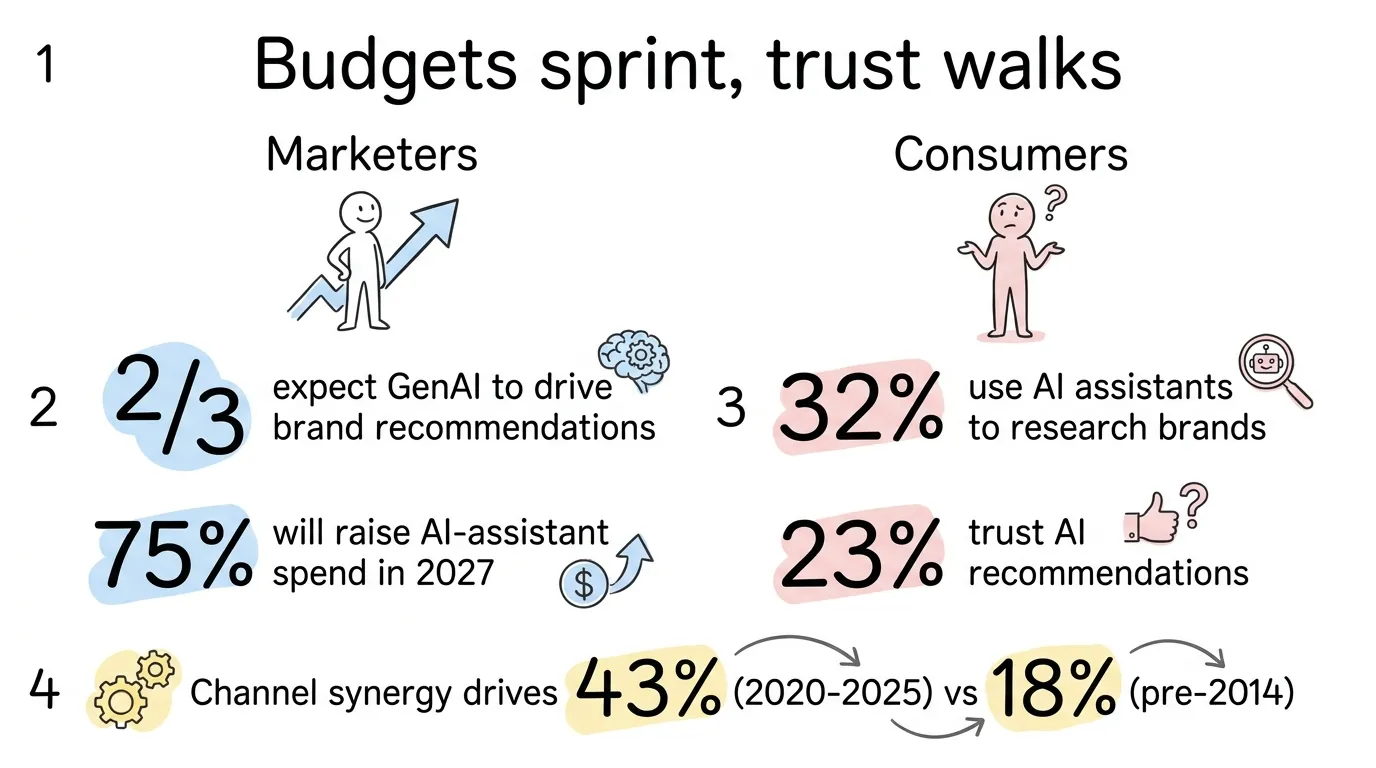
💬 How marketers can use this: This dataset works best as guardrails for internal budget conversations. When you ask leadership for AI-channel budget, put the 23% trust figure on the table and pair it with a small-scale testing plan plus measurement metrics — that builds more trust than asking for scale on instinct. Also bank the 43% channel-synergy stat: whenever you evaluate any single channel, apply a synergy coefficient, and never veto a channel that's actually playing an assist role based on isolated ROI. And one inverse use of the same data: the 57% confidence gap in media mix means even top advertisers are feeling their way forward — which makes today the cheapest moment to experiment. Once peers standardize the playbook, entry prices and competitive density will double. Internally, set up a standing AI-channel trust funnel: keep one number for each of the four layers — exposure, click, research, trust — and review migration trends quarterly rather than absolute values.
🔗 Further reading: Read the full article
🏷 Playbooks
Zeta unpacks 8 advanced AI use cases: from writing copy to making decisions
A newly published advanced guide tiers AI marketing use cases by maturity: if your AI only writes copy, drafts subject lines, and summarizes reports, it's still an efficiency tool; real growth comes from moving AI into the decision layer. The guide details 8 concrete use cases with deployment conditions. Predictive churn intervention comes first: customers don't leave suddenly — falling interaction frequency and slowing response times are early signals — and a model built on engagement signals, purchase cadence, and channel-touch history predicts 60-day churn probability, ranking interventions by expected retention lift and ROI. Next is next-best-action decisioning across the full lifecycle: no longer pushing "the next message" but orchestrating globally across acquisition, retention, and win-back. The guide also cites industry data: fewer than one in four marketers has fully integrated martech and adtech systems, which makes cross-channel incrementality measurement nearly impossible.
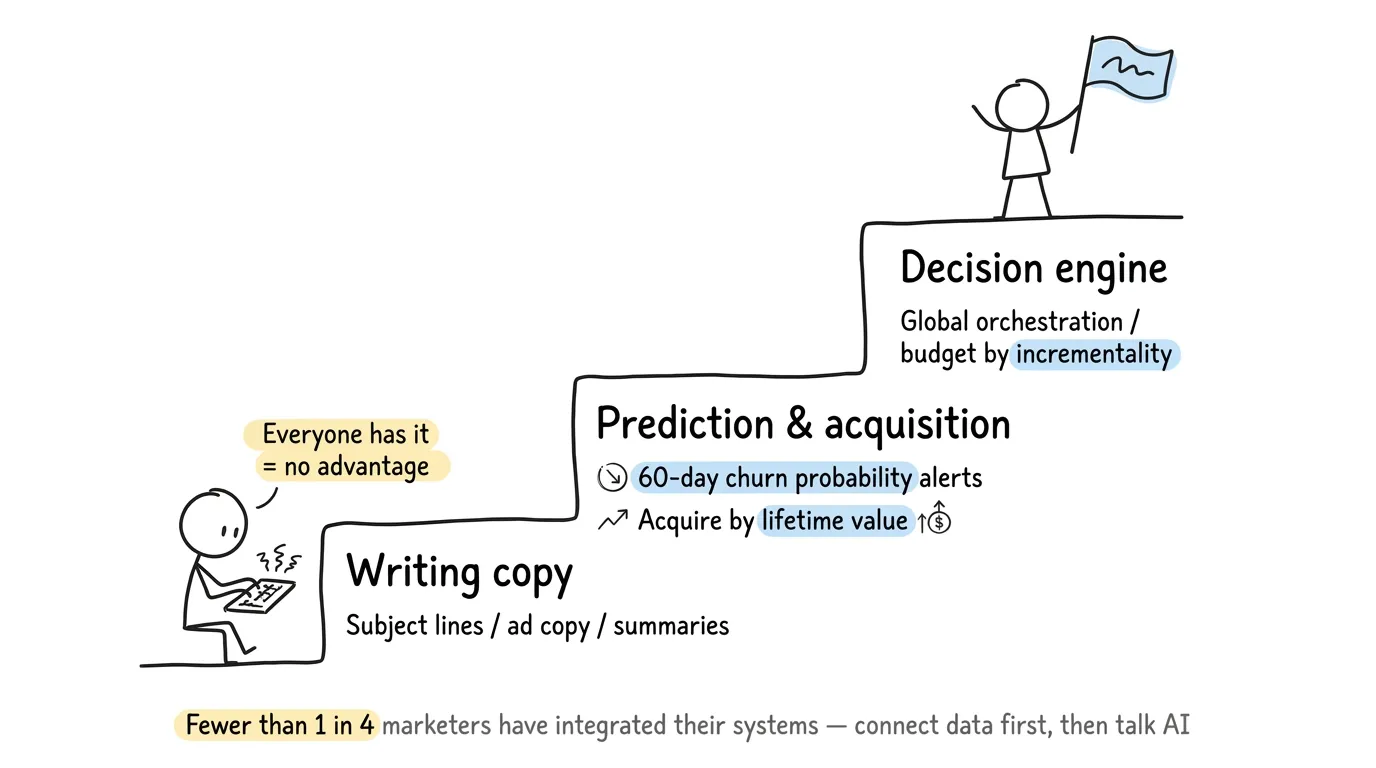
💬 How marketers can use this: Don't chase all eight — pick one and go deep. Subscription or high-repeat businesses should start with predictive churn: feed existing CRM interaction history to the model for a baseline and you'll have a churn-watch list within four weeks. The most common failure isn't the model; it's data scattered across five systems nobody connected — spend a week consolidating data before talking AI. Give second priority to profit-based budget allocation: shift from channel egalitarianism to allocating by predicted profit. It's usually the fastest-paying of all the use cases because it needs no new data, only a new algorithm looking at existing data. For every use case, set explicit acceptance criteria up front — accuracy of the churn-watch list, retention cost of interventions — and cut losses on anything that can't produce numbers.
🔗 Further reading: Read the full article
An operating ledger for AI-transformed customer journeys: what personalization actually converts
A long-read on AI and customer experience offers quotable quantified ranges: companies that have integrated AI into CX strategy report roughly 40% improvement in customer satisfaction and about 35% gains in operational efficiency; AI-driven personalization can deliver 20–30% conversion lifts. There are three operational levers: dynamic content generated and swapped in real time based on behavior; product recommendations ranked on historical behavior and preferences; personalized journeys stitched together by predicting the next best action at every touchpoint. The piece stresses that machine learning, real-time behavioral tracking, and content-system integration work as a combination punch — deploying any single layer in isolation produces nothing.
💬 How marketers can use this: Don't paste those three numbers into KPIs — they're industry ranges, not promises. The sturdier move is an A/B test on your existing touchpoints: split the same audience between static and dynamic content, run two weeks, and get the real lift range for your own book before deciding how much compute to commit to full-journey personalization. On sequencing, start with recommendation slots: product or content recommendations are the easiest touchpoints to quantify, then extend into dynamic content and journey orchestration, carrying each step's experimental data into the next — avoid the big-bang relaunch.
🔗 Further reading: Read the full article
🏷 Marketing Tools
Annual field test of AI content tools: AI-visibility monitoring becomes its own category
A just-updated field test of content-marketing AI tools opens with two baseline numbers: 93% of companies already use generative AI to accelerate content production, and 52% use it to produce text, images, and video. The most notable signal in the list is a new category taking shape: AI visibility monitoring. Brandi AI tracks a brand's visibility and competitive share of voice inside AI answers; HubSpot bundles visibility data with AEO (answer engine optimization) recommendations and the tooling to act on them. Another cluster centers on content reuse: Riverside automatically splits a single recording into multi-channel content, while StoryChief and Jasper handle distribution and creation.
💬 How marketers can use this: If nobody on your team owns "can you be found inside AI," assign it this week. Step one needs no purchase: manually ask the ten highest-frequency questions in your industry across mainstream AI assistants, record how often your brand appears and how often competitors do — that baseline table alone can carry next quarter's AEO budget request. Add one more move: for the three questions where your brand never showed up, audit your content structure — usually you're missing directly quotable factual sentences and clearly titled product pages. And put the reuse line to work at the same time: feed a customer interview or a livestream recording into a repurposing tool and split it into short-video scripts, social posts, and email paragraphs. One batch of raw material, five channels — the fastest-payback lever a content team has.
🔗 Further reading: Read the full article
16 AI marketing tools grouped by function: your first selection map
A guide updated in early October sorts 16 mainstream AI marketing tools into five functional groups: content and copywriting (Jasper, Copy.ai, Anyword, Claude); visuals and video (Canva, HeyGen, Sora); SEO and strategy (Surfer, MarketMuse, Profound); automation and social (Gumloop, Sprout Social, Manychat, HubSpot); and personalization (Clay, Mutiny). Selection criteria compress into six: integration capability, ease of use, scalability, output transparency, predictable pricing, and data-security compliance. The guide's sharpest warning: the most common procurement mistake is comparing feature checklists instead of shopping against the breakpoints in your existing workflow.
💬 How marketers can use this: Use this five-group map as an inventory sheet, not a shopping list. Mark which groups your current tools already cover — the blank groups are your real capability gaps. For the first time, AEO tooling sits beside traditional SEO tools in the strategy group; if you haven't tried an answer-engine monitor like Profound, that's the lowest-cost catch-up entry. Procurement order matters too: close the gaps in automation and social first, then consider personalization — the former pays back fast with low trial-and-error cost, while the latter depends on data quality and turns half-built if you rush it. One more signal worth reading: Claude listed inside the content-and-copywriting group means general-purpose LLMs now hold a permanent seat in the marketing tool lineup, and managing your team's prompt assets should be on the agenda.
🔗 Further reading: Read the full article
New selection standard for 2026: not who generates fastest, but who plugs into your system
A 2026 tool survey makes a clean judgment: the era of the standalone generator is over. AI tool value now measures on five words: speed, relevance, consistency, insight, execution. Product by product: ChatGPT remains the most flexible starting point for unstructured ideation, drafting, and research synthesis. HubSpot's Breeze wins by living inside the CRM platform — content production and lead tracking share one dataset, and campaigns plug straight into the sales pipeline. Jasper's value isn't creativity but brand consistency, holding tone and messaging steady at scale. Canva AI solves everyday creative throughput for lean teams, turning prompts directly into editable designs. The guide's conclusion: the best tool is the one that embeds into your existing working system, not the one that generates best.
💬 How marketers can use this: Score your current stack against those five words and find the lowest score. For most teams the weak items are "consistency" and "execution" — the first is patched by brand-governance tools like Jasper, the second by CRM integration. Fix the weak points before chasing new tools and you'll save at least half your selection time. Add one hard gate to the process: any new tool must plug into your existing workflow and complete one full loop within two weeks; if it can't, shelve it no matter how good it looks. That gate is what keeps "stunning demo, painful deployment" tools out — and it's the single biggest difference between 2026 selection and previous years.
🔗 Further reading: Read the full article
The 8-tool SaaS ads automation kit: match by team size
A review built for SaaS teams covers 8 ad-automation tools, each pinned to its best-fit scenario: Optmyzr leads on Google Ads automation; Madgicx goes deep on Meta; Adext AI runs cross-platform audience testing; Albert serves enterprise-level campaigns; Bïrch excels at rules-based social automation; Opteo suits lean teams; Smartly.io merges creative automation and media optimization into one pipeline; Trapica targets self-serve advertisers. The most useful part of the review is the caution list: one Meta-only tool with opaque pricing and trial billing terms worth reading carefully. The author's core method is matching tools to conversion volume: sales-led B2B converts too thinly for most AI optimizers to learn anything — rules-based automation is more reliable there.
💬 How marketers can use this: First count your real monthly conversions per channel. For channels converting fewer than a few dozen orders a month, don't buy AI optimization — spend the money growing sample size instead. Teams above a thousand conversions per month should read this list and pick by primary channel, avoiding double budgets for cross-platform features you'll never use. Copy the trial-terms diligence into your internal procurement handbook line by line — especially for tools where "pricing appears only inside the app"; negotiating room usually lives in the first phone call. Another transferable judgment is the channel-to-tool matching logic: sales-led teams concentrate budget on search-intent capture, where rules-based automation plus human review is enough; product-led teams with high conversion volume and short repeat cycles are the ones that should hand the keys to AI optimizers.
🔗 Further reading: Read the full article
An AI marketing framework from the DACH market: compliance and ROI before features
A guide for German-speaking marketing teams turns AI tool selection into a ten-step framework, and two choices are worth borrowing. First, data protection and compliance sit at the top of the selection criteria — every tool passes a GDPR gate before entering evaluation. Second, it defines an explicit ROI measurement framework: hours saved by automation, conversion lift from personalization, and churn reduction from predictive models are booked on three separate ledgers, so no single metric gets to judge the whole AI program. The workflow-platform comparison lays out selection logic for n8n, Zapier, and Make, tiered by team technical capability and budget flexibility.
💬 How marketers can use this: Even outside the DACH region, "compliance first" is the right order. For teams in China, the equivalent is moving data-transfer and privacy review to round one of selection. The three-ledger ROI method can drop straight into next quarter's AI budget table: hours saved, conversion lift, and churn reduction each get a baseline and a target, and year-end reporting stops relying on vibes. The three-way workflow-platform tiering also deploys directly: teams with weak engineering and standardized processes pick Zapier for peace of mind; complex processes without dedicated engineers find balance with Make; teams with technical resources and data-sovereignty concerns self-host n8n. Set this foundation before stacking AI applications on top — getting the order wrong makes rework expensive.
🔗 Further reading: Read the full article
A 50-tool panorama of AI marketing: 69% of marketers are already on the road
A continuously updated 50-tool panorama opens with two numbers: the AI market is projected to reach US$1.3 trillion by 2030, and 69.1% of marketers have already woven AI into daily work. The list groups tools by working scenario — content creation, photo and video editing, SEO, lead generation and email marketing, site building and landing pages, social media management — with representative tools and fit stages per group. The value here isn't novelty but completeness: it works as a tool dictionary. Whenever a new need appears, check here first for an existing AI option before deciding to build or buy.
💬 How marketers can use this: Forward the list to the owner of every role and have each pick three tools tagged "useful for my work," then collect the forms after a week. This crowd-sourced filter beats a procurement meeting on efficiency and doubles as a temperature check on the team's real AI literacy. The second move after collection is cross-validation: tools picked by two people go to pilot first, single-pick tools wait and watch — a fifty-item long tail converges into three to five real candidates, and the selection cycle shrinks from months to weeks.
🔗 Further reading: Read the full article
Mining Reddit for real-world reputation: a tool-review method worth copying
One tool review takes a different route from every other ranking: beyond hands-on testing of 30+ tools, it mined hundreds of genuine marketer discussions on Reddit as scoring evidence, weighted across five criteria — ease of use 20%, feature depth 25%, output quality 25%, value for money 15%, and use-case fit 15%. The detail pages carry immediately usable facts — Jasper's Creator plan at $49/month with unlimited words and 50+ templates, Teams at $125/month, a direct pipe into Surfer's SEO scoring system, and trainable brand voice. The review also names a set of overhyped categories and warns against paying for features you won't use.
💬 How marketers can use this: The dual-source method itself — official review plus community reputation — is copyable. Before purchasing any tool, spend 20 minutes searching Reddit and industry communities for negative feedback, focusing on billing disputes and data-migration complaints: those two categories expose hidden costs earliest. The scoring weights are worth borrowing for an internal scorecard; most teams underweight output quality and end up with fully-featured tools that produce unusable output. Then institutionalize the community signal: a fixed quarterly sweep of tool discussions in industry communities catches shifts earlier than any review newsletter subscription.
🔗 Further reading: Read the full article
15 tools compared by function: a one-stop table from content to attribution
Another function-by-function comparison table covers 15 tools across six functions — content, email, advertising, attribution, video, paid media — with each entry marked for what it does, who it fits, and what it costs. What separates it from common rankings is the "attribution" group most lists skip, and the practice of writing a buyer profile into every entry: what small teams should use, what mid-size and large enterprises should avoid, at a glance. One trend the list underlines: attribution and multi-touch measurement tools are moving from enterprise-exclusive to standard equipment for mid-size teams.
💬 How marketers can use this: Go straight to the attribution group. If your team still credits channels on last click, any multi-touch attribution tool in this table immediately improves decision quality. Start with a free tier running two months of real data, verify integration depth with your CRM, then consider paid plans. Don't skip the buyer-profile section either: line up your team size against the recommended tier and you'll often discover you bought oversized — paying enterprise-tier prices for a three-to-five-person team is the most common and most silent budget leak.
🔗 Further reading: Read the full article
💡 Today's Big Picture
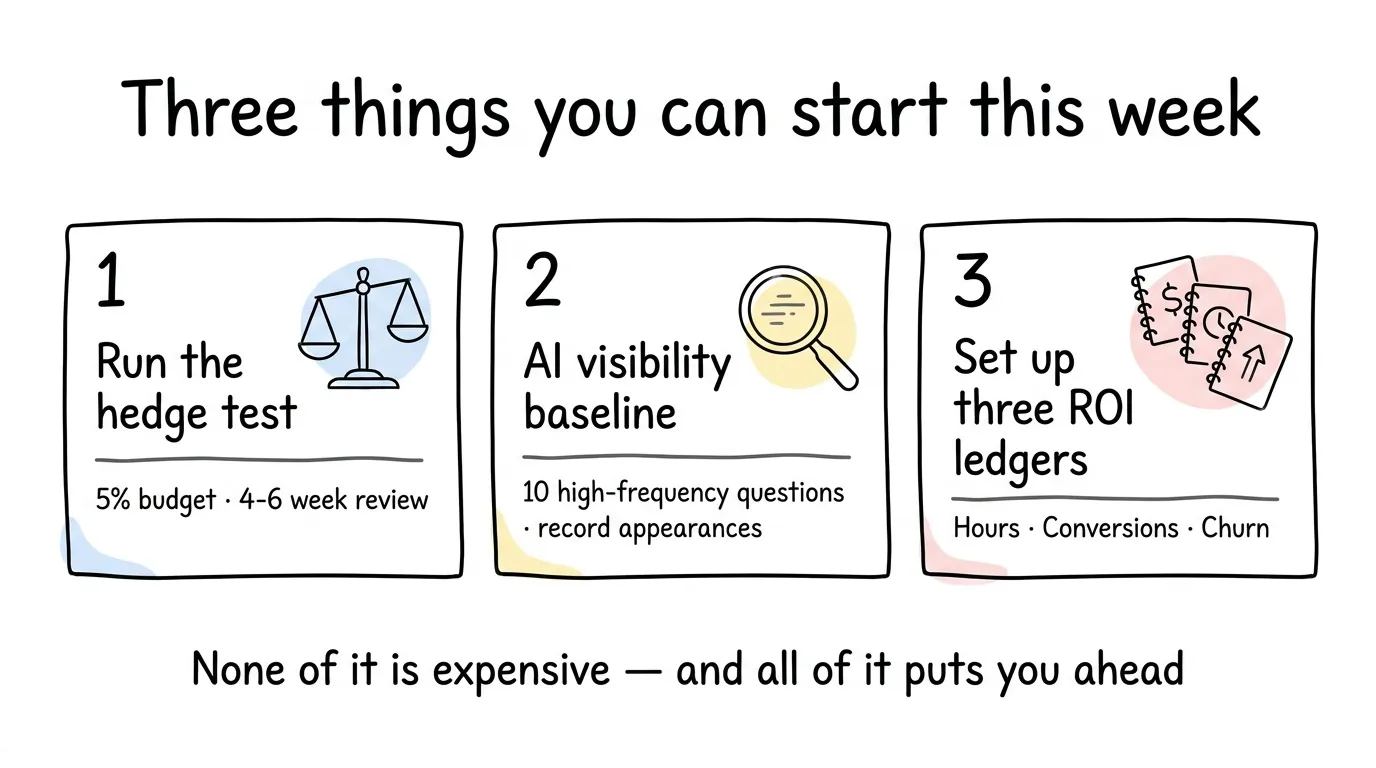
Read today's 12 items together and one storyline emerges: AI marketing is moving from the "adopt or not" phase into the "are you using it right" phase. The headline's ChatGPT ads open a new distribution entrance, but Kantar's data says consumer trust-building is far behind the budget expansion — a 23% trust rate means most AI-channel spend buys "placeholder" today, not "conversion." That scissors gap is the backdrop for everything else this week. Eight tool roundups landing on one day looks repetitive but points at one structural shift: the selection bar has moved from "what can it generate" to "what can it plug into and what can it measure" — five of the eight lists put integration and measurement criteria in their top tier, evidence the market has already been burned once by demo-driven purchasing. The two playbook items complete the other half of the puzzle: as channels multiply and single-touch attribution gets harder, the deciding factor is decision-layer AI — models that choose the next action, not write the next sentence. Fit the three threads together and you get a complete action frame: open small-scale experiments on new entrances, converge your tool list by integration and measurement standards, and upgrade AI from a content tool into a decision tool — each independent, each amplifying the others. Today's to-do list: launch the small-scale ChatGPT hedge test, assign someone the AI-visibility baseline audit, and put your existing AI projects on the three-ledger ROI system. None of the three costs much — and all three put you ahead of the majority.
Continue reading
Related articles
AI Marketing Daily · 2026-11-22
AI Marketing Daily for 2026-11-22 rounds up 20 items led by Microsoft opening Bing AI Overviews to ads and Google expanding AI Mode ads to ten countries, plus GEO guides, ad automation delegation guidance, AI Overviews CTR data, and a legal-risk checklist for AI-generated creative.
AI Marketing Daily · 2026-11-21
A November 21, 2026 AI-marketing daily covering AI search visibility, GEO methods, Google AI Mode ads expanding to ten countries, Meta's pre-Black Friday changes, agentic shopping, and industry adoption and ROI data.
AI Marketing Daily · 2026-11-20
AI Marketing Daily for 2026-11-20 rounds up 19 items centered on measurement: OpenAI's ChatGPT Business Hub dashboard, EU rules for agent-mediated purchasing, Meta pausing four AI terms, and B2B data on shortlists and the dark funnel, each with action advice.