
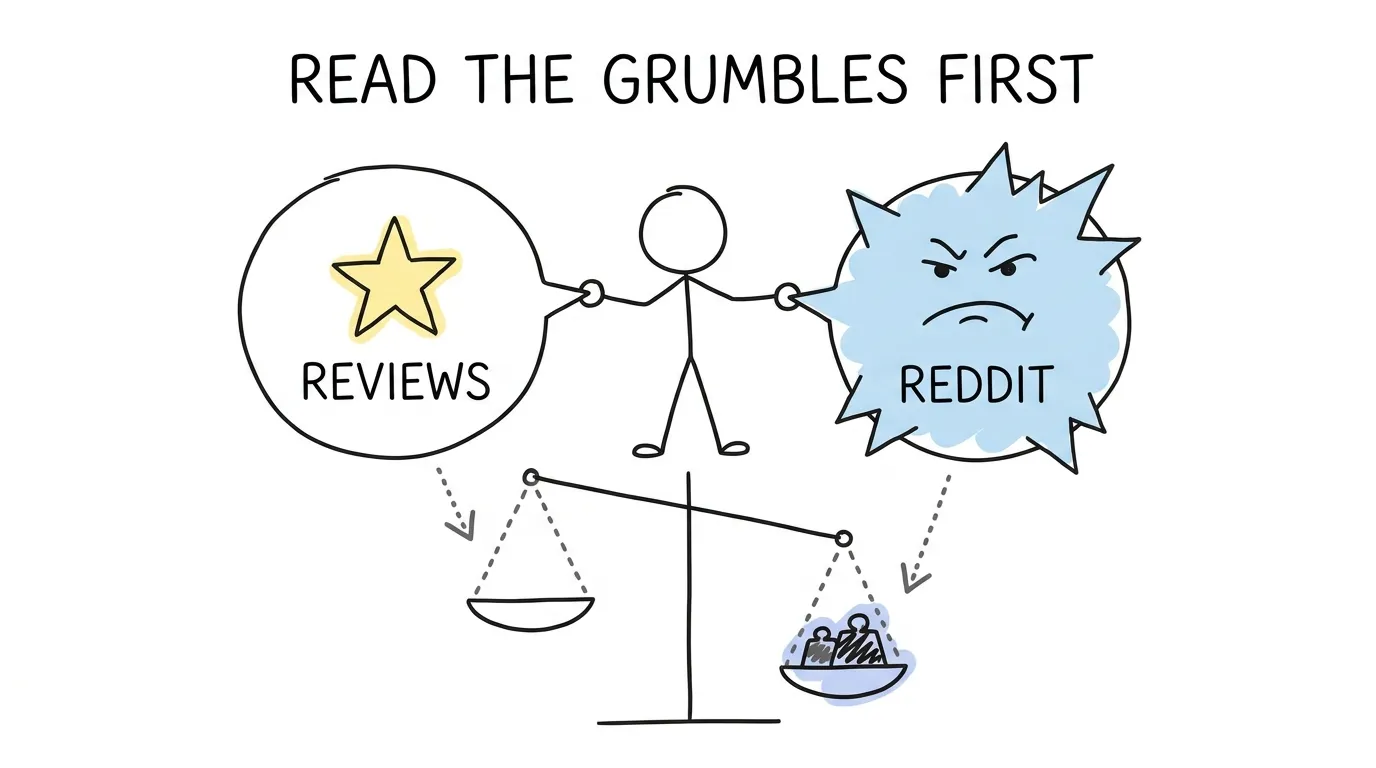
Before you buy a tool, search Reddit for its bad reviews first
A learn article on AI marketing tool procurement argues that vendor demos miss real-world flaws, and recommends checking Reddit user complaints about billing and data migration before buying. It also highlights a review method combining hands-on testing with community feedback and weighted scoring.
A friend of mine bought a hugely popular AI writing tool for his team last year.
The demo was thrilling. The feature list was flawless. The price fit the budget. Signed, paid, rolled out to everyone.
Three months later he was complaining: the features were all there, but the output was unusable — the tone drifted, facts needed manual fact-checking, and all the time saved went straight back into rework.
I asked: before you bought, did you search for what real users complained about?
He froze: no.
This may be the most common mistake in tool procurement: listening only to what the seller says, never to what users curse.
One: a review method that does it differently
A recent AI marketing tools review took an approach that caught my eye.
It layered two things.
The first, conventional: hands-on testing of more than 30 tools, run personally, noted one by one.
The second, unconventional: it mined hundreds of genuine marketer discussions on Reddit, treating both the praise and the complaints as scoring evidence.
Two sources — official and grassroots — checking each other.
Why is that step worth so much? Because even the most honest review is short-term and partial. Complaints in communities are feedback from users who paid real money for months: billing traps, data-migration pitfalls, the attitude of support teams. None of that ever appears in a demo.
Two: the scoring weights are worth stealing
Its dimensions and weights are also instructive:
Ease of use 20%. Feature depth 25%. Output quality 25%. Value for money 15%. Use-case fit 15%.
Notice two details.
Output quality ties feature depth for the top weight, a quarter each. Most internal scorecards do the opposite: feature rows multiply while output quality gets one perfunctory vote. The result is tools that are fully featured and unusable.
Use-case fit gets its own 15%, reminding you: there is no best tool, only the best tool for your scenario.
The details carry hard facts too. A leading writing assistant, for example: a Creator plan at $49 a month with unlimited words and 50+ templates; a Teams plan at $125; a direct pipe into an SEO scoring tool so drafts can be scored as you write; trainable brand voice that improves the more you feed it.
Facts you can compare beat adjectives a hundred to one.
Three: a 20-minute pre-purchase check
Compress the dual-source method into one action: before signing for any tool, spend 20 minutes searching community complaints.
Search for what? Two categories especially.
One: billing disputes. How the trial converts to paid, surprise usage bills, obstacles to canceling. Behind every such complaint is a hidden cost.
Two: data migration. Tools that are easy to enter and hard to leave hold your data hostage. Switching next year will be expensive.
Reviews won't tell you these things. Burned users will, in the community, in detail.
Read the complaints first, then the praise, and the tool's true face emerges.
Four: turn reputation into process
A single action is a technique. A fixed process is a capability.
Suggest a quarterly habit: once a quarter, sweep the tool discussions in your industry communities.
Two benefits. First, lead time — community sentiment always runs a quarter ahead of review newsletters; a tool's reputation inflection shows up first in user complaints. Second, authenticity — community comparisons are spontaneous, uncontaminated by business development.
Pair it with an internal scorecard that raises output quality to equal weight with features, and your selection quality takes a step change.
Five: my take
The tool market has a strange paradox: the more information exists, the harder the choice.
Because nearly all of it is information someone wants you to see.
Genuine user reputation is the only information the vendor doesn't produce.
Before any big purchase, hear how the users curse. Those five minutes may be the highest-ROI five minutes of your quarter.
May every purchase start with the bad reviews and end with the right fit.
Continue reading
Related articles

What Is an AI Marketing Agent? From "Using AI" to "Delegating to AI"
A learn article explaining what an AI marketing agent is, how it differs from rule-based automation, and which repetitive tasks such as lead qualification, reporting, and campaign monitoring can be delegated while humans keep key decisions.
If AI Can Write the Copy, What's Left for Social Media Marketers?
A long-form guide on how AI reshapes social media marketing work, covering content creation, advertising, listening, community management, and data interpretation. It argues that AI accelerates production while humans keep strategy, judgment, review, and accountability.
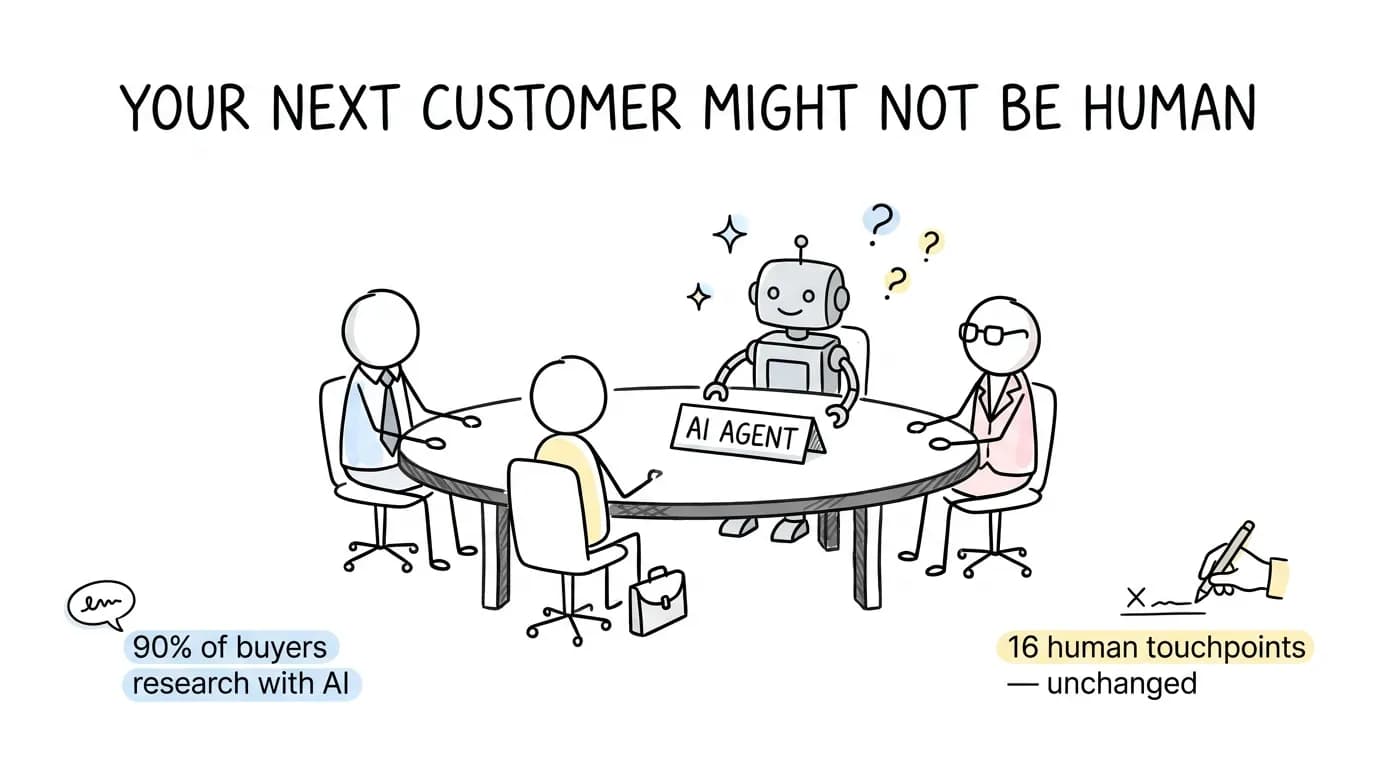
Your Next Customer Might Not Be Human: What Changes — and What Doesn't — in B2B Marketing, 2026
A long-form analysis of 2026 B2B marketing predictions covering AI agents joining buying decisions, visibility in AI answers, email filtering, trust, and first-party buying signals.