
A marketing guide from the DACH region — why the whole world should copy it
A commentary on a DACH-region AI marketing guide that places data-protection checks first in tool selection, splits AI returns into three ROI ledgers (hours saved, conversion lift, churn reduction), and compares n8n, Zapier, and Make for workflow automation.
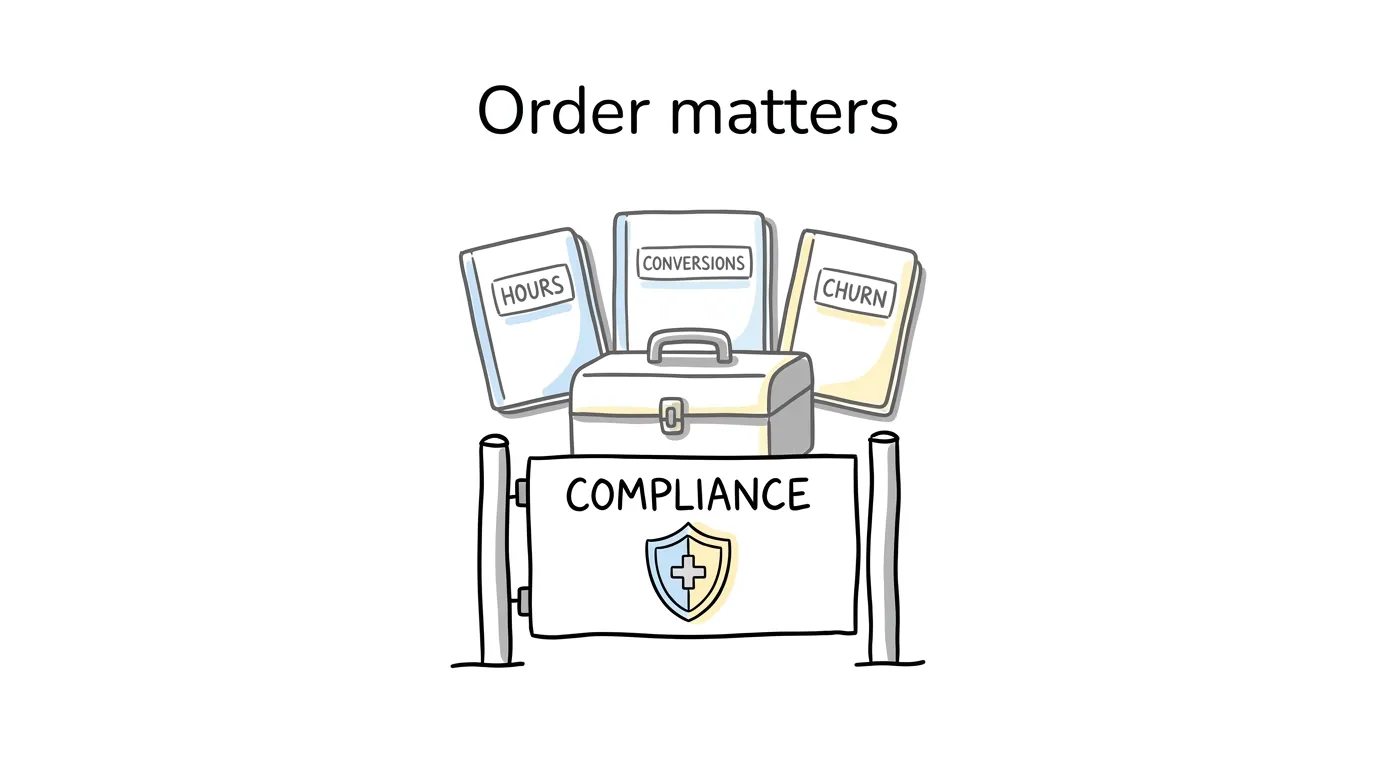
The DACH region. For most people the word summons one image: conservative.
Long processes, strict reviews, compliance before everything.
But here's what you may not have considered: on AI adoption, that "slowness" has produced the most solid path.
A recent guide built for marketing teams in the German-speaking market turns AI tool selection into a ten-step framework. After reading it, my takeaway is that two of its choices deserve to be copied worldwide.
One: the first choice — compliance goes in round one
How do most teams select tools? Features, price, a two-week trial, sign the contract. Compliance? Legal glances at it before signature.
This guide inverts the order: every tool passes the data-protection gate before entering evaluation.
GDPR is a hard constraint in the DACH region: where the data flows, where it's stored, whether it trains anything — all asked in round one.
Some will say that's slow.
It's actually the opposite. Picture two scenarios. In the first, the tool runs your business for a year before a compliance review finds a data-transfer problem. Now what? Tear it out, at enormous cost. In the second, non-compliant tools are filtered in round one. The loss? Two weeks of evaluation time.
Slow at the start so you're fast the whole way. That math always wins.
Two: the second choice — three ROI ledgers
The second thing worth copying is its ROI measurement framework.
How do most companies report AI projects? One sentence: "Efficiency improved." Push once — improved by how much, coming from where? Nobody can say.
The guide's fix: split AI's returns into three separate ledgers.
Ledger one: hours saved. Automation replacing human hours, converted at hourly cost.
Ledger two: conversion lift. The increment from personalization, evidenced by A/B experiments.
Ledger three: churn reduction. Customers retained by predictive models, valued at customer lifetime value.
Three ledgers, each with a baseline, each with a target, each accounting for itself.
Why separate them? Because blended numbers become fog. At year-end review, the phrase "efficiency improved" can neither defend a project nor justify a budget. Once the ledgers are split, which use case makes money and which burns it is plain to see.
Kills become defensible. Budgets become justifiable.
Three: a bonus — how to pick the workflow platform
The framework also includes a very practical comparison: n8n, Zapier, and Make — how to choose?
The tiering logic runs on two axes: team technical capability, and budget flexibility.
Standardized processes, no engineering resources: Zapier, for peace of mind — the connectors are all there, and onboarding is quick.
Complex processes without dedicated engineers: Make strikes the balance, with strong visual orchestration.
Technical resources plus data-sovereignty concerns: self-hosted n8n — the data never leaves, and the logic bends to your will.
Memorize this tiering. The workflow platform is the foundation every AI application sits on; choose the foundation wrong and everything above it gets rebuilt.
Four: how to carry it to your own team
Three actions.
First, change the selection process. Move compliance and data security from "legal glances before signature" to "item one on the evaluation checklist." For teams in China, the equivalents are data-transfer and privacy clauses — with veto power.
Second, change the budget table. Next quarter's AI budget, organized as three ledgers: hours saved, conversion lift, churn reduction — each with a baseline and a target. Year-end reporting stops leaning on adjectives.
Third, set the foundation. Lock the workflow platform before stacking AI applications on top. Wrong order means expensive rework.
Five: my take
What inspires me most about this DACH guide isn't any single recommendation. It's a sense of order.
Compliance first. Separate ledgers. Foundation before floors.
All three are slow work — but systems built from slow work survive expansion.
Speed is a strategy. Slowness is a capability.
May your AI projects start life in the right order.
Continue reading
Related articles

What Is an AI Marketing Agent? From "Using AI" to "Delegating to AI"
A learn article explaining what an AI marketing agent is, how it differs from rule-based automation, and which repetitive tasks such as lead qualification, reporting, and campaign monitoring can be delegated while humans keep key decisions.

Marketing Automation Is Shifting from "You Do It" to "You Say It"
This article explains how marketing automation is shifting from rule-based platforms that merely execute toward AI agents that plan, create, publish, and review campaigns, covering delegable tasks, underlying technologies, tool categories, adoption steps, and risks such as privacy and automating without strategy.

When AI Does the Creative, Mistakes Come in Batches Too
A learn article on the risks of using generative AI for marketing creative across brand, legal, compliance, and operational layers, with case examples and seven practices for review, rights clearance, documentation, and vendor governance.