
69% of marketers are already on the road. What is your team waiting for?
A learn article reviewing a panorama of 50 AI marketing tools grouped by workflow, plus a three-step team filtering method for selecting candidates and assessing adoption.
Two numbers first.
Number one: 69.1% of marketers have already woven AI into their daily work.
Number two: the AI market is projected to reach US$1.3 trillion by 2030.
What does that mean? Two-thirds of your peers are already moving, with capital pushing from behind. A team still asking "should we use AI" isn't asking a new question anymore — it's asking an old one.
The real new question is:
How to use it, where to use it, and how much.
One: a 50-slot map of tools
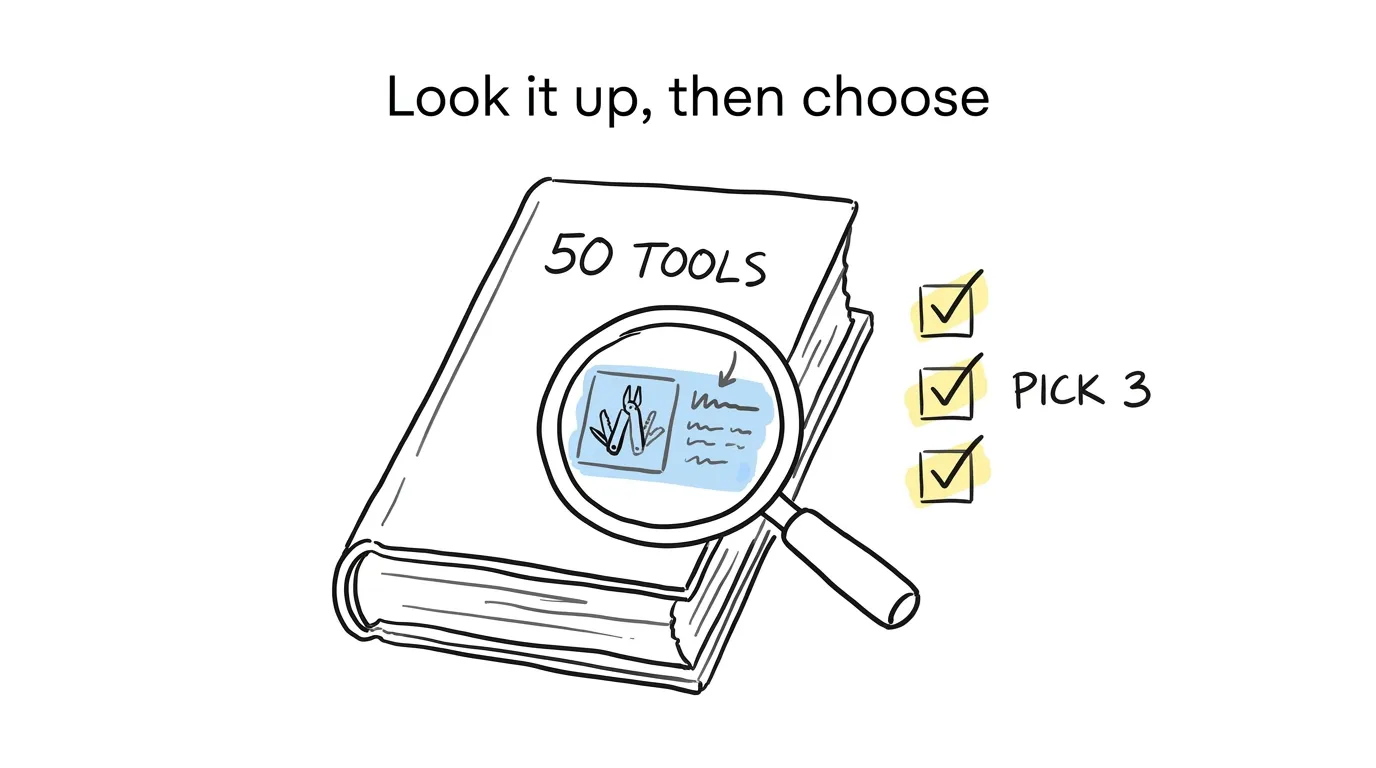
I recently went through a continuously updated panorama: 50 AI marketing tools, grouped by working scenario.
A content-creation group, from drafting to editing. A photo-and-video group: retouching, voice, asset generation. An SEO group: keywords, content optimization, answer engines. A lead-gen and email group. A site-and-landing-page group. A social-media-management group.
Each group lists representative tools, price tiers, and fit stages.
What won me over isn't novelty — it's completeness.
New-tool rankings appear weekly, and reading too many of them breeds anxiety, the feeling that everything requires spending. A panorama does the opposite: it tells you that 90% of the problems you'll ever meet already have an off-the-shelf AI solution.
What you lack isn't tools. It's the habit of consulting the dictionary.
Two: how to make a panorama actually useful
Lists like this usually die one way: bookmarked, then forgotten.
To make it work, change the usage. Here's a crowd-sourced filter, three steps.
Step one: split the list by group and hand each group to the owner of the matching role. Content people get the creation group; media buyers get the advertising-related groups; ecommerce gets site-building and landing pages.
Step two: each person marks three tools tagged "genuinely useful for my work." Collect the forms after a week.
Step three: cross-validate. Tools picked by two people go to pilot first; single-pick tools wait and watch.
A fifty-item long tail converges into three to five real candidates. The selection cycle shrinks from months to weeks.
The filter has a byproduct more valuable than the selection itself: it takes the temperature of your team's real AI literacy. Someone marking tools unrelated to their job needs training. Someone marking nothing hasn't started thinking.
Three: what the numbers don't say
Back to the two opening numbers.
$1.3 trillion is about money flowing in.
69.1% is about people already aboard.
But neither number says this: among those aboard, the ones using it well are the minority.
Adopting a tool is easy; producing results is hard. The same AI writing tool, in one pair of hands pads word counts, in another runs ten headline tests a day. The difference isn't the tool — it's whether the operator has a clear working standard.
So the phrase "we use AI" should be retired from team reporting, replaced by three sharper questions: used at which step? What was the baseline? How much did it improve?
Four: my take
A tool panorama is, in essence, a mirror.
Fifty tools reflect not the market's prosperity, but the breakpoints in your own workflow.
Demand-driven selection beats anxiety-driven hoarding.
Start today: split the list, collect the forms in a week, run the first pilot before month-end.
May your team work with the efficiency of the other 31%.
Continue reading
Related articles

It's 2026: Stop "Buying" AI Tools for Your Marketing Team — Start "Hiring" AI Agents
This learn article explains how AI agents differ from standalone AI tools in marketing, outlines three agent categories — build-your-own platforms, CRM-native agents, and vertical tools — and covers use cases across SEO, social media, advertising, and reporting, plus criteria for choosing one.

What Is GEO? How Your Brand Gets "Mentioned" in the Age of AI Search
An explainer on GEO (Generative Engine Optimization) for e-commerce and DTC brands: how it differs from SEO and AEO, why AI answers shape brand visibility, and eight practices covering question-focused content, consistent brand messaging, structured pages, external evidence, comparisons, and AI mention tracking.

AI Is Already Making Decisions for Your Customers. Are You on the List?
A learn article explains GEO (Generative Engine Optimization): why AI-generated answers now shape which brands customers see, and how SEO fundamentals, entity clarity, citable evidence, and monthly measurement affect visibility in AI answers.