
Your content is great. Unfortunately, the AI can't see it.
Everyone uses AI to produce content, yet most brands never appear in AI answers. This article explains why GEO — not SEO — now decides visibility, reviews tools that track AI share of voice, and shares a practical path: baseline testing, content audits, and repurposing workflows that win citations.
First, a question: over the past year, how many late nights did you put into content?
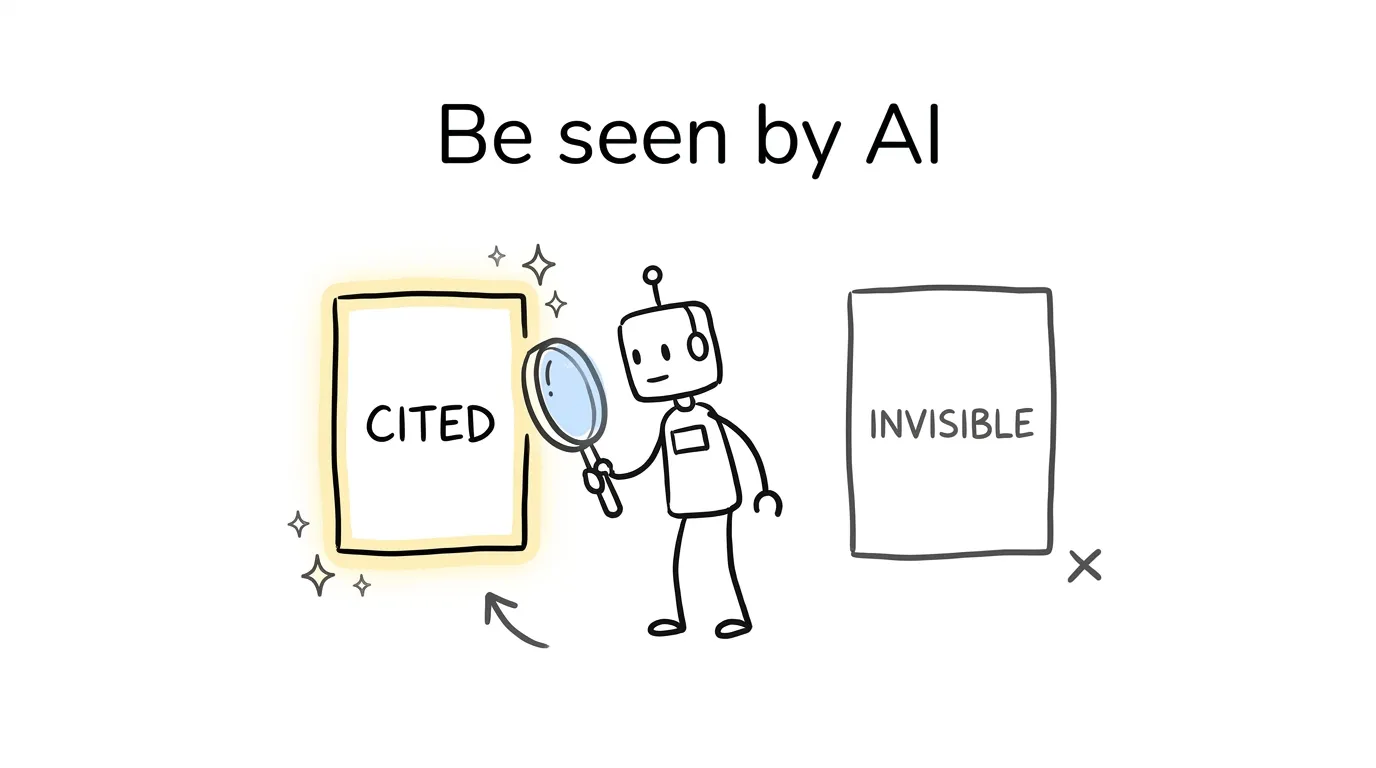
Writing, images, formatting, distribution — you didn't skip a single step. But if you ask ChatGPT, Gemini, or Perplexity "which brand is best in this category" — is your answer there?
Most likely, no.
That's today's most painful reality in content marketing: it's not that you didn't do the work well. It's that you did it for a place that is losing attention.
One: 93% are using it — so what?
Two numbers first.
93% of companies already use generative AI to accelerate content production. 52% use it to produce text, images, and video.
Those figures come from a global survey a couple of years back; today they'd only be higher.
When everyone uses it, what does it mean? It means "using AI to write content" carries zero competitive advantage by itself.
Like typing on a computer thirty years ago: once a skill, now just air.
So here's the question: when production is equal for everyone, where does advantage come from?
Two: the answer hides in a new question
Recently I went through a field-tested tools list, and the more I read, the clearer it became: this is a gear shift for content marketing.
The list covers five tools, and the one ranked first is a new species.
It doesn't write content for you. It answers a different question: what does your brand actually look like inside AI answers?
It does three things. First, it tracks your "AI share of voice": across real buyer-intent prompts, how often is your brand mentioned, cited, and positioned? Second, competitive benchmarking: what gets cited when the AI mentions your competitor, versus what gets cited for you. Third, it gives guidance for revising existing content so AI systems can interpret it, trust it, and cite it more easily.
It isn't cheap — starting at $349.99 a month, positioned for enterprises.
But look at the logic underneath: the old SEO optimized for search crawlers; today's GEO optimizes for large language models. Crawlers read keywords and links. LLMs read structure, facts, and credibility.
The second slot on the list goes to HubSpot, whose approach goes one step further: visibility data bundled with AEO recommendations and the tooling to act on them, all in one platform. See it, fix it, track it.
Put those together and a new job title is born: every team used to need an SEO specialist; going forward, they may need an "AI visibility owner."
Three: an underrated shortcut
There's another line in that list I consider seriously underrated: content repurposing.
A product built for podcast and video recording can automatically split a single recording into multi-channel content. One interview becomes short-video scripts, social posts, pull quotes, and email paragraphs.
Why do I call it underrated? Do the math.
A 60-minute interview traditionally takes scriptwriters, designers, and copywriters at least a week to become 5 short videos, 3 articles, and 1 email. Now, one afternoon.
What you save isn't time — it's opportunity. Where you used to dare two livestreams a month, you can now dare ten. Only with more sample size do the odds of a hit go up.
Rounding out the list are a multi-channel distribution specialist and the established creation players, each covering their stretch of the pipeline.
Four: how to choose
Here's a decision path without agony.
First, locate your content stage. If you're still worried about "do we have enough content," use creation and repurposing tools to solve capacity. If content is no longer your constraint, it's time to solve visibility.
Second, build the baseline. No purchase required: manually ask the ten highest-frequency questions in your industry across mainstream AI assistants, and record how often your brand appears versus competitors.
That table is your starting line — and the evidence file for next quarter's budget request.
Third, take the three questions where your brand never appeared and audit your content structure. Usually two things are missing: directly quotable factual sentences, and clearly titled product pages.
Five: my take
Look back and you'll see the content-marketing battlefield keeps moving.
Ten years ago, the contest was who wrote the most. Five years ago, who formatted best and distributed widest. Today, who holds a seat inside AI answers.
The battlefield moved; the weapons have to follow.
The endgame of content isn't publishing. It's being cited.
May every late-night edit you make show up in the AI's next answer.
Continue reading
Related articles

It's 2026: Stop "Buying" AI Tools for Your Marketing Team — Start "Hiring" AI Agents
This learn article explains how AI agents differ from standalone AI tools in marketing, outlines three agent categories — build-your-own platforms, CRM-native agents, and vertical tools — and covers use cases across SEO, social media, advertising, and reporting, plus criteria for choosing one.

What Is GEO? How Your Brand Gets "Mentioned" in the Age of AI Search
An explainer on GEO (Generative Engine Optimization) for e-commerce and DTC brands: how it differs from SEO and AEO, why AI answers shape brand visibility, and eight practices covering question-focused content, consistent brand messaging, structured pages, external evidence, comparisons, and AI mention tracking.

AI Is Already Making Decisions for Your Customers. Are You on the List?
A learn article explains GEO (Generative Engine Optimization): why AI-generated answers now shape which brands customers see, and how SEO fundamentals, entity clarity, citable evidence, and monthly measurement affect visibility in AI answers.