
Stop asking which AI is smartest. Ask whether it can enter your system.
This article argues that AI tool selection should favor tools that embed into existing workflows over standalone generators. It proposes five criteria — speed, relevance, consistency, insight, execution — and compares ChatGPT, HubSpot Breeze, Jasper, and Canva AI, with a two-week integration gate for new tools.
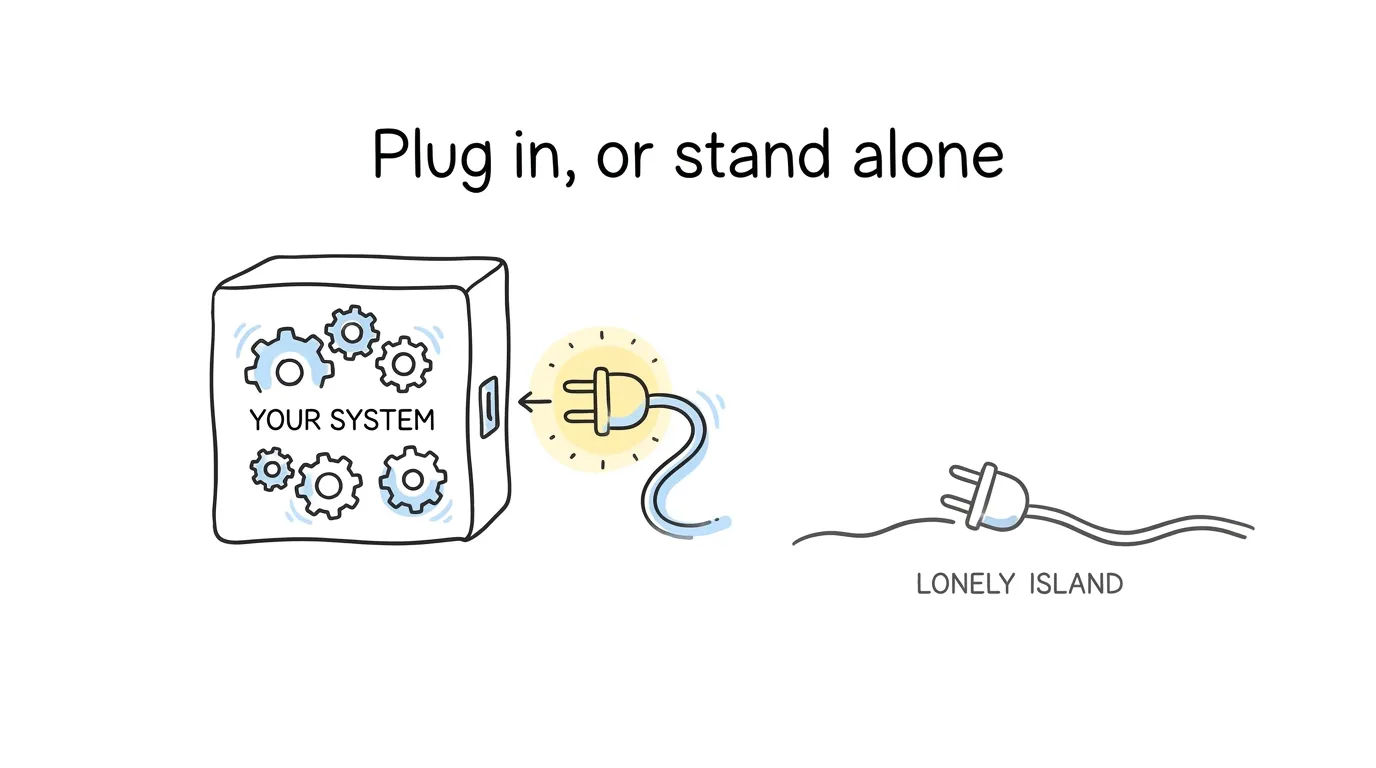
Suppose two AI tools are sitting on your procurement shortlist.
Tool A: dazzling creativity, stunning demo — but it fits your CRM, your content library, and your data warehouse like a square peg.
Tool B: creatively unremarkable, but it lives inside your workflow — content gets produced and flows straight into lead tracking and the sales pipeline.
Which one do you buy?
Most teams used to pick A. Today I want to make the case seriously: in 2026, pick B.
One: the era of the standalone generator is over
A 2026 industry survey delivers a clean judgment: the era of the standalone generator is over.
In plain language: three years ago, a tool could win budget just by "being able to write." Today, "being able to write" is merely the entry ticket.
So what's the new scoring system? Five words: speed, relevance, consistency, insight, execution.
Speed: how fast it produces. Relevance: how close it stays to your business. Consistency: whether scaled output holds your voice. Insight: whether it helps you read your data. Execution: whether it finishes the job, not just drafts it.
The first two were the story of 2023. The last three are the dividing line of 2026.
Two: four products, four survival strategies
Run the main players through this standard and their strategies come into focus.
ChatGPT remains the most flexible starting point. Ideation, drafting, research synthesis — unstructured work is its home turf. But it stops at execution: what it generates, you still have to carry over the line.
HubSpot's Breeze lives inside the system. That's its fundamental difference from every standalone tool: content production, CRM data, lead tracking, and service tickets share one dataset, and campaigns plug directly into the sales pipeline. Marketing doesn't end at content — it ends at pipeline, and the closer a tool sits to the pipe, the more it's worth.
Jasper bets on consistency. Its value isn't creativity but brand governance. A hundred people writing in a hundred voices is the invisible killer of scaled content; Jasper nails the tone and the messaging so mass production doesn't drift.
Canva AI solves throughput. Lean teams hurt most on design capacity. Prompts go in, editable designs come out, and the metronome of creative production starts ticking.
Notice something? None of the four is competing on "who generates best." They compete on: closer to your system, closer to your brand voice, closer to your execution.
Three: how to use the five words
Here's an action you can take today: score your current stack against the five words, one to five each.
A pattern will appear: for most teams, the lowest scores land on consistency and execution.
Consistency is patched by brand-governance tools — write your voice, your messaging rules, and your no-go zones into the system so everyone can produce and nothing drifts.
Execution is patched by integration. The tool must connect to your CRM: where content flows after production, who picks it up, whether it converted — every link on the chain has to be visible.
Four: one hard gate
Beyond fixing weak points, one procurement gate: any new tool must plug into your existing workflow and complete one full loop within two weeks.
If it can't, shelve it, whatever its brilliance.
Why so strict? Because "stunning demo, painful deployment" tools waste more money and hours every year than all the success stories combined. If it can't close a loop in two weeks, it doesn't fit your systems, and forcing it has one ending: another gray icon nobody clicks.
Five: my take
The line I resonate with most from that survey: the best tool is the one that embeds into your existing working system, not the one that generates best.
A tool's value never depends on how smart it is by itself.
It depends on how much smarter it makes the system you already have.
A beautiful island is still an island. What enters the system becomes productivity.
May every tool in your cabinet actually be on duty.
Continue reading
Related articles

What Is an AI Marketing Agent? From "Using AI" to "Delegating to AI"
A learn article explaining what an AI marketing agent is, how it differs from rule-based automation, and which repetitive tasks such as lead qualification, reporting, and campaign monitoring can be delegated while humans keep key decisions.

Marketing Automation Is Shifting from "You Do It" to "You Say It"
This article explains how marketing automation is shifting from rule-based platforms that merely execute toward AI agents that plan, create, publish, and review campaigns, covering delegable tasks, underlying technologies, tool categories, adoption steps, and risks such as privacy and automating without strategy.

When AI Does the Creative, Mistakes Come in Batches Too
A learn article on the risks of using generative AI for marketing creative across brand, legal, compliance, and operational layers, with case examples and seven practices for review, rights clearance, documentation, and vendor governance.