
23,000 consumers just poured cold water on AI marketing's sprint — here's what they said
Summarizes Kantar's Media Reactions 2026 study of 800+ marketers and 23,000 consumers, contrasting growing AI-assistant budgets with low consumer use and trust in AI brand recommendations, and suggesting synergy-aware channel measurement plus a trust funnel metric.
Let me start with a scene I keep replaying in my head.
A media team in a meeting, full of fire: next year, we double the AI channel budget. After the meeting, their customer is frowning at what an AI assistant just recommended about their brand.
Two events, same moment in time, two different worlds.
A new global study has finally put both worlds on the same table.
One: a set of numbers with real tension
Kantar has published its Media Reactions 2026 study. The sample is substantial: more than 800 senior marketers, and 23,000 consumers.
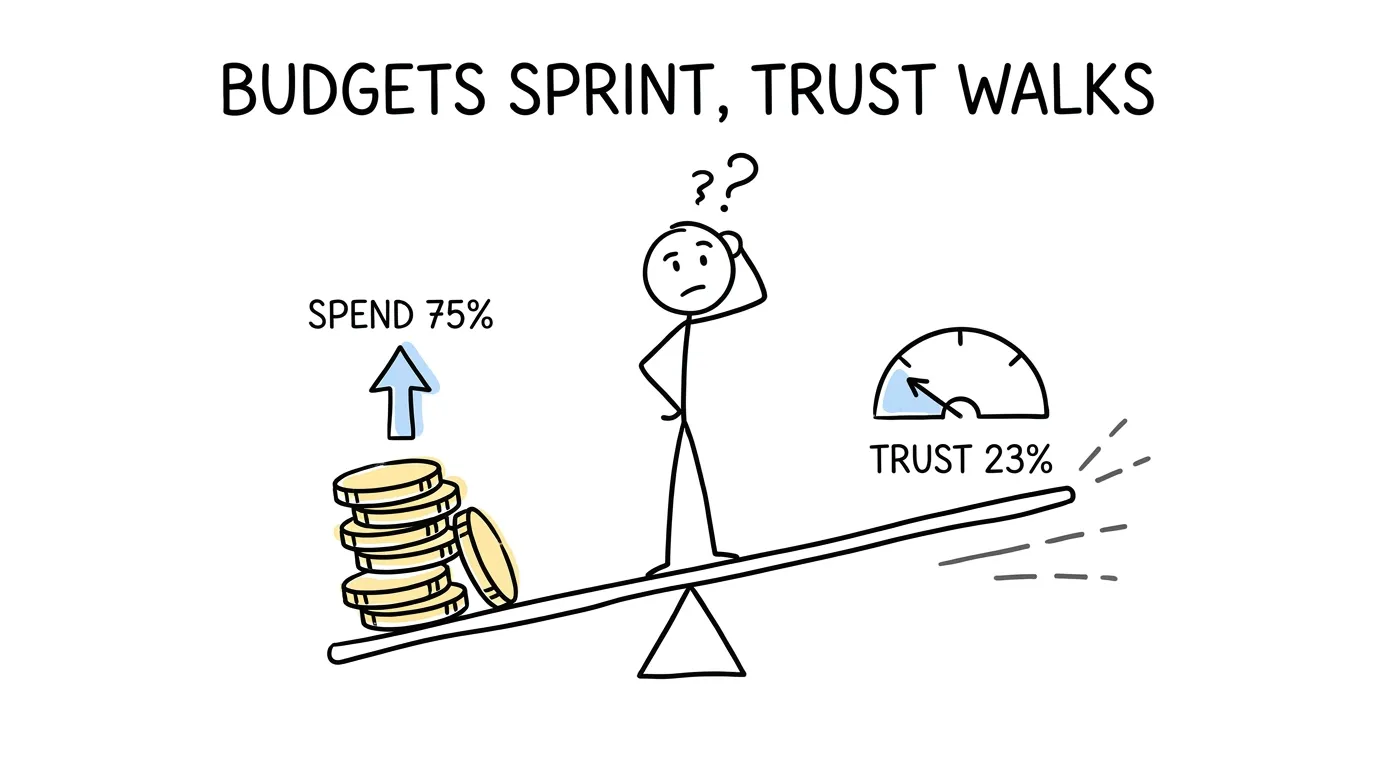
Look at the marketer side first. Nearly two-thirds expect generative AI to play a pivotal role in brand recommendations. Three-quarters plan to increase AI-assistant spending in 2027.
Real money is flooding toward AI.
Now the consumer side.
Only 32% use AI assistants to research brands and products. Only 23% actually trust AI recommendations.
What does that mean? Out of ten consumers, fewer than four even use AI to browse brands — and fewer than two and a half actually believe it.
The budget is sprinting. Trust is taking a walk.
Two: the ones losing confidence are the marketers themselves
Here's the third set of numbers, and it's the most interesting.
Only 57% of marketers believe their organization's media mix is right. A year ago, that number was 64%.
Confident they've struck the right balance between brand-building and performance marketing? Exactly half.
You read that right. More channels, more powerful tools — and marketers feel less sure than ever.
Why? Fragmentation. Channels are splintering, data volumes are exploding, and AI is manufacturing new fragments every quarter. Nobody is an expert in all of them anymore.
But buried in Kantar's data is a consolation.
Between 2020 and 2025, 43% of campaign performance came from channels working together. Before 2014, that number was 18%.
Translate that: the value of any single channel is diluting, while the value of channel synergy is rising. When a channel's ROI looks low, it may not be useless — it may be playing assist.
Three: how to actually use these numbers
Three moves you can make immediately.
First, use them as guardrails for budget conversations. When you ask leadership for AI-channel budget, put the 23% trust figure on the table yourself, paired with a small-scale testing plan and measurement metrics.
Volunteering the weakness builds more trust than asking for scale on instinct. It proves you've thought about risk, not just enthusiasm.
Second, add a synergy coefficient to every single-channel evaluation. Never veto a channel on isolated ROI alone. With 43% of performance coming from synergy, your measurement has to credit the assists.
Third, make the trust funnel a standing internal metric. Exposure, click, research, trust — keep one number per layer, and review the migration trends every quarter.
And pay attention to that 57% confidence gap. If even top advertisers are feeling their way forward, this is the cheapest moment in the market to experiment. Once a peer standardizes the playbook, entry prices and competitive density both double.
Four: my take
Kantar's leadership said something that stuck with me: brands must now earn recommendations from both people and machines.
Pull that sentence apart and you get two entirely different engineering problems.
Winning recommendations from people is about product and experience. Winning recommendations from machines is about content structure and citability. The first has stayed constant for decades; the second is a brand-new exam.
And the answer to both, Kantar says, is better intelligence — not more data.
Consumers don't distrust AI. They're waiting for a reason to trust it. Whoever supplies that reason first owns the recommendation slot of the next decade.
May your brand be recommended by both.
Continue reading
Related articles

What Is GEO? How Your Brand Gets "Mentioned" in the Age of AI Search
An explainer on GEO (Generative Engine Optimization) for e-commerce and DTC brands: how it differs from SEO and AEO, why AI answers shape brand visibility, and eight practices covering question-focused content, consistent brand messaging, structured pages, external evidence, comparisons, and AI mention tracking.

AI Is Already Making Decisions for Your Customers. Are You on the List?
A learn article explains GEO (Generative Engine Optimization): why AI-generated answers now shape which brands customers see, and how SEO fundamentals, entity clarity, citable evidence, and monthly measurement affect visibility in AI answers.

Google Is Stuffing Ads Into AI Search: These Recent Stories Are Really One Story
A news roundup linking recent AI marketing stories—Google adding ads to AI Mode, Amazon's Ads Agent, ChatGPT image updates, a UK startup tracking brand mentions in AI answers, and an AI ransomware warning—arguing that control over ad data and visibility is shifting toward platforms.