
Your ads need to wait where your customers actually are now
A media buying analysis comparing Google search ads with the new ChatGPT ad placements, covering differences in buying logic, creative limits, attribution, and user intent, plus a five-step hedge test for splitting a small budget share.
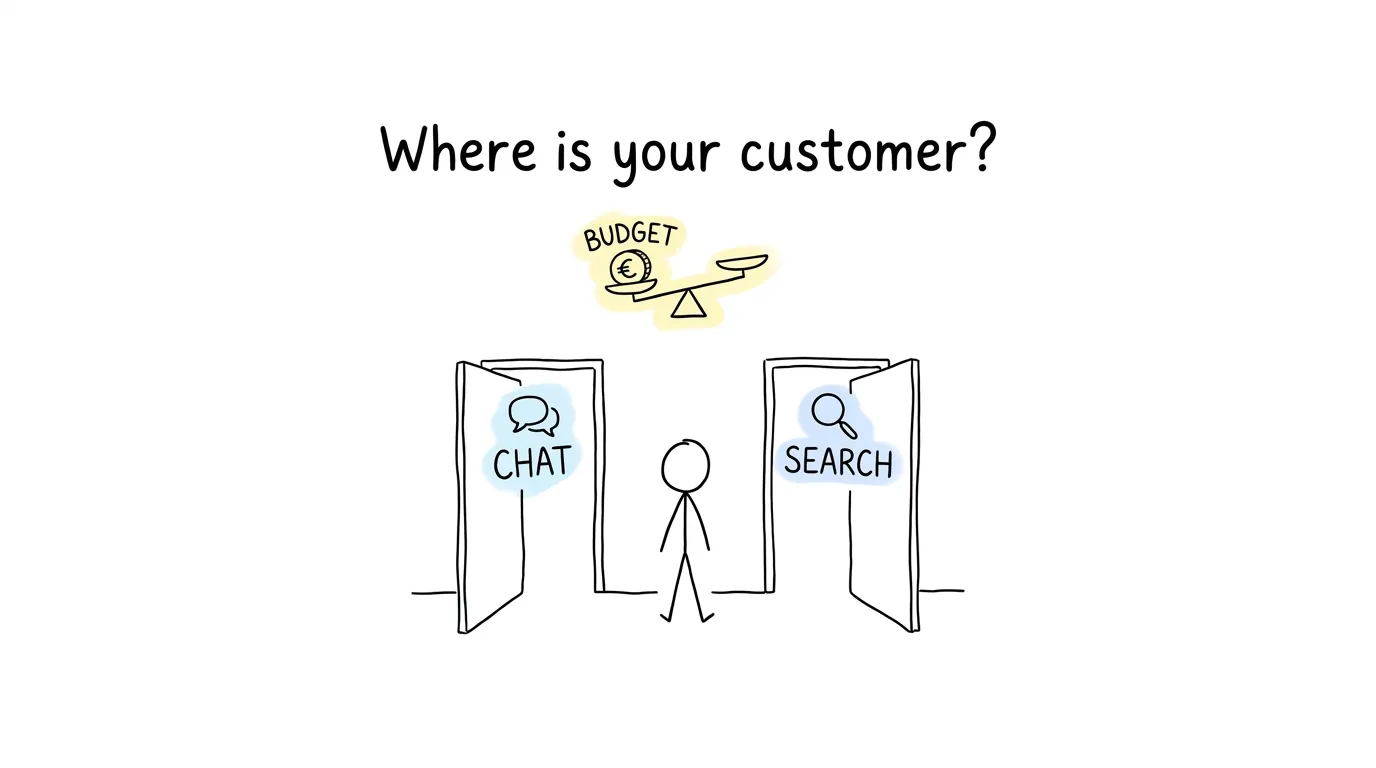
Something has been stuck in my head lately while studying media buying.
On one side, Google. Over five trillion searches a year, two decades of conversion tracking, data-driven attribution. Solid.
On the other side, ChatGPT. Starting this October, ads have officially appeared below its answers.
A friend who has bought media for twenty years asked me: should we move the budget? I answered with a question of my own: first figure out one thing — which doorway is your customer actually standing at?
One: two doorways, two kinds of people
What are search ads? Your customer walks into Google's door with a clear question. They know what they want; you bid, and your ad is handed to them. That is intent capture.
What are ChatGPT ads? A completely different door. The customer walks in saying, "I'm trying to figure out how to choose in this category." They don't know yet what they want. ChatGPT matches ads to the context of the conversation — like a personal shopper, not a shelf.
Yes, that's the difference between two kinds of business: one where the customer comes looking for goods, one where the customer comes looking for advice.
The rules OpenAI set are also clear: ads appear below relevant answers, labeled sponsored, in a unit containing the brand name, logo, headline, description, landing page, and image. But watch two gates:
First, ads serve only on the Free and Go tiers. Plus, Pro, and Business subscribers, and anyone under 18, never see them.
And who are paying subscribers? Precisely the cohort with the strongest purchasing power.
Second, on October 5, OpenAI announced a new visual ad format, to be tested first inside image generation. In other words, the shape of this channel is still changing.
Two: five differences, every one of them costly
I ran the numbers on both sides, and five differences matter before you make any decision.
First, the buying logic differs. Google auctions keywords; the highest bidder wins placement. ChatGPT uses "context hints" — you describe which conversations fit your product, and it does the matching. Note its own wording: these are not exact-match keywords, and delivery is not guaranteed.
Second, creative freedom differs. Google's responsive search ads let you feed in 15 headlines and 4 descriptions for the system to mix and let data pick the winner. ChatGPT? One headline, one description. Far less room for trial and error. A weak ad has no understudy.
Third, attribution maturity differs. Google's conversion tracking has run for over twenty years and can split credit down to each click. ChatGPT's measurement tooling is still in its infancy. Short-term comparisons tilt toward Google by default.
Fourth, the context differs. An ad inside an AI answer gets judged as part of the answer. A brand voice that misses does more damage there than in a feed.
Fifth, the intent stage differs. Google catches people who say "I'm buying today"; ChatGPT meets people who say "I'm learning and comparing." Earlier leads — but earlier.
That fifth one hides an opportunity. A January survey of more than 3,000 CRM purchase decision-makers found that buyers who used AI search were 36% more likely to purchase.
Early leads are precisely the leads no competitor's quote has yet battered.
Three: don't move — run a hedge test
So should the budget move? My answer is blunt: no. Carve out a small plot and run a hedge test.
Here's how, and you can start this week.
Step one: freeze the main account. Existing Google campaigns keep running — that's your baseline. Carve about 5% of total search budget as the experimental allocation.
Step two: align both ends. Same product, same landing pages, same conversion goal. Google runs standard search campaigns; ChatGPT creative is written around conversational scenarios. Separate UTM parameters and conversion events on each side — never mix.
Step three: change the way you write. Not a slogan — something that reads like a helpful answer. The first sentence should name the problem the user is trying to solve. The landing page must deliver what the ad promised, and the image should show the product or its result.
Step four: compare only relative values. CPM and cost per conversion, two sets of numbers. Never absolute scale — the two audience pools are different sizes, and comparing them is self-deception.
Step five: review after four to six weeks before deciding whether to scale. One manual check per week in between; over-optimizing only muddies the sample. Finally, compare in your CRM by lifecycle stage: which channel produced more qualified leads, which had the lower acquisition cost, whose leads traveled further.
Four: my take
In the end, the value of this shift isn't a verdict on whether ChatGPT ads work today.
It's that it forces every media team to build two separate capabilities: intent capture, which competes on keyword assets and bidding efficiency; and scenario matching, which competes on answer quality and content assets.
Different org muscles, different vendor ecosystems, different success metrics.
The data is still thin. Whoever builds the test infrastructure first will be a quarter ahead when the channel truly scales.
The opposite risk doesn't live today. It lives on the day the platform order flips.
And these two channels were never zero-sum. Google keeps catching explicit demand; ChatGPT catches demand that is still hesitating.
The real question was never either-or.
It's the ratio between the two — and how you run two creative systems separately.
May your ads always be waiting exactly where your customer happens to pass by.
Continue reading
Related articles

What Is GEO? How Your Brand Gets "Mentioned" in the Age of AI Search
An explainer on GEO (Generative Engine Optimization) for e-commerce and DTC brands: how it differs from SEO and AEO, why AI answers shape brand visibility, and eight practices covering question-focused content, consistent brand messaging, structured pages, external evidence, comparisons, and AI mention tracking.

AI Is Already Making Decisions for Your Customers. Are You on the List?
A learn article explains GEO (Generative Engine Optimization): why AI-generated answers now shape which brands customers see, and how SEO fundamentals, entity clarity, citable evidence, and monthly measurement affect visibility in AI answers.

Google Is Stuffing Ads Into AI Search: These Recent Stories Are Really One Story
A news roundup linking recent AI marketing stories—Google adding ads to AI Mode, Amazon's Ads Agent, ChatGPT image updates, a UK startup tracking brand mentions in AI answers, and an AI ransomware warning—arguing that control over ad data and visibility is shifting toward platforms.