
AI Marketing Daily · 2026-10-19
Today's theme is doing the math.
Today's theme is doing the math. S&P Global's survey delivers the hard numbers: 60% of enterprises have already deployed GenAI, yet the abandonment rate jumped from 17% to 42% — AI marketing has entered the phase where ROI has to do the talking. On the same day, five GEO (Generative Engine Optimization) practical guides landed back to back, as AI search rewrites the starting point of the customer journey; two academic papers lay the evidence on the table for whether virtual influencers are worth using; plus a tool-selection framework and a going-global checklist. Read all 12 items and you'll know what to do first this week.
🎯 Today's Top Story
S&P Global surveyed 1,006 enterprises: 60% have deployed GenAI, yet the abandonment rate soared from 17% to 42%
S&P Global Market Intelligence's 451 Research has published its annual enterprise AI adoption report, surveying 1,006 enterprises (fielded October 21 to November 25, 2024, margin of error ±3 percentage points). Among organizations investing in AI, 60% have already deployed generative AI — overtaking rule-based models (54%) and pattern recognition (51%), the approaches they'd been building for years. The comparison with last year's forecast is even more interesting: only 47% of enterprises expected to complete deployment by Q4 2024, yet 60% actually did — beating their own optimistic estimate by 13 percentage points. Organization-wide adoption rose from 13% to 27%, while another 33% remain confined to departments or isolated projects. Telecom is moving fastest: the share expected to finish organization-wide integration by year-end rose 18 percentage points in a single year, and in software and retail more than a third of organizations have rolled GenAI out company-wide. Reporting lines are shifting too — machine learning vendors and consultants lost 4 percentage points of presence in project approvals, while business units like customer service, marketing, and sales have taken over decision-making. Decentralization is good news; the price is uncontrolled tool sprawl, with runaway costs and strategic drift always ready to move in.
The failure rate is climbing just as fast. The share of companies abandoning most of their AI projects — never reaching production — jumped from 17% to 42%, and enterprises scrap an average of 46% of their proof-of-concept (PoC) projects. High-failure organizations also suffer collateral backlash: they are 77% more likely to admit reputational damage, 41% more likely to face customer resistance, and 36% more likely to face employee resistance. Project failure is not an internal affair — it burns brand and customer relationships.
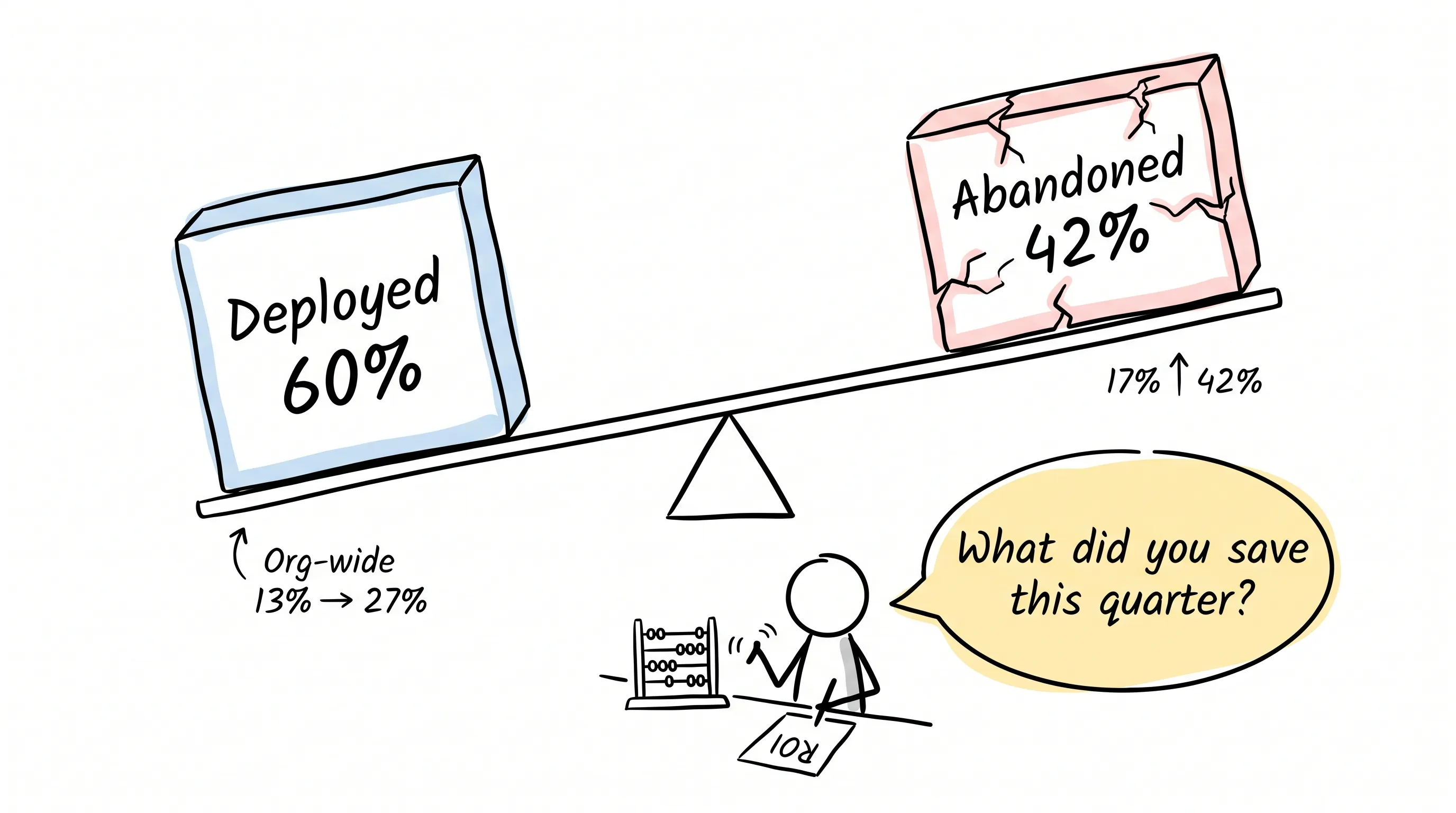
This is the hardest enterprise-side audit yet of the question "does GenAI actually work?" The value-side data is just as sobering: 46% of enterprises admit that not a single business objective has seen a strongly positive impact from GenAI, and only 19% are getting strong returns on most of their objectives. The share of organizations reporting positive impact fell across the board — revenue growth targets dropped from 81% to 76%, cost management from 79% to 74%, risk management from 74% to 70%. The more mature, the more disappointed — a trajectory that runs exactly counter to the industry narrative that "value compounds once you scale." The report's verdict: it's time to change the GenAI pitch, from disruption opportunity to verifiable ROI.
Marketing is one of the few areas moving against the grain in this report. The share of enterprises applying AI to marketing processes rose 7 percentage points year over year; 27% of organizations now use AI for marketing analytics, and campaign management is the second-largest planned investment area this year, behind only financial planning. The good news: budgets keep growing. The bad news: scrutiny is tightening. Budget constraints leapt to the top of the five biggest challenges this year (29%), tied with confidence in accuracy, followed closely by employee resistance (28%), customer resistance (27%), and skills shortages (27%). Low-failure organizations share one trait: they weigh an average of 4.9 factors when prioritizing projects; high-failure organizations weigh only 4.2. And 54% of low-failure organizations factor data availability into their ranking, versus just 42% in the high-failure group. Delivery speed, meanwhile, has no correlation with project success — rushing buys you nothing.
Three actionable moves for marketing teams. First, make marketing analytics your first entry point — it is the most validated high-value scenario, a safer bet than jumping straight into a content factory. Second, clear the data gate before green-lighting any project; any scenario where the data can't be obtained or completed gets demoted — high-failure organizations fail precisely because they never checked data availability. Third, list fewer KPIs and make them sharper. The report finds that enterprises are tracking more and more KPIs, yet metrics like revenue impact, project cost, and energy consumption are actually deteriorating — metric inflation buries the real returns. One line for the leadership team: with the share of organizations abandoning most projects now at 42%, what you need is not more PoCs, but fewer ones that have actually done the math.
The most useful thing in this report isn't any specific percentage — it's the narrative shift it declares. In 2024, vendors said get on board or get left behind; in 2025, buyers ask how much you saved and earned this quarter. The skills hole is even clearer: one in five organizations has killed projects outright over cybersecurity skills shortages, 32% have rescoped, delayed, or downsized because of them, and more than three-quarters admit they are understaffed across the board from data governance to engineering delivery. One respondent put it bluntly: thirty percent of AI-generated code is wrong. No shortage of tools, budgets in place, people missing — that is the real bottleneck of bringing AI into marketing right now. Doing one small scenario thoroughly beats spreading yourself across ten half-built projects if you want to survive the year.
🔗 Further reading: Read the full article
🏷 AI Search & GEO
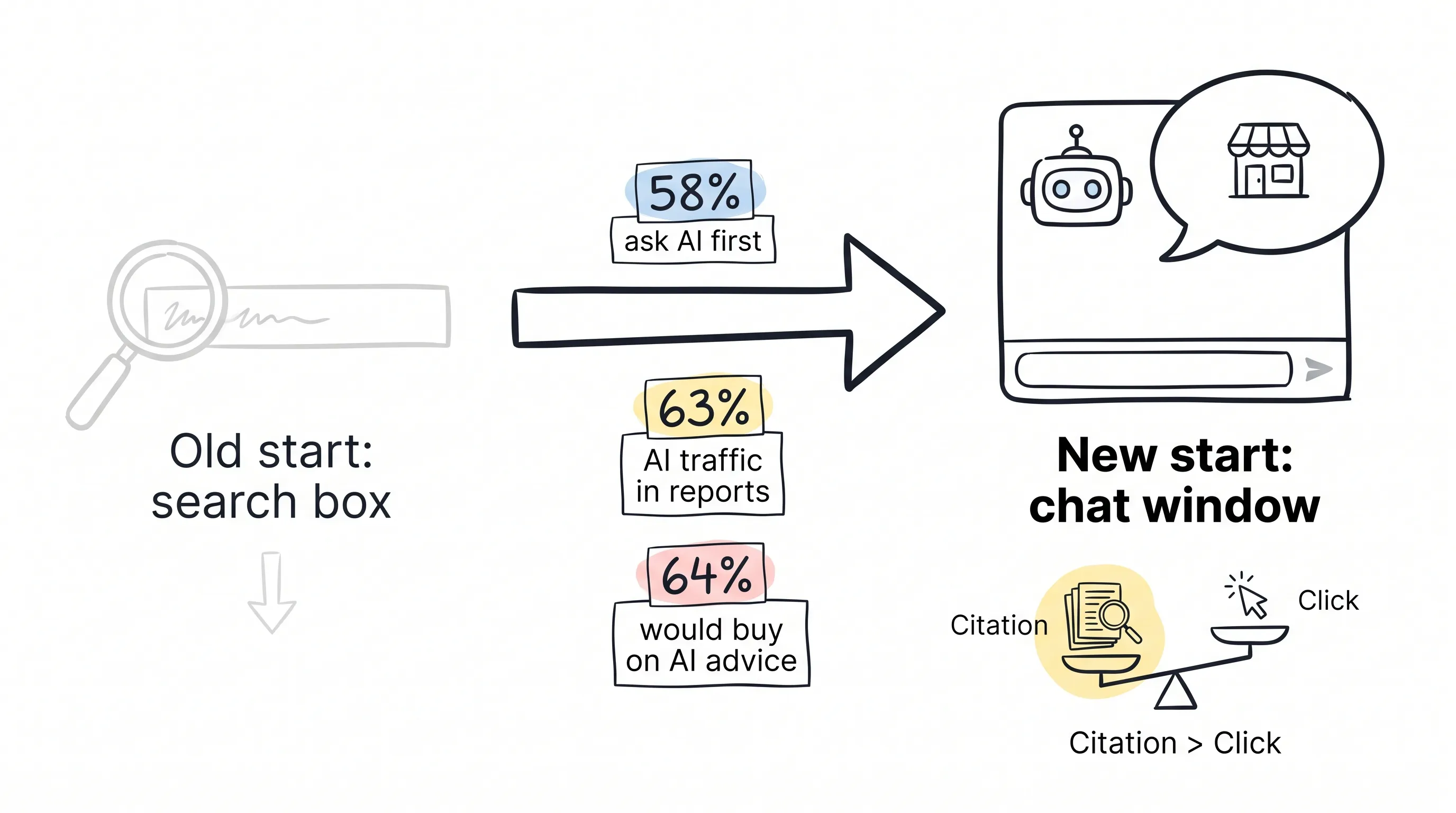
Capgemini: 58% of users already use AI instead of search to find products, and AI traffic is starting to show up in website reports
Insightland's annual GEO review pins the customer-journey migration to three sets of coordinates. Capgemini's 2025 study shows 58% of users now turn to AI tools instead of traditional search engines for product discovery; Ahrefs counts AI-search traffic appearing in 63% of website reports; and 64% of consumers say they are willing to buy what AI recommends. Together, the three numbers sketch this picture: the starting point of product discovery is migrating from the Google search box to the chat windows of ChatGPT, Perplexity, Copilot, and Gemini. The review stresses that this migration reshapes the marketing funnel: when buyers complete discovery and comparison inside a chat window, the brand website's role as the front door weakens, and measurement has to shift from clicks to citations and recommendation slots. Its thesis is clear: GEO and SEO are complements, not substitutes — the goal is for your brand to appear in AI-generated answers, cited and recommended, even if the reader never clicks a link. Which leads to a counterintuitive way to measure: a citation without a click may be worth more than a click, because it speaks for you at the very moment a user is making the decision. Clicks can be tracked; goodwill can't.
💬 The 64% willing to buy on AI recommendation is the most valuable number here — being cited amounts to seeding purchase intent. Give your team one task this week: ask a recommendation question for your category once in ChatGPT and once in Perplexity, and note whether your brand shows up in the answer. This five-minute test is GEO's baseline health check — establish the baseline before you talk investment.
🔗 Further reading: Read the full article
ChatGPT passes 900 million weekly users, but 95% of Americans haven't abandoned traditional search: buyers are stacking, not switching
IMPACT has released its 2026 AI marketing landscape guide, arguing that this year's competitive edge lies not in chasing new tools but in keeping up with new buyer expectations. The data side: ChatGPT has reached 900 million weekly active users, AI search accounts for roughly 56% of global search volume, and Google's AI Overviews now appear in nearly half of search results — occupying nearly half the screen on mobile, with the answer showing up before the blue links. But the other side: 95% of Americans still use traditional search. The guide's reading is that buyers are stacking channels, not replacing them — the old funnel hasn't disappeared; new entrances have layered on top. On method, it offers a three-layer framework: SEO handles rankings, AEO (Answer Engine Optimization) handles direct answers, GEO handles being cited by AI, and E-E-A-T (experience, expertise, authoritativeness, and trust) is the shared weighting foundation across all three. For teams: treat AI as a collaborator, not a generator; master one or two platforms before expanding. Claude, ChatGPT, Gemini, and Perplexity each have distinct strengths in marketing scenarios — trying to use them all means mastering none, and the marketing team's role must shift toward editor, engineer, and iterator.
💬 The stacking thesis deserves a spot in your quarterly review. Don't rush to slash SEO budget to fund GEO — first break down your traffic sources by entrance and see what share AI channels actually hold in your own data. Setting your investment pace off your own numbers beats chasing industry percentages.
🔗 Further reading: Read the full article
HubSpot updates its eight GEO best practices: lead with the answer, write entities in full, and don't skimp on Schema
HubSpot's official blog has updated its generative engine optimization best practices, defining GEO as making content findable, understandable, and citable by ChatGPT, Gemini, Perplexity, and AI Overviews. Along the way it dissolves the GEO-vs-AEO terminology feud: different names, same discipline — SEO fights for real estate on the search results page, GEO fights to be cited by AI, most tactics serve both, but GEO demands extra care with information structure and credibility, because AI systems only cite what they're confident about. A few of the eight practices deserve underlining. Open each section with the answer, compress key conclusions to under 300 words, and make any paragraph stand on its own as a complete answer even when plucked out of context. When mentioning an entity, use the full name — writing "the company released a product in 2024" leaves the AI guessing which company you mean; spelling out "HubSpot released Content Hub AI in 2024" is what gets you correctly indexed. On the technical side, protect Schema markup, site speed, and metadata; on the content side, use pillar pages to demonstrate topical depth and add multimodal assets. It also cites BrightLocal's data as a warning against overcorrecting: Google still holds 61% of general search, while GWI shows 31% of Gen Z already start their research on AI platforms.
💬 The easiest of the eight to make count today is writing entities in full. Have an editor search your site for vague references like "the company" or "our product" and replace them with full names plus brand terms. Half an hour of work; the change in citation probability is verifiable directly inside AI engines.
🔗 Further reading: Read the full article
London agency Found breaks down the systemic differences between GEO and SEO: rankings become citations, and every metric must be rebuilt
The GEO guide from London agency Found puts its craft into contrast. Traditional SEO aims at search-results-page rankings, optimizes pages and keywords, and measures clicks and position; GEO aims at entry into AI-generated answers, optimizes entities, authority, and semantic clarity, and measures how often a brand is mentioned and cited in AI responses. The guide's three levers are authoritative content, structured data, and semantic clarity, and it warns brands not to bet on a single entrance: Gemini, ChatGPT, Perplexity, and Claude each have their own content tastes, and coverage sets the floor for visibility. The guide's value is in breaking GEO from a concept into comparable engineering work: the way you once built keyword lists and internal links for SEO is now the way you build entity tables and citation lists for AI engines. Its thesis fits in one sentence: in an era when AI engines curate answers on the user's behalf, only a trusted citation source stays at the table.
💬 The metric switchover is the guide's most important takeaway. In the SEO era you looked at ranking screenshots; in the GEO era you build a citation-monitoring system — scan the major AI engines every week with the same fixed set of questions and log mention counts as a trend line. Without that line, there is no proving GEO's ROI to the boss.
🔗 Further reading: Read the full article
How do AI engines pick their sources? The three gates — crawl, understand, cite — broken down
eLearning Industry's long GEO piece puts the weight on mechanics: for an AI search engine to select a piece of content, it must pass three gates — be crawled first, understood correctly second, and cited last. That's the GEO/SEO divide: the former seeks citation in answers, the latter rankings and clicks, but both rest on the same foundation — quality content plus technical infrastructure; neither survives without the other. For execution, the article gives seven GEO-ready essentials: shore up E-E-A-T signals, implement structured data, redo keyword research around how AI asks questions, widen content distribution, protect the technical SEO base, build brand authority, and actively manage citations and mentions. It closes with worked examples and tool lists for two industries, eLearning and HR Tech. One caution: this piece was published under an advertorial slot — the framework is worth borrowing, but cross-check any specific figures before using them.
💬 The three-gates framework converts directly into a checklist. Take the five existing pages you most want cited and audit them item by item: can it be crawled, is the structured data complete, is there a clear conclusion section. One pass, one round of fixes — refreshing old content costs far less than writing something new.
🔗 Further reading: Read the full article
A dental-marketing podcast's warning: when AI recommends local providers, it looks at your social media and reviews
This 35-minute episode of the Raving Patients podcast uses dental clinics as its sample, but the logic holds for every local service business. Guest Dr. Anissa Broussard observes that AI platforms are scanning social media content to recommend local providers — a client's next search for a dentist may never open Google at all. Her visibility trio: quality social content (Instagram as the exemplar), a website FAQ that answers real inquiries, and Google reviews with enough depth — miss any one of the three and you're hard to pick in AI search. The episode adds that social posting, FAQ updates, and Google profile maintenance now feed back into Google rankings, so the era of traditional SEO flying solo is over. The podcast was uploaded in October 2025 with a full transcript available — hands-on, first-hand practitioner experience; single-industry sample, treat the conclusions as directional.
💬 Local providers can steal this playbook this week: audit your Google review count and latest reply time, check whether your FAQ answers the ten questions customers actually ask, then set a floor of two Instagram posts per week. None of the three costs money — what's missing is execution.
🔗 Further reading: Read the full article
🏷 Marketing Tools & Selection
2026 AI marketing tool selection guide: McKinsey says ROI can rise 5–15%, but the obstacle isn't the tools
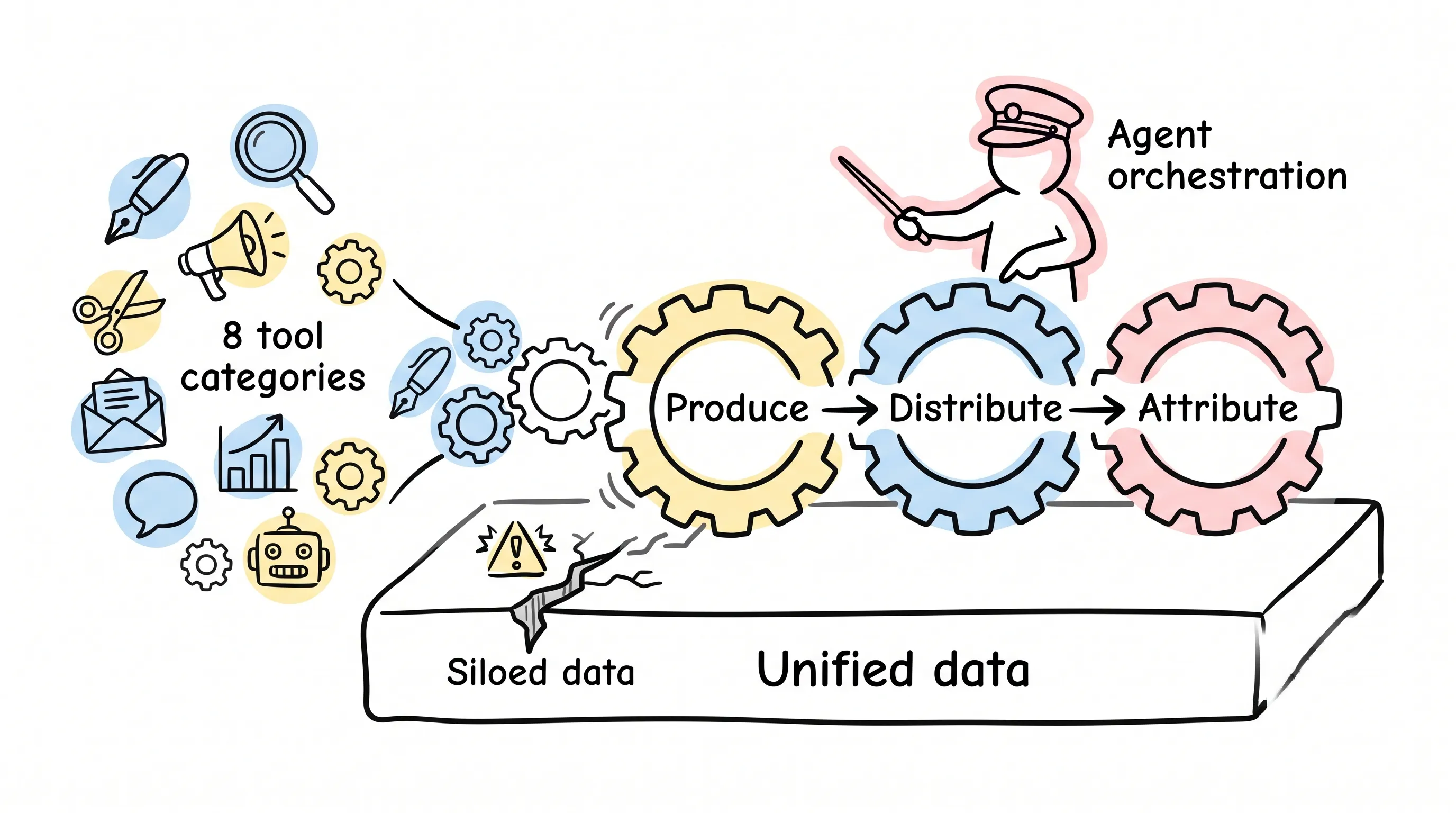
ContentGrip has published its complete 2026 guide to AI marketing tools, positioning them as the marketing team's operating system rather than point plugins. The guide maps eight categories — content creation, SEO, social media, image and video editing, email, analytics, chatbots, marketing automation — and lays out six selection criteria, from goal fit, integration capability, and scalability to AI capability, ease of use, and analytics reporting. Two verifiable data points: 93% of marketers say AI has accelerated content production, and McKinsey estimates AI can lift marketing ROI by 5–15% in most scenarios. Each category has its representatives: copywriting maps to ChatGPT and Jasper, image and video to Midjourney and Runway, and SEO tools cluster around keyword clustering, content scoring, and SERP (search results page) competitive analysis. The guide stresses that every point tool works standalone — the real value is in meshing them into one pipeline from content production to distribution to attribution. Its sharpest point: the biggest obstacle isn't the tools themselves but the fragmented data stack and the capability gap between high adoption and shallow use. Teams use everything and master nothing; customer data sits scattered in the separate silos of marketing, sales, support, and ERP, and the quality of what an AI model takes in caps what it puts out. The next stage of evolution runs from a pile of tools to AI agent orchestration — agents stitching the workflow together, instead of humans hauling data between tools.
💬 In tool selection, look at integration before feature lists. List the interfaces of your existing CRM, email platform, and data warehouse; tools that connect natively get priority, and however dazzling the rest, they wait. Data-stack fragmentation is the number-one reason teams' AI spend goes down the drain.
🔗 Further reading: Read the full article
🏷 Consumer Trends & Data
SAP Emarsys surveys 17,000 respondents: 69% happy with AI recommendations, 40% still feel brands don't understand them
SAP Emarsys's 2026 retail and e-commerce AI marketing trends report is based on surveys of more than 14,000 consumers and 3,000-plus marketers. The contrast has real tension: 69% of consumers are satisfied with AI recommendations, yet 40% believe brands still don't understand them. The report calls it the engagement gap — the technology works, but execution stalls at segmentation, batch blasts, and guesswork. Agentic commerce is listed as the force reshaping the purchase path: Google, OpenAI, and Perplexity have all launched consumer shopping agents, and 30% of consumers have already used an AI shopping agent. At this stage, the report warns, structured product data, price transparency, and cross-channel consistency decide outcomes more than creative headlines do. The efficiency math on the marketing side looks good too: 71% of marketers say AI speeds up campaign launches, saving an average of 2.3 hours each, and 72% say their teams can now focus on creative work. The report also carries two pieces of hard data that are easy to tune out. First, the data foundation: 78% of enterprises deem AI a must-have for customer retention in 2026, but 60% hold dark data — collected, never used — 54% can't access real-time data at all, and only 40% have wired interaction data into a CX (customer experience) platform or CRM. Personalization, agents, and predictive models all run on data; when the foundation is uneven, investment becomes a castle in the air. Data integration never dazzles and never makes headlines, yet it is the shared precondition for every trend in this report. Second, predictive analytics has moved from optional to profit line: AI forecasting models are being pressed into inventory management, dynamic pricing, customer lifetime value prediction, and next-best-action recommendations. The logic is direct — predict accurately what will sell, when, and at what price, and you directly cut markdown clearance and inventory-carrying costs, improvements that land straight on the P&L. The dark side is the trust deficit: the share of consumers who don't trust AI with their data privacy rose from 44% in 2024 to 63%, and only 16% believe retailers can protect their personal information.
💬 The trust deficit is a shortcut opportunity for small and mid-size brands. The bigger the platform's data, the warier its users — so go the other way: say explicitly in every personalized touch what data you used and what benefit the customer gets in return. Make transparency your selling point; that position is still open this year. And while you're at it, sweep your dark data — waking up your sleeping data is the top zero-cost move on the list.
🔗 Further reading: Read the full article
🏷 Influencer Marketing Evidence
Evidence from Brazil's three biggest retail groups: virtual influencers are easier to manage than humans, and story beats looks
Technological Forecasting and Social Change has published a full-text case study from authors at France's NEOMA Business School and Spain's Universitat Politècnica de València, analyzing the virtual influencers of Brazil's three largest retail groups: Lu of Magazine Luiza, CB of Casas Bahia, and Nat of Natura — Lu, with a following of more than 31 million, is the world's most popular virtual influencer. Drawing on interviews with 16 experts, the study distills five themes: narrative continuity is the source of authenticity — a persona's backstory creates engagement better than appearance; virtual influencers carry no blow-up risk and are available around the clock, so on reliability they outdo humans; they cost less without performing worse; brands that build their own virtual ambassadors keep narrative control; and limitations and risks remain. The paper also cites counterexamples to make its motive clear: from the Will Smith slap to Kanye West's serial gaffes, Sony and Netflix pulled projects immediately, and Gap, Adidas, Balenciaga, and Vogue rushed to terminate contracts — hiring human influencers means betting your brand's image on someone else's character. The comparison numbers are laid out too: Cristiano Ronaldo has 614 million Instagram followers and MrBeast tops 220 million subscribers; as top human influencers' rates keep climbing, the virtual option's cost advantage compounds with scale. Some experts go further: a human influencer's persona is just as invented — which makes the virtual ones feel more real.
💬 On whether to deploy virtual influencers, run the risk math before the reach math. If your influencer roster carries a blow-up record or contract disputes, the stability premium of a virtual ambassador shows immediately. Step one doesn't have to be building your own — pick an existing virtual influencer for a single-campaign test, see how the word-of-mouth numbers look, then talk about deeper binding.
🔗 Further reading: Read the full article
European Journal of Marketing evidence pours cold water: AI influencers earn less trust — don't replace humans wholesale yet
A second paper on the same topic offers the restrained version. In the European Journal of Marketing, Sands et al. ran two empirical studies comparing consumer responses to AI virtual influencers versus human influencers, and the findings cut both ways: on follow intention and perceived personalization there is no significant difference, and AI influencers are even more effective at sparking word of mouth — but source trust is markedly lower. Social distance acts as a mediator: people with high uniqueness needs respond more strongly to AI influencers, and those consumers happen to enjoy trying new things. Another key variable is influencer autonomy — AI influencers are fully brand-controlled and lack an independent voice, and that sense of being puppeteered weakens their effect. The authors' warning is blunt: don't rush to replace human influencers with AI across the board; a blended lineup is the steady state.
💬 The two papers together form a deployment formula: use AI influencers for word-of-mouth breadth, human influencers for trust depth. Split the budget by objective, not by follower count — awareness-and-desire goals go to virtual, endorsement goals stay human — and track ROI on the two lines separately.
🔗 Further reading: Read the full article
🏷 Going Global & Cross-Border
An AI checklist for cross-border brands: customs paperwork automation, demand forecasting, checkout customization
Glopal's merchant blog has drawn up an AI checklist for cross-border brands. On logistics, AI can automate customs paperwork and duty calculation, cut clearance times, and improve cross-border fulfillment through predictive maintenance and route optimization. On data, the gains are real-time supply-chain visibility and demand forecasting, cutting the two most expensive forms of waste in cross-border commerce: dead stock and stockouts. On marketing, the three levers are personalized product recommendations, campaign targeting, and checkout customization — so buyers in different countries see different payment methods and delivery options. The article also flags three implementation challenges: systems integration is slow and expensive, customer-data security and privacy compliance vary by country, and connecting to existing systems like inventory is quiet, unglamorous integration work. The omnichannel part corroborates the Emarsys report: consumers don't think in channels — they scroll on their phones, touch in-store, and check reviews on their laptops, expecting one continuous conversation, while most brands' email, app, and store teams each run their own script on their own data. A fragmented experience is where churn begins. Cross-border amplifies the contradiction one more layer: the more countries, the more channels, the more data-compliance variants — and a brand without a unified data foundation rebuilds it from scratch in every new market. The piece carries no supporting data or case studies; it's a survey-style starter framework — fine as a checklist, not as evidence.
💬 Going-global teams should start from the most painful square. For most cross-border sellers the first pain point is customs clearance and returns — hand rule-based tasks like paperwork and duty calculation to AI first (fast results, low risk), then move on to model-driven tasks like demand forecasting.
🔗 Further reading: Read the full article
💡 Today's Synthesis
Put today's 12 items side by side and the through-line is singular: AI marketing has moved from the land-grab phase into the accounting phase. S&P Global's data supplies the hardest evidence of the turn — deployment raced to 60% while the abandonment rate grew to nearly two-and-a-half times the original, and positive returns on every objective fell across the board. The five GEO guides, one tool-selection framework, and two influencer-marketing papers published the same day are really the second half of the same story: the money keeps flowing, but how it's spent has changed — from sprawling out to picking precisely, measuring clearly, and counting the payback.
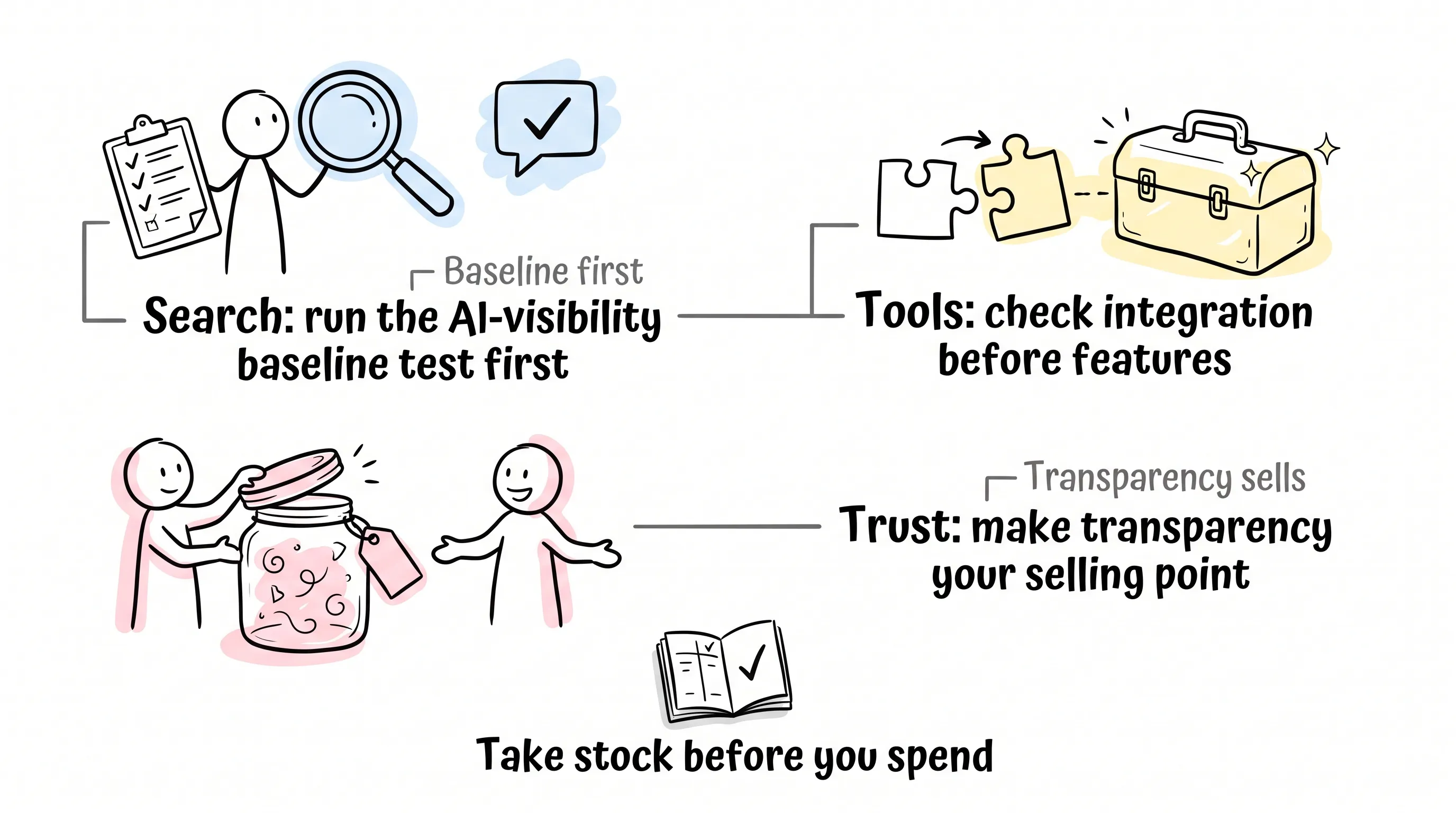
For marketers, three takeaways today. On search: AI-entrance traffic is starting to surface in your reports — run the baseline health check before talking investment, and don't set budgets off industry percentages. On tools: check integration before comparing features — data-stack fragmentation is the number-one reason AI spend goes down the drain. On trust: 63% of consumers aren't comfortable letting AI use their data — transparency itself is becoming a selling point. All three share one precondition: take stock before you spend, which matches exactly how the low-failure organizations in the top story operate.
One more easily missed signal: in the S&P report, low-failure organizations weigh data availability and compliance risk when prioritizing projects — not delivery speed. Starting projects a little slower, killing the ones that never did the math a little faster — that may be the year's most counterintuitive and most money-saving discipline. Today's 12 items contain no earth-shattering launches, yet together they assemble a complete ledger of a turning point, and the way to use it is simple: pick one item and start this week. There's a second, quieter thread — trust becoming the new battleground. From the 63% privacy deficit, to the trust discount on AI influencers, to the dental podcast trading review volume for AI recommendations: whoever banks credit with both the algorithms and the consumers takes the cheap traffic of the next phase.
Continue reading
Related articles
AI Marketing Daily · 2026-11-03
No new model launches today.
AI Marketing Daily · 2026-10-31
Today's protagonist is measurement.
AI Marketing Daily · 2026-10-25
Daily briefing on nine AI marketing items: the IAB generative AI advertising playbook, a 16-vendor B2B selection list, Meta ads automation rollout guidance, cross-border TikTok and Amazon playbooks, and an academic study on AIGC localization, with cautions on unverified vendor-reported numbers.